
Confidence After Being Publicly Corrected at Work

Being publicly corrected at work can feel like the ground drops beneath you. But here's what matters most: your confidence isn't defined by the correction itself — it's defined by what you do next. Rebuilding confidence after being publicly corrected at work requires a specific recovery process: managing your immediate emotional response, reframing the event accurately, re-engaging with your team strategically, and using the experience to strengthen your professional credibility over time.
What Is a Public Correction at Work?
A public correction at work occurs when a colleague, manager, or senior leader points out an error, challenges your statement, or contradicts your position in front of other people — whether in a meeting, on a group call, in a shared Slack channel, or during a presentation. Unlike private feedback, public corrections carry an added layer of social exposure that can trigger shame, embarrassment, and a lasting dip in professional confidence.
It's important to distinguish between constructive public feedback (a manager clarifying a data point during a review) and public humiliation (a leader belittling you in front of peers). Both can damage confidence, but they require different responses.
Why Public Corrections Hit So Hard Psychologically
The Brain's Threat Response to Social Exposure
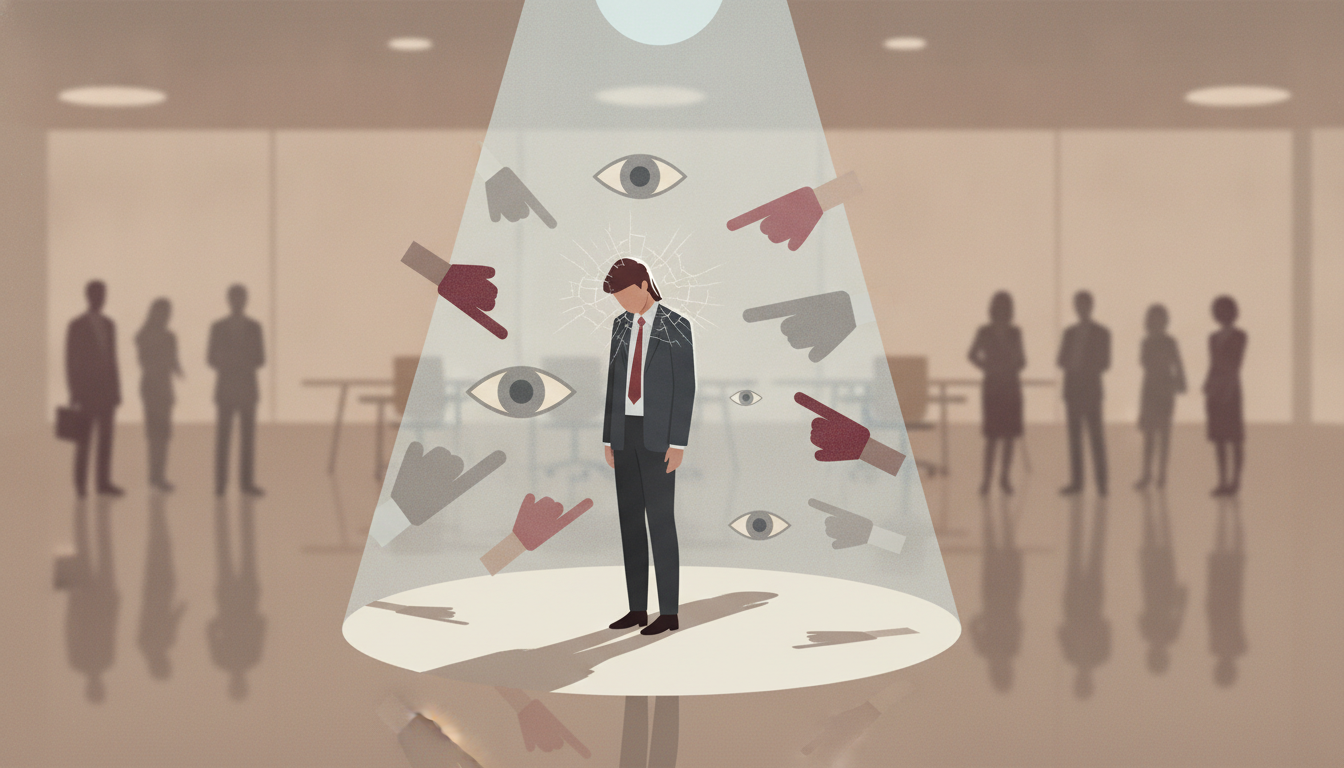
When you're corrected publicly, your brain processes it as a social threat. Research from the NeuroLeadership Institute shows that social pain — like public embarrassment — activates the same brain regions as physical pain (the dorsal anterior cingulate cortex and anterior insula). This is why a public correction can feel genuinely painful, not just uncomfortable.
Your fight-or-flight system kicks in. Your heart rate increases, your face flushes, and your cognitive function temporarily narrows. In that moment, you're not thinking strategically — you're surviving. Understanding this biological response is the first step toward managing it.
The Credibility Spiral: How One Moment Can Snowball
A single public correction doesn't have to damage your reputation. But how you respond to it can. According to a 2023 study published in the Journal of Applied Psychology, employees who withdrew from participation after public negative feedback experienced a 34% decline in perceived competence by peers over the following three months — not because of the original mistake, but because of the withdrawal itself.
This is the credibility spiral: the correction shakes your confidence, the confidence dip changes your behavior, and the behavior change erodes how others perceive you. The goal isn't to pretend the correction didn't happen. It's to interrupt this spiral before it starts.
Why Some People Recover Faster Than Others
Resilience after public correction isn't about having thicker skin. Research from the American Psychological Association indicates that professionals with a strong sense of professional identity — a clear understanding of their value, expertise, and role — recover from public setbacks 2.5 times faster than those whose self-worth is primarily tied to external validation. This is why building a confident professional identity matters long before a crisis hits.
The Immediate Response: What to Do in the First 60 Seconds
Control Your Physical Reaction First
Before you say a single word, manage your body. Unclench your jaw. Place both feet flat on the floor. Take one slow breath through your nose. These micro-actions activate your parasympathetic nervous system and pull you out of pure reactivity.
Do not cross your arms, look down, or laugh nervously. These signals broadcast defensiveness or insecurity to everyone watching. Instead, maintain neutral, open body language. Keep your hands visible and still. Look at the person who corrected you — not with a glare, but with composed attention.
Use the Acknowledgment Framework: Accept, Clarify, Redirect
Here's a three-step verbal framework for responding in the moment:
Accept — Acknowledge the correction without over-apologizing. Say: "Thank you for flagging that" or "Good catch — I appreciate the correction." One sentence. No rambling. Clarify — If you believe the correction is partially wrong or missing context, add one clarifying statement: "I want to make sure we have the full picture — the data I referenced was from Q2, which may explain the discrepancy." Redirect — Steer focus back to the broader discussion: "Let me verify that detail and circle back. For now, the key takeaway remains..."This framework lets you stay composed without being dismissive or submissive. It's the verbal equivalent of maintaining authority in high-stakes conversations.
What Not to Do: Three Common Mistakes
Don't over-apologize. Saying "I'm so sorry, I'm terrible with numbers, I should have double-checked, this is so embarrassing" turns a small correction into a credibility collapse. One acknowledgment is enough. Don't get defensive. Arguing back in the moment — especially with a senior leader — rarely works in your favor, even if you're right. A 2022 Harvard Business Review analysis found that professionals who responded defensively to public corrections were rated 40% lower in "leadership potential" by observers compared to those who responded with composure. Don't go silent for the rest of the meeting. Withdrawing signals that you've been defeated. Even if you need a moment, re-enter the conversation within the next few minutes with a relevant comment or question.Know exactly what to say next time. The Pushback Playbook has 50 word-for-word scripts for moments like this one: what they say, what you say, why it works, and what to do if they push back. Get The Pushback Playbook — $27
The Recovery Plan: Days 1–7 After Being Publicly Corrected
Day 1: Process the Emotion Privately

Give yourself permission to feel frustrated, embarrassed, or angry — privately. Journal about it. Talk to a trusted friend outside of work. Do not vent to colleagues; workplace venting almost always gets back to the wrong people.
Then ask yourself two honest questions: Was the correction accurate? and Was it delivered appropriately? These are separate issues. The correction might have been factually right but delivered poorly. Or it might have been inaccurate and publicly embarrassing. Your recovery strategy depends on which scenario you're dealing with.
Days 2–3: Have a Private Follow-Up Conversation
If the correction came from your manager or a senior leader, schedule a brief private conversation. This isn't about confrontation — it's about demonstrating professionalism and closing the loop.
Use this script: "I wanted to follow up on the point you raised in yesterday's meeting. I've looked into it, and [share what you found]. I also want to make sure we're aligned on how to handle similar situations going forward — I'm always open to feedback, and I find I can act on it most effectively when we can discuss it directly."
This accomplishes three things: it shows accountability, it demonstrates initiative, and it sets a boundary about future feedback delivery — all without being combative. This type of direct communication is a hallmark of communicating with gravitas at work.
Days 4–7: Re-Engage Visibly and Strategically
The biggest mistake professionals make after a public correction is disappearing. They stop volunteering in meetings, avoid the person who corrected them, and hope everyone forgets. Everyone notices the withdrawal — and it does more damage than the original correction.
Instead, re-engage deliberately:
- Speak up in the next meeting. It doesn't have to be brilliant. A relevant question or brief insight shows you're unfazed.
- Share a follow-up with the group. If the correction involved a factual error, send a brief email: "Following up on the discussion about X — I've confirmed the updated figures and wanted to share them with the group." This turns the correction into a demonstration of thoroughness.
- Contribute proactively. Volunteer for a visible task or share a useful resource. Action rebuilds perception faster than time alone.
Rebuilding Long-Term Credibility After a Public Correction
Reframe the Narrative: From Mistake to Mastery
How you talk about the experience — to yourself and eventually to others — shapes its long-term impact. Internally, replace "I looked incompetent" with "I handled a difficult moment with composure and followed through."
According to organizational psychologist Dr. Tasha Eurich, 95% of people think they're self-aware, but only 10–15% actually are. The professionals who grow from public corrections are the ones who can honestly assess what happened without catastrophizing or minimizing. They extract the lesson and move forward.
Over time, if the topic comes up naturally, you can reference it with confidence: "That experience actually sharpened my approach to data verification — I've built a review process that's caught several issues since then." This reframe positions you as someone who learns and improves, which is a core component of building professional credibility.
Strengthen Your Authority Signals
After a public correction, your authority signals matter more than usual. People are subconsciously watching to see if you've been diminished. Counter this by doubling down on the habits that project competence:
- Speak with precision. Eliminate hedging language like "I think maybe" or "I could be wrong, but." Use direct, clear statements. If you're unsure, say "I'll confirm and follow up" — which signals rigor, not uncertainty. For more on this, see our guide on how to stop sounding unsure at work.
- Prepare more visibly. Come to meetings with organized notes, pre-read materials, and specific questions. Visible preparation signals competence.
- Own your expertise. Share insights in your area of strength. One well-timed, authoritative contribution can shift perception faster than weeks of quiet competence.
Build Allies, Not Just Resilience
Credibility isn't rebuilt in isolation. A study from the Center for Creative Leadership found that professionals who had strong peer relationships recovered from public setbacks 60% faster than those who relied solely on individual performance.
After a public correction, invest in your professional relationships. Check in with colleagues. Offer help on their projects. Share credit generously. These actions build social capital — the kind of goodwill that protects your reputation when mistakes happen.
Consider also building your personal brand for career growth so that one moment doesn't define your professional narrative.
When the Public Correction Was Unfair or Inappropriate
Distinguishing Feedback From Humiliation
Not every public correction is legitimate. If a leader mocked you, used a condescending tone, or corrected you on something that wasn't actually wrong, that's a different situation. According to a 2023 Workplace Bullying Institute survey, 30% of U.S. workers have experienced workplace bullying, and public humiliation is one of its most common forms.
Signs that a correction crossed the line:
- It included personal attacks or sarcasm
- The "correction" was factually inaccurate
- The tone was disproportionate to the issue
- It happened repeatedly and seems targeted
How to Address It Professionally
If the correction was unfair, document it. Note the date, what was said, who was present, and any impact on your work. Then address it privately with the person involved using this framework:
"I want to discuss what happened in [meeting]. I'm always open to feedback on my work, and I take accuracy seriously. However, the way the feedback was delivered felt [specific — e.g., dismissive, disproportionate] and made it difficult to respond constructively. I'd like to find a way to handle these situations that works for both of us."If the behavior continues, escalate to HR or a trusted senior leader. You can maintain your confidence while also protecting yourself — these aren't mutually exclusive. For more scripts on navigating difficult workplace dynamics, explore our guide on handling being undermined at work.
Frequently Asked Questions
How long does it take to recover confidence after being publicly corrected at work?
Most professionals begin to feel a noticeable shift within 1–2 weeks if they follow a deliberate recovery plan — processing the emotion, having a private follow-up conversation, and re-engaging visibly. However, fully rebuilding internal confidence can take 4–8 weeks, depending on the severity of the correction and your existing support network. The key accelerator is action: the sooner you re-engage, the faster confidence returns.
What should you say when corrected in front of colleagues?
Keep it brief and composed. Acknowledge the correction with one sentence — "Thank you for catching that" — then clarify if needed and redirect to the broader topic. Avoid over-apologizing, getting defensive, or going silent. Your tone matters as much as your words: steady voice, neutral body language, and a quick return to the conversation signal that you're unfazed.
Public correction vs. private feedback: which is more effective?
Research consistently shows that private feedback is more effective for behavior change and skill development. Public corrections can trigger shame responses that impair learning and damage trust. A 2019 study in Personnel Psychology found that employees who received critical feedback privately were 26% more likely to improve performance compared to those corrected publicly. Effective leaders correct privately and praise publicly.
How do you rebuild credibility after making a mistake at work?
Rebuilding credibility requires three actions: acknowledge the mistake without over-explaining, demonstrate corrective action (show what you've done to fix it and prevent recurrence), and re-engage visibly by contributing strong work in the days and weeks following. Avoid withdrawing or overcompensating. Consistency and composure rebuild credibility faster than any single grand gesture.
Can being publicly corrected damage your career long-term?
A single public correction rarely causes lasting career damage — unless you handle it poorly. The withdrawal spiral (going quiet, avoiding visibility, losing confidence) is what creates long-term impact. Professionals who respond with composure, follow through with corrective action, and maintain their visibility typically see no lasting negative effects. In some cases, handling the moment well can actually enhance your reputation for resilience.
How do you stop replaying a public correction in your mind?
Rumination after a public correction is normal but counterproductive. Two evidence-based strategies help: cognitive reappraisal (consciously reframing the event — "I handled a tough moment with composure") and behavioral activation (taking a visible, positive action like contributing in the next meeting). Writing down three things you did well that day can also interrupt the rumination loop by redirecting your focus.
Never Be Caught Without the Right Words Again
50 word-for-word scripts for being talked down to, interrupted, dismissed, and put on the spot at work, plus five worksheets. PDF, 50 pages.
Get The Pushback Playbook — $27Related Articles

How to Gain Confidence at Work After a Mistake
Everyone makes mistakes at work — even top performers and seasoned executives. The difference between professionals who stall and those who accelerate their careers lies in how they recover. To gain confidence at work after a mistake, you need a structured approach: acknowledge the error without over-apologizing, reframe the mistake as evidence of growth, communicate a clear corrective plan, and then rebuild trust through consistent, visible action. This article gives you the exact framework to

How to Regain Confidence After Being Humiliated at Work
To regain confidence after being humiliated at work, start by processing the emotional impact privately before reacting publicly. Allow yourself 24–48 hours to regulate your emotions, then reframe the narrative by separating the event from your identity. Strategically re-engage by showing up consistently, contributing value in visible ways, and rebuilding credibility through competence—not by addressing the humiliation directly. The goal isn't to erase what happened; it's to make what happens ne

How to Handle Being Talked Down to at Work Professionally
To handle being talked down to at work, stay calm and address the behavior directly using neutral, assertive language. Name the specific behavior without attacking the person by saying something like, "I'd appreciate it if we could discuss this as equals—I have relevant expertise here." Set clear boundaries, document patterns of condescension, and escalate to HR if the behavior continues. The goal is to protect your credibility and professional standing without matching their tone or becoming re