
How to Present Complex Ideas Simply: 5 Frameworks

To present complex ideas simply, use structured frameworks that strip away jargon and organize information around what your audience already understands. The five most effective approaches are: the Pyramid Principle (lead with your conclusion), the Analogy Bridge (connect unfamiliar concepts to familiar ones), the Rule of Three (group details into three digestible pillars), the So-What Ladder (tie every detail to a business outcome), and the Progressive Disclosure method (layer complexity gradually). These frameworks help you sound credible, clear, and commanding — especially in front of senior leadership.
What Does It Mean to Present Complex Ideas Simply?
Presenting complex ideas simply is the skill of distilling technical, strategic, or multifaceted information into clear, structured narratives that any audience can understand and act on — without losing the substance that makes the idea valuable. It's not about dumbing things down. It's about elevating clarity so your expertise becomes accessible.
This is one of the most sought-after executive communication skills. According to a 2024 survey by Duarte, Inc., 79% of executives said they've disengaged from a presentation because the speaker couldn't get to the point. The ability to simplify complexity is what separates professionals who inform from leaders who influence.
Why Most Professionals Struggle to Simplify Complex Ideas
The Curse of Knowledge

Harvard psychologist Steven Pinker popularized the term "the curse of knowledge" — the cognitive bias where the more you know about a subject, the harder it becomes to imagine not knowing it. When you've spent months on a data migration project or a market analysis, every detail feels essential. You forget that your audience hasn't been on that journey with you.
This is why subject matter experts often over-explain. They present the process instead of the conclusion. They share the research instead of the insight. The result? Audiences tune out, and the speaker's credibility takes a hit — not because they lack expertise, but because they can't translate it.
Confusing Complexity with Credibility
Many professionals unconsciously equate technical language with authority. They believe that sounding sophisticated proves competence. But research from the journal Applied Cognitive Psychology (Oppenheimer, 2006) found the opposite: using unnecessarily complex language actually makes speakers appear less intelligent and less credible.
If you've ever noticed that the way executives communicate differs sharply from how managers communicate, this is a key reason. Senior leaders strip away complexity. They speak in outcomes, decisions, and impact. If you want to be perceived as leadership-ready, simplifying your communication is non-negotiable.
The Audience Gap
The third barrier is failing to diagnose your audience. A technical update for your engineering team requires a different structure than the same update delivered to a CFO. When you don't adjust, you're essentially speaking a foreign language — and your audience fills the gap with confusion or, worse, disinterest.
Framework 1: The Pyramid Principle (Lead With Your Answer)
How It Works
Developed by Barbara Minto at McKinsey & Company, the Pyramid Principle is the gold standard for executive communication. The rule is simple: start with your conclusion, then support it with evidence — never the other way around.
Most professionals build up to their point. They walk through background, data, analysis, and finally arrive at a recommendation. The Pyramid Principle flips this entirely. You state the answer first, then provide the two or three supporting arguments, and only go deeper if your audience asks.
When to Use It
Use the Pyramid Principle any time you're presenting to senior leadership, briefing stakeholders, or communicating a recommendation. It's especially powerful in meetings where time is limited and decisions need to happen fast. This is the same structure covered in our guide on how to brief executives quickly.
Real-World Example
Before (bottom-up): "We analyzed Q3 customer churn data across four segments. We looked at NPS scores, support ticket volume, and renewal rates. The enterprise segment showed a 12% decline in renewals, correlated with a spike in escalation tickets. After cross-referencing with onboarding timelines, we found that customers who didn't receive a dedicated CSM in the first 30 days churned at 3x the rate. So we recommend assigning dedicated CSMs to all enterprise accounts within the first two weeks." After (Pyramid Principle): "We need to assign dedicated CSMs to enterprise accounts within two weeks of signing. Enterprise churn is up 12%, and the data shows customers without early CSM support churn at three times the rate. Here's the supporting analysis."The second version takes 15 seconds. The first takes two minutes. Both contain the same information — but only one commands the room.
Framework 2: The Analogy Bridge (Connect New to Known)
How It Works
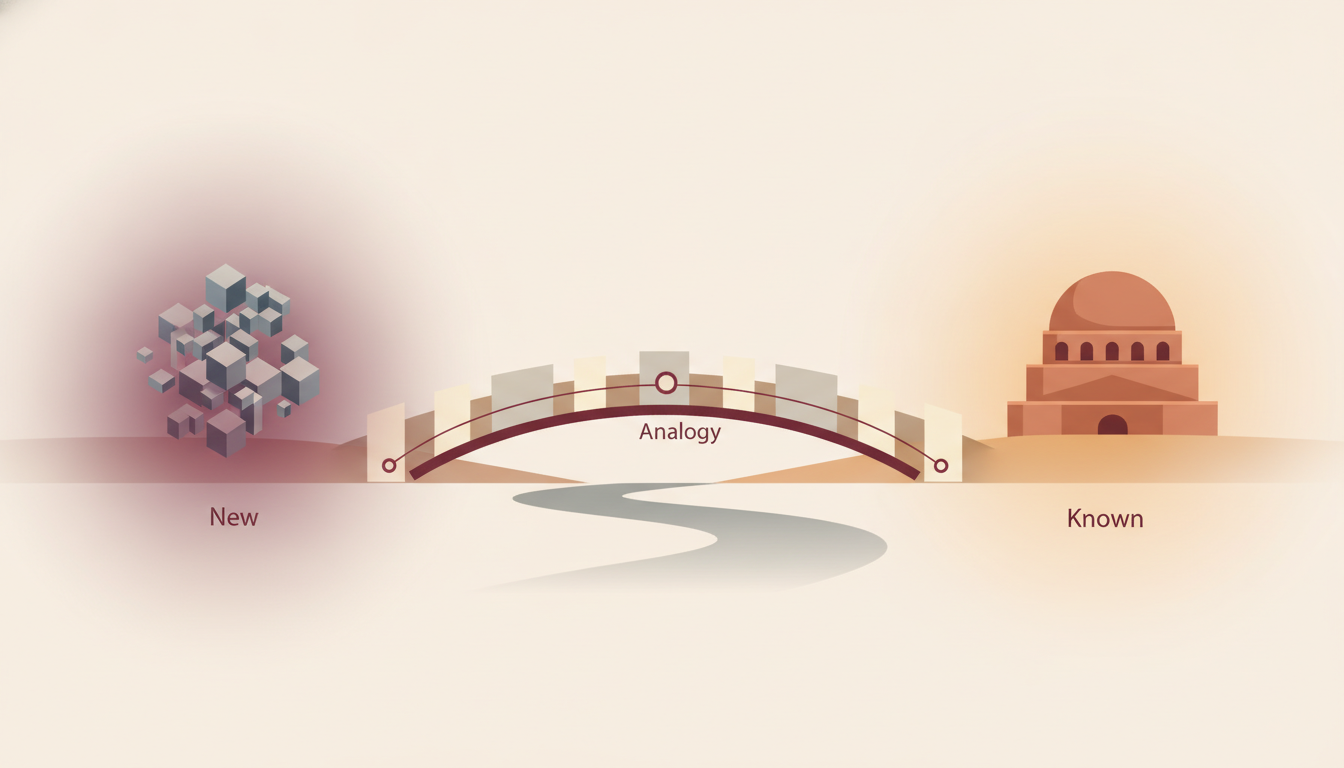
The Analogy Bridge works by connecting an unfamiliar concept to something your audience already understands. Cognitive scientists at the University of California found that analogies activate existing neural pathways, making new information up to 40% easier to retain (Gentner & Smith, 2012, Cognitive Science).
The structure is straightforward:
- Identify the complex concept you need to explain.
- Find a familiar parallel from your audience's world (not yours).
- Map the key similarities — then explicitly state where the analogy ends.
When to Use It
This framework is ideal when you're explaining technical concepts to non-technical audiences, introducing a new strategy, or pitching an unfamiliar idea. It's also essential when you're presenting ideas to senior management who may not have your domain expertise but need to make investment decisions.
Real-World Example
Imagine you're a cybersecurity lead explaining zero-trust architecture to a board of directors.
Without analogy: "Zero-trust architecture eliminates implicit trust within the network perimeter and requires continuous verification of every user and device, regardless of location, using micro-segmentation and least-privilege access controls." With Analogy Bridge: "Think of our current security like a building with a locked front door — once you're inside, you can go anywhere. Zero-trust is like giving every room its own lock and requiring a new key card at every door. Even if someone gets into the lobby, they can't access the vault. That's what we're implementing across our network."The board doesn't need to understand micro-segmentation. They need to understand why it matters and what it does. The analogy gets them there in ten seconds.
Framework 3: The Rule of Three (Structure for Retention)
How It Works
The human brain is wired to process information in groups of three. Research from Georgetown University's McDonough School of Business confirms that audiences retain messages structured in threes at significantly higher rates than messages with four or more points (Bradshaw, 2019).
The Rule of Three means organizing any complex idea into exactly three pillars, three arguments, or three steps. Not two (feels incomplete). Not four (feels overwhelming). Three is the sweet spot for clarity and memorability.
How to Apply It
Take your complex idea and ask: What are the three most important things my audience needs to understand? Everything else becomes supporting detail that you share only if asked.
Example: You're a product manager explaining a new platform migration to cross-functional stakeholders.Instead of walking through 14 workstreams, you say:
"This migration comes down to three things: speed — we're cutting load times by 60%. Reliability — we're moving to infrastructure with 99.99% uptime. Cost — we'll reduce hosting spend by $400K annually."
Each pillar can have supporting data beneath it. But the three-word framework gives your audience a mental filing system. They'll remember speed, reliability, and cost long after the meeting ends.
Combining With Other Frameworks
The Rule of Three works beautifully inside the Pyramid Principle. State your conclusion, then support it with three reasons. This combination is how the most effective communicators structure their thoughts before speaking — and it's a hallmark of speaking with gravitas.
Framework 4: The So-What Ladder (Tie Everything to Impact)
How It Works
The So-What Ladder forces you to climb from raw data to business impact by repeatedly asking one question: "So what?"
Here's the climb:
- Level 1 — Data: "Customer support tickets increased 23% last quarter."
- Level 2 — Insight: "So what? Our average resolution time is slipping, which means customers are waiting longer."
- Level 3 — Impact: "So what? Longer wait times correlate with a 15% drop in renewal intent among mid-market accounts."
- Level 4 — Action: "So what? We need to hire three additional support engineers before Q2 to protect $2.1M in renewals."
Most professionals stop at Level 1 or Level 2. They present data and insights but never connect them to what leadership actually cares about: revenue, risk, growth, or competitive position.
Why Leaders Respond to This Framework
According to a 2023 McKinsey Global Survey on decision-making, 67% of senior executives said they struggle to act on presentations that don't clearly connect information to strategic outcomes. The So-What Ladder solves this by doing the thinking for your audience — which is exactly what leaders expect from trusted advisors.
This framework is also essential for anyone working to be seen as a strategic thinker at work. Strategic thinkers don't just report what happened. They explain why it matters and what to do about it.
Practice Drill
Before your next presentation, take each data point and write the So-What Ladder on paper. If you can't reach Level 4 (a clear action or decision), the data point probably doesn't belong in your presentation. Cut it.
Communicate complex ideas with the clarity of a senior executive. The Credibility Code walks you through the exact communication frameworks that build authority and influence — even in high-stakes rooms. Discover The Credibility Code
Framework 5: Progressive Disclosure (Layer Complexity Gradually)
How It Works
Progressive Disclosure is borrowed from UX design, where interfaces reveal information incrementally to avoid overwhelming users. Applied to communication, it means structuring your message in layers — starting with the simplest, most essential version and adding complexity only as your audience signals they want more.
Think of it as a three-layer cake:
- Layer 1 (The Headline): One sentence that captures the entire idea. Anyone in any role should understand this.
- Layer 2 (The Summary): Three to five sentences that add context, scope, and key details. This is enough for most decision-makers.
- Layer 3 (The Deep Dive): Full technical detail, methodology, data tables, edge cases. This is for specialists who need it — and only when they ask.
When to Use It
Progressive Disclosure is ideal for mixed audiences — when you're presenting to a room that includes both the CTO and the CMO, or when you're writing a report that will be read by people at different levels of technical fluency. It's also the backbone of how to present to executives without slides.
Real-World Example
You're a data science manager presenting a new predictive model to the leadership team.
Layer 1: "We've built a model that predicts which customers are at risk of churning 90 days before it happens, with 87% accuracy." Layer 2: "The model uses three years of behavioral data — login frequency, support interactions, and usage patterns — to flag at-risk accounts. It's already been validated against last quarter's actual churn and outperformed our current method by 34%." Layer 3 (only if asked): "We used a gradient-boosted decision tree trained on 142 features, with SHAP values for interpretability. The AUC-ROC is 0.91, and we've accounted for class imbalance using SMOTE. Here's the confusion matrix..."Notice what happens: every audience member gets value. The CEO gets the headline. The VP of Customer Success gets the summary. The data team gets the deep dive. No one is lost. No one is bored.
How to Choose the Right Framework for Any Situation
Not every framework fits every scenario. Here's a quick decision guide:
Use the Pyramid Principle when: You're making a recommendation, briefing leadership, or answering a direct question. Time is short and decisions need to happen. Use the Analogy Bridge when: Your audience lacks domain expertise. You're introducing something genuinely new or technical. Use the Rule of Three when: You need your message to be memorable. You're presenting at a town hall, giving a keynote, or writing a high-visibility email. Use the So-What Ladder when: You're presenting data or analysis. Your audience is results-oriented. You need to justify a budget, headcount, or strategic shift. Use Progressive Disclosure when: Your audience is mixed (different roles, different expertise levels). You're writing a document that will be read by multiple stakeholders.In practice, the most effective communicators combine frameworks. A strong executive presentation might use the Pyramid Principle for overall structure, the Rule of Three for the supporting arguments, and the Analogy Bridge for one particularly technical point. Mastering these combinations is what separates good communicators from people who command respect in every room.
Frequently Asked Questions
How do you explain a complex idea in simple terms?
Start with the conclusion or outcome, not the process. Use the Pyramid Principle to lead with your answer, then support it with no more than three key points. Replace jargon with everyday language, and use analogies to connect unfamiliar concepts to things your audience already understands. Practice by explaining the idea to someone outside your field — if they can repeat it back, you've simplified it effectively.
What is the best framework for presenting to executives?
The Pyramid Principle is widely considered the most effective framework for executive presentations. Executives want the answer first, followed by supporting evidence. Combine it with the So-What Ladder to ensure every point connects to a business outcome. According to McKinsey research, 67% of senior executives struggle to act on presentations that don't link information to strategic impact.
How do you simplify technical information for non-technical audiences?
Use the Analogy Bridge framework. Identify the core concept, find a parallel your audience already understands, and map the similarities. For example, explaining cloud computing as "renting storage space instead of buying a warehouse." Also use Progressive Disclosure — give the simple version first and add technical detail only when asked.
Presenting complex ideas simply vs. oversimplifying: what's the difference?
Simplifying means removing unnecessary complexity while preserving accuracy and substance. Oversimplifying means stripping away so much detail that the idea becomes misleading or loses its value. The test: can an expert still endorse your simplified version as accurate? If yes, you've simplified well. If they'd object, you've gone too far.
How do you structure a presentation so people remember your key points?
Use the Rule of Three. Organize your entire message around three core pillars and repeat them throughout your presentation — in your opening, in the body, and in your close. Research from Georgetown University confirms that audiences retain three-point structures at significantly higher rates than messages with four or more points.
How can I sound more confident when presenting complex ideas?
Confidence comes from structure. When you have a clear framework — like the Pyramid Principle or Rule of Three — you don't ramble, hedge, or lose your place. Pair this with executive speaking cadence techniques: slow your pace, pause after key points, and eliminate filler words. Structure is the foundation of vocal authority.
Speak So the Room Takes You Seriously
The Credibility Code covers the verbal patterns that make presenters sound authoritative, and the ones that make audiences tune out.
Discover The Credibility CodeRelated Articles

How to Speak With Authority in Presentations
To speak with authority in presentations, focus on five core areas: slow your speaking pace to 130–150 words per minute, use downward vocal inflections at the end of statements, structure your content with a clear "claim-evidence-action" framework, adopt grounded body language with planted feet and purposeful gestures, and eliminate hedging language like "I think" or "sort of." Authority isn't about volume—it's about vocal control, structural clarity, and unwavering conviction in your message.

How to Give a Presentation to Senior Leadership That Lands
To give a presentation to senior leadership that lands, lead with the answer first, frame everything around business impact, keep it to half the time you think you need, and prepare more for the Q&A than the slides. Senior leaders don't want a journey through your process—they want your recommendation, the data behind it, and a clear decision path. Structure your content using the pyramid principle (conclusion first, evidence second), design slides that communicate in under five seconds each, an

How to Present to a Board of Directors: 8 Key Rules
Presenting to a board of directors requires a fundamentally different approach than any other business presentation. To succeed, lead with strategic insight rather than operational detail, keep your presentation to 15–20 minutes maximum, frame every point around business outcomes, anticipate tough questions before you walk in, and project calm executive presence throughout. Boards want decisions, not data dumps. Master these eight rules and you'll earn credibility with the most senior audience i