
Personal Brand for Promotion: Position Yourself to Advance

Building a personal brand for promotion at work means intentionally shaping how decision-makers perceive your value, expertise, and leadership readiness. It goes beyond doing good work — it requires making your contributions visible, aligning your reputation with organizational priorities, and consistently communicating in ways that signal you're ready for the next level. This article gives you a concrete 90-day plan to build the internal brand that gets you promoted.
What Is a Personal Brand for Promotion at Work?
A personal brand for promotion at work is the deliberate, consistent reputation you build inside your organization that signals leadership readiness to the people who control advancement decisions. It's the intersection of what you're known for, how you communicate, and the strategic value others associate with your name.
Unlike an external personal brand (which focuses on social media or industry visibility), an internal personal brand is built through everyday interactions: how you run meetings, how you frame ideas in emails, how you handle conflict, and whether decision-makers think of you when high-visibility opportunities arise. According to a 2023 LinkedIn Workforce Confidence survey, 85% of jobs are filled through networking and internal relationships — meaning your internal reputation often matters more than your résumé.
Why Your Internal Brand Matters More Than Your Performance Review
Most mid-career professionals assume that strong performance automatically leads to promotion. It doesn't. Performance is the baseline. Your personal brand is what separates you from every other high performer competing for the same role.

The Perception Gap That Stalls Careers
Research from Gartner's 2022 report on workforce management found that only 1 in 4 employees feel confident their manager can advocate for their promotion to senior leadership. This means even when your direct manager values your work, the people making final promotion decisions may have little idea who you are or what you bring to the table.
Consider this scenario: Two senior analysts both exceed their targets. Analyst A delivers results quietly and waits for recognition. Analyst B delivers the same results but also presents quarterly insights to the VP, volunteers for a cross-functional initiative, and writes clear, strategic email updates that get forwarded up the chain. When a director role opens, Analyst B gets the call — not because of better performance, but because of a stronger internal brand.
If you've ever felt overlooked despite strong results, the issue is almost certainly a brand gap, not a performance gap.
What Decision-Makers Actually Evaluate
Promotion decisions are rarely made in a single meeting. They're shaped over months through accumulated impressions. Senior leaders evaluate three things when considering someone for advancement:
- Competence signals — Can this person handle the complexity of the next role?
- Leadership signals — Do others already treat this person as a leader?
- Strategic alignment — Does this person understand and advance our priorities?
Your personal brand is the vehicle that delivers all three signals. Without it, you're relying on someone else to make your case — and that's a gamble.
The 5 Pillars of a Promotion-Ready Personal Brand
Building a personal brand that drives promotion isn't about self-promotion or office politics. It's a structured approach to making your value unmistakable. Here are the five pillars.
Pillar 1: Define Your Strategic Value Proposition
Before you can shape how others see you, you need clarity on what you want to be known for. This isn't your job title — it's the specific, strategic value you bring that others don't.
Ask yourself: If a senior leader had to describe my unique contribution in one sentence, what would I want them to say?
For example:
- Weak: "She's a great project manager."
- Strong: "She's the one who turns chaotic cross-functional initiatives into measurable results."
Your value proposition should connect what you do best to what the organization needs most. If your company is focused on digital transformation, position yourself as the person who bridges technical complexity and business outcomes. If leadership is prioritizing retention, become known as the manager who develops and keeps top talent.
For a step-by-step process to build this foundation, see our guide on how to develop a confident professional identity.
Pillar 2: Communicate Accomplishments Without Bragging
This is where most professionals get stuck. They know they should be more visible, but they don't want to seem self-promotional. The solution is a technique called value framing — where you communicate results in terms of organizational impact rather than personal achievement.
Here's the formula: Context + Contribution + Impact
Instead of: "I closed the Henderson deal."
Try: "The Henderson account was at risk of going to a competitor. I restructured our proposal around their Q3 priorities, and we secured a two-year contract worth $1.2M."
The first version sounds like bragging. The second sounds like strategic thinking. Same accomplishment, completely different brand signal.
A 2019 study published in the Journal of Personality and Social Psychology found that people who frame achievements in terms of effort and strategy (rather than innate ability) are perceived as both more competent and more likable. This matters enormously for promotion, where likability and competence must coexist.
For more techniques on this balance, explore our article on building credibility without bragging.
Pillar 3: Build Strategic Visibility With the Right People
Visibility without strategy is noise. You don't need everyone in the company to know your name — you need the right people to associate your name with the right things.
Map your promotion influence network: the 5-8 people who will directly or indirectly influence your next promotion decision. This typically includes your direct manager, your skip-level leader, 2-3 cross-functional peers, and at least one senior leader outside your department.
Then, create touchpoints with each person:
- Direct manager: Weekly updates that highlight strategic wins, not just task completion.
- Skip-level leader: Volunteer for initiatives they sponsor; share relevant insights when appropriate.
- Cross-functional peers: Collaborate visibly on projects that matter to the business.
- External senior leader: Attend their town halls, ask thoughtful questions, or request a 15-minute informational conversation.
According to research from the Center for Talent Innovation (now Coqual), professionals with active sponsors are 23% more likely to advance than those without. Building strategic visibility is how you earn sponsorship.
Pillar 4: Align Your Communication Style With the Next Level
One of the most overlooked elements of a promotion-ready brand is how you communicate, not just what you communicate. Every level of leadership has a distinct communication style, and decision-makers unconsciously evaluate whether you "sound like" someone at the next level.
Key shifts to make:
- From detail-heavy to insight-led. Instead of reporting everything you did, lead with the strategic takeaway. (Learn the specific differences in our guide on how executives communicate differently.)
- From reactive to proactive. Don't wait to be asked for updates. Anticipate questions and provide answers before they're needed.
- From hedging to decisive. Replace "I think maybe we should consider..." with "Based on the data, I recommend we..."
This shift applies to every channel: meetings, emails, presentations, and even Slack messages. Your email communication is especially important because it creates a written record of your brand that gets forwarded, quoted, and remembered.
Pillar 5: Demonstrate Leadership Before the Title
The most powerful personal brand signal for promotion is evidence that you're already operating at the next level. Decision-makers want to promote people who have de-risked the decision — meaning the promotion feels like a formality, not a gamble.
Here's how to demonstrate leadership without a title:
- Mentor a junior colleague and let it be known naturally (not performatively).
- Facilitate a meeting when your manager is absent — and do it well.
- Propose a solution to a problem no one asked you to solve, especially one that crosses departmental lines.
- Speak up in high-stakes conversations with composure and clarity. (If this feels challenging, our guide on how to sound confident in meetings when you feel anxious offers practical techniques.)
A 2023 McKinsey report on leadership development found that organizations increasingly promote based on demonstrated leadership behaviors rather than tenure alone. This means the old "wait your turn" approach is becoming obsolete. Your brand must show leadership now.
For a deeper playbook on this approach, read our article on how to present yourself as a leader before promotion.
Your 90-Day Personal Brand Building Plan
Strategy without execution is just theory. Here's a concrete 90-day plan to build your promotion-ready personal brand.
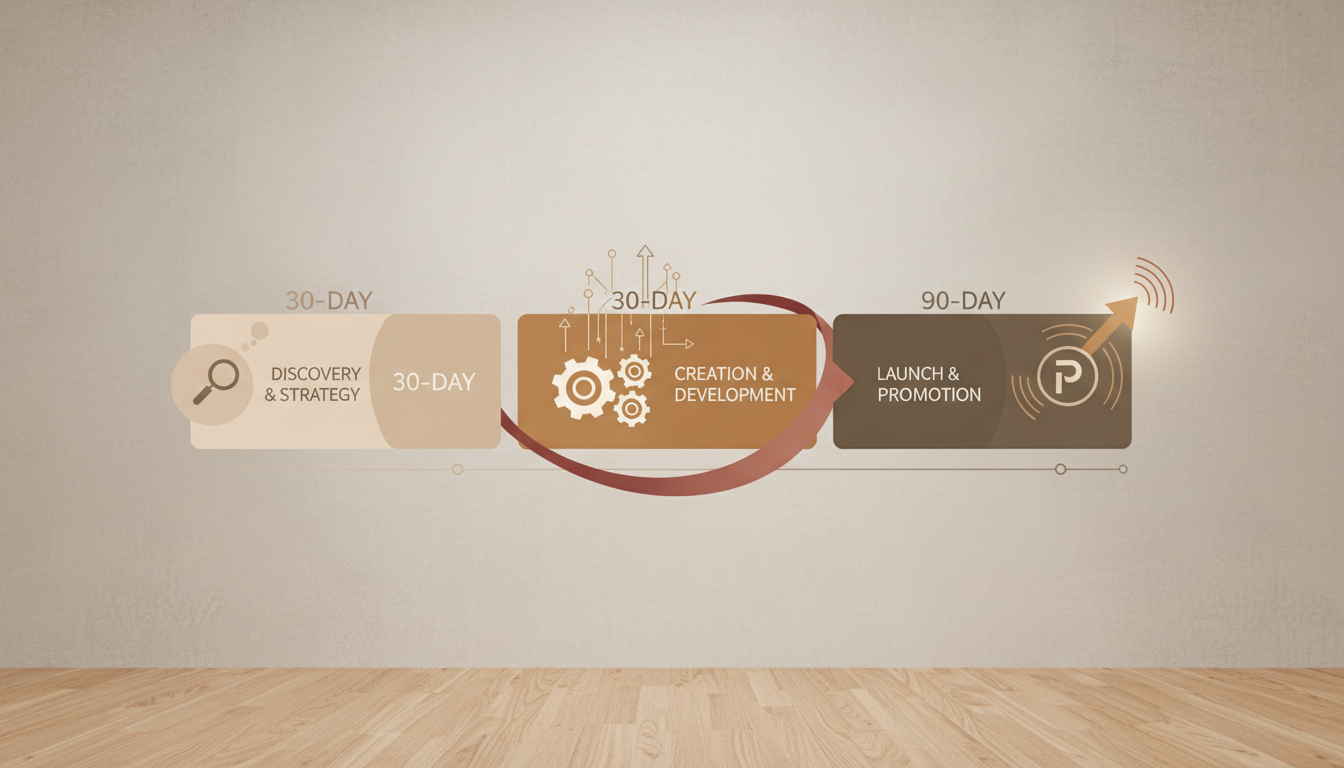
Days 1–30: Foundation and Clarity
Week 1: Write your strategic value proposition. Test it with a trusted colleague: "Does this match how you'd describe my contribution?" Refine until it feels both accurate and aspirational. Week 2: Audit your current brand. Ask three people at different levels: "When my name comes up in a meeting, what do you think people say?" The gap between their answers and your value proposition is your brand gap. Week 3: Map your promotion influence network. Identify the 5-8 people who matter most. Note your current relationship strength with each (strong, moderate, weak, nonexistent). Week 4: Upgrade your communication defaults. Rewrite your email signature, update your internal bio, and draft a 30-second "here's what I'm working on" answer that leads with strategic impact.Days 31–60: Visibility and Engagement
Week 5–6: Create one high-visibility touchpoint per week. This could be sharing an insight in a leadership meeting, sending a strategic update to your skip-level, or volunteering for a cross-functional task force. Week 7–8: Strengthen your weakest promotion influence relationships. Schedule brief conversations, offer help on their priorities, or share relevant information that demonstrates your strategic awareness. If you need to communicate more effectively with senior leadership, master those unwritten rules now.During this phase, track every accomplishment using the Context + Contribution + Impact framework. You'll need this inventory for your promotion conversation.
Days 31–90: Authority and Advocacy
Week 9–10: Take on a visible leadership moment. Lead a presentation, facilitate a strategy session, or represent your team in a senior meeting. Prepare thoroughly — this is a brand-defining moment. Week 11–12: Activate your advocates. Have direct conversations with your manager and sponsor about your promotion goals. Use your accomplishment inventory and your value proposition to make a clear, confident case. Our guide on negotiating a promotion with conversation scripts provides word-for-word language for this conversation. Ongoing: Continue building touchpoints, communicating strategically, and demonstrating next-level leadership. Personal branding isn't a project — it's a practice.Common Mistakes That Undermine Your Promotion Brand
Even smart professionals sabotage their internal brand without realizing it. Here are the most damaging patterns.
Mistake 1: Letting Your Work "Speak for Itself"
This is the single most common brand mistake among high performers. Your work doesn't speak — you do. If you're not narrating your contributions in strategic terms, someone else will define your value for you (or worse, no one will).
A Harvard Business Review analysis found that employees who actively manage their visibility are 30% more likely to receive stretch assignments — the very assignments that build promotion-ready brands.
Mistake 2: Inconsistent Signals Across Channels
Your brand is only as strong as its weakest signal. If you're polished in presentations but passive in meetings, or authoritative in person but tentative in emails, decision-makers notice the inconsistency and default to the weaker impression.
Audit every channel: meetings, emails, one-on-ones, Slack, presentations, and even hallway conversations. Your brand should be coherent across all of them.
Mistake 3: Building Visibility Without Substance
Visibility without genuine value quickly becomes a liability. If people see your name everywhere but can't point to meaningful contributions, you'll be perceived as political rather than promotional material. Always lead with value, then ensure it's visible — never the reverse.
Build the Presence That Earns Promotion The Credibility Code gives you the frameworks, scripts, and daily practices to communicate with the authority that decision-makers look for when choosing who advances. Discover The Credibility Code and start building your promotion-ready brand today. Discover The Credibility Code
Frequently Asked Questions
How long does it take to build a personal brand for promotion?
Expect 90 days of intentional effort before your brand shift becomes noticeable to decision-makers. Brand perception changes gradually — it's built through consistent signals, not a single event. Start with the 90-day plan outlined above and commit to weekly brand-building actions. Most professionals see measurable changes in how they're perceived within one quarter.
What's the difference between personal branding and self-promotion?
Personal branding is strategic and value-centered — it focuses on making your contributions visible in terms of organizational impact. Self-promotion is ego-centered and focuses on getting credit. The key difference is framing: personal branding says "here's how this helps the business," while self-promotion says "look what I did." Decision-makers reward the former and penalize the latter.
Can introverts build a strong personal brand for promotion?
Absolutely. Introverts often build stronger brands because they tend toward depth over breadth. Focus on high-quality touchpoints rather than high-frequency visibility: well-crafted emails, thoughtful contributions in key meetings, and deep relationships with a small number of influential stakeholders. Our guide on personal brand for introverts at work provides a complete quiet strategy.
How do I build a personal brand when working remotely?
Remote professionals must be more intentional about visibility since there are no hallway conversations or informal face time. Prioritize written communication (strategic email updates, Slack thought leadership), volunteer for virtual presentations, and schedule regular video check-ins with your promotion influence network. Written channels actually offer an advantage: your brand signals are documented and forwardable.
What if I've already been passed over for promotion — can I rebuild my brand?
Yes, but it requires an honest audit of why you were passed over. Was it a visibility gap, a perception problem, or a skill gap? Once you identify the root cause, you can address it directly. Many professionals successfully rebuild after being overlooked — the key is to avoid withdrawing and instead double down on strategic brand-building. Our recovery plan for being overlooked walks you through this process step by step.
Should I tell my manager I'm building my personal brand for promotion?
Yes — but frame it as professional development, not political maneuvering. Say something like: "I want to make sure my contributions are visible and aligned with where the team is headed. Can we talk about what leadership looks for when considering people for advancement?" This signals ambition and self-awareness, both of which strengthen your brand.
Make Your Expertise Obvious in the First Minute
The Credibility Code helps you describe your work with clarity and authority, whether you are introducing yourself, interviewing, or presenting.
Discover The Credibility CodeRelated Articles

Personal Brand Statement for Promotion: Write Yours Today
A personal brand statement for work promotion is a concise, compelling declaration—typically one to three sentences—that communicates your unique professional value, expertise, and the measurable impact you deliver. To write yours, use this formula: "I help [audience] achieve [outcome] by [unique approach/skill]." Tailor it to the role you're targeting, not the one you currently hold, and weave it into performance reviews, stakeholder conversations, and internal communications so decision-makers

Personal Branding for Middle Managers Who Want More
A personal brand for middle managers is the deliberate, strategic reputation you build to distinguish yourself from peers and signal readiness for senior leadership. To create one, you need three things: a clear leadership narrative that communicates your unique value, consistent upward visibility with decision-makers, and a professional presence that positions you as the obvious choice for advancement — all without coming across as self-promotional or politically motivated.

Build a Personal Brand That Gets You Promoted
Building a personal brand for promotion at work means deliberately shaping how decision-makers perceive your value, expertise, and leadership potential. It requires auditing your current reputation, mapping stakeholder perceptions, aligning your visibility with organizational priorities, and consistently communicating your strategic value. The professionals who get promoted aren't always the hardest workers — they're the ones whose brand makes them the obvious choice when opportunities arise.