
Build Career Authority Online and Offline: 10 Moves

What Is Career Authority?
Career authority is the professional reputation that causes others to seek your opinion, trust your judgment, and defer to your expertise—without you having to ask for it. It's the difference between being in the room and being the person the room turns to.
Unlike a job title, career authority is earned through a combination of demonstrated expertise, visible contributions, and consistent credibility signals. It operates across two dimensions: online (how you show up digitally through content, profiles, and public thought leadership) and offline (how you communicate, contribute, and carry yourself in person).
Why You Need Both Online and Offline Authority
The Visibility Gap Most Professionals Face
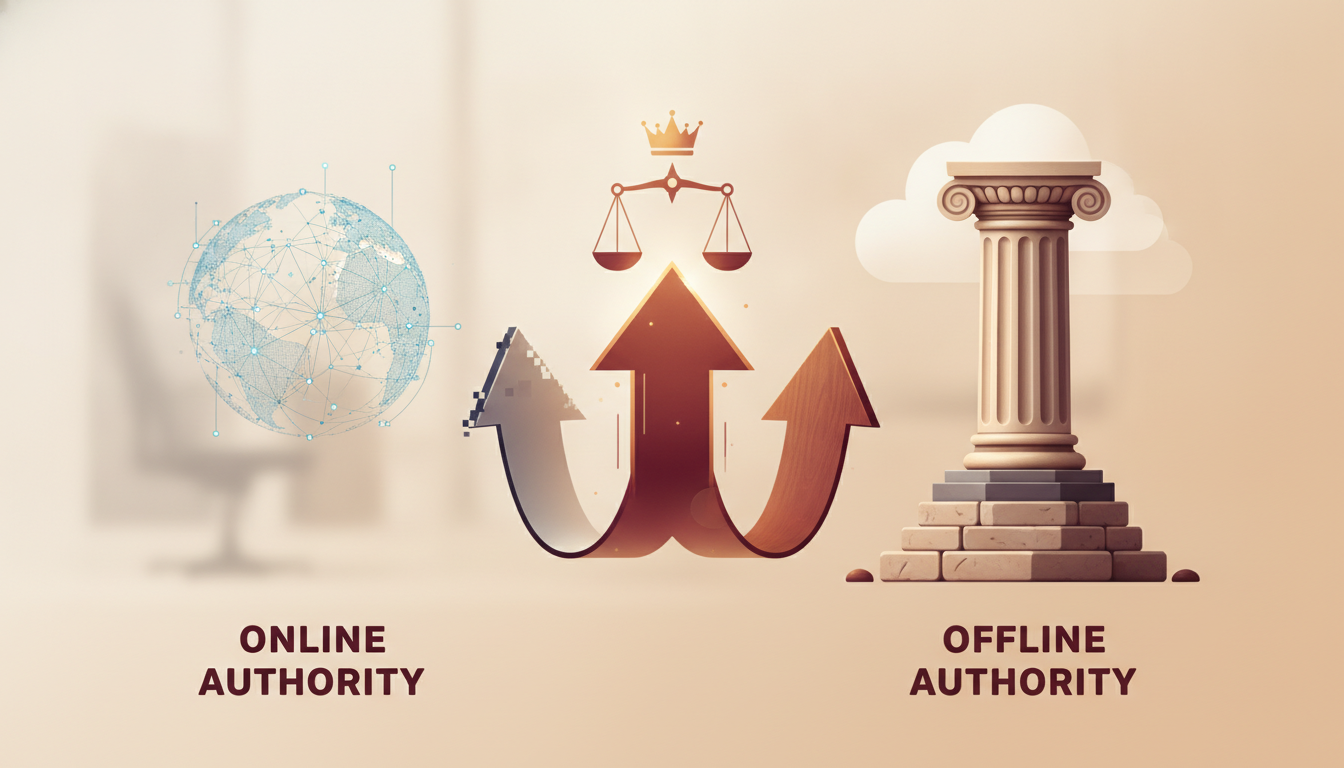
Here's a pattern that plays out in organizations daily: a talented director does exceptional work behind closed doors but has zero digital footprint. When a VP role opens, the hiring committee Googles the candidates. One has published articles, a polished LinkedIn presence, and conference speaking credits. The other has… a bare-bones profile with a stock headshot.
According to a 2023 CareerBuilder survey, 70% of employers use social media to screen candidates during the hiring process. Your offline reputation may get you in the conversation, but your online presence often determines whether you stay in it.
How Online and Offline Authority Reinforce Each Other
Think of your career authority as a flywheel. When you share a sharp insight in a leadership meeting (offline), a colleague mentions it to their network or invites you to speak at an industry event. When you publish a well-argued LinkedIn article (online), a senior leader references it in your next one-on-one. Each channel feeds the other.
Professionals who master both channels build what researchers call "360-degree credibility." A study published in the Harvard Business Review found that leaders who actively manage their reputation across multiple channels are 2.5 times more likely to be perceived as high-potential by senior leadership.
If you're looking to deepen your understanding of how credibility works in professional settings, our guide on how to build professional credibility at work breaks down the foundational framework.
5 Moves to Build Career Authority Online
Move 1: Optimize Your LinkedIn as a Leadership Asset
Your LinkedIn profile isn't a résumé—it's a positioning document. Most professionals treat it as a list of past roles. Authorities treat it as a statement of what they stand for.
Here's the shift: Rewrite your headline to reflect your expertise, not just your title. Instead of "Senior Product Manager at Acme Corp," try "Senior Product Manager | Helping Enterprise Teams Ship Products Users Actually Want." Your summary should answer one question: Why should someone trust your perspective on this topic?According to LinkedIn's own data, profiles with a custom headline receive up to 40% more connection requests and significantly more profile views than those using default titles. For a complete walkthrough on crafting a positioning statement, see our guide on personal brand statements for LinkedIn.
Move 2: Publish Point-of-View Content Consistently
Authority isn't built by sharing other people's articles with "Great read!" as your commentary. It's built by publishing your own informed perspective.
You don't need to write 2,000-word essays. Start with a format I call the Authority Micro-Post:
- Hook (1 sentence): State a counterintuitive or specific observation from your work.
- Context (2-3 sentences): Briefly explain the situation or trend.
- Point of View (2-3 sentences): Share your take—what most people get wrong, what you've learned, or what you'd recommend.
- Takeaway (1 sentence): End with a clear, quotable line.
Aim for two to three posts per week. Consistency matters more than virality. Within 90 days, you'll notice colleagues, recruiters, and industry peers engaging with your ideas.
Move 3: Build a Digital Thought Leadership Portfolio
Beyond social posts, create at least one anchor content asset that demonstrates deep expertise. This could be:
- A long-form article on LinkedIn or Medium analyzing a trend in your field
- A guest post on an industry blog or publication
- A recorded webinar or podcast appearance
- A case study showcasing results you've driven
This portfolio becomes your "proof layer." When someone hears your name in a meeting, they can find substantive evidence of your thinking online. For a deeper dive into thought leadership strategy, explore our article on thought leadership on LinkedIn.
Move 4: Engage Strategically in Industry Conversations
Don't just post—participate. Comment thoughtfully on content from leaders in your space. Join LinkedIn groups or Slack communities where your target audience gathers. When you add value to someone else's conversation, you borrow their audience's attention.
The key word is strategically. Don't comment on everything. Choose three to five thought leaders or publications in your niche and engage consistently. Over time, their audiences begin to recognize your name and associate you with expertise.
Move 5: Curate Your Digital Footprint
Google yourself. Seriously. What shows up on the first page of results is your de facto public reputation.
If the results are thin or unflattering, take control. Publish content on platforms that rank well (LinkedIn articles, Medium, your company blog). Request to be quoted in industry roundups. Update professional directory listings. The goal is to ensure that when anyone searches your name, the first page reflects the authority you're building.
5 Moves to Build Career Authority Offline
Move 6: Make Strategic Contributions in Meetings
Most professionals speak in meetings to share updates. Authorities speak to shift the conversation. The difference is strategic framing.
Before your next leadership meeting, prepare one contribution using the Authority Contribution Framework:
- Elevate: Connect the discussion to a bigger strategic question. ("This ties into a larger trend we should be watching…")
- Reframe: Offer a perspective no one else has raised. ("We're focused on the timeline, but the real risk is stakeholder alignment.")
- Synthesize: Summarize what's been said and propose a clear next step. ("We've heard three valid concerns. Here's what I'd recommend we test first…")
Research from MIT's Human Dynamics Lab shows that the pattern of communication—not just the content—accounts for roughly 40% of the variation in team performance. How and when you contribute matters as much as what you say. For more on commanding attention in meetings, our guide on leadership presence in meetings offers specific habits you can start using immediately.
Move 7: Volunteer for Cross-Functional Visibility
Authority grows when people outside your immediate team know your name and associate it with competence. The fastest way to achieve this is through cross-functional projects, task forces, or committees.
Here's the scenario: Your company launches a working group to evaluate a new market opportunity. Volunteering for this group puts you in front of leaders from sales, marketing, finance, and product—people who wouldn't normally see your work. When you contribute meaningfully, your reputation spreads through channels you can't access from your desk.Look for opportunities that are visible to senior leadership: company-wide initiatives, client-facing projects, or strategic planning committees. These are authority accelerators.
Move 8: Become the Internal Go-To Expert
Pick one topic—one narrow area where you have genuine depth—and become the person everyone calls about it. This could be a technical domain, a process, a client segment, or a market trend.
Then do three things:
- Share proactively. Send a brief email to your team when you spot a relevant development. ("Saw this regulatory change—here's what it means for our Q3 plans.")
- Offer to present. Host a 15-minute brown-bag session or team learning moment on your area.
- Create a resource. Build a one-page reference guide, decision framework, or FAQ that others can use.
Over time, people will start introducing you as "the person who knows X." That's authority. For more on positioning yourself as a subject matter expert, check out how to position yourself as an expert at work.
Move 9: Invest in High-Stakes Communication Skills
Offline authority lives or dies in high-stakes moments: the board presentation, the difficult negotiation, the all-hands Q&A. These moments disproportionately shape how others perceive your competence.
A study by Quantified Communications found that executives who score in the top quartile on communication effectiveness are rated 50% more favorably on overall leadership capability. Communication isn't a soft skill—it's the skill that makes all your other skills visible.
Focus on three high-leverage areas:
- Presentations to senior leadership: Structure your message around decisions, not data. Lead with the recommendation, then support it.
- Difficult conversations: Use direct, composed language. Avoid hedging phrases that undermine your credibility.
- Negotiations: Prepare your position, know your alternatives, and speak with calm certainty.
Our guide on how to speak with authority in presentations provides a detailed framework for each of these scenarios.
Move 10: Build a Reputation Through Mentorship and Sponsorship
Authority isn't just about being seen—it's about being vouched for. When a senior leader says, "You should talk to [your name] about this," that's the highest form of career authority.
To earn this, invest in relationships above and below you:
- Mentor junior colleagues. When they succeed and credit your guidance, your reputation grows organically.
- Seek sponsors, not just mentors. A mentor gives advice. A sponsor puts your name forward in rooms you're not in. Build relationships with senior leaders by consistently delivering results and making their priorities easier to achieve.
- Be generous with credit. Paradoxically, giving others credit builds your authority. Leaders who elevate others are perceived as more confident and more trustworthy.
Your credibility is your career currency. The Credibility Code shows you how to build a professional presence that commands respect in every interaction—from emails to executive presentations. Discover The Credibility Code
How to Integrate Your Online and Offline Authority
Create a Consistency Loop

The most common mistake professionals make is presenting two different personas—polished and strategic online, but passive and uncertain in person (or vice versa). Authority requires consistency.
Here's a simple integration practice: After every significant offline contribution—a presentation, a successful project, a strategic recommendation that landed—create a corresponding online artifact. Write a LinkedIn post about the lesson learned. Publish a brief article about the approach you used. Share a framework you developed.
This loop ensures that your offline wins become part of your permanent digital record, and your online content stays grounded in real experience rather than theory.
The 30-Day Authority Audit
Every quarter, run a quick audit across both channels:
| Online Check | Offline Check |
|---|---|
| Is my LinkedIn headline current and positioned around expertise? | Have I made at least one strategic contribution in a leadership meeting this month? |
| Have I published 8-12 pieces of content this quarter? | Am I known for a specific area of expertise on my team? |
| Does my Google search results page reflect my authority? | Have I built or strengthened a relationship with a senior sponsor? |
| Am I engaging in industry conversations online? | Have I volunteered for a cross-functional or visible project? |
If you're building authority after a career transition or break, our guide on how to build career authority after a career break offers a tailored roadmap for reestablishing credibility.
Frequently Asked Questions
What is the fastest way to build career authority?
The fastest path is combining a visible offline contribution with an online amplification. Deliver a strong presentation or lead a successful project, then publish a LinkedIn post or article about the approach you used. This creates immediate credibility in two channels simultaneously. Within 90 days of consistent effort, most professionals notice a measurable shift in how colleagues and leaders perceive them.
Can you build career authority without social media?
Yes. Many professionals build strong authority through offline channels alone—strategic meeting contributions, internal thought leadership, mentorship, and cross-functional visibility. However, adding even a minimal online presence (an optimized LinkedIn profile and occasional content) significantly amplifies your reach. Our article on building career authority without social media covers this approach in detail.
Online authority vs. offline authority: which matters more?
Neither is inherently more important—they serve different functions. Offline authority drives trust and influence with people who interact with you directly. Online authority extends your reputation to people who haven't met you yet, including recruiters, potential collaborators, and industry peers. The professionals who advance fastest build both, because each channel reinforces the other.
How do I build career authority without formal credentials?
Credentials open doors, but demonstrated expertise keeps them open. Focus on publishing your perspective consistently, becoming the go-to expert on a specific topic within your organization, and delivering visible results. Over time, your track record becomes more persuasive than any degree. See our full guide on building career authority without credentials for a step-by-step approach.
How long does it take to build real career authority?
Most professionals begin to see recognition shifts within 90 to 180 days of consistent, dual-channel effort. However, deep authority—the kind where your name is synonymous with expertise in a domain—typically takes two to three years of sustained contribution. The key is consistency. Sporadic efforts produce sporadic results.
How do I build authority as an introvert?
Introverts often build the most durable authority because they tend to favor depth over volume. Focus on written content online (articles, thoughtful comments) and prepared, high-impact contributions offline rather than trying to dominate every conversation. Strategic presence beats constant presence. Our guide on building presence as a quiet leader offers eight specific moves tailored to introverted professionals.
Be the Person Leadership Thinks Of First
The Credibility Code is a practical guide to the communication habits that get professionals noticed, trusted, and promoted.
Discover The Credibility CodeRelated Articles

How to Position Yourself as an Expert at Work: 8 Moves
To position yourself as an expert at work, consistently share specialized knowledge, contribute insights before being asked, document your results, build a visible body of work, speak with authority in high-stakes moments, cultivate a strategic network, teach others what you know, and align your personal brand with a specific domain. These eight moves shift perception from "competent contributor" to "recognized authority."

Build Credibility at Work Without Self-Promotion: 9 Moves
You can build credibility at work without self-promotion by focusing on nine key behaviors: delivering consistent results, sharing credit generously, asking strategic questions, becoming a reliable knowledge resource, following through relentlessly, offering help before being asked, communicating with precision, building genuine relationships across departments, and letting your work create its own visibility through documentation and strategic positioning. These approaches build lasting authori

How to Build Authority in Your Career: A 5-Phase System
Building authority in your career requires a deliberate, phased approach that compounds over time. The system works across five stages: (1) establish baseline competence and reliability, (2) develop a distinctive professional point of view, (3) increase strategic visibility within your organization, (4) expand influence beyond your immediate team, and (5) become the recognized go-to voice in your domain. Each phase builds on the last, and skipping stages is why most authority-building efforts st