
Leadership Presence in Meetings: 10 Habits That Command Respect

What Is Leadership Presence in Meetings?
Leadership presence in meetings is the ability to project confidence, credibility, and composure in group settings so that others naturally listen, defer, and engage with your contributions. It's not about being the loudest voice or dominating the agenda — it's about how you show up, how you communicate, and how you make others feel when you speak.
According to a 2012 study by the Center for Talent Innovation (now Coqual), executive presence accounts for 26% of what it takes to get promoted to senior leadership. Meetings are where that presence is most visibly tested. For a deeper exploration of what this concept entails and how it differs from related ideas, see our guide on leadership presence vs. executive presence.
Habit 1: Choose Strategic Seating
Where you sit in a meeting room sends a message before you say a word. This isn't about power games — it's about positioning yourself for visibility, influence, and engagement.

Why Seat Choice Matters More Than You Think
Research from environmental psychology consistently shows that people seated at the head of a table are perceived as more authoritative, even when they hold no formal leadership role. A study published in the journal Human Relations found that spatial positioning in group settings directly influences perceived status and participation rates.
Here's how to apply this:
- If you're leading the meeting, sit at the head of the table or at the center of the longest side. This gives you natural sightlines to every participant.
- If you're a key contributor but not the leader, sit directly across from the decision-maker. This positions you as a counterpart, not a subordinate.
- If you want to build an alliance, sit adjacent to the person whose support you need. Side-by-side seating reduces psychological opposition.
The Virtual Meeting Equivalent
In virtual meetings, "strategic seating" translates to camera positioning and screen presence. Position your camera at eye level, ensure strong lighting from the front, and keep your background clean and professional. These visual cues replicate the authority signals of physical positioning. Our guide on leadership presence in virtual meetings covers this in detail.
Habit 2: Open With a Clear, Confident Statement
The first 30 seconds of your contribution in any meeting set the tone for how everything else you say will be received. Leaders with strong meeting presence never open with apologies, hedging language, or long-winded context.
The Authority Opening Framework
Use this three-part structure for your opening statement in any meeting:
- State your position or observation (one sentence).
- Provide one supporting reason (one sentence).
- Signal what you want from the group (one sentence).
Compare that to: "So, I was thinking, and I'm not sure if this is the right call, but maybe we could possibly push the launch back a little? I mean, there were some issues in beta, so…"
The first version takes 12 seconds. The second takes longer and communicates uncertainty. If you struggle with hedging language, our article on how to stop sounding unsure when speaking at work offers practical fixes.
Practice the "First Five Words" Drill
Before your next meeting, write down the first five words you plan to say. Strong openings start with declarative verbs: "I recommend," "We need," "The data shows," "My assessment is." Weak openings start with qualifiers: "I just wanted to," "I'm not sure but," "Sorry, can I just."
Habit 3: Use Deliberate Pauses to Signal Confidence
Pausing is one of the most underused power tools in professional communication. A Harvard Business Review analysis of TED Talk speakers found that the most compelling communicators pause for an average of 2-3 seconds between key points — and audiences rated them as more credible and confident.
The Three Types of Strategic Pauses
- The Pre-Statement Pause: Pause for 1-2 seconds before you begin speaking. This draws attention and signals that what you're about to say is considered, not reactive.
- The Emphasis Pause: Pause immediately after your most important point. Silence after a key statement gives the room time to absorb it and amplifies its weight.
- The Disagreement Pause: When someone challenges you, pause for 2-3 seconds before responding. This prevents you from sounding defensive and signals composure.
How to Practice
In your next meeting, commit to pausing for a full two seconds before responding to any question. It will feel uncomfortably long at first. It won't look uncomfortable to anyone else. In fact, research on executive speaking cadence shows that deliberate pacing is one of the strongest markers of seniority.
Habit 4: Command Attention With Authoritative Body Language
Your body communicates before, during, and after you speak. According to research by Albert Mehrabian — often cited but frequently misapplied — nonverbal cues play a significant role in how emotional intent and attitude are perceived, especially when verbal and nonverbal signals conflict.

The Four Body Language Anchors for Meetings
- Stillness over fidgeting. Leaders with presence keep their hands visible and relatively still. They don't tap pens, adjust their hair, or shift constantly. Stillness reads as control.
- Open posture. Keep your chest open, shoulders back (not rigidly), and arms uncrossed. Lean slightly forward when listening to signal engagement.
- Purposeful gestures. When you do use your hands, make gestures deliberate and at chest height. Avoid pointing; use open-palm gestures instead.
- Steady eye contact. Make eye contact with the person you're addressing for 3-5 seconds, then shift to another participant. In a group, distribute your gaze to include everyone.
For a comprehensive breakdown of nonverbal authority signals, read our guide on body language that conveys authority.
The "Below the Table" Trap
Many professionals focus on facial expressions but forget their lower body. Bouncing legs, crossed ankles tucked under your chair, or sitting on the edge of your seat all signal anxiety. Plant both feet flat on the floor. This grounds your posture and creates a stable foundation that radiates calm.
Habit 5: Listen Strategically Before Speaking
The most respected voices in any meeting are rarely the first to speak. They listen, synthesize, and then contribute at the moment of highest impact.
The Listen-Label-Lead Method
This three-step framework turns active listening into a leadership behavior:
- Listen without planning your response. Focus entirely on what others are saying, including what they're not saying.
- Label the dynamics you observe. Mentally note patterns: "Two people disagree on timeline," "No one has addressed the budget risk," "The team is avoiding the real issue."
- Lead by naming the pattern out loud. Example: "I'm noticing we've discussed timeline and resources, but we haven't addressed the budget gap. Can we spend five minutes on that before we decide?"
This technique positions you as the person who sees the full picture — a hallmark of communicating like a senior leader.
When to Speak First vs. When to Wait
Speak first when you're the subject-matter expert or the meeting leader. Wait when you're in a cross-functional meeting, when you want to understand the political landscape, or when a complex issue requires multiple perspectives before you weigh in. A study by Wharton professor Adam Grant found that leaders who speak last in team discussions often generate better outcomes because they incorporate more information into their guidance.
Habit 6: Handle Disagreement With Composed Authority
How you respond to pushback reveals more about your leadership presence than any polished presentation ever could. Professionals who command respect don't avoid conflict — they navigate it with precision.
The ACE Disagreement Framework
When someone challenges your idea or position in a meeting, use ACE:
- Acknowledge their point without dismissing it: "That's a valid concern, and I understand why the timeline feels aggressive."
- Clarify your reasoning with evidence: "The reason I'm recommending this pace is that our competitor's launch date is confirmed for Q2, and our market research shows a 30% first-mover advantage in this segment."
- Extend an invitation to collaborate: "I'm open to adjusting the approach — what would need to change for you to feel confident in this timeline?"
This framework prevents the two most common mistakes: capitulating too quickly (which erodes credibility) and becoming combative (which erodes trust). For specific scripts you can use in tense moments, see how to disagree with your boss in a meeting respectfully.
What to Do When You're Wrong
Leaders with genuine presence admit mistakes cleanly and quickly. If someone presents evidence that contradicts your position, say: "You're right — I didn't have that data point. That changes my recommendation. Here's what I'd suggest instead." This kind of intellectual honesty doesn't weaken your credibility. It strengthens it.
Habit 7: Ask High-Impact Questions
The quality of your questions signals the depth of your thinking. In meetings, a single well-placed question can redirect an entire conversation and position you as a strategic thinker.
Three Question Types That Command Respect
- Clarifying questions that cut through ambiguity: "When you say 'soon,' are we talking this quarter or next?"
- Implication questions that reveal hidden risks or opportunities: "If we move forward with this approach, what happens to our partnership with [vendor]?"
- Decision-forcing questions that move the group toward action: "What would need to be true for us to commit to this today?"
Avoid questions that are really statements in disguise ("Don't you think we should…") or questions that signal you weren't paying attention ("Can you repeat what you said about…").
The "One Great Question" Practice
Before every meeting, prepare one thoughtful question related to the agenda. Even if you never ask it, the preparation sharpens your thinking and ensures you're engaging at a strategic level. This habit is a cornerstone of how to be seen as a strategic thinker at work.
Habit 8: Manage Your Airtime Intentionally
A 2021 study published in the Academy of Management Journal found that individuals who spoke for approximately 20-30% of a meeting's total time were rated as having the highest leadership presence — not those who spoke the most. Speaking too much dilutes your impact. Speaking too little makes you invisible.
The Airtime Audit
After your next three meetings, estimate what percentage of the total speaking time was yours. If you're consistently above 40%, you may be dominating. If you're below 10%, you're likely being overlooked.
Aim for the 20-30% range in meetings where you're a key contributor. In meetings where you're an observer or learner, 5-10% is appropriate — but make those contributions count.
How to Say More With Less
Use the Bottom Line Up Front (BLUF) technique borrowed from military communication:
- State your conclusion or recommendation first.
- Follow with 2-3 supporting points.
- Stop.
This takes 15 seconds and communicates everything the room needs. For more frameworks on speaking with precision, explore our article on how to speak concisely in meetings.
Turn These Habits Into Your Default Operating Mode. *The Credibility Code* provides the complete framework for building authority, credibility, and commanding presence — not just in meetings, but in every professional interaction. Discover The Credibility Code
Habit 9: Close Discussions With Clear Next Steps
How a discussion ends matters as much as how it begins. Leaders with meeting presence don't let conversations trail off into ambiguity. They close with clarity.
The Close-and-Confirm Technique
At the end of any discussion you've been part of — whether you're leading the meeting or not — use this structure:
- Summarize the decision or outcome in one sentence: "So we've agreed to delay the launch by one week and reassign the QA team."
- Assign ownership: "Sarah, you'll coordinate with engineering. Mark, you'll update the stakeholder timeline."
- Confirm the deadline: "Can we have both updates by Friday at noon?"
Even if you're not the meeting leader, offering this kind of summary positions you as someone who drives outcomes — not just discussions. This is a behavior that distinguishes managers from executives in how they communicate. Our guide on how executives communicate differently explores this distinction further.
Why This Habit Sets You Apart
Most meetings end without clear next steps. A study by Atlassian found that the average employee attends 62 meetings per month and considers half of them wasted time. When you consistently close discussions with clarity, you become the person others rely on to make meetings productive. That reputation is a direct path to increased influence and authority.
Habit 10: Follow Up With Authority
The meeting doesn't end when people leave the room. Leaders with lasting presence extend their influence through deliberate follow-up.
The 24-Hour Follow-Up Rule
Within 24 hours of any significant meeting, send a brief follow-up that includes:
- Key decisions made (2-3 bullet points)
- Action items with owners and deadlines (bulleted list)
- Any open questions that need resolution before the next meeting
Keep this to five sentences or fewer. This isn't a transcript — it's a leadership artifact. It demonstrates that you were engaged, that you understood the strategic implications, and that you're driving accountability.
When to Follow Up Privately
After contentious meetings or discussions where someone was visibly frustrated, a brief private message can reinforce your leadership presence. A simple "I appreciated your perspective on the budget issue today. I think your concern about Q3 spending is worth exploring further — would you have 15 minutes this week to discuss?" turns a potential adversary into a collaborator.
Frequently Asked Questions
What is leadership presence in meetings?
Leadership presence in meetings is the combination of communication skills, body language, strategic thinking, and composure that makes others perceive you as credible, confident, and worth listening to. It's not a personality trait — it's a set of observable, learnable behaviors that signal authority and earn respect in group settings. For a full definition and framework, see our guide on leadership presence: what it is and how to build it.
How can introverts build leadership presence in meetings?
Introverts can build powerful meeting presence by leveraging their natural strengths: deep listening, thoughtful preparation, and considered responses. Focus on the "One Great Question" practice, the Listen-Label-Lead method, and the BLUF technique for concise contributions. Introverts often excel at the strategic pausing habits that extroverts struggle with. Presence isn't about volume — it's about impact per word.
Leadership presence vs. executive presence: what's the difference?
Leadership presence is the broader ability to inspire confidence and trust in any setting, while executive presence specifically refers to the gravitas, communication style, and appearance expected at senior organizational levels. Leadership presence can exist at any career stage; executive presence is typically associated with C-suite and VP-level expectations. Both share core elements like composure, clarity, and credibility.
How do you command respect in meetings without being aggressive?
Commanding respect without aggression comes down to three principles: speak with conviction (not volume), listen with genuine curiosity (not just waiting for your turn), and disagree with evidence (not emotion). The ACE Disagreement Framework — Acknowledge, Clarify, Extend — lets you hold firm positions while remaining collaborative. Respect is earned through consistency and competence, not dominance.
How long does it take to develop leadership presence in meetings?
Most professionals notice measurable changes within 2-4 weeks of deliberately practicing specific habits. A study by Phillippa Lally at University College London found that new behaviors take an average of 66 days to become automatic. Start with two or three habits from this article, practice them in every meeting for a month, and then layer in additional habits. Consistency matters more than perfection.
Can you have leadership presence in meetings without talking too much?
Absolutely. Some of the most powerful meeting behaviors — strategic listening, deliberate pausing, composed body language, and asking one high-impact question — require minimal speaking time. Research shows that speaking for 20-30% of a meeting's total time correlates with the highest perceived leadership presence. Quality of contribution always outweighs quantity.
Build Presence People Notice Before You Say a Word
The Credibility Code gives you the specific verbal and nonverbal habits that make people treat you as the senior person in the room.
Discover The Credibility CodeRelated Articles

Body Language for Leadership Presence: A Complete Guide
Body language for leadership presence is the intentional use of nonverbal cues—posture, eye contact, gestures, facial expressions, and spatial positioning—to project authority, confidence, and credibility in professional settings. Research from UCLA professor Albert Mehrabian found that up to 55% of communication impact comes from nonverbal signals. This guide gives you a complete framework for mastering the physical cues that make people listen, trust, and follow your lead in meetings, presenta
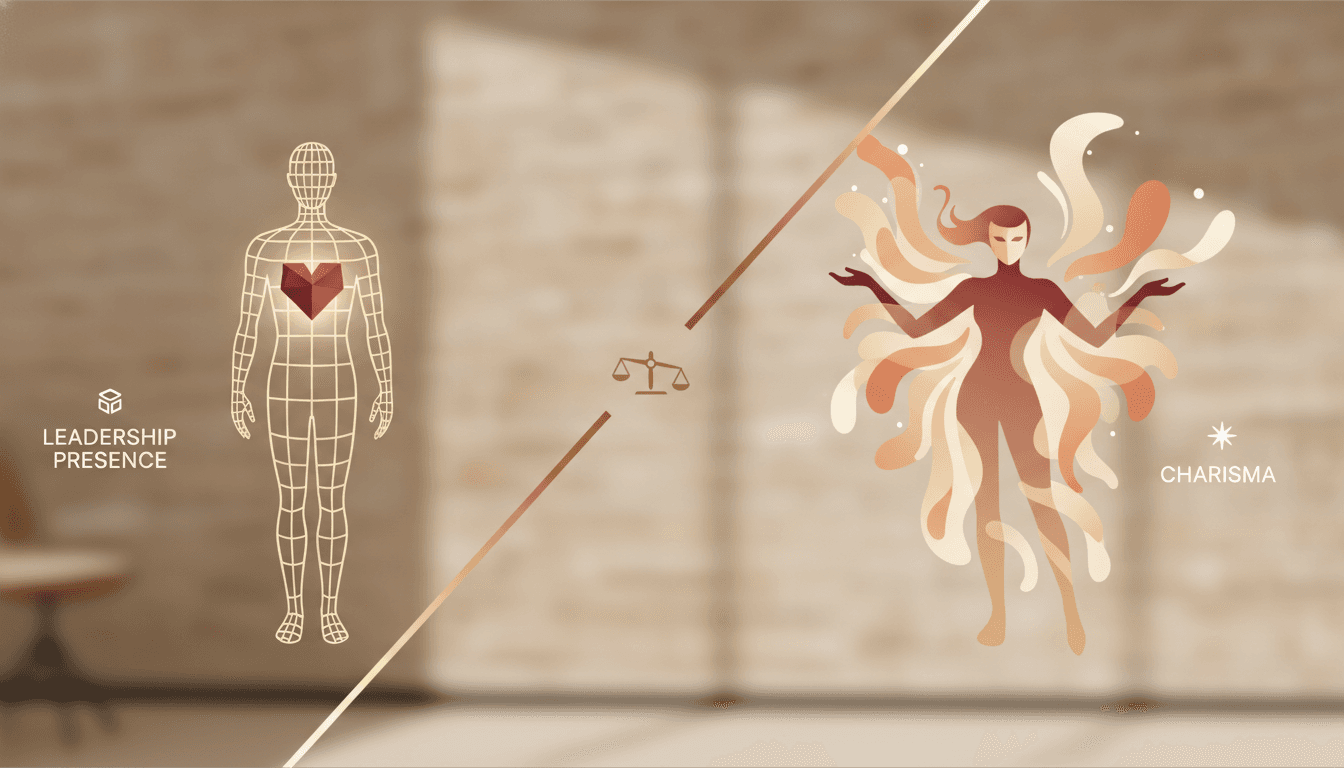
Leadership Presence vs Charisma: Key Differences Explained
Leadership presence and charisma are often confused, but they are fundamentally different. Charisma is a personality-driven magnetism that draws people in through energy and charm. Leadership presence is a credibility-based authority built on consistency, competence, and composure. The critical difference: charisma is largely innate and situational, while leadership presence is learnable, sustainable, and rooted in trust. Professionals who understand this distinction can stop chasing charm and s

Leadership Presence in Meetings Without Talking Too Much
Leadership presence in meetings without talking too much comes down to strategic contribution over constant contribution. The most influential people in any room rarely speak the most — they speak at the right moments, with the right framing, and let their body language and listening do the rest. You build authority by choosing when to weigh in, asking high-impact questions, and using non-verbal cues that signal confidence. This article gives you the exact frameworks to do all three.