
Leadership Presence: What It Is and How to Build It

What Is Leadership Presence? A Clear Definition
Leadership presence is the consistent ability to convey credibility, confidence, and calm authority through how you communicate, carry yourself, and respond under pressure. It's the quality that makes people stop, listen, and trust your judgment — whether you're leading a team meeting or presenting to the board.
Put simply: *leadership presence is the gap between being in the room and owning the room.
It's not about being the loudest voice or the most extroverted person. Research from the Center for Talent Innovation (now Coqual) found that executive presence accounts for 26% of what it takes to get promoted to senior leadership. Yet most professionals can't articulate what it actually consists of — which makes it nearly impossible to develop intentionally.
Leadership presence operates on two levels. There's the internal dimension — your mindset, self-regulation, and sense of authority. And there's the external dimension — what others observe in your behavior, speech, and body language. Building genuine leadership presence requires working on both.
For a deeper exploration of how this concept differs from executive presence, see our guide on executive presence vs. leadership presence.
The Four Core Components of Leadership Presence
Most frameworks reduce leadership presence to vague concepts like "having a commanding aura." That's not useful. Based on research from Sylvia Ann Hewlett's work on executive presence and multiple leadership development studies, leadership presence breaks down into four measurable components.
1. Gravitas: The Weight Behind Your Words
Gravitas is the most critical component, accounting for 67% of executive presence according to Hewlett's research with over 4,000 professionals (Harvard Business Review Press, 2014). It's the perception that you have substance — that your ideas carry weight and your judgment is sound.
Gravitas shows up in specific behaviors:
- Decisiveness — You state a clear position rather than hedging
- Emotional composure — You stay steady when others get reactive
- Intellectual depth — You demonstrate that you've thought through implications, not just surface-level answers
- Confidence under scrutiny — You handle tough questions without crumbling
Here's a workplace scenario: Two directors present competing strategies to the VP. Director A says, "I think maybe we could consider shifting our approach, if that makes sense to everyone." Director B says, "Based on Q3 data and customer feedback, I recommend we shift to a product-led growth model. Here's the risk profile and the mitigation plan." Director B has gravitas. The difference isn't personality — it's preparation and delivery.
You can start developing gravitas today with our guide on how to develop gravitas as a leader.
2. Communication: How You Deliver Your Message
Communication in the context of leadership presence goes beyond "speaking clearly." It encompasses your ability to structure ideas, control your vocal delivery, and adapt your message to your audience.
Leaders with strong communication presence share these habits:
- They lead with the conclusion, not the backstory
- They use pauses strategically instead of filling silence with "um" and "so"
- They match the altitude of their audience — strategic framing for executives, tactical detail for teams
- They speak in declarative sentences, not questions disguised as statements
A 2023 study published in the Journal of Business Communication* found that professionals who used structured communication frameworks were rated 34% more credible by peers than those who spoke extemporaneously without a clear structure.
Your speaking cadence matters too. Leaders who speak at a moderate pace (around 140-160 words per minute) with intentional pauses are perceived as more authoritative than those who rush. Learn the specific vocal techniques in our post on executive speaking cadence techniques.
3. Appearance: The Visual Signal of Authority
Appearance is the most misunderstood component of leadership presence. It's not about wearing expensive suits. It's about visual congruence — does how you look match the authority you're claiming?
This includes:
- Professional grooming and attire appropriate to your context
- Posture and physical bearing — standing tall, taking up appropriate space
- Facial expressions — maintaining a composed, engaged expression rather than looking anxious or checked out
- Environmental signals — your virtual background, your workspace, even how you organize your materials
Research from Princeton psychologists Janine Willis and Alexander Todorov shows that people form first impressions in as little as 100 milliseconds. Your appearance is the first data point others use to assess your credibility — often before you've said a single word.
The key principle: your appearance should never distract from your message. It should reinforce it. For a complete breakdown of the physical signals that communicate authority, explore our guide on leadership presence body language.
4. Composure: Steadiness Under Pressure
Composure is what separates leaders from everyone else when stakes are high. It's your ability to maintain emotional regulation, clear thinking, and measured responses when things go sideways.
Composure doesn't mean suppressing emotions. It means managing how and when you express them. A leader who slams the table in frustration during a crisis loses presence instantly. A leader who acknowledges the difficulty while calmly outlining next steps gains it.
Specific composure behaviors include:
- Controlled breathing — slowing your physiological stress response
- Deliberate pausing before responding to provocative questions
- Steady vocal tone — avoiding the pitch increase that signals anxiety
- Naming the situation without being consumed by it: "This is a setback. Here's how we move forward."
Composure is especially visible in difficult conversations and high-pressure meetings. Our framework on leadership presence in difficult situations walks you through specific scenarios.
Leadership Presence vs. Charisma: A Critical Distinction
One of the most common misconceptions is that leadership presence and charisma are the same thing. They're not — and confusing them holds many professionals back.

What Charisma Is (and Isn't)
Charisma is a magnetic personal quality that draws people in emotionally. It's often associated with warmth, energy, and storytelling ability. Charismatic leaders like Richard Branson or Oprah Winfrey captivate audiences through personality and emotional connection.
But charisma has limitations. It can be inconsistent — dependent on mood, energy, or audience chemistry. It can also exist without substance. We've all met charismatic people who are engaging but lack depth. You leave the conversation entertained but not convinced.
What Leadership Presence Offers That Charisma Doesn't
Leadership presence is more durable and more learnable than charisma. Here's the distinction:
| Dimension | Charisma | Leadership Presence |
|---|---|---|
| Source | Personality-driven | Behavior-driven |
| Consistency | Varies with mood/context | Stable across situations |
| Learnability | Difficult to teach | Highly trainable |
| Foundation | Emotional connection | Credibility + composure |
| Impact | People like you | People trust and follow you |
You can have both, of course. But if you had to choose, leadership presence is more valuable for career advancement. A 2022 survey by DDI's Global Leadership Forecast found that leaders rated highest in "presence" by their teams were 2.4 times more likely to be identified as high-potential talent — regardless of their charisma scores.
For a more detailed comparison, read our full breakdown of leadership presence vs. charisma.
The Leadership Presence Self-Assessment Framework
You can't develop what you can't measure. Use this framework to assess where you stand across all four components. Rate yourself honestly on a 1-5 scale for each behavior.
Gravitas Assessment
- I state clear positions without excessive hedging (1-5)
- I remain calm and composed when challenged (1-5)
- I demonstrate strategic thinking, not just tactical execution (1-5)
- People seek my opinion on important decisions (1-5)
- I can hold silence comfortably after making a point (1-5)
Communication Assessment
- I structure my ideas before speaking (1-5)
- I speak in declarative sentences, not upspeak (1-5)
- I adapt my message to my audience's level (1-5)
- I use pauses effectively rather than filler words (1-5)
- My written communication is concise and clear (1-5)
Appearance Assessment
- My attire matches or slightly exceeds my professional context (1-5)
- My posture communicates confidence, not tension (1-5)
- I maintain appropriate eye contact (1-5)
- My workspace and virtual background signal professionalism (1-5)
Composure Assessment
- I manage my emotional reactions in high-stakes moments (1-5)
- I respond thoughtfully rather than reactively (1-5)
- My voice stays steady under pressure (1-5)
- I can deliver difficult messages without becoming defensive (1-5)
- 70-95: Strong leadership presence — focus on refinement
- 50-69: Solid foundation — target your weakest component
- Below 50: Significant opportunity — start with gravitas and composure
The power of this assessment is in identifying your specific gaps. Most professionals are strong in one or two areas but have blind spots that undermine the overall impression. A brilliant communicator who loses composure under pressure, for example, will be perceived as inconsistent — which erodes trust.
How to Build Leadership Presence: A 5-Step Action Plan
Knowing the components isn't enough. Here's a structured approach to developing each element, starting with the highest-impact changes.
Step 1: Eliminate Presence-Killers First
Before adding new behaviors, remove the habits that actively undermine your presence. These are faster wins and create immediate improvement.
Common presence-killers:- Hedging language: "I just think," "I'm not sure, but," "Does that make sense?"
- Apologetic openers: "Sorry, can I add something?" or "This might be a dumb question..."
- Physical shrinking: Crossed arms, hunched shoulders, avoiding eye contact
- Vocal undermining: Upspeak (ending statements as questions), trailing off at the end of sentences
A study from the University of Texas found that speakers who eliminated hedging language were rated 22% more competent by listeners — with no change to the actual content of their message.
Start by identifying your top three presence-killers. Record yourself in a meeting (with permission) or ask a trusted colleague for honest feedback. Our post on words that undermine your credibility at work provides a complete list with replacements.
Step 2: Build Your Gravitas Foundation
Gravitas comes from preparation, not personality. Here's a daily practice:
The Pre-Meeting Gravitas Prep (5 minutes):- Identify the one point you want to be remembered for
- Formulate it as a clear, declarative statement
- Anticipate the most likely pushback and prepare your response
- Decide what you will not say — brevity signals confidence
- Read one article or report outside your functional area each week
- Form a clear opinion on it
- Practice articulating that opinion in two sentences
This builds the intellectual breadth that makes your contributions feel weightier. Over time, people begin to see you as someone who thinks broadly and speaks with substance.
Step 3: Develop Your Communication Authority
Focus on structure first, style second.
The PREP Framework for Structured Speaking:- Point — Lead with your conclusion
- Reason — Give the strongest supporting reason
- Evidence — Provide one specific data point or example
- Point — Restate your conclusion
Example: "I recommend we delay the product launch by two weeks. [Point] Our beta testing revealed three critical UX issues that will drive negative reviews. [Reason] Specifically, 40% of test users couldn't complete the checkout flow. [Evidence] A two-week delay protects our launch reputation and costs less than a post-launch fix. [Point]"
This framework works in meetings, presentations, emails, and even casual conversations. It trains your brain to lead with clarity rather than building up to your point — a habit that immediately signals leadership presence.
For more on communicating with authority, see our complete system for communicating with confidence at work.
Step 4: Master Composure Through Rehearsal
Composure under pressure isn't about willpower — it's about having practiced responses. The leaders who look calm in crises have usually rehearsed similar scenarios.
The Composure Drill:- Identify three high-pressure scenarios you're likely to face (tough questions, pushback, bad news)
- Write out your ideal response — not a script, but key phrases and your opening line
- Practice delivering them out loud, focusing on slow pace and steady tone
- After the real event, debrief: What worked? What would you adjust?
- "That's an important question. Let me think about that for a moment."
- "I hear your concern. Here's how I see it."
- "I don't have that answer right now. I'll follow up by [specific time]."
That last one is crucial. Many professionals lose composure because they feel they must have every answer immediately. Giving yourself permission to pause or follow up is itself a sign of leadership presence. Learn more in our guide on how to answer questions you don't know without faking.
Step 5: Create a Feedback Loop
Leadership presence exists in the perception of others. You need external data to calibrate your self-assessment.
Three feedback methods:- The Trusted Observer — Ask one colleague to watch you in your next three meetings and note specific moments where your presence was strong or weak
- Video Review — Record a presentation or virtual meeting and watch it with the sound off first (to assess body language), then with sound (to assess vocal delivery)
- The 360 Presence Check — Ask three people at different levels (peer, direct report, senior leader) one question: "When you think of me in meetings, what's the first impression that comes to mind?"
The gap between how you think you show up and how others actually experience you is where the real development happens.
Your Leadership Presence Development Plan Starts Here. The Credibility Code includes a 30-day presence-building system with daily practices, self-assessment tools, and real-world scripts for every high-stakes scenario. Discover The Credibility Code
Common Leadership Presence Mistakes (and How to Fix Them)
Even well-intentioned professionals make errors that sabotage their presence. Here are the four most common.

Mistake 1: Confusing Volume with Authority
Speaking louder doesn't make you more authoritative. In fact, leaders with the strongest presence often speak more quietly than everyone else, which forces people to lean in and listen.
The fix: Focus on pace and pauses rather than volume. Slow down by 10-15%. Insert a two-second pause before key points. This signals confidence far more than raising your voice.Mistake 2: Over-Preparing to the Point of Rigidity
Some professionals prepare so thoroughly that they become inflexible — unable to adapt when the conversation shifts. This creates a robotic impression that undermines authenticity.
The fix: Prepare your three key points and your opening line. Beyond that, trust your expertise. Leadership presence requires the ability to think on your feet, not recite a script.Mistake 3: Trying to Be Someone Else
Mimicking another leader's style almost always backfires. If you're naturally reserved, trying to be the high-energy motivational leader will feel (and look) inauthentic.
The fix: Build presence on your natural strengths. Introverts can develop powerful presence through thoughtful contributions, deep listening, and calm composure. Our guide on building leadership presence as an introvert shows you how.Mistake 4: Neglecting Written Presence
Leadership presence isn't limited to in-person interactions. Your emails, Slack messages, and written communications also signal (or undermine) your authority. Rambling emails with excessive qualifiers erode the same presence you're building in meetings.
The fix: Apply the same principles — lead with the point, eliminate hedging language, be concise. Your written voice should match your spoken authority.Frequently Asked Questions
What is leadership presence in simple terms?
Leadership presence is the ability to consistently project confidence, credibility, and composure in professional settings. It's the combination of how you communicate, carry yourself, and respond under pressure that makes others trust your judgment and follow your lead. Unlike charisma, it's a set of learnable behaviors — not an innate personality trait.
What is the difference between leadership presence and executive presence?
Leadership presence and executive presence overlap significantly, but executive presence typically refers to the qualities needed at the C-suite level — strategic communication, board-level gravitas, and enterprise-wide influence. Leadership presence is broader and applies at every career stage. You can demonstrate leadership presence as an individual contributor, while executive presence is specifically tied to senior leadership contexts.
Can introverts develop leadership presence?
Absolutely. Research from Wharton professor Adam Grant shows that introverted leaders often outperform extroverts in teams that take initiative. Introverts can build powerful presence through deep listening, thoughtful contributions, calm composure under pressure, and structured communication. The key is building on your natural strengths rather than trying to mimic extroverted leadership styles.
How long does it take to develop leadership presence?
Most professionals notice meaningful improvement within 30-60 days of deliberate practice. Quick wins — like eliminating hedging language and improving posture — create immediate impact. Deeper shifts in gravitas and composure typically take 3-6 months of consistent effort. The key is daily practice: leadership presence is built through small, repeated behaviors, not one-time workshops.
What are the biggest signs of weak leadership presence?
The most common signs include: excessive use of hedging language ("I think maybe..."), apologizing before sharing ideas, avoiding eye contact, speaking too quickly, upspeak (turning statements into questions), physical shrinking in meetings, and inability to hold composure when challenged. Most professionals exhibit 2-3 of these without realizing it, which is why feedback from trusted colleagues is essential.
How do you measure leadership presence?
Use a multi-source approach: self-assessment against the four components (gravitas, communication, appearance, composure), video review of your own meetings and presentations, and structured feedback from peers, direct reports, and senior leaders. The most revealing metric is the gap between your self-perception and how others experience you. Regular 360-degree check-ins help you calibrate and track progress over time.
Featured image alt text: Professional leader standing confidently at the head of a conference table, demonstrating leadership presence through composed posture, direct eye contact, and engaged body language during a team meeting.
Build Presence People Notice Before You Say a Word
The Credibility Code gives you the specific verbal and nonverbal habits that make people treat you as the senior person in the room.
Discover The Credibility CodeRelated Articles
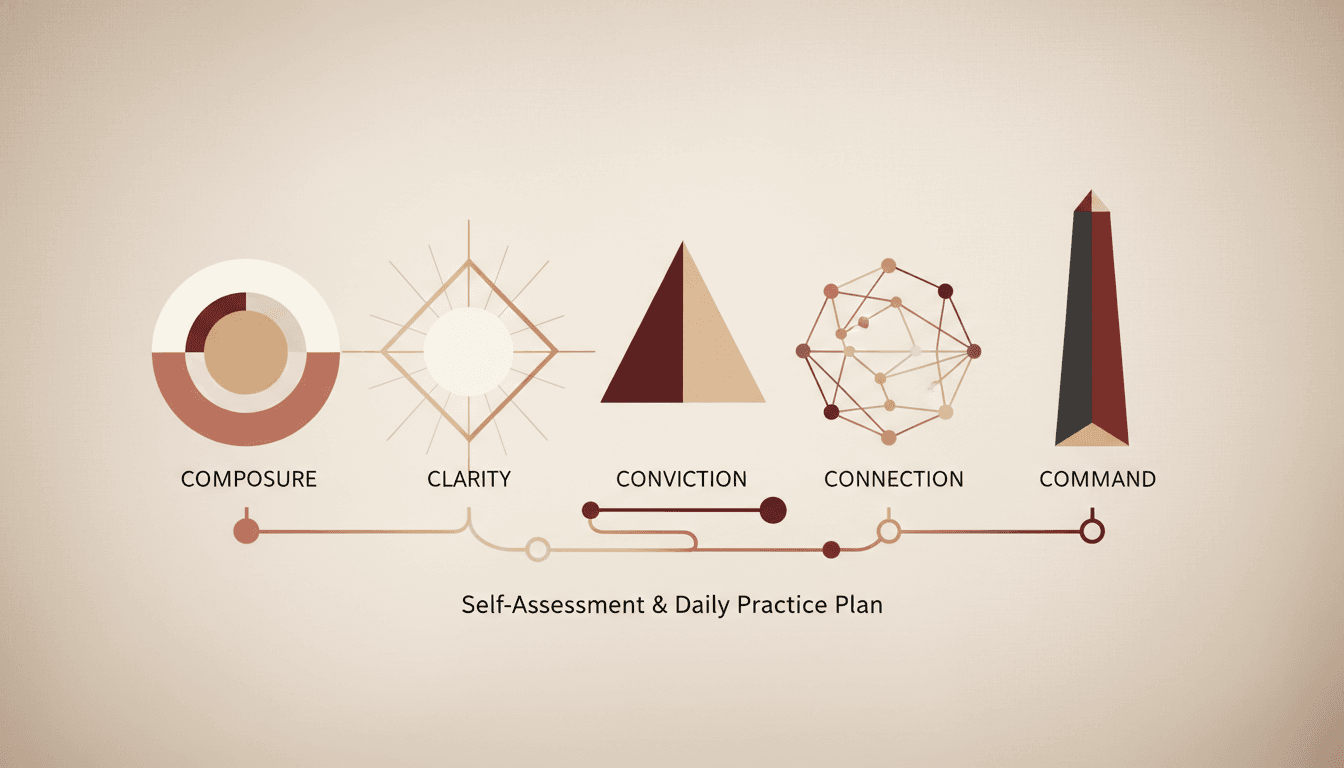
How to Develop Leadership Presence: A 5-Step Framework
To develop leadership presence, build five core dimensions: composure (staying calm under pressure), clarity (communicating with precision), conviction (speaking with certainty), connection (building trust through empathy), and command (directing attention and action). Leadership presence isn't an inborn trait—it's a set of learnable skills. By assessing yourself across these five dimensions and practicing targeted daily habits, you can transform how others perceive your authority, credibility,

Leadership Presence vs Executive Presence: Key Differences
Leadership presence and executive presence are related but distinct professional competencies. Leadership presence is the ability to inspire, influence, and connect with others at any level—regardless of title. Executive presence is a more specific set of signals—gravitas, communication polish, and appearance—that convey readiness for senior-level roles. Understanding the difference matters because developing the wrong one first can stall your career. This article breaks down both, compares them

Body Language for Leadership Presence: A Complete Guide
Body language for leadership presence is the intentional use of nonverbal cues—posture, eye contact, gestures, facial expressions, and spatial positioning—to project authority, confidence, and credibility in professional settings. Research from UCLA professor Albert Mehrabian found that up to 55% of communication impact comes from nonverbal signals. This guide gives you a complete framework for mastering the physical cues that make people listen, trust, and follow your lead in meetings, presenta