
Leadership Presence Body Language: 11 Cues That Signal Power

Leadership presence body language cues are the specific nonverbal signals—such as expansive posture, deliberate gestures, steady eye contact, controlled facial expressions, and strategic spatial positioning—that communicate authority and confidence before you say a single word. Research from Harvard Business School shows that nonverbal cues account for over 55% of how your message is perceived. The 11 cues below, backed by behavioral science, will help you project power in meetings, presentations, and one-on-one conversations.
What Is Leadership Presence Body Language?
Leadership presence body language refers to the intentional and habitual nonverbal signals that distinguish authoritative communicators from everyone else in a room. It encompasses posture, gesture patterns, eye contact, facial expressions, spatial awareness, and physical stillness—all working together to project confidence, competence, and control.
Unlike charisma, which can feel innate and personality-driven, leadership presence body language is a learnable skill set. According to a landmark study by Albert Mehrabian at UCLA, 55% of emotional communication is conveyed through body language, 38% through tone of voice, and only 7% through words. While this ratio applies specifically to emotional context, the broader insight holds: your body speaks louder than your slides. For a deeper dive into the distinction, see our guide on leadership presence vs. charisma.
The 4 Foundational Power Cues (Cues 1–4)
Cue 1: The Expansive Posture
Expansive posture means taking up space intentionally—shoulders back, chest open, arms uncrossed, feet shoulder-width apart. It is the single most studied body language cue linked to perceptions of power.
A 2017 study published in Psychological Science by researchers at the University of British Columbia found that individuals who adopted expansive postures were rated as 25% more competent and 15% more influential by observers, regardless of what they actually said. In a meeting, this looks like sitting upright with your forearms resting on the table rather than folded in your lap. When standing at a whiteboard, it means planting both feet and resisting the urge to cross your ankles.
Practice exercise: Before your next meeting, stand in a doorway with your arms extended to touch both sides for 30 seconds. This primes your body to stay open. Then carry that width into your seat.Cue 2: Deliberate Hand Gestures
Leaders don't fidget. They use purposeful hand gestures that illustrate their points and then return their hands to a neutral resting position. Research from the University of Chicago found that speakers who used illustrative gestures—such as counting on fingers, showing spatial relationships, or using open palms—were perceived as 30% more convincing than those who kept their hands still or fidgeted.
The key distinction is deliberate versus nervous movement. Tapping a pen, touching your face, or adjusting your hair signals anxiety. Steepling your fingers, using open palms when presenting an idea, or placing one hand flat on the table while making a point signals control.
Scenario: You're presenting a quarterly update to your VP. Instead of gripping a clicker with white knuckles, you rest one hand on the podium and use the other to gesture toward key data points. You pause, return your hand to rest, and continue. The VP later tells your manager you "owned the room."Cue 3: Controlled Facial Expressions
Your face is the first thing people read. Leaders maintain what researchers call "facial composure"—a neutral-to-positive baseline expression that doesn't betray every internal reaction.
This doesn't mean being a robot. It means controlling reactive expressions: the eye roll when a colleague says something uninformed, the furrowed brow when you hear bad news, the nervous smile when you're put on the spot. A study from Princeton University found that observers form trustworthiness judgments from facial expressions in as little as 100 milliseconds.
Practice exercise: Record yourself on a video call for five minutes. Watch it back with the sound off. Notice micro-expressions you weren't aware of—raised eyebrows, pursed lips, darting eyes. Awareness is the first step to control.Cue 4: Grounded Stillness
The most powerful people in any room move the least. Grounded stillness means eliminating unnecessary movement—swaying, shifting weight, rocking in your chair—and replacing it with intentional, minimal motion.
Think about the difference between a junior analyst who rocks in their chair and taps their foot under the table, and a senior director who sits motionless, leans forward slightly when interested, and leans back when listening. The stillness itself communicates: I am not anxious. I am not rushed. I am in control.
This cue is especially critical in high-stakes conversations where nervous energy can undermine your credibility before you even make your point.
The 4 Engagement Power Cues (Cues 5–8)
Cue 5: Strategic Eye Contact
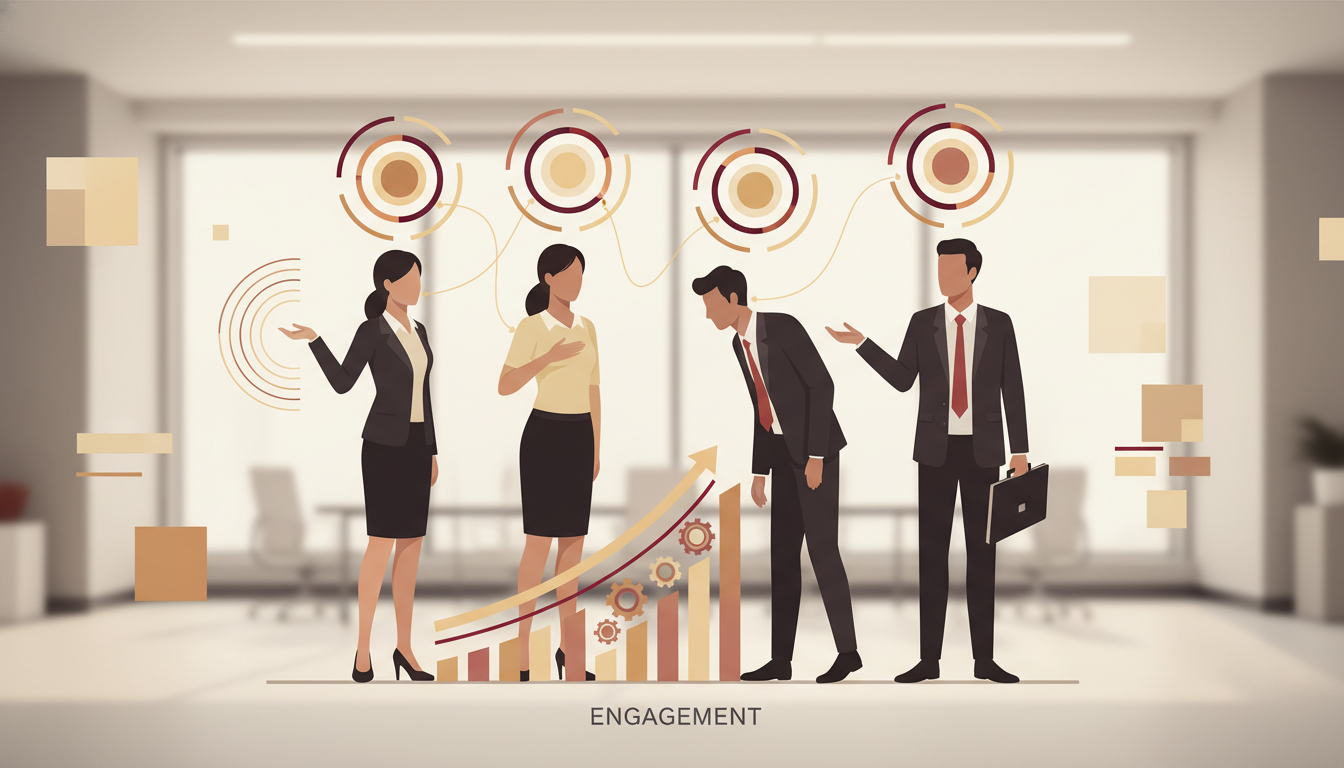
Eye contact is the currency of presence. Too little and you seem evasive or insecure. Too much and you seem aggressive or socially unaware. Leaders hit the sweet spot: sustained eye contact for 3–5 seconds per person, breaking naturally to look at notes or another participant.
A 2020 study in the Journal of Nonverbal Behavior found that speakers who maintained eye contact for 60–70% of a conversation were rated highest in credibility and warmth. Below 40%, credibility dropped sharply. Above 80%, discomfort increased.
In meetings: Make direct eye contact with the person asking you a question for the first sentence of your answer, then shift your gaze to include the broader group. This honors the questioner while demonstrating you're speaking to everyone. In presentations: Use the "lighthouse method"—sweep your gaze across the room in a slow arc, pausing on individuals for 3–5 seconds each. Avoid looking at the back wall or your slides.For more on commanding attention in group settings, see our guide on leadership presence in meetings.
Cue 6: The Purposeful Head Tilt and Nod
A slight head tilt signals active listening and engagement. A single, slow nod signals agreement and understanding. Leaders use both strategically—not as nervous habits, but as deliberate communication tools.
The critical mistake is the rapid nod. Rapid nodding communicates eagerness to please, impatience, or a desire for the other person to stop talking. A single, slow nod after someone finishes a point communicates: I heard you. I'm processing. I take this seriously.
Scenario: Your CEO is explaining a new strategic direction in a town hall. While others fidget or stare at their phones, you maintain eye contact, tilt your head slightly during the explanation, and offer one slow nod when the CEO makes a key point. After the meeting, the CEO approaches you: "You seemed to really get it." That's the power of intentional engagement cues.Cue 7: Mirroring With Intention
Mirroring—subtly matching another person's posture, gestures, or pace—is a well-documented rapport-building tool. Research from INSEAD business school found that negotiators who mirrored their counterparts reached agreements 67% of the time, compared to 12.5% for those who didn't.
The key word is subtly. Leaders don't mimic. They match energy. If your CEO leans forward with intensity, you lean forward slightly. If a direct report relaxes back in their chair during a one-on-one, you ease your posture a degree. This creates unconscious alignment without appearing performative.
This cue is particularly powerful in one-on-one meetings and negotiations where trust-building is essential.
Cue 8: The Power Pause With Physical Stillness
The power pause combines two cues: vocal silence and physical stillness. When you finish a key statement, you stop speaking and stop moving. No hand gestures, no weight shifts, no glancing at notes. You hold.
This is the nonverbal equivalent of a period at the end of a sentence. It signals that what you just said matters and that you're confident enough to let it land without filling the silence.
Practice exercise: In your next presentation, identify three key statements. After each one, pause for a full two seconds while maintaining eye contact and physical stillness. Notice how the room's attention sharpens. For more on the vocal component, explore our guide on how to pause effectively in public speaking.The 3 Spatial Authority Cues (Cues 9–11)
Cue 9: Strategic Positioning in the Room
Where you sit or stand in a room communicates power before you open your mouth. Research in environmental psychology consistently shows that people seated at the head of a table are perceived as more influential, regardless of their actual role.
But spatial authority goes beyond seating. It includes:
- Standing when others sit during a key point (signals authority)
- Moving toward the audience rather than retreating behind a podium (signals confidence)
- Positioning yourself at the visual center of a group rather than the periphery
Cue 10: Proximity and Approach Behavior
Leaders approach. They don't retreat. When a colleague raises a challenging question, a leader steps forward slightly rather than leaning back. When greeting someone, a leader closes distance with a firm handshake and squared shoulders rather than waiting to be approached.
A study published in the Journal of Experimental Social Psychology found that individuals who initiated approach behavior—stepping toward others, closing physical distance appropriately—were rated 33% higher in dominance and leadership potential.
This doesn't mean invading personal space. It means eliminating retreat behaviors: stepping back when challenged, angling your body away from the group, or positioning yourself behind furniture as a barrier.
Practice exercise: In your next three meetings, notice your instinct when someone disagrees with you. Do you lean back? Cross your arms? Look away? Practice holding your position—or leaning forward one inch—instead.Cue 11: The Territorial Claim
Territorial claiming is the use of physical objects and space to signal ownership and authority. This includes:
- Spreading materials across your section of the table rather than keeping everything in a tight stack
- Resting your arm on the back of an adjacent chair (signals comfort and ownership)
- Using a pen or hand to gesture across shared documents rather than pointing from your own space
This cue works because it communicates comfort and belonging. People who feel like outsiders compress themselves. People who feel like owners expand. The research on this is clear: a 2018 study in Organizational Behavior and Human Decision Processes found that workspace expansion behaviors were positively correlated with perceived authority, even when participants had no formal leadership role.
For a complete system on projecting authority without arrogance, pair these spatial cues with the verbal strategies in our related guide.
Turn These Cues Into Daily Habits Body language isn't about performing—it's about reprogramming your defaults. *The Credibility Code* includes a 30-day practice system that turns these 11 cues into automatic behaviors that signal leadership in every interaction. Discover The Credibility Code
How to Practice Leadership Body Language Daily
The Morning Mirror Check (2 Minutes)
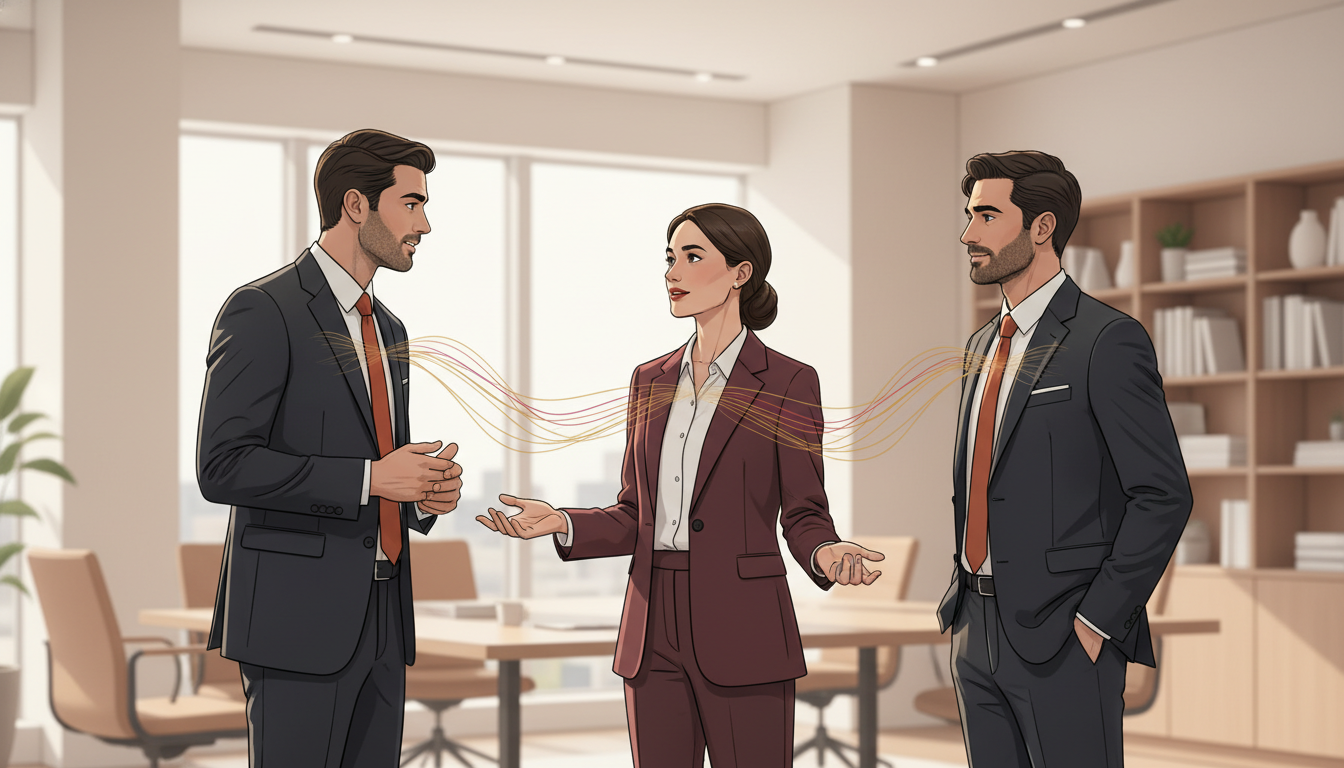
Before leaving for work, stand in front of a mirror in your work clothes. Check your default posture: Are your shoulders rounded? Is your chin tilted down? Adjust to an expansive, grounded stance. Hold it for 60 seconds. This recalibrates your body's baseline for the day.
The Meeting Audit (Post-Meeting)
After every meeting, spend 30 seconds scoring yourself on three cues: eye contact, stillness, and hand gestures. Use a simple 1–3 scale. Track your scores for two weeks. You'll see patterns—maybe your eye contact is strong but you fidget under pressure. This data tells you exactly where to focus.
The Video Review (Weekly)
Record one meeting or presentation per week (with permission). Watch it back at 2x speed with the sound off. Focus exclusively on your body language. This is the fastest feedback loop available, and it's how professional speakers and executives refine their presence. For additional daily practices, see our guide on developing a commanding presence.
Common Body Language Mistakes That Destroy Presence
The Self-Soothing Trap
Self-soothing gestures—touching your neck, rubbing your hands together, playing with jewelry—are your body's way of managing anxiety. They're also the fastest way to signal to a room that you're uncomfortable. The fix isn't to suppress them through willpower. It's to give your hands a designated "home base": steepled on the table, resting on the arms of your chair, or clasped lightly in front of you.
The Smile Default
Many professionals, particularly women in leadership, default to smiling as a social lubricant. While warmth matters, a constant smile during serious discussions undermines gravity. Match your facial expression to the content. Serious topic? Neutral face. Good news? Genuine smile. The mismatch between expression and content is what erodes credibility. For more on this, read our guide on how to communicate with gravitas.
The Retreat Under Challenge
When someone pushes back on your idea, your body's instinct is to retreat: lean back, cross arms, break eye contact. This is the single most damaging body language pattern in professional settings because it happens at the exact moment your credibility is being tested. Train yourself to hold position—or advance slightly—when challenged. It communicates that you welcome the pushback and stand behind your point.
Frequently Asked Questions
What body language signals leadership presence in meetings?
The most impactful body language signals in meetings are expansive posture (sitting upright with open shoulders), strategic eye contact (60–70% of the conversation), grounded stillness (minimal fidgeting), deliberate hand gestures, and spatial positioning (sitting at the center of the table rather than the periphery). Combined, these cues create an impression of authority and composure that reinforces everything you say verbally.
How can I improve my body language for executive presence?
Start with three daily practices: a morning posture check in the mirror, a post-meeting self-audit scoring your eye contact, stillness, and gestures on a 1–3 scale, and a weekly video review of one recorded meeting. Focus on eliminating one negative habit per week—such as fidgeting or breaking eye contact under pressure—rather than trying to change everything at once. Consistency matters more than perfection.
What is the difference between leadership presence and confident body language?
Confident body language is a component of leadership presence, but leadership presence is broader. It includes vocal authority, strategic communication, emotional composure, and the ability to influence a room. Confident body language—such as good posture and steady eye contact—is the visible layer. Leadership presence also encompasses how you structure your thoughts, respond under pressure, and make others feel. Learn more about this distinction in our complete leadership presence guide.
Can introverts develop powerful leadership body language?
Absolutely. Introverts often excel at the stillness and composure cues that signal authority because they're naturally less prone to excessive movement and rapid-fire gesturing. The key areas for introverts to develop are eye contact duration, spatial positioning (moving toward the center rather than the periphery), and approach behavior during greetings and conversations. Leadership body language is about intentional signals, not extroverted energy.
How long does it take to change body language habits?
Research on habit formation from University College London suggests an average of 66 days for a new behavior to become automatic. For body language specifically, most professionals see noticeable improvement in 2–3 weeks of daily practice and significant change within 6–8 weeks. The key is focusing on one cue at a time and using feedback tools like video review to track progress.
Does body language matter in virtual meetings?
Yes—arguably more so. In virtual meetings, the camera frame limits visible cues to your face, shoulders, and hands. This means eye contact (looking at the camera lens), facial composure, and visible hand gestures carry even more weight. A study by Zoom's research team found that participants who maintained camera-level eye contact and used visible hand gestures were rated 20% more engaging than those who looked at their screen or kept hands below frame. For a full guide, see our post on leadership presence in virtual meetings.
Build Presence People Notice Before You Say a Word
The Credibility Code gives you the specific verbal and nonverbal habits that make people treat you as the senior person in the room.
Discover The Credibility CodeRelated Articles

Body Language for Leadership Presence: A Complete Guide
Body language for leadership presence is the intentional use of nonverbal cues—posture, eye contact, gestures, facial expressions, and spatial positioning—to project authority, confidence, and credibility in professional settings. Research from UCLA professor Albert Mehrabian found that up to 55% of communication impact comes from nonverbal signals. This guide gives you a complete framework for mastering the physical cues that make people listen, trust, and follow your lead in meetings, presenta

Body Language That Conveys Authority: 12 Proven Signals
Body language that conveys authority includes expansive posture, deliberate hand gestures, sustained eye contact, controlled movement, and strategic use of space. Research from Harvard Business School shows that nonverbal cues account for over 55% of how your message is received. The 12 signals below—grouped into posture, gestures, eye contact, spatial positioning, and movement—are used by the most credible leaders to project confidence and command respect without saying a word.

Project Calm Authority Under Pressure: A Leader's Guide
To project calm authority under pressure, anchor yourself with a controlled exhale before responding, slow your speech rate by 10–15%, plant your feet or hands in a stable position, and choose deliberate language that acknowledges the situation without matching its chaos. Calm authority isn't the absence of stress—it's the visible management of it. Leaders who master this skill earn deeper trust, defuse escalations faster, and maintain decision-making clarity when it matters most.