
Leadership Presence in Meetings: 8 Habits That Command Respect

Leadership presence in meetings comes down to eight observable habits: how you enter the room, how you claim physical space, how you use silence strategically, how you speak with vocal authority, how you listen actively, how you respond to challenges, how you redirect conversations, and how you close with clarity. These aren't personality traits — they're learnable behaviors. Master them, and you shift from participant to the person everyone watches and follows.
What Is Leadership Presence in Meetings?
Leadership presence in meetings is the ability to project confidence, credibility, and authority through your verbal and nonverbal behavior in group settings. It's the combination of how you carry yourself, how you communicate, and how you make others feel — all within the high-stakes environment of a meeting room.
Unlike charisma, which can feel innate and elusive, leadership presence is a set of specific, repeatable habits. According to a study published in the Harvard Business Review, 67% of senior executives say "executive presence" accounts for roughly 26% of what it takes to get promoted — yet most professionals have never been taught what it actually looks like in practice.
Leadership presence doesn't mean dominating every conversation. It means that when you do speak, people listen. When you enter, the energy shifts. When you're challenged, you respond with composure that earns respect rather than compliance born from fear.
Habit 1: Enter With Intentional Energy
The first 7 seconds of any interaction shape how people perceive you. In meetings, those seconds start the moment you cross the threshold — not when you begin speaking.

The "Arrival Reset" Technique
Most professionals stumble into meetings mid-thought — checking their phone, shuffling papers, or sliding into their chair while apologizing for being late. This signals that the meeting (and the people in it) aren't a priority.
Instead, use what executive coaches call the "Arrival Reset." Thirty seconds before entering, pause outside the door. Take one deep breath. Set your intention: What do I want people to remember about me from this meeting? Then walk in with your shoulders back, your chin level, and your eyes making contact with at least two people before sitting down.
A study from Princeton University found that people form judgments about competence, trustworthiness, and likability within 100 milliseconds of seeing a face. Your entrance is the first data point people use to decide whether you're a leader or a bystander.
Before-and-After Example
Before: Sarah rushes in two minutes late, laptop open, muttering "Sorry, my last call ran over." She drops into the nearest empty chair, eyes on her screen. After: Sarah arrives one minute early. She stands briefly at the door, scans the room, nods to the meeting organizer, and takes a seat near the center of the table. She places her notebook open and pen ready, then makes eye contact with the person across from her and says, "Good morning."The difference isn't dramatic. It's deliberate. And people notice deliberate.
Practice Drill
For your next five meetings, set a phone alarm for two minutes before start time labeled "Reset." Use those two minutes to close your previous task, stand, breathe, and set your intention. Track how the first 60 seconds of each meeting feel compared to your old pattern.
For a deeper dive into the body language that supports this kind of entrance, read our guide on body language for leadership presence.
Habit 2: Claim Physical Space With Purpose
Where you sit, how you sit, and how much space you occupy all communicate status and confidence — often louder than your words.
Strategic Seating
Research from the University of British Columbia found that people who occupy more physical space are perceived as more powerful and confident, regardless of their actual title. In meetings, this translates to three rules:
- Sit at the center, not the edges. Corner seats and chairs against the wall signal low status. The center of the table — or a seat directly across from the decision-maker — signals engagement and authority.
- Avoid the "squeeze-in" chair. If you have to pull up an extra chair from the wall, you've already positioned yourself as an outsider. Arrive early enough to claim a real seat.
- Spread your materials. Place your notebook, pen, and a single document in front of you. This isn't about being territorial — it's about signaling that you belong at the table.
The Posture Framework: Grounded, Open, Still
Leadership presence in meetings requires a posture that communicates three things simultaneously:
- Grounded: Both feet flat on the floor. This stabilizes your body and your voice. Crossed legs or tucked feet create tension that shows up as fidgeting.
- Open: Arms uncrossed, hands visible (on the table or resting on your lap). Open posture signals confidence and receptivity. Closed posture signals defensiveness — even when you don't feel defensive.
- Still: Minimal fidgeting. No pen-clicking, hair-touching, or chair-swiveling. Research from the Journal of Nonverbal Behavior shows that stillness is one of the strongest nonverbal signals of confidence and authority. Movement bleeds perceived power.
Before-and-After Example
Before: Marcus sits in the back corner, arms crossed, leaning back with one ankle on his knee. He checks his phone under the table. After: Marcus takes a seat one chair from the center. He places both forearms on the table, hands loosely clasped. His phone is face-down beside his notebook. When someone speaks, he turns his torso — not just his head — toward them.Habit 3: Use Silence as a Power Tool
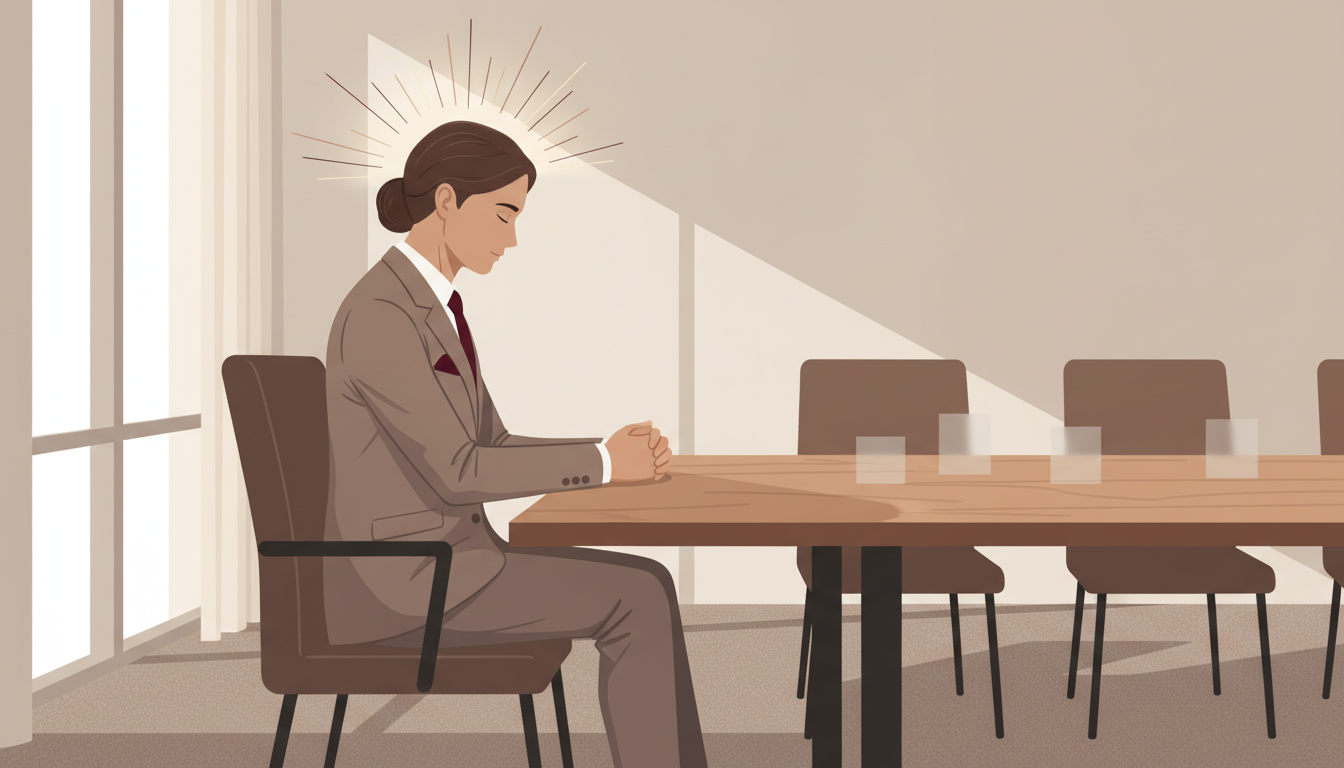
Most professionals fill silence with filler words, nervous laughter, or premature agreement. Leaders use silence the way a musician uses rests — to give weight to what comes next.
The 3-Second Rule
Before responding to any question or comment in a meeting, pause for a full three seconds. This does three things:
- It signals that you're thinking, not reacting.
- It prevents you from interrupting (a credibility killer).
- It creates anticipation, which makes your words land harder.
Three seconds feels like an eternity when you first try it. It's not. Time it on a clock — it's barely noticeable to others. What is noticeable is the composure it projects.
When to Deploy Strategic Silence
- After being asked a tough question. Pausing before you answer signals confidence. Rushing signals anxiety. For a complete framework on handling unexpected questions, see our guide on how to respond when put on the spot at work.
- After making a key point. Let it breathe. Don't dilute your statement by immediately adding qualifiers or asking "Does that make sense?"
- When someone is being aggressive. Silence in the face of aggression is disarming. It forces the other person to fill the space — often by moderating their tone.
Practice Drill
In your next meeting, count to three silently before every response. After the meeting, note how it felt versus how it was received. Most people report feeling uncomfortable but being told they seemed "thoughtful" or "composed."
If you struggle with filler words during these pauses, our article on how to stop using filler words in professional speaking offers practical replacement techniques.
Habit 4: Speak With Vocal Authority
What you say matters. How you say it determines whether anyone remembers it.
The Three Vocal Levers
According to research by Albert Mehrabian (often misquoted but still instructive), vocal tone accounts for a significant portion of how messages are received in ambiguous situations. In meetings, three vocal elements separate leaders from everyone else:
- Pace: Slow down by 10-15%. Rushed speech signals nervousness. Measured speech signals control. Aim for 140-160 words per minute in meetings — slightly slower than conversational pace.
- Pitch: End statements on a downward inflection. Upward inflections ("uptalk") turn assertions into questions. "We should move forward with Option B" sounds authoritative. "We should move forward with Option B?" sounds uncertain.
- Volume: Speak at the volume appropriate for the person farthest from you — not the person next to you. Under-projecting forces people to lean in, which might seem powerful in theory but actually signals low confidence in group settings.
The "Headline First" Speaking Pattern
Leaders in meetings don't build up to their point. They lead with it.
Low-presence version: "So I was looking at the data from last quarter, and there were some interesting trends in the customer feedback, and I think when you combine that with the sales numbers, it suggests that maybe we should consider revisiting our pricing model." High-presence version: "We need to revisit our pricing model. Last quarter's customer feedback and sales data both point to the same conclusion — our mid-tier pricing is driving customers to competitors. Here's what I recommend."The second version uses what communication coaches call the "headline first" approach. State your conclusion, then support it. This is how executives communicate, and it's a core principle we explore in our guide on how to communicate with senior executives.
Before-and-After Example
Before: David speaks quickly, his voice rising at the end of sentences. He prefaces his idea with "This might be a dumb question, but..." and trails off when he sees a colleague frown. After: David pauses, takes a breath, and says in a steady voice: "I have a recommendation." He waits one beat. "We should delay the launch by two weeks. The QA data shows three unresolved issues that will cost us more in customer churn than in timeline. I'd rather launch right than launch fast." He stops. No qualifiers. No apology.Habit 5: Listen Like a Leader
Leadership presence in meetings isn't just about how you speak — it's about how you listen. The most respected leaders in any room are often the ones who make others feel genuinely heard.
Active Listening vs. Performative Listening
Performative listening looks like nodding while mentally rehearsing your next point. Active listening looks like:
- Paraphrasing before responding: "So your concern is that the timeline doesn't account for regulatory review — is that right?"
- Asking follow-up questions that go deeper: "What would need to be true for that approach to work?"
- Referencing earlier comments: "That connects to what Priya said earlier about customer retention. I think there's a pattern here."
A study by Zenger and Folkman, published in Harvard Business Review, found that leaders rated as the best listeners were also rated as the most effective leaders overall — with a correlation of 0.74. Listening isn't passive. It's one of the most powerful authority signals in any meeting.
The "Name and Frame" Technique
When you reference someone's point by name and frame how it connects to the larger discussion, you accomplish two things: you validate the speaker (building alliance) and you position yourself as the person who sees the big picture (building authority).
Example: "James raised an important point about vendor reliability. If we combine that with the budget constraints Lisa outlined, we're really looking at a risk management question, not a procurement question. I think that reframe changes our approach."This technique works especially well for those who want to speak up in meetings as an introvert without forcing it — you don't need to generate original ideas on the spot. You need to synthesize what's already been said.
Habit 6: Respond to Challenges With Composure
Every meeting has moments of friction — a pointed question, a dismissive comment, a direct challenge to your idea. How you handle these moments defines your leadership presence more than anything else.
The "Acknowledge, Bridge, Redirect" Framework
When challenged, most people either get defensive (which looks weak) or get aggressive (which looks insecure). Leaders use a three-step response:
- Acknowledge the challenge without agreeing or dismissing: "That's a fair concern."
- Bridge to your perspective: "And here's what I've seen in the data..."
- Redirect to the shared goal: "Ultimately, we both want to minimize risk for Q3. Let me show you how this approach does that."
This framework keeps you in control without creating conflict. It's the foundation of being more assertive in meetings without being aggressive.
Before-and-After Example
Before: When a senior colleague says, "I don't think that's going to work," Anika responds with, "Oh, okay, yeah, maybe you're right. I just thought... never mind." After: Anika responds: "I appreciate the pushback — it's an important stress test. Here's what gives me confidence in this direction: we piloted a similar approach in the Southeast region last quarter and saw a 14% improvement in conversion. I'd like to run the same test here. What would you need to see to feel comfortable moving forward?"Practice Drill
Write down the three most common objections you face in meetings. For each one, script an Acknowledge-Bridge-Redirect response. Rehearse them out loud until they feel natural. The goal isn't to memorize scripts — it's to build the neural pathways so composure becomes your default response under pressure.
Turn Challenges Into Credibility Moments. The Credibility Code includes ready-to-use scripts for the 15 most common high-pressure meeting scenarios — from being interrupted to having your expertise questioned. Discover The Credibility Code
Habit 7: Redirect Conversations Strategically
Leaders don't just participate in meetings — they shape them. The ability to redirect a conversation that's gone off track, gotten stuck in details, or become unproductive is one of the clearest signals of leadership presence in meetings.
Three Redirection Phrases That Work
- When the conversation is spiraling: "Let me pull us back to the core question: [restate the meeting's objective]."
- When two people are in a side debate: "Both perspectives have merit. For the purpose of today's decision, what do we need to resolve right now?"
- When the group is stuck: "We've been circling this for ten minutes, which tells me we might be missing information. What would we need to know to move forward?"
These phrases work because they don't blame anyone. They reframe the situation as a shared problem and position you as the person with the clarity to solve it.
The "Decision Catalyst" Role
According to a Bain & Company study, companies that excel at decision-making generate returns nearly 6% higher than their peers. In meetings, the person who moves the group toward a decision — not the person who talks the most — earns the most respect.
You can claim this role by asking: "What's the decision we need to make before we leave this room?" or "Can we agree on next steps and owners before we wrap?"
This habit connects directly to how to develop gravitas at work — gravitas is often simply the willingness to say what everyone is thinking but no one is saying.
Habit 8: Close With Clarity and Ownership
How you end your participation in a meeting is the last impression people carry. Leaders close with specificity, not vagueness.
The "Summary + Ownership" Close
Before a meeting ends, offer a brief summary of what was decided and who owns what:
"Let me make sure I have this right: we're moving forward with the revised timeline, Jordan is updating the stakeholder deck by Thursday, and I'll circle back with the vendor on pricing by end of week. Anything I'm missing?"
This accomplishes three things:
- It shows you were fully engaged (listening presence).
- It creates accountability (leadership behavior).
- It positions you as the person who drives action (authority signal).
Avoid the Credibility Killers at Close
- Don't end with "Sorry, one more thing..." — it undermines everything you said before.
- Don't trail off with "So, yeah..." — close your final statement with a period, not an ellipsis.
- Don't over-apologize for taking up time. If your contribution was valuable, own it. For more on this, read how to stop over-apologizing at work and what to say instead.
Practice Drill
After your next three meetings, send a brief follow-up email within 30 minutes summarizing the key decisions and action items. This reinforces your leadership presence beyond the meeting room and builds a reputation as someone who drives results — not just discussions.
Frequently Asked Questions
How can I develop leadership presence in meetings if I'm an introvert?
Leadership presence doesn't require being the loudest voice. Introverts often excel at strategic silence, active listening, and synthesizing ideas — three of the eight habits covered above. Focus on the "Name and Frame" technique and the "Summary + Ownership" close. These let you demonstrate authority without forcing extroverted behavior. Many of the most respected leaders in business — from Bill Gates to Susan Cain — lead with quiet, deliberate presence.
What is the difference between leadership presence and executive presence?
Leadership presence refers to the ability to project confidence and authority in any professional setting, regardless of title. Executive presence is a subset that specifically describes the qualities senior leaders use to influence at the highest organizational levels — often including strategic vision and stakeholder management. In meetings, the habits are nearly identical: composure, clarity, vocal authority, and the ability to drive decisions. Both are learnable skills, not fixed traits.
How long does it take to build leadership presence in meetings?
Most professionals notice a shift within two to four weeks of deliberate practice. The key is focusing on one or two habits at a time rather than trying to overhaul everything at once. Start with the Arrival Reset and the 3-Second Rule — these are the fastest wins. Within 90 days of consistent practice, colleagues and managers typically begin commenting on the change without being told what you're working on.
Can leadership presence in meetings be learned through virtual/remote meetings?
Absolutely. While body language cues are reduced on video calls, vocal authority, strategic silence, active listening, and conversation redirection all translate directly to virtual settings. Additional virtual-specific tips include: position your camera at eye level, look into the lens (not the screen) when speaking, use a clean background, and eliminate the "you're on mute" fumble by mastering your platform's controls. The core habits remain the same — the medium is just different.
How do I project leadership presence without undermining my boss?
This is a common concern, and the answer is alignment. Leadership presence doesn't mean competing for authority — it means contributing with confidence. Use phrases like "Building on what [boss's name] said..." or "To support the direction we're heading..." This positions you as an ally, not a rival. The goal is to be seen as a leader within the team, not above it. Our guide on how to challenge your boss respectfully and be heard covers this dynamic in detail.
What is the biggest mistake that kills leadership presence in meetings?
Over-qualifying your statements. Phrases like "I'm not sure if this is right, but..." or "This might be a stupid idea..." or "I just wanted to say..." instantly undercut your credibility. According to communication research, hedging language reduces perceived competence by up to 40%. Say what you mean. If you're uncertain, say "Here's my current thinking" — not "I could be wrong, but maybe..."
Build Presence People Notice Before You Say a Word
The Credibility Code gives you the specific verbal and nonverbal habits that make people treat you as the senior person in the room.
Discover The Credibility CodeRelated Articles

Body Language for Leadership Presence: A Complete Guide
Body language for leadership presence is the intentional use of nonverbal cues—posture, eye contact, gestures, facial expressions, and spatial positioning—to project authority, confidence, and credibility in professional settings. Research from UCLA professor Albert Mehrabian found that up to 55% of communication impact comes from nonverbal signals. This guide gives you a complete framework for mastering the physical cues that make people listen, trust, and follow your lead in meetings, presenta

How to Build Presence as a Quiet Leader: 8 Moves
Building presence as a quiet leader means leveraging strategic silence, deliberate body language, and high-impact contributions to command authority without raising your volume. Instead of mimicking extroverted leadership styles, quiet leaders build credibility through preparation, precision, and composure. The eight moves below give you a repeatable system for developing commanding presence that aligns with your natural temperament — no personality overhaul required.

Leadership Presence Body Language: 11 Cues That Signal Power
Leadership presence body language cues are the specific nonverbal signals—such as expansive posture, deliberate gestures, steady eye contact, controlled facial expressions, and strategic spatial positioning—that communicate authority and confidence before you say a single word. Research from Harvard Business School shows that nonverbal cues account for over 55% of how your message is perceived. The 11 cues below, backed by behavioral science, will help you project power in meetings, presentation