
How to Develop Gravitas at Work: A Practical Guide

What Is Gravitas in the Workplace?
Gravitas is the quality that makes people stop and pay attention when you speak. It's the combination of weight, seriousness, and credibility that signals to others, "This person knows what they're talking about, and they can be trusted."
In professional settings, gravitas doesn't mean being the loudest voice in the room. It means being the most grounded. It's the ability to hold your position with calm authority, communicate with precision, and make others feel confident in your judgment—even under pressure.
According to a study published in the Harvard Business Review, 67% of senior executives identified "gravitas" as the core characteristic of executive presence, ranking it above communication skills (28%) and appearance (5%) (Hewlett, 2014). This tells us something important: the people who decide promotions and leadership opportunities are actively looking for this quality.
The Three Dimensions of Gravitas: The CCC Framework
To make gravitas practical and learnable, we can break it into three dimensions: Composure, Conviction, and Connection. Each one is distinct, each one is trainable, and together they form the foundation of genuine workplace authority.
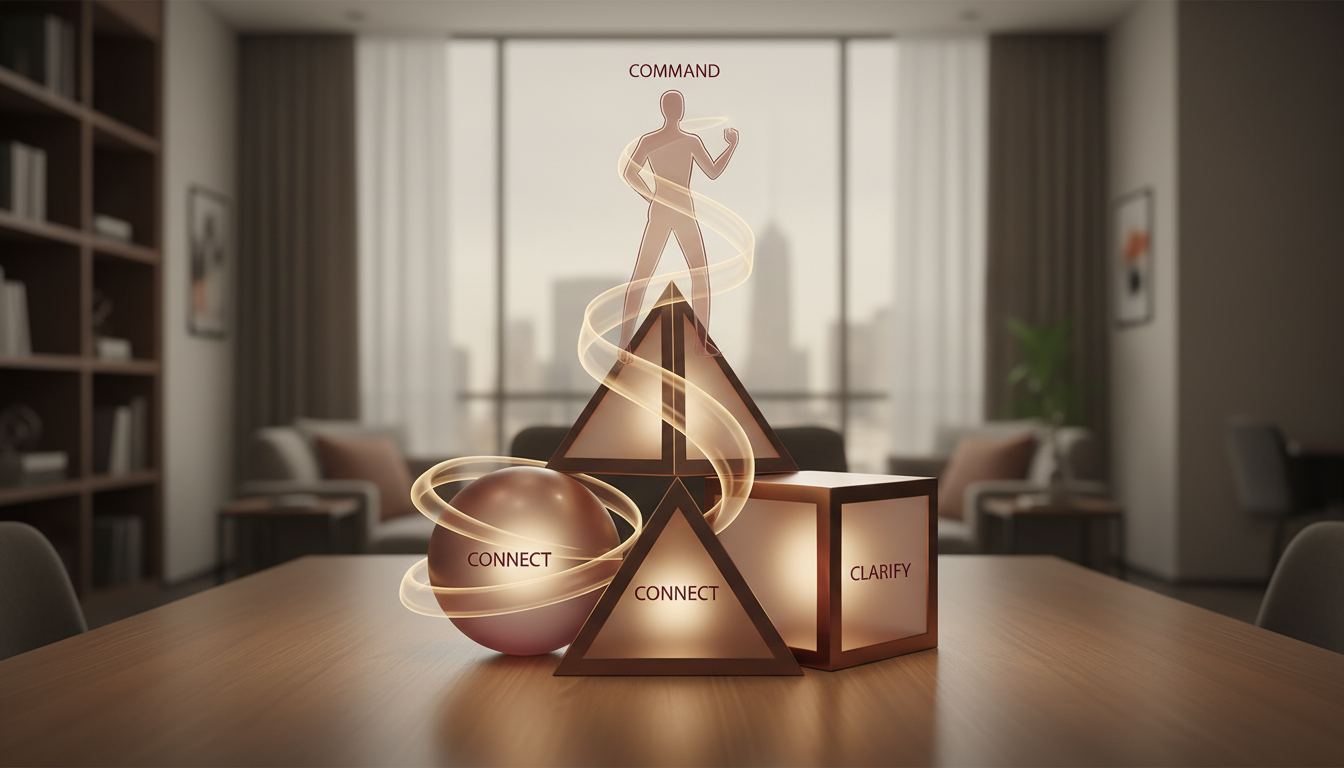
Think of these dimensions as three legs of a stool. Composure without conviction makes you seem passive. Conviction without connection makes you seem arrogant. Connection without composure makes you seem eager to please. You need all three.
Why Most Advice on Gravitas Fails
Most articles on gravitas offer vague suggestions like "be more confident" or "project authority." That's like telling someone to "be funnier" without teaching them timing, structure, or delivery. The CCC Framework gives you specific behaviors to practice in each dimension, so you can measure your progress and adjust your approach.
How the CCC Framework Works in Practice
Here's a quick overview before we dive deep into each dimension:
- Composure: How you regulate yourself under pressure—your emotional steadiness, body language, and vocal control.
- Conviction: How you communicate your ideas—your clarity, decisiveness, and willingness to take a stand.
- Connection: How you engage with others—your listening quality, empathy, and ability to build trust.
In the sections that follow, we'll break each dimension into specific, daily practices you can start using immediately.
Dimension 1: Composure — The Foundation of Gravitas
Composure is what people notice first. Before they process your words, they read your energy. A leader who stays calm when a project derails, who doesn't rush to fill silence, who maintains steady eye contact during a tough question—that leader radiates gravitas.
Research from the Center for Creative Leadership found that leaders rated highest in "executive presence" consistently demonstrated emotional regulation as their strongest trait, outperforming peers in 360-degree assessments by 25% on composure-related behaviors (Ruderman & Ohlott, 2004).
Practice 1: The Strategic Pause
When someone asks you a challenging question in a meeting, resist the urge to respond immediately. Instead, pause for two to three seconds. Take a breath. Then respond.
Here's what this looks like in practice: Your VP asks, "Why are we behind on the Q3 deliverables?" Instead of launching into a defensive explanation, you pause, nod slightly, and say, "There are two factors driving the delay. Let me walk you through both." That pause signals control. It tells the room you're thinking, not reacting.If you struggle with being put on the spot at work, the strategic pause is your most powerful first tool.
Practice 2: Grounding Your Body Language
Composure isn't just mental—it's physical. People with gravitas tend to take up appropriate space, move deliberately, and avoid fidgeting. Here are three body language shifts to practice daily:
- Plant your feet. Whether standing or sitting, keep both feet flat on the floor. This creates a physical sense of stability that translates into how others perceive you.
- Slow your gestures. Quick, jerky movements signal nervousness. Deliberate, measured gestures signal control.
- Hold eye contact for a full thought. Don't dart your eyes around the room. When making a point, hold eye contact with one person for the duration of a complete sentence.
For a deeper dive into physical presence, explore our complete guide to body language for leadership presence.
Practice 3: Vocal Steadiness Under Pressure
Your voice reveals your emotional state faster than anything else. When you're anxious, your pitch rises, your pace quickens, and your volume drops. Composure requires you to manage these tendencies.
Daily drill: Before your next meeting, spend 60 seconds doing box breathing (inhale for 4 counts, hold for 4, exhale for 4, hold for 4). Then read a paragraph aloud at a pace that feels uncomfortably slow. This recalibrates your baseline so that when pressure hits, your "fast" is everyone else's "normal." For more on this, see our guide on how to sound more authoritative through vocal shifts.Dimension 2: Conviction — Speaking With Weight
Conviction is the substance behind composure. It's the difference between someone who looks calm and someone who is calm because they know exactly where they stand. Professionals with conviction communicate with clarity, take positions, and back them with evidence.
A 2023 survey by Korn Ferry found that 71% of hiring managers rated "ability to articulate a clear point of view" as a top-three trait when evaluating candidates for senior leadership roles. Gravitas without conviction is just a performance. Conviction is what makes it real.
Practice 1: Lead With Your Conclusion
Most professionals bury their main point under layers of context, caveats, and qualifiers. This weakens every message you deliver. People with gravitas do the opposite—they lead with the conclusion, then provide supporting evidence.
Example: Instead of saying, "So I've been looking at the data, and there are a few things to consider, and I think maybe we should think about shifting our approach…" say this: "We should shift our approach to the Eastern region. Here's why."This structure—conclusion first, evidence second—is the hallmark of executive communication. It signals that you've done the thinking and you're ready to lead.
Practice 2: Eliminate Hedging Language
Hedging language erodes conviction sentence by sentence. Words and phrases like "I think," "sort of," "maybe," "I'm not sure but," and "does that make sense?" all signal uncertainty.
Replace hedging with precision:| Instead of… | Say… |
|---|---|
| "I sort of think we should…" | "My recommendation is…" |
| "Maybe we could try…" | "The approach I'd propose is…" |
| "Does that make sense?" | "Here's what I'd like your input on." |
| "I'm not an expert, but…" | "Based on my analysis…" |
This doesn't mean being rigid or dismissive. It means using power language that communicates your ideas with the weight they deserve. You can still invite input—but from a position of clarity, not apology.
Practice 3: Take a Position (Even When It's Uncomfortable)
Gravitas requires intellectual courage. In meetings, this means being willing to share your perspective—especially when it differs from the consensus. People notice when you consistently defer or stay silent on important issues. They also notice when you speak up thoughtfully.
The 3-Part Position Framework:- State your position: "I see this differently."
- Provide your reasoning: "The customer data from Q2 suggests that retention, not acquisition, should be our priority."
- Invite dialogue: "I'd like to hear how others see this."
This framework lets you disagree professionally without burning bridges while still demonstrating the kind of conviction that builds gravitas over time.
Dimension 3: Connection — The Human Side of Gravitas
Connection is the most overlooked dimension of gravitas. Many professionals assume that gravitas means being stoic or distant. In reality, the leaders with the most gravitas are deeply attuned to the people around them. They listen intently, acknowledge others' contributions, and create psychological safety.

A landmark study by Google's Project Aristotle found that psychological safety—the belief that you can take risks without being punished—was the single most important factor in high-performing teams (Duhigg, 2016, The New York Times). Leaders who create that safety through genuine connection don't just have gravitas—they have influence.
Practice 1: Listen to Understand, Not to Respond
Most people listen with half their attention, mentally preparing their response while the other person is still talking. Gravitas-level listening means you fully absorb what someone is saying before you formulate your reply.
The 3-second rule: After someone finishes speaking, wait three seconds before responding. During those three seconds, ask yourself: "What is this person really saying?" This tiny delay transforms your responses from reactive to thoughtful—and people feel the difference immediately.Practice 2: Acknowledge Before You Redirect
When you disagree with someone or need to redirect a conversation, start by acknowledging their contribution. This isn't flattery—it's respect. And respect builds the kind of trust that amplifies your gravitas.
Example: A colleague proposes a marketing strategy you think is flawed. Instead of jumping to your objection, say: "I appreciate the thinking behind this, especially the focus on brand awareness. I'd like to build on that by looking at it from a different angle." This approach is especially valuable when communicating with difficult stakeholders.Practice 3: Be Consistent Across Contexts
True connection—and true gravitas—means showing up the same way whether you're talking to the CEO or the intern. People with gravitas don't adjust their respect level based on someone's title. They treat everyone with the same thoughtful attention.
This consistency is what builds your professional reputation over time. People talk. When your team sees you treat the junior analyst with the same composure and respect you show the board, your gravitas multiplies.
Daily Practices to Build Gravitas Over Time
Gravitas isn't developed in a single workshop or after reading one article. It's built through consistent, daily practice. Here's a practical weekly routine to strengthen each dimension of the CCC Framework.
The Gravitas Morning Check-In (2 Minutes)
Before your first meeting or interaction each day, ask yourself three questions:
- Composure: What's my energy right now? Do I need to slow down, breathe, or center myself?
- Conviction: What's the one most important point I need to communicate today? Am I clear on my position?
- Connection: Who do I need to genuinely listen to today? Where can I show respect or acknowledgment?
This two-minute practice creates intentionality. Over weeks, it rewires how you show up.
The Weekly Gravitas Audit
At the end of each week, reflect on these questions:
- Where did I lose composure this week? What triggered it, and how could I respond differently next time?
- Where did I hedge or defer when I should have taken a clear position?
- Where did I fail to truly listen or connect with someone?
Write down one specific behavior to improve the following week. This kind of deliberate practice is what separates professionals who talk about developing gravitas from those who actually do it.
Building Gravitas in Written Communication
Gravitas isn't limited to in-person interactions. Your emails, Slack messages, and written reports also signal your level of authority. Professionals who write with clarity, brevity, and confidence extend their gravitas into every channel.
If your written communication doesn't match your in-person presence, you're undermining your own credibility. Learn how to write like an executive to ensure your gravitas carries across every medium.
Build Authority in Every Interaction Whether you're presenting to the C-suite, writing a critical email, or navigating a tough negotiation, The Credibility Code equips you with the tools to lead with gravitas. Discover The Credibility Code
Common Gravitas Mistakes (and How to Avoid Them)
Even well-intentioned professionals make mistakes that undermine their gravitas. Here are the most common ones—and what to do instead.
Mistake 1: Confusing Gravitas With Intimidation
Gravitas is not about making people uncomfortable. If colleagues describe you as "intense" or "unapproachable," you've crossed the line from authority into intimidation. True gravitas makes people feel safe and confident in your leadership—not afraid of it. The goal is to be assertive without being aggressive.
Mistake 2: Over-Apologizing
Excessive apologizing is one of the fastest ways to erode gravitas. Saying "sorry" when you haven't done anything wrong signals deference, not respect. If you catch yourself doing this, our guide on how to stop over-apologizing at work offers concrete replacement phrases.
Mistake 3: Performing Confidence Instead of Building It
Some professionals try to fake gravitas by adopting a deep voice, using big words, or dominating conversations. This backfires quickly. People sense inauthenticity. Real gravitas comes from the inside out—from genuine composure, real conviction, and authentic connection. If you're struggling with the internal side, start with our guide on overcoming imposter syndrome.
Frequently Asked Questions
What is gravitas, and why does it matter at work?
Gravitas is the quality of being taken seriously—a combination of composure, conviction, and connection that makes others trust your judgment and follow your lead. It matters because research consistently shows it's the top factor in executive presence assessments. Without gravitas, even technically brilliant professionals get overlooked for leadership roles and high-visibility opportunities.
How long does it take to develop gravitas?
Most professionals notice meaningful changes within 4–8 weeks of consistent practice. Gravitas isn't a switch you flip—it's a set of habits you build. Start with one dimension of the CCC Framework (composure, conviction, or connection), practice daily, and expand from there. The key is consistency, not intensity.
Gravitas vs. executive presence: What's the difference?
Executive presence is the broader package—how you look, communicate, and carry yourself as a leader. Gravitas is the core component of executive presence, focused specifically on the weight and credibility of your character and communication. Think of executive presence as the house and gravitas as the foundation. You can learn more in our deep dive on gravitas in leadership.
Can introverts develop gravitas?
Absolutely. Introverts often have natural advantages in gravitas because they tend to listen deeply, think before speaking, and avoid dominating conversations—all qualities associated with composure and connection. The area most introverts need to develop is conviction: speaking up more often and sharing their perspective with confidence. Our guide on how to speak up in meetings as an introvert is a great starting point.
How do I develop gravitas as a woman in the workplace?
Women face unique challenges in developing gravitas because of double standards around assertiveness and authority. The key is to focus on the CCC Framework without trying to mimic traditionally masculine communication styles. Speak with conviction using your natural voice, maintain composure under scrutiny, and build connection through authentic engagement. For tailored strategies, explore our guide on leadership presence for women.
What are quick wins for building gravitas immediately?
Three immediate changes that signal gravitas: (1) Eliminate filler words like "um," "like," and "just" from your speech. (2) Pause for two seconds before answering any question. (3) Lead with your conclusion in every email and verbal update. These small shifts create a noticeable difference in how others perceive your authority within days.
Build Presence People Notice Before You Say a Word
The Credibility Code gives you the specific verbal and nonverbal habits that make people treat you as the senior person in the room.
Discover The Credibility CodeRelated Articles

How to Develop Professional Presence: 7 Pillars
Professional presence is the ability to project confidence, credibility, and composure in every professional interaction—and it's entirely learnable. To develop professional presence, you need to master seven interconnected pillars: vocal authority, body language, strategic brevity, composure under pressure, appearance alignment, listening power, and decisive language. Each pillar can be strengthened through deliberate daily practice, and together they create the commanding presence that separat

How to Develop Gravitas as a Leader: The Complete Method
Developing gravitas as a leader requires deliberate work across three dimensions: confidence (how you carry yourself), composure (how you respond under pressure), and substance (the depth behind your words). It is not an innate trait reserved for a few. You build gravitas by mastering structured thinking, controlling your emotional reactions, training your vocal delivery, and consistently demonstrating expertise. This article provides a complete, step-by-step method — including daily exercises,

How to Communicate With Gravitas at Work: 7 Pillars
To communicate with gravitas at work, master seven interconnected pillars: composure under pressure, economy of language, conviction in delivery, emotional regulation, strategic thinking signals, commanding physical presence, and moral authority. Gravitas isn't about being the loudest person in the room—it's about being the most grounded. When you speak with gravitas, people stop multitasking and listen. These seven pillars give you a repeatable framework to build that weight into every conversa