
How to Stop Over-Apologizing at Work (And What to Say Instead)
What Is Over-Apologizing at Work?
Over-apologizing at work is the habit of saying "sorry" in professional situations where no genuine apology is needed. It includes apologizing for asking questions, sharing opinions, taking up space in meetings, or responding to emails at a normal pace.
This pattern goes beyond politeness. It's a verbal tic that signals uncertainty, low status, and a lack of confidence — even when none of those things are true. According to research published in the journal Psychological Science, people who apologize excessively are often perceived as less competent by colleagues, regardless of their actual performance.
Over-apologizing is different from genuine accountability. A real apology — owning a mistake, expressing empathy, and committing to change — is a leadership strength. But reflexive, unnecessary apologies erode your professional credibility one "sorry" at a time.
Why Professionals Over-Apologize (And Why It's So Hard to Stop)
The Psychology Behind Reflexive Apologies

Over-apologizing is rarely a conscious choice. It's a deeply ingrained communication habit, often rooted in childhood conditioning, cultural norms, or workplace environments that punish assertiveness. A 2010 study by researchers Karina Schumann and Michael Ross at the University of Waterloo found that people who apologize frequently have a lower threshold for what they perceive as offensive behavior — meaning they genuinely believe they've done something wrong, even when they haven't.
This creates a cycle. You apologize reflexively, which reinforces the belief that you needed to apologize, which makes you more likely to apologize next time. Breaking this cycle requires both awareness and deliberate language replacement.
Gendered Expectations and Workplace Culture
Research consistently shows that women apologize more frequently than men in professional settings. A study published in Psychological Science found that this isn't because women are more willing to apologize — it's because women report committing more offenses, suggesting a lower threshold for what warrants an apology.
But workplace culture plays a role for everyone. In organizations that value hierarchy and deference, over-apologizing can become a survival strategy. If you've been in environments where speaking up was punished, "sorry" becomes a shield. Understanding this context is the first step toward changing the pattern. For a deeper exploration of assertive communication in complex workplace dynamics, see our guide on how to be assertive at work without being aggressive.
The Credibility Cost You Don't See
Here's what most people miss: the damage from over-apologizing is cumulative. One "sorry" in a meeting won't tank your career. But dozens of unnecessary apologies each week create a persistent impression of self-doubt. A 2019 survey by language analytics firm Textio found that professionals who used hedging and apologetic language in workplace communications were 32% less likely to be rated as "leadership material" in performance reviews.
Your colleagues and managers are forming impressions of your competence in real time. Every unnecessary apology is a small withdrawal from your credibility account.
The 5 Most Common Over-Apologizing Patterns at Work
Pattern 1: The Email Opener ("Sorry for the Late Reply")
This is the most widespread pattern. You respond to an email after a few hours — or even a day — and lead with an apology. The problem? You're apologizing for having a workload, priorities, and boundaries. It immediately frames your response as a failure rather than a contribution.
Replace with: "Thanks for your patience" or simply dive into your response. If the delay was genuinely problematic, acknowledge it once and move on: "I wanted to give this the attention it deserves."Pattern 2: The Meeting Interjection ("Sorry, Can I Just Say Something?")
Apologizing before sharing an idea in a meeting tells everyone in the room that your contribution is an interruption, not a value-add. According to a 2022 study by Catalyst, professionals who prefaced contributions with apologies were rated as 25% less influential by meeting participants compared to those who stated their points directly.
Replace with: "I'd like to add something here" or "Building on that point..." If you struggle with speaking up in meetings, the issue isn't your ideas — it's the framing.Pattern 3: The Disagreement Softener ("Sorry, But I See It Differently")
Apologizing before a disagreement doesn't make you polite. It makes your position sound weak before you've even stated it. You're essentially telling the other person, "I feel bad for having a different perspective," which undermines the very point you're about to make.
Replace with: "I see it differently" or "I'd like to offer another perspective." For more on navigating professional disagreements with confidence, see our guide on how to disagree professionally without burning bridges.Pattern 4: The Question Apology ("Sorry, This Might Be a Dumb Question")
Apologizing before asking a question signals that you believe your curiosity is a burden. In reality, asking clear, direct questions is a hallmark of leadership. The most senior executives in any organization ask the most questions — they just don't apologize for them.
Replace with: "I want to make sure I understand..." or "Can you clarify..." or simply ask the question directly.Pattern 5: The Boundary Apology ("Sorry, I Can't Take That On")
This pattern is especially damaging because it undermines your ability to set professional boundaries. When you apologize for having limits, you invite people to push past them. You're essentially saying, "I know I should be doing this, and I feel guilty that I'm not."
Replace with: "My plate is full this week — let's discuss priorities" or "I'm not able to take that on right now. Here's what I can do instead." For scripts on negotiating deadlines professionally, we've got you covered.Know exactly what to say next time. The Pushback Playbook has 50 word-for-word scripts for moments like this one: what they say, what you say, why it works, and what to do if they push back. Get The Pushback Playbook — $27
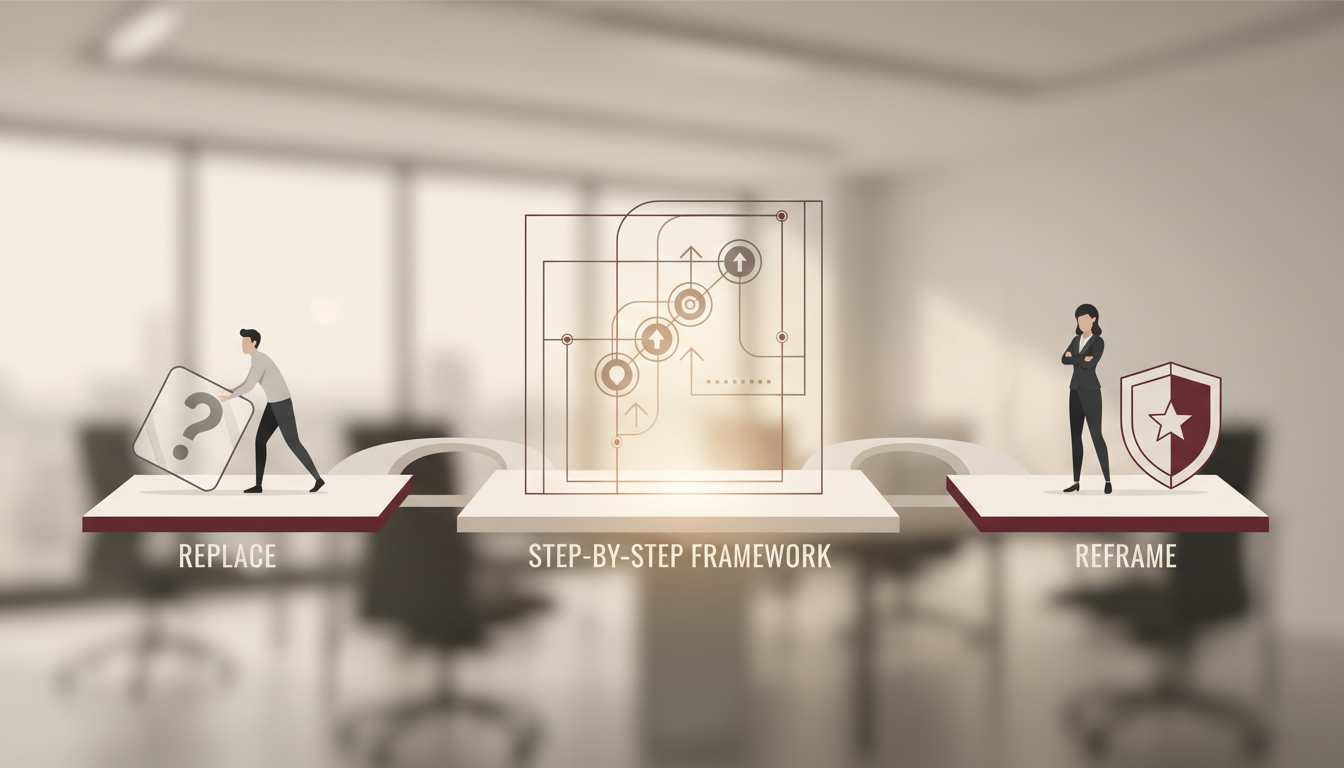
The Replace-and-Reframe Method: A Step-by-Step Framework
Knowing you should stop apologizing isn't enough. You need a repeatable system. Here's a four-step method you can start using today.
Step 1: Audit Your Apology Triggers
For one full workday, track every time you say or type "sorry," "apologies," or any apologetic phrase. Don't try to change anything yet — just observe. Most people are shocked to discover they apologize 15-20 times per day in professional settings.
Write down each instance and categorize it:
- Legitimate apology (you made a genuine mistake)
- Social lubricant (you're using "sorry" as filler)
- Self-diminishing (you're apologizing for existing, having needs, or taking up space)
Most professionals find that 70-80% of their apologies fall into the last two categories.
Step 2: Build Your Replacement Phrase Bank
For each trigger you identified, write a specific replacement phrase. Don't rely on willpower in the moment — have the alternatives ready. Here are proven swaps:
| Instead of... | Say... |
|---|---|
| "Sorry for bothering you" | "Do you have a moment?" |
| "Sorry, I'm confused" | "I'd like some clarification on..." |
| "Sorry for the mistake" | "Thank you for catching that — here's the correction" |
| "Sorry, I disagree" | "I have a different perspective" |
| "Sorry I'm late" | "Thank you for waiting" |
| "Sorry to ask" | "I have a question" |
The key principle: replace apology with gratitude or direct statement. This reframes the interaction from deficit (you did something wrong) to contribution (you're adding value).
Step 3: Practice the 3-Second Pause
When you feel the urge to apologize, pause for three seconds before speaking. This brief pause serves two purposes: it interrupts the automatic apology, and it gives you time to choose your replacement phrase. Research from Columbia University's neuroscience department shows that a brief pause before speaking activates the prefrontal cortex — the brain region responsible for deliberate decision-making — overriding habitual responses.
This pause also makes you sound more authoritative when you speak. Leaders don't rush to fill silence. They speak with intention.
Step 4: Reframe Your Internal Narrative
The deepest over-apologizing patterns are driven by beliefs, not just habits. If you fundamentally believe that your ideas are an imposition, no amount of phrase-swapping will fix the problem long-term.
Start challenging these beliefs directly:
- "My perspective adds value to this conversation."
- "Setting boundaries is a sign of professional maturity."
- "Asking questions demonstrates engagement, not ignorance."
This internal work is what separates a temporary fix from a permanent transformation. If imposter syndrome is fueling your apologetic patterns, our guide on overcoming imposter syndrome at work goes much deeper.
What to Do When a Real Apology Is Needed
The Anatomy of a Credible Apology
Eliminating over-apologizing doesn't mean never apologizing. A genuine, well-delivered apology is one of the most powerful leadership tools available. The difference is intentionality.
A credible professional apology has three components:
- Acknowledgment — Name the specific mistake. ("I missed the deadline on the Henderson report.")
- Impact — Show you understand the consequence. ("I know that put pressure on your team's timeline.")
- Action — State what you'll do differently. ("I've restructured my workflow to prevent this going forward.")
Notice what's missing: groveling, excessive self-blame, and repeated apologies. One clear, direct apology is far more powerful than five scattered "sorry"s.
Knowing the Difference: Accountability vs. Self-Diminishment
A simple test: Did your action cause a specific, identifiable negative impact on another person? If yes, apologize — once, clearly, and with a commitment to change. If no, you don't need an apology. You need a confident statement.
This distinction is the foundation of assertive communication at work. Accountability builds credibility. Self-diminishment destroys it.
Building Long-Term Confidence in Your Communication
Track Your Progress Weekly
Change doesn't happen overnight. Set a weekly check-in where you review your communication patterns. Ask yourself: How many unnecessary apologies did I catch this week? How many did I successfully replace? What situations still trigger reflexive apologizing?
A 2021 study in the Journal of Applied Psychology found that professionals who tracked their communication habits for 30 days showed a 40% reduction in self-undermining language patterns, with gains sustained at the six-month follow-up.
Enlist an Accountability Partner
Tell a trusted colleague about your goal. Ask them to give you a subtle signal — a look, a tap on the table — when they hear you apologize unnecessarily. External feedback accelerates habit change because it catches the apologies you don't even notice.
Expand Beyond Apologies
Over-apologizing is usually just one symptom of a broader pattern of self-undermining language. Once you've addressed the "sorry" habit, look for other credibility killers: filler words, upspeak, hedging phrases like "I just think" or "I'm no expert, but..." Our guide on power language at work covers the full spectrum of language upgrades that build authority.
Frequently Asked Questions
How long does it take to stop over-apologizing at work?
Most professionals see significant improvement within 2-4 weeks of deliberate practice. The key is consistent tracking and replacement. Research suggests it takes an average of 66 days to form a new habit (according to a study published in the European Journal of Social Psychology), but you'll notice credibility gains much sooner as colleagues respond to your more confident language.
Is it unprofessional to never apologize at work?
Not at all — but that's not the goal. The goal is to reserve apologies for situations where you've genuinely caused harm or made a mistake. Strategic, intentional apologies actually carry more weight because they're rare. Eliminating reflexive, unnecessary apologies makes your real apologies far more credible and impactful.
Over-apologizing vs. being polite: What's the difference?
Politeness is about respect — acknowledging others, expressing gratitude, and communicating with consideration. Over-apologizing is about self-diminishment — signaling that your presence, ideas, or needs are a burden. You can be deeply polite without ever saying "sorry" unnecessarily. Phrases like "Thank you for your time" and "I appreciate your flexibility" convey warmth and respect without undermining your authority.
Why do women apologize more than men at work?
Research from the University of Waterloo shows that women don't apologize more because they're more willing to — they apologize more because they perceive more situations as requiring an apology. This is driven by societal conditioning, not a lack of confidence. Awareness of this pattern is the first step toward change. For targeted strategies, see our guide on leadership presence for women.
What if my boss expects me to be apologetic and deferential?
This is a common concern, especially in hierarchical organizations. The key is to replace apologies with respect signals that don't undermine you. Instead of "Sorry to bother you," try "I'd value your input on this." You're still showing deference to their role — you're just not diminishing yourself in the process. If navigating a difficult manager is a challenge, our guide on communicating with difficult stakeholders offers specific scripts.
Can over-apologizing affect my chances of getting promoted?
Yes. The Textio research cited earlier found that apologetic language in workplace communications correlated with lower leadership ratings. Promotion decisions are influenced by perceived confidence and executive presence. When you consistently communicate without unnecessary apologies, you signal readiness for greater responsibility — which is exactly what decision-makers look for.
Never Be Caught Without the Right Words Again
50 word-for-word scripts for being talked down to, interrupted, dismissed, and put on the spot at work, plus five worksheets. PDF, 50 pages.
Get The Pushback Playbook — $27Related Articles

How to Rebuild Confidence After Being Micromanaged
Rebuilding confidence after being micromanaged starts with recognizing that the damage is real — and reversible. Prolonged micromanagement erodes your trust in your own judgment, makes you second-guess routine decisions, and shrinks your professional voice. Recovery requires a deliberate process: separating your manager's controlling behavior from your actual competence, reclaiming small decisions daily, rebuilding your internal authority, and learning to communicate boundaries so it never happe

How to Handle Being Talked Down to at Work Professionally
To handle being talked down to at work, stay calm and address the behavior directly using neutral, assertive language. Name the specific behavior without attacking the person by saying something like, "I'd appreciate it if we could discuss this as equals—I have relevant expertise here." Set clear boundaries, document patterns of condescension, and escalate to HR if the behavior continues. The goal is to protect your credibility and professional standing without matching their tone or becoming re

How to Handle Being Interrupted in Meetings Professionally
When you're interrupted in a meeting, pause briefly, maintain open body language, and use a calm redirect phrase such as "I'd like to finish my point" or "Let me complete this thought." The key is responding without escalating—combining assertive language with composed delivery signals confidence and commands respect. Chronic interrupters can be managed through proactive strategies like pre-framing your contributions, building alliances, and addressing the pattern directly in private.