
Assertive Communication at Work: Scripts & Frameworks
What Is Assertive Communication in the Workplace?
Assertive communication in the workplace is a style of professional interaction where you state your thoughts, feelings, and needs directly, honestly, and respectfully. It means standing behind your position without bulldozing others or shrinking from the conversation.
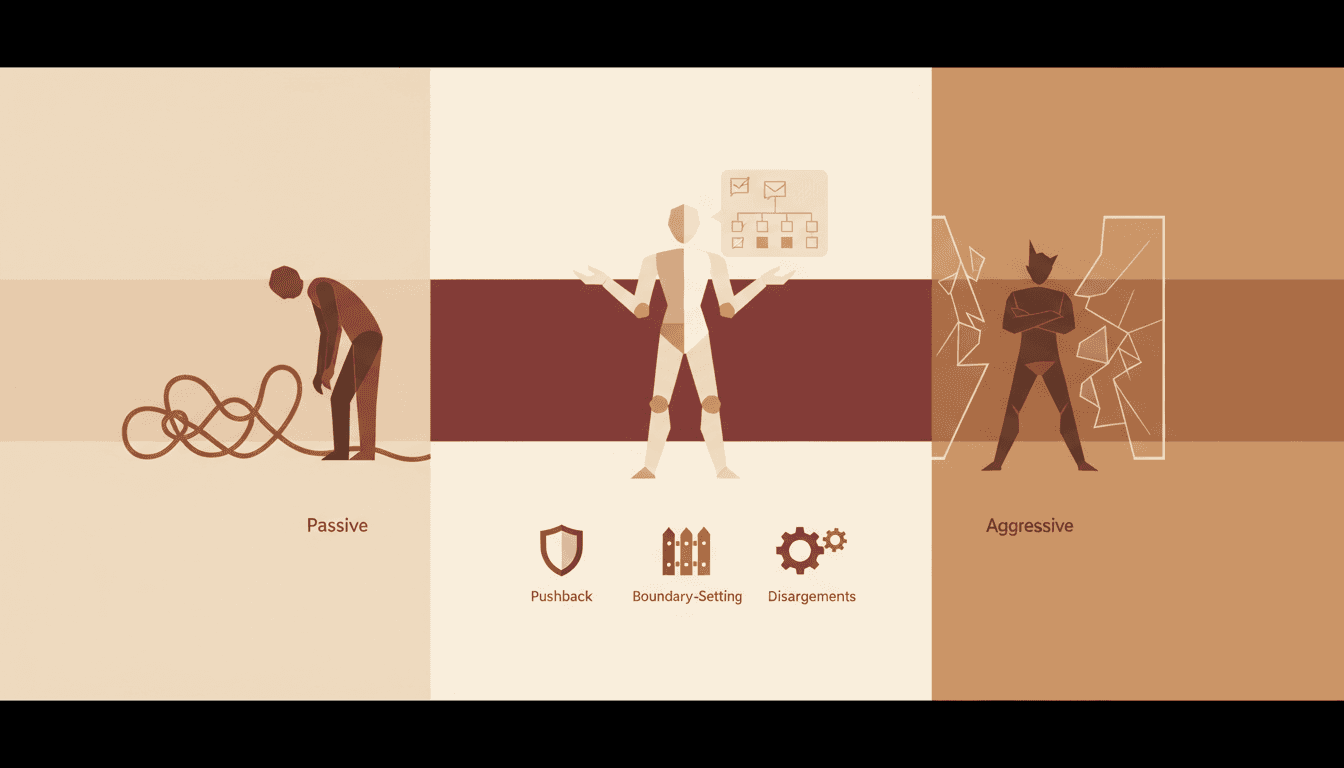
Unlike passive communication (where you defer to everyone) or aggressive communication (where you dominate), assertive communication balances self-advocacy with empathy. It is the communication style most strongly linked to leadership effectiveness, team trust, and career advancement.
Think of it as speaking with a backbone and a heart. You say what needs to be said, and you say it in a way that maintains the relationship.
The Communication Spectrum: Passive, Assertive, and Aggressive
Before you can practice assertive communication in the workplace, you need to recognize where you currently fall on the spectrum. Most professionals swing between passive and aggressive without realizing there's a powerful middle ground.

Passive Communication: The Cost of Staying Quiet
Passive communicators avoid conflict at all costs. They say "It's fine" when it isn't, agree to unreasonable deadlines, and let others take credit for their work. The short-term payoff is avoiding discomfort. The long-term cost is resentment, burnout, and invisibility.
A 2023 study published in the Journal of Occupational Health Psychology found that employees who consistently used passive communication styles reported 32% higher rates of workplace burnout compared to their assertive peers. Staying quiet doesn't keep the peace — it erodes it, starting with yours.
Signs you're being passive:- You apologize before stating an opinion ("Sorry, but maybe we could…")
- You agree to tasks you don't have capacity for
- You avoid eye contact or speak in a low, uncertain voice
- You feel frustrated after meetings because you didn't say what you meant
Aggressive Communication: Authority Without Respect
Aggressive communicators get their point across — but at a cost. They interrupt, dismiss, use sarcasm, or steamroll objections. They may get short-term compliance, but they destroy trust and psychological safety.
According to research from the Center for Creative Leadership, 38% of new leaders fail within their first 18 months, and a leading cause is an inability to build relationships — often rooted in overly aggressive or controlling communication patterns.
Signs you're being aggressive:- You interrupt or talk over colleagues
- You use "you always" or "you never" language
- You raise your voice or use a condescending tone
- People seem tense, guarded, or avoidant around you
Assertive Communication: The Authority Sweet Spot
Assertive communication is direct without being harsh. It's confident without being arrogant. You own your perspective ("I see it differently") rather than attacking the other person ("You're wrong") or abandoning your position ("Never mind, your idea is fine").
This is the style that builds what we call credibility in communication — the kind of presence that makes people listen, trust, and follow.
Signs you're being assertive:- You use "I" statements grounded in facts
- You maintain steady eye contact and calm body language
- You can say "no" without guilt or over-explaining
- You invite dialogue after stating your position
The DEAR Framework: A Repeatable System for Assertive Responses
Scripts are useful, but what you really need is a framework — a mental model you can apply to any workplace situation. The DEAR framework gives you exactly that.
D — Describe the Situation Objectively
Start by stating the facts. No interpretation, no emotion, no blame. Just what happened.
Example: "In yesterday's meeting, the project timeline was moved up by two weeks without consulting the development team."This grounds the conversation in reality. It's hard for anyone to argue with an objective description of events.
E — Express Your Perspective Using "I" Statements
Now share how the situation affects you or the team. Use "I" language to own your experience rather than accusing the other person.
Example: "I'm concerned that this new timeline doesn't account for the testing phase, which puts the team at risk of delivering lower-quality work."Notice the difference between "I'm concerned" and "You didn't think this through." Both communicate dissatisfaction. Only one keeps the conversation productive.
A — Ask for What You Need
Be specific. Vague requests get vague results. State exactly what outcome you want.
Example: "I'd like us to revisit the timeline together and identify where we can realistically compress without cutting quality."This is where many professionals stumble. They describe the problem and express frustration but never make a clear request. The ask is where assertiveness creates action.
R — Reinforce the Mutual Benefit
Close by connecting your request to a shared goal. This transforms your assertion from a demand into a collaboration.
Example: "That way, we can hit the client's expectations and protect the team's reputation for quality delivery."The DEAR framework works because it's structured, respectful, and outcome-oriented. It turns emotional reactions into professional responses. If you're working on communicating like an executive, this framework is foundational.
Say it once, and be taken seriously. The Authority Toolkit gives you 8 frameworks, the 7 shifts that make speech sound sure, and 100+ phrases for meetings and email, so the point lands the first time you make it. Get The Authority Toolkit — $27
Ready-to-Use Scripts for 5 Common Workplace Scenarios
Frameworks are powerful, but sometimes you need the exact words. Here are five workplace scenarios where assertive communication in the workplace makes the difference, complete with scripts you can adapt immediately.

Script 1: Pushing Back on an Unreasonable Deadline
Scenario: Your manager assigns a major deliverable due in three days. It realistically requires two weeks. Passive response: "Okay, I'll try my best." (Then you work nights and weekends, resenting every minute.) Aggressive response: "That's impossible. There's no way anyone could do this in three days." Assertive response:"I want to make sure this deliverable meets the standard we both expect. Based on the scope, I estimate it needs about two weeks. I can deliver a focused first section by Friday if that helps with an interim need. Can we discuss which components are highest priority?"Why it works: You demonstrate commitment to quality, offer a partial solution, and invite collaboration — all without agreeing to something you can't deliver.
Script 2: Setting Boundaries When You're Overloaded
Scenario: A colleague asks you to take on their portion of a shared project because they're "swamped." Assertive response:"I understand you're stretched right now — I appreciate you being upfront about it. My current workload doesn't leave room to take on additional tasks this week without something else slipping. Let's flag this with [manager's name] so we can figure out the best path forward together."
A survey by the American Institute of Stress found that 83% of U.S. workers suffer from work-related stress, and a significant driver is the inability to set clear boundaries. This script protects your capacity while showing empathy.
Script 3: Disagreeing With a Superior in a Meeting
Scenario: Your director proposes a strategy you believe has a critical flaw. Assertive response:"I appreciate the direction you've outlined, and I can see the logic behind it. I want to raise one concern: the data from Q3 suggests [specific data point], which could affect [specific outcome]. Would it be worth exploring [alternative approach] as a contingency?"
This script uses what communication researchers call "the cushion technique" — you acknowledge the other person's position before introducing your counterpoint. It's especially important when navigating hierarchy. For more on building authority in high-stakes conversations, see our guide on becoming the go-to expert at work.
Script 4: Addressing Someone Who Talks Over You
Scenario: A colleague consistently interrupts you in meetings. Assertive response (in the moment):"I'd like to finish my point — I'll be brief. [Complete your thought.] Go ahead, [colleague's name]."Assertive response (in private, if it's a pattern):
"I've noticed that in our last few meetings, I've been interrupted before finishing my points. I don't think it's intentional, but it's making it harder for me to contribute fully. I'd appreciate the space to complete my thoughts, and I'll do the same for you."
Research from Northwestern University's Kellogg School of Management found that in group settings, just two or three people dominate 70% of the conversation. Assertive communication is how you claim your share without creating conflict.
Script 5: Saying No to a Request That Doesn't Align With Your Role
Scenario: You're asked to handle administrative tasks that fall outside your job description — again. Assertive response:"I'm happy to help the team when there's a genuine need. This type of task has come my way several times now, and it's pulling focus from [your core responsibility]. Can we find a more sustainable solution, like assigning it to the appropriate role or rotating the responsibility?"
This script is particularly important for professionals who struggle with imposter syndrome, where the impulse to over-prove your value leads to saying yes to everything.
Body Language: The Unspoken Half of Assertive Communication
Your words can be perfectly assertive while your body language screams passivity — or aggression. Research from Albert Mehrabian's foundational communication studies (often cited but frequently misapplied) makes one thing clear: nonverbal cues significantly influence how your message is received, especially when there's a mismatch between words and tone.
Posture and Presence
Stand or sit with an open posture. Shoulders back, feet grounded, arms uncrossed. This isn't about power posing — it's about not physically shrinking when you're advocating for yourself.
When you deliver an assertive statement while slouching, avoiding eye contact, or fidgeting, the listener receives a mixed signal. Your words say "I'm confident in this position." Your body says "Please don't challenge me."
Vocal Tone and Pacing
Assertive communication uses a steady, mid-range vocal tone. Avoid upspeak (ending statements as if they're questions) and avoid dropping into a monotone. Pace yourself. Rushing signals anxiety. Pausing signals control.
A study by Quantified Communications found that executives who varied their vocal tone were rated 24% more persuasive than those who spoke in a flat delivery. Your voice is a credibility tool — use it deliberately.
Eye Contact and Facial Expression
Maintain steady (not staring) eye contact, especially when making your key point. A neutral, engaged facial expression signals that you're serious but approachable. Smiling through a boundary-setting conversation undermines your message. Scowling through a collaborative discussion creates unnecessary tension.
Building an Assertive Communication Habit: The 30-Day Practice Plan
Assertive communication in the workplace isn't a one-time decision. It's a skill you build through deliberate practice. Here's a structured approach to making it your default.
Week 1: Awareness and Observation
Spend the first week simply noticing your communication patterns. After each meeting or significant conversation, ask yourself:
- Did I say what I actually meant?
- Did I agree to something I didn't want to?
- Did I speak up when I had something valuable to add?
Keep a brief log. You'll start seeing patterns — specific people, situations, or topics that trigger passive or aggressive responses.
Week 2: Low-Stakes Practice
Start using the DEAR framework in low-stakes situations. Ask a barista to remake a drink that's wrong. Tell a colleague you'd prefer to meet at a different time. These small moments build the neural pathways for assertive responses.
According to research published in the European Journal of Social Psychology, it takes an average of 66 days to form a new habit. Starting with low-stakes practice reduces the friction and builds momentum.
Week 3-4: High-Stakes Application
Now bring your assertive communication into the conversations that matter: performance reviews, project negotiations, team disagreements, and meetings with senior leadership. Use the scripts from this article as starting templates, then adapt them to your voice and context.
Track your results. You'll likely find that assertive communication doesn't create the conflict you feared — it actually reduces it while increasing your influence and visibility.
Frequently Asked Questions
What is the difference between assertive and aggressive communication?
Assertive communication expresses your needs and opinions directly while respecting others. Aggressive communication prioritizes your position at the expense of others — through interrupting, blaming, or intimidating. The key distinction is respect: assertive communicators seek mutual understanding, while aggressive communicators seek dominance. Both are direct, but only assertiveness builds lasting trust and professional relationships.
How do I become more assertive at work without being seen as rude?
Start with "I" statements instead of "you" accusations. Frame requests around shared goals, not personal complaints. Use the DEAR framework to structure your responses: Describe the situation, Express your perspective, Ask for what you need, and Reinforce the mutual benefit. When your assertiveness is grounded in respect and facts, it's almost never perceived as rude — it's perceived as leadership.
Can assertive communication help with career advancement?
Yes. A study by the University of Notre Dame found that people who are agreeable (often correlated with passive communication) earn significantly less — up to 18% less for men and 5% less for women — than those who assert their value. Assertive communicators are more likely to negotiate promotions, receive high-visibility assignments, and be perceived as leadership material.
What are some examples of assertive communication phrases?
Common assertive phrases include: "I see it differently, and here's why…", "I'm not available for that, but here's what I can do…", "I need more context before I can commit to this timeline," and "I value your input, and I'd also like to share my perspective." These phrases are direct without being confrontational, and they keep the conversation open.
Assertive communication vs. passive-aggressive communication: What's the difference?
Passive-aggressive communication disguises hostility behind indirect behavior — sarcasm, the silent treatment, backhanded compliments, or deliberate procrastination. Assertive communication is the opposite: it's transparent and direct. If you're frustrated, you say so clearly and constructively. Passive-aggression erodes trust because the real message is hidden. Assertiveness builds trust because the real message is spoken.
How do I handle someone who reacts badly to my assertiveness?
Stay calm and don't retreat into passivity. You might say: "I understand this might feel different from how we've communicated before. My intention is to be clear and find a solution that works for both of us." Some people are accustomed to your passive patterns and may resist the change. Consistency is key — over time, most colleagues adjust and develop greater respect for your directness.
Stop Sounding Uncertain in Everyday Conversations
8 communication frameworks, the 7 speech shifts with 30 before-and-after rewrites, 6 email templates, and 100+ phrases for speaking and writing with calm authority at work. PDF.
Get The Authority Toolkit — $27Related Articles
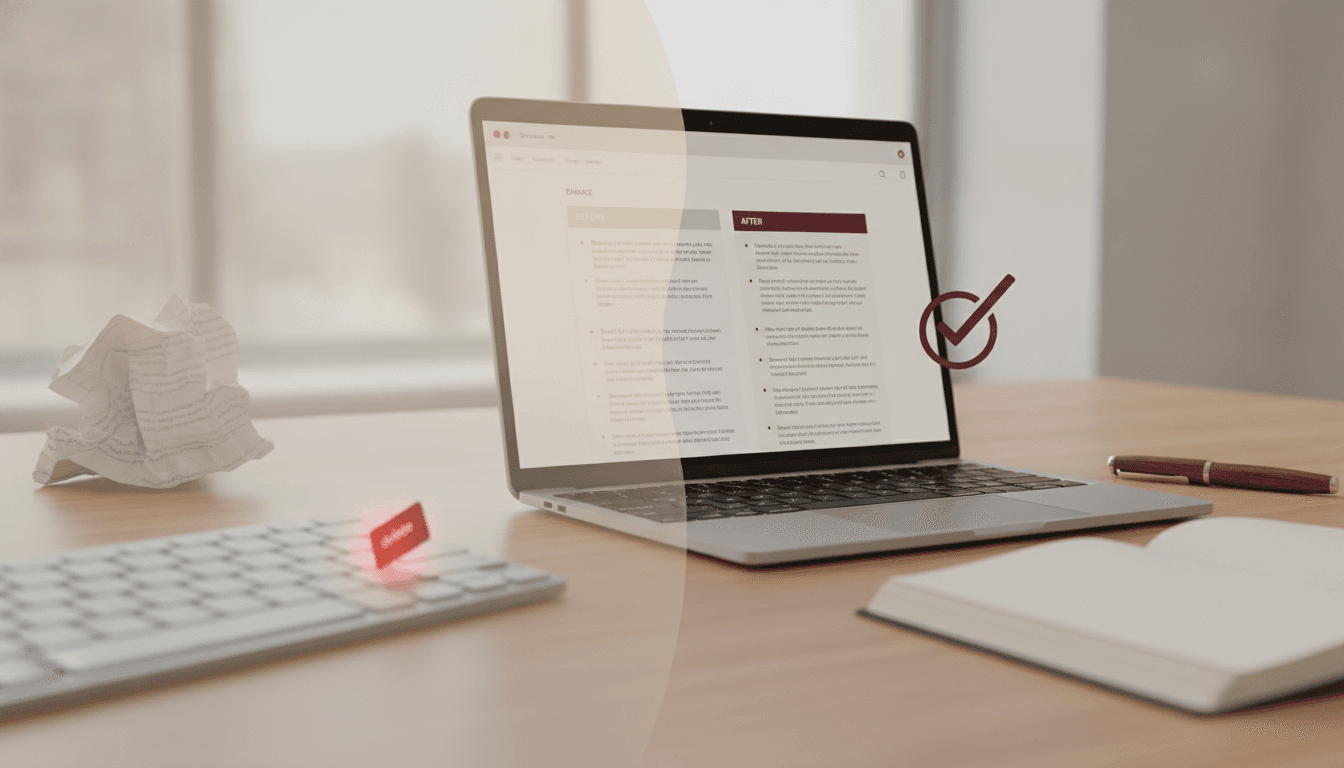
Assertive Communication in Emails: 15 Before & After Examples
Assertive communication in emails means replacing passive, hedging, or overly apologetic language with direct, respectful, and confident phrasing. Below, you'll find 15 real-world before-and-after email rewrites covering requests, pushback, deadline setting, escalation, and more—each showing exactly how to transform uncertain messages into credible, authoritative professional communication that gets results.
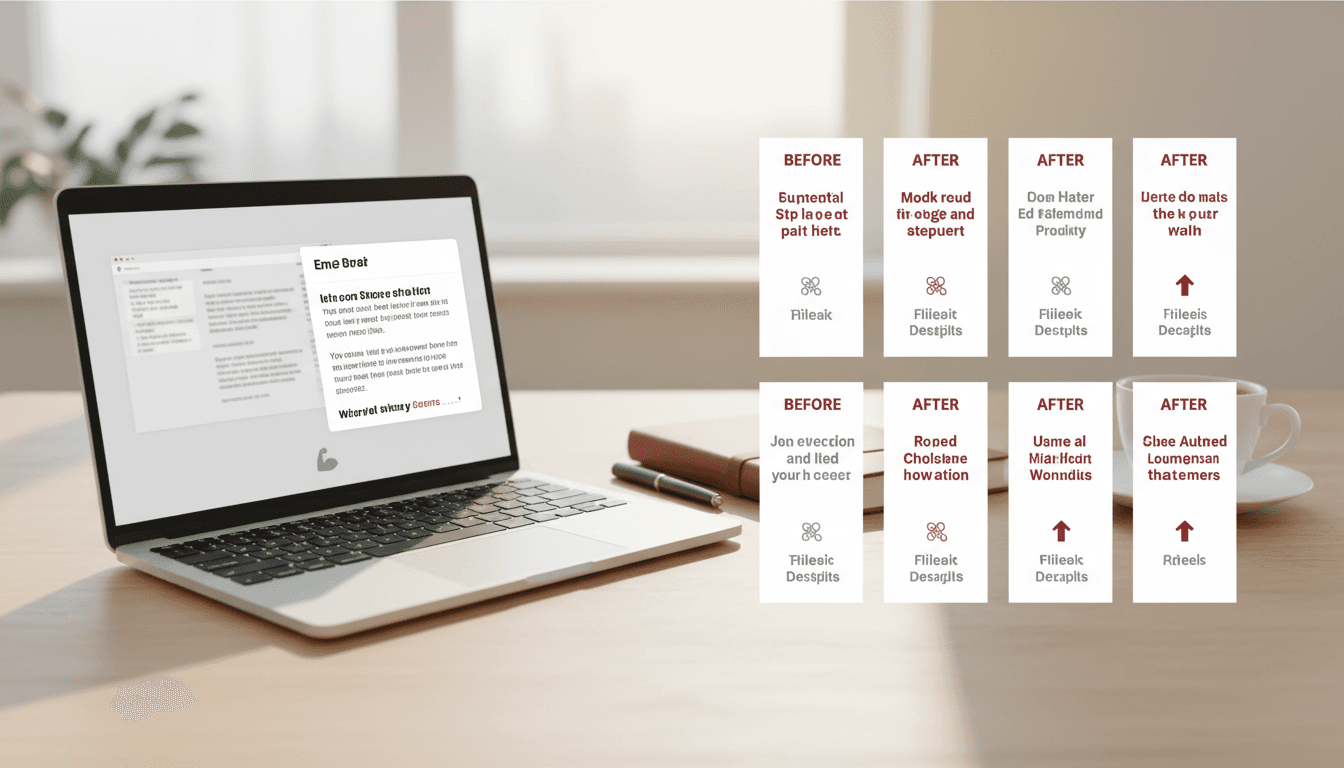
How to Be More Assertive in Emails: 12 Before & Afters
To be more assertive in emails, eliminate hedging language ("just," "I think," "sorry to bother you"), replace vague requests with specific actions and deadlines, and lead with your main point instead of burying it. Assertive emails aren't aggressive—they're clear, direct, and respectful. The 12 before-and-after rewrites below show you exactly how to transform passive, uncertain email language into messages that command attention and get results.

How to Be More Assertive in Professional Emails (With Examples)
To be more assertive in professional emails, replace hedging language with direct statements, lead with your main point, use confident sentence structures, and state clear expectations with deadlines. Assertive emails aren't aggressive — they're clear, respectful, and impossible to misinterpret. The key shift is moving from "I was just wondering if maybe we could…" to "I'd like to move forward with X by Friday." Below, you'll find 15+ before-and-after rewrites covering the most common profession