
Credibility in Communication: The 5 Pillars of Authority

Credibility in communication is built on five core pillars: competence signaling, consistency, confidence cues, connection, and character. When professionals master these pillars, they stop being overlooked and start being heard. Each pillar works together to create a commanding presence that earns trust in emails, meetings, presentations, and negotiations. Below, you'll find a complete framework with specific techniques you can implement today to build lasting authority in every professional interaction.
What Is Credibility in Communication?
Credibility in communication is the perceived trustworthiness, expertise, and reliability that others assign to you based on how you deliver your message — not just what you say. It's the difference between a recommendation that gets ignored and one that shapes a company's direction.
Aristotle called it ethos — the character and authority of the speaker. In modern professional settings, credibility in communication encompasses your word choice, body language, track record, emotional intelligence, and the consistency between what you say and what you do. When your credibility is high, people listen, agree, and act. When it's low, even brilliant ideas fall flat.
Why Credibility in Communication Matters More Than Ever
The Trust Deficit in Modern Workplaces

We're operating in an era of information overload and declining institutional trust. According to the 2024 Edelman Trust Barometer, only 40% of respondents trust business leaders to tell the truth. That means more than half of your colleagues, clients, and stakeholders may default to skepticism before you even open your mouth.
This trust deficit creates both a challenge and an opportunity. Professionals who actively build credibility in communication stand out dramatically. They get promoted faster, close deals more effectively, and lead teams with less resistance.
The Career Impact of Low Credibility
Think about the last meeting where someone shared a solid idea but was immediately questioned or dismissed. Now think about the person in the room whose suggestions were accepted almost without debate. The difference usually isn't intelligence — it's perceived credibility.
Research from the Harvard Business Review found that executives who communicate with high credibility are 1.3 times more likely to be rated as "high potential" by senior leadership. Credibility doesn't just make you sound better. It directly shapes your career trajectory.
The Compounding Effect
Credibility in communication compounds over time. Each interaction where you demonstrate competence, consistency, and character adds to your reputation. Each instance of vagueness, contradiction, or overstatement chips away at it. Understanding the five pillars below gives you a deliberate system for building — rather than accidentally eroding — your professional authority.
Pillar 1: Competence Signaling — Show What You Know (Without Showing Off)
What Competence Signaling Looks Like
Competence signaling is the art of demonstrating expertise in a way that builds trust rather than triggering defensiveness. It's not about listing your credentials or dominating conversations with jargon. It's about strategically revealing your knowledge at the right moments.
For example, instead of saying "I think we should consider a new vendor," a competence signal sounds like: "Based on the supply chain disruptions we tracked last quarter — where lead times increased 22% — I'd recommend we evaluate two alternative vendors before Q3." The second version communicates the same recommendation but anchors it in specific, verifiable knowledge.
Three Techniques for Signaling Competence
1. Lead with evidence, not opinion. Before stating your position, briefly reference the data, experience, or research that supports it. A study published in the Journal of Applied Psychology found that speakers who cited specific evidence were rated 35% more persuasive than those who shared opinions alone (Petty & Cacioppo, 1986). 2. Use precise language. Replace vague words like "a lot," "soon," and "significant" with specific numbers, dates, and metrics. Instead of "We've seen a big increase in complaints," say "Customer complaints rose 18% between January and March." 3. Acknowledge the limits of your knowledge. Counterintuitively, saying "I don't have the data on that yet, but I'll follow up by Thursday" signals more competence than bluffing. It shows intellectual honesty and rigor.The Competence Trap to Avoid
Over-signaling competence backfires. If every sentence is loaded with credentials and data, you come across as insecure or condescending. The goal is strategic placement — one or two well-timed competence signals per interaction are far more effective than a constant barrage.
Pillar 2: Consistency — The Silent Credibility Builder
Why Consistency Outperforms Charisma
Charisma gets attention. Consistency earns trust. When your words match your actions, when your tone stays steady under pressure, and when your message doesn't shift based on your audience, people start treating you as a reliable authority.
According to research by Dr. Robert Cialdini, author of Influence: The Psychology of Persuasion, consistency is one of the six fundamental principles of persuasion. People are psychologically wired to trust those whose behavior is predictable and aligned with their stated values.
Building Consistency Across Channels
Credibility in communication breaks down when you say one thing in a meeting and something different in an email. Here's how to stay consistent across channels:
In meetings: State your position clearly and avoid hedging excessively. If you say "I support this direction," don't send a follow-up email walking it back. In emails: Match the tone and substance of your verbal commitments. If you promised a deliverable by Friday in a meeting, your email confirmation should reflect that same timeline — not a vague "early next week." In presentations: Align your slides, your spoken words, and your body language. If your slide says "record-breaking quarter" but your voice is flat and uncertain, the inconsistency undermines your message.The Consistency Audit
Once a month, review your last 10-15 professional communications — emails, Slack messages, meeting notes. Ask yourself: Would someone reading all of these form a coherent picture of what I stand for and what I'm working toward? If the answer is no, you've identified a credibility leak.
Say it once, and be taken seriously. The Authority Toolkit gives you 8 frameworks, the 7 shifts that make speech sound sure, and 100+ phrases for meetings and email, so the point lands the first time you make it. Get The Authority Toolkit — $27
Pillar 3: Confidence Cues — The Nonverbal and Verbal Signals That Command Respect
The Science Behind Confidence Perception

People form credibility judgments within the first seven seconds of an interaction, according to research by Princeton psychologists Janine Willis and Alexander Todorov (2006). Most of that judgment is based on nonverbal cues — posture, eye contact, vocal tone — rather than the content of your words.
This doesn't mean you need to fake confidence. It means you need to remove the anti-confidence signals that undermine your message before anyone processes what you're actually saying.
Verbal Confidence Cues
Eliminate permission-seeking language. Phrases like "I just wanted to check," "Sorry, but I think," and "This might be a dumb question" signal subordination. Replace them with direct alternatives:- Instead of: "I just wanted to follow up…" → "Following up on our conversation…"
- Instead of: "Sorry, but I disagree…" → "I see it differently. Here's why…"
- Instead of: "Does that make sense?" → "Here's what I recommend as next steps."
Nonverbal Confidence Cues
Posture: Stand or sit with your shoulders back and your weight evenly distributed. Research by Amy Cuddy at Harvard Business School found that expansive postures are associated with increased feelings of power and higher confidence ratings from observers. Eye contact: Maintain steady (not staring) eye contact for 3-5 seconds at a time, especially when making key points. In virtual meetings, look directly at your camera during important statements. Gestures: Use open-palm gestures when speaking. Pointing, crossing arms, or fidgeting with objects all reduce perceived credibility.A Quick Confidence Reset for High-Stakes Moments
Before an important meeting or presentation, use the 4-2-6 breathing technique: inhale for 4 seconds, hold for 2 seconds, exhale for 6 seconds. Repeat three times. This activates your parasympathetic nervous system, steadies your voice, and reduces visible tension — all of which support stronger confidence cues.
Pillar 4: Connection — Credibility Through Emotional Intelligence
Why Logic Alone Doesn't Build Credibility
You can be the most competent, consistent, confident communicator in the room and still fail to build credibility if people don't feel connected to you. Credibility in communication isn't just about being right — it's about being relatable.
A 2023 study from the Center for Creative Leadership found that leaders who scored highest in empathy were rated 40% higher in overall effectiveness by their direct reports. Connection isn't a "soft" skill. It's a credibility multiplier.
Techniques for Building Connection
1. Name the emotion in the room. When tension is high, saying "I can see this decision is creating some real concern, and I want to make sure we address that" does more for your credibility than launching into data. It shows awareness and emotional courage. 2. Use inclusive language. Replace "I" with "we" when discussing team outcomes. Instead of "I completed the project ahead of schedule," try "We delivered ahead of schedule, and here's what made it possible." This signals collaborative leadership. 3. Listen before you lead. In meetings, resist the urge to speak first. Ask a clarifying question. Paraphrase what someone else said. Then offer your perspective. This sequence — listen, reflect, contribute — positions you as someone who values others' input, which paradoxically increases the weight people give to your own ideas.Connection in Written Communication
Emails and messages strip away tone, facial expressions, and vocal nuance. To maintain connection in writing:
- Open with a human sentence before diving into business: "Hope the product launch went smoothly last week."
- Use the recipient's name at least once in the body of the email.
- Close with a forward-looking, collaborative statement: "Looking forward to building on this together."
These small adjustments prevent your written communication from feeling transactional, which preserves the relational foundation of credibility.
Pillar 5: Character — The Foundation Everything Else Rests On
What Character Means in Professional Communication
Character is the pillar that holds up all the others. Without it, competence feels manipulative, consistency feels robotic, confidence feels arrogant, and connection feels performative.
In communication terms, character means: you say what you mean, you admit when you're wrong, you give credit to others, and you don't shift your message to tell people what they want to hear.
How to Demonstrate Character in Everyday Communication
Own your mistakes publicly. When something goes wrong, resist the instinct to minimize or deflect. A simple "That was my call, and it didn't work. Here's what I've learned and what I'll do differently" builds more credibility than a perfect track record ever could. According to a study in the Journal of Experimental Social Psychology, leaders who admitted errors were rated as more trustworthy and more competent than those who deflected blame (Kim et al., 2004). Give credit generously. In meetings, presentations, and emails, name the people who contributed to a success. "This strategy worked because of the research Priya did on competitor pricing" does two things: it demonstrates your character, and it builds loyalty in your team. Be willing to disagree respectfully. Character-driven communicators don't nod along with ideas they think are flawed just to avoid conflict. They say, "I respect the thinking behind this, and I want to offer a different perspective." Disagreeing with grace — not aggression — is one of the strongest credibility signals in any professional environment.Character as a Long-Term Strategy
You can build competence in weeks. You can develop confidence cues in months. But character is built over years and destroyed in moments. Every email, every meeting, every side conversation either reinforces or erodes the character component of your credibility. Treat every interaction as a deposit or withdrawal from your credibility account.
How to Implement the 5-Pillar Framework Starting This Week
The Daily Credibility Check-In
Each morning, choose one pillar to focus on for the day. Before your first meeting or email, ask yourself:
- Monday (Competence): Where can I lead with evidence today?
- Tuesday (Consistency): Am I aligning my words with my previous commitments?
- Wednesday (Confidence): What filler phrases or hedging language will I eliminate?
- Thursday (Connection): How will I show empathy or acknowledge someone else's contribution?
- Friday (Character): Is there a mistake I need to own or credit I need to give?
This rotation keeps all five pillars active without overwhelming you.
Measuring Your Progress
Track your credibility growth with a simple weekly reflection: On a scale of 1-10, how often did people accept my ideas, seek my input, or defer to my judgment this week? Over 8-12 weeks, you should see a measurable upward trend as the five pillars become habitual.
You can also ask a trusted colleague for candid feedback: "When I communicate in meetings, what's one thing that strengthens my credibility and one thing that weakens it?" This single question often reveals blind spots that no self-assessment can uncover.
Frequently Asked Questions
What is credibility in communication?
Credibility in communication is the degree to which your audience perceives you as trustworthy, knowledgeable, and reliable based on how you deliver your message. It encompasses your word choice, body language, track record, and emotional intelligence. High credibility means people listen, trust, and act on what you say. Low credibility means even strong ideas get dismissed.
How can I build credibility quickly in a new job?
Focus on the competence and consistency pillars first. In your first 30 days, lead with evidence-based statements rather than opinions, follow through on every commitment — no matter how small — and ask thoughtful questions that show you've done your homework. Avoid overcompensating by talking too much. Listening carefully and delivering on promises builds credibility faster than trying to impress.
Credibility vs. trust: What's the difference?
Credibility is the perception that you can deliver — that you have the expertise and reliability to back up your words. Trust is the belief that you will deliver — that your intentions are genuine. Credibility is often established faster through competence and confidence cues. Trust develops more slowly through consistency and character. Both are essential, but credibility typically opens the door that trust keeps open.
What are the biggest credibility killers in professional communication?
The top credibility killers include: using excessive filler words ("um," "like," "you know"), making promises you don't keep, over-hedging your language ("I might be wrong, but…"), taking credit for others' work, and contradicting yourself across different conversations or channels. Even one instance of dishonesty or blame-shifting can destroy years of credibility.
Can introverts build strong credibility in communication?
Absolutely. Introverts often excel at the consistency, connection, and character pillars because they tend to listen carefully, think before speaking, and follow through on commitments. The key for introverts is to ensure their competence and confidence cues are visible — especially in meetings and presentations. Preparing key talking points in advance and practicing declarative statements can help introverts project authority without changing their personality.
How does credibility in communication apply to virtual meetings?
Virtual meetings amplify some credibility cues and mute others. Your camera positioning, lighting, and eye contact (looking at the camera) become critical confidence cues. Your audio quality affects perceived competence — muffled sound or background noise signals lack of preparation. Consistency matters even more in virtual settings because written chat messages, screen-shared documents, and verbal statements all need to align in real time.
Stop Sounding Uncertain in Everyday Conversations
8 communication frameworks, the 7 speech shifts with 30 before-and-after rewrites, 6 email templates, and 100+ phrases for speaking and writing with calm authority at work. PDF.
Get The Authority Toolkit — $27Related Articles
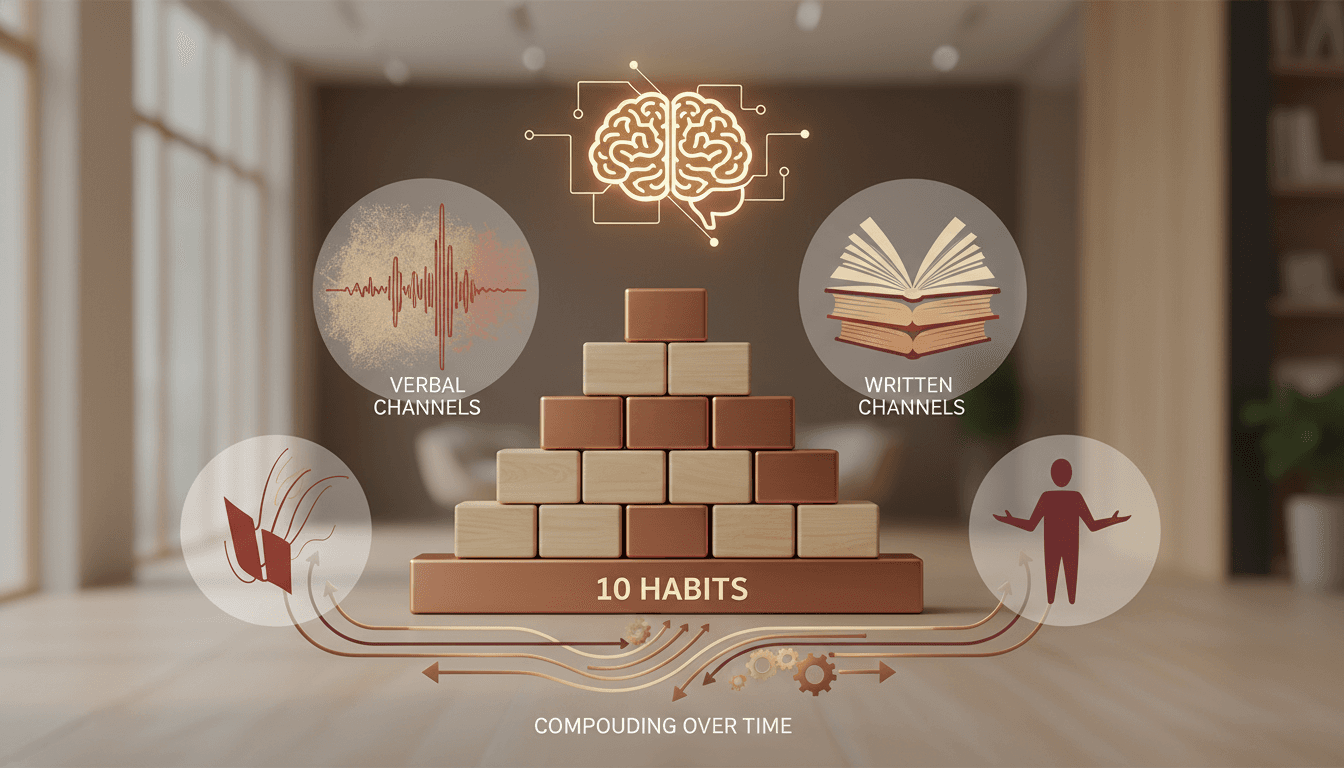
How to Communicate With Authority at Work: 10 Habits
To communicate with authority at work, build ten daily habits across verbal, written, and nonverbal channels: lead with your conclusion, eliminate hedging language, use strategic pauses, anchor your body language, control your vocal tone, write concisely, prepare a point of view before every meeting, ask high-value questions, set verbal boundaries, and follow through visibly. These small, repeatable actions compound over time to build a lasting reputation for credibility and leadership presence.

5 Professional Communication Frameworks Leaders Use Daily
The difference between professionals who get heard and those who get overlooked often comes down to one thing: structure. The most effective leaders don't wing their messages—they use professional communication frameworks to organize their thinking before they speak or write. The five most widely used professional communication frameworks are PREP (Point, Reason, Example, Point), SBI (Situation, Behavior, Impact), the Minto Pyramid, STAR for Influence (Situation, Task, Action, Result), and the W

How to Influence Without Formal Authority at Work
To influence without formal authority at work, focus on five core strategies: build deep credibility through expertise and reliability, map strategic relationships across the organization, communicate with precision and confidence, create coalitions around shared goals, and consistently deliver visible value. Influence without a title isn't about manipulation—it's about earning trust, demonstrating competence, and positioning yourself as someone whose perspective genuinely moves outcomes forward