
How to Build Confidence in Meetings (Even as an Introvert)
What Is Confidence in Meetings?
Confidence in meetings is the ability to share your ideas, respond to challenges, and hold your ground in group professional settings—without second-guessing yourself or shrinking back. It's a combination of preparation, communication skill, and self-trust that allows you to contribute with authority and clarity.
Meeting confidence doesn't mean dominating every conversation. It means knowing when to speak, how to frame your contributions for maximum impact, and trusting that your perspective belongs at the table. For introverts especially, this reframing is critical: confidence isn't volume—it's conviction.
Why So Many Professionals Struggle with Meeting Confidence
The Visibility Trap
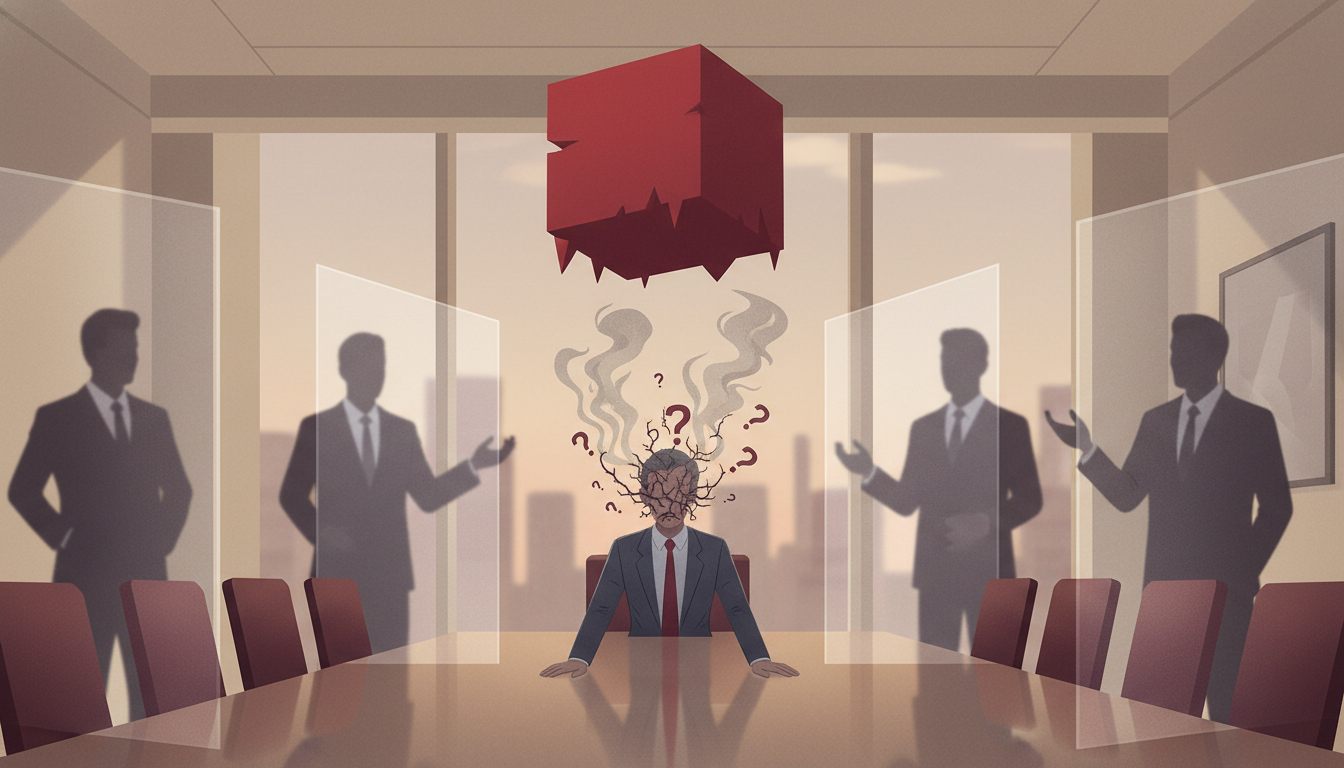
Meetings are one of the few workplace settings where your competence is judged in real time. A 2023 survey by Korn Ferry found that 69% of professionals say meetings are the primary setting where their leadership potential is evaluated by senior management. That kind of visibility creates pressure—and pressure breeds hesitation.
You might know your material inside and out. But when the spotlight swings your way in a packed conference room, that knowledge can evaporate. This isn't a competence problem. It's a performance anxiety problem, and it's far more common than most people admit.
The Introvert Disadvantage (That Isn't Really a Disadvantage)
Research published in the Harvard Business Review (2022) found that introverts are 24% less likely to be identified as "high potential" leaders—not because of lower performance, but because they contribute less visibly in group settings. Meetings disproportionately reward fast talkers and quick reactors, which puts reflective thinkers at a structural disadvantage.
But here's the reframe: introverts tend to offer more considered, higher-quality contributions. The challenge isn't developing something to say—it's building the systems and habits that get those contributions heard. If you've been struggling with how your communication style is perceived, our guide on assertive communication at work offers practical scripts for exactly these situations.
Imposter Syndrome in the Room
That voice whispering "everyone here knows more than you" isn't evidence—it's imposter syndrome. According to a study published in the International Journal of Behavioral Science, an estimated 70% of people experience imposter feelings at some point in their careers. In meetings, this manifests as over-qualifying your statements ("This might be a dumb question, but..."), deferring to others, or staying silent entirely.
Recognizing imposter syndrome as a pattern—not a truth—is the first step toward dismantling it. For a deeper dive, see our guide on overcoming imposter syndrome at work.
Pre-Meeting Preparation: The Foundation of Confidence in Meetings
The 3-Point Preparation Method
The single most effective strategy for building confidence in meetings is structured preparation. Before any meeting, identify three things:
- One insight you can contribute — a data point, observation, or recommendation tied to the agenda.
- One question you can ask — a thoughtful question signals engagement and authority more than any statement.
- One position you're prepared to defend — even a small one. Having a stance you've thought through gives you an anchor.
Write these down. Literally. Research from Princeton University found that handwriting notes improves conceptual understanding and recall by 29% compared to typing. A pocket notebook with your three points gives you a physical safety net.
Arrive Early, Own the Space
Confidence is partly environmental. When you rush into a meeting two minutes late and squeeze into a corner seat, you've already ceded psychological ground. Arriving five minutes early lets you choose your seat strategically (closer to the decision-maker or at the center of the table), settle your nervous system, and greet people as they arrive—which positions you as a host rather than a guest.
This small shift in arrival time changes your entire posture in the meeting. It's one of the simplest leadership presence techniques you can adopt immediately.
Visualize Your Contribution, Not Your Performance
Most advice says "visualize success." That's too vague. Instead, visualize the specific moment you deliver your prepared insight. Picture the words coming out clearly. Picture making eye contact with the person you're addressing. Picture the brief pause after you finish—because pausing signals confidence.
This isn't woo-woo. A meta-analysis published in Psychological Bulletin found that mental rehearsal improves actual performance by an average of 13.5% across professional and athletic settings (Driskell et al., 1994, updated review 2016). Visualize the contribution, not the applause.
Know exactly what to say next time. The Pushback Playbook has 50 word-for-word scripts for moments like this one: what they say, what you say, why it works, and what to do if they push back. Get The Pushback Playbook — $27
In-Meeting Strategies: How to Speak Up with Authority
The First Five Minutes Rule

The longer you stay silent in a meeting, the harder it becomes to speak. Psychologists call this the "silence spiral"—each passing minute raises the perceived stakes of your first contribution. Break the cycle by committing to saying something—anything substantive—within the first five minutes.
This doesn't have to be groundbreaking. It can be as simple as:
- Affirming a point: "I want to build on what Sarah just said—our Q3 data supports that trend."
- Asking a clarifying question: "Before we go further, can we align on what success looks like for this initiative?"
- Framing the discussion: "It seems like we're weighing two options here. Can I summarize what I'm hearing?"
Each of these positions you as an active participant early, which makes every subsequent contribution feel easier.
How to Interrupt Respectfully (Without Being Rude)
Getting talked over is one of the most demoralizing meeting experiences. And for many professionals—especially women and introverts—it happens constantly. The solution isn't to shout louder. It's to master the strategic interrupt.
Use these phrases to reclaim the floor:
- "I want to make sure we capture this point before we move on..."
- "Adding to that—" (said while leaning slightly forward and making eye contact with the speaker)
- "Let me jump in here because this connects directly to..."
- "Before we leave this topic, I have data that's relevant."
The key is coupling your words with physical signals: sit forward, raise your hand slightly, or use a brief palm-out gesture. Body language accounts for a significant portion of how your communication is received—a principle we explore in depth in our piece on how to communicate like an executive.
The Power of Strategic Silence
Counterintuitively, one of the most powerful moves in a meeting is deliberate silence. When someone asks you a question, pausing for two to three seconds before answering signals that you're thoughtful, not reactive. It also gives your brain time to formulate a sharper response.
Strategic silence works especially well in tense moments. If someone challenges your idea aggressively, a calm pause followed by a measured response communicates far more confidence than a rapid-fire defense. As the saying goes in executive communication: the person who controls the pace controls the room.
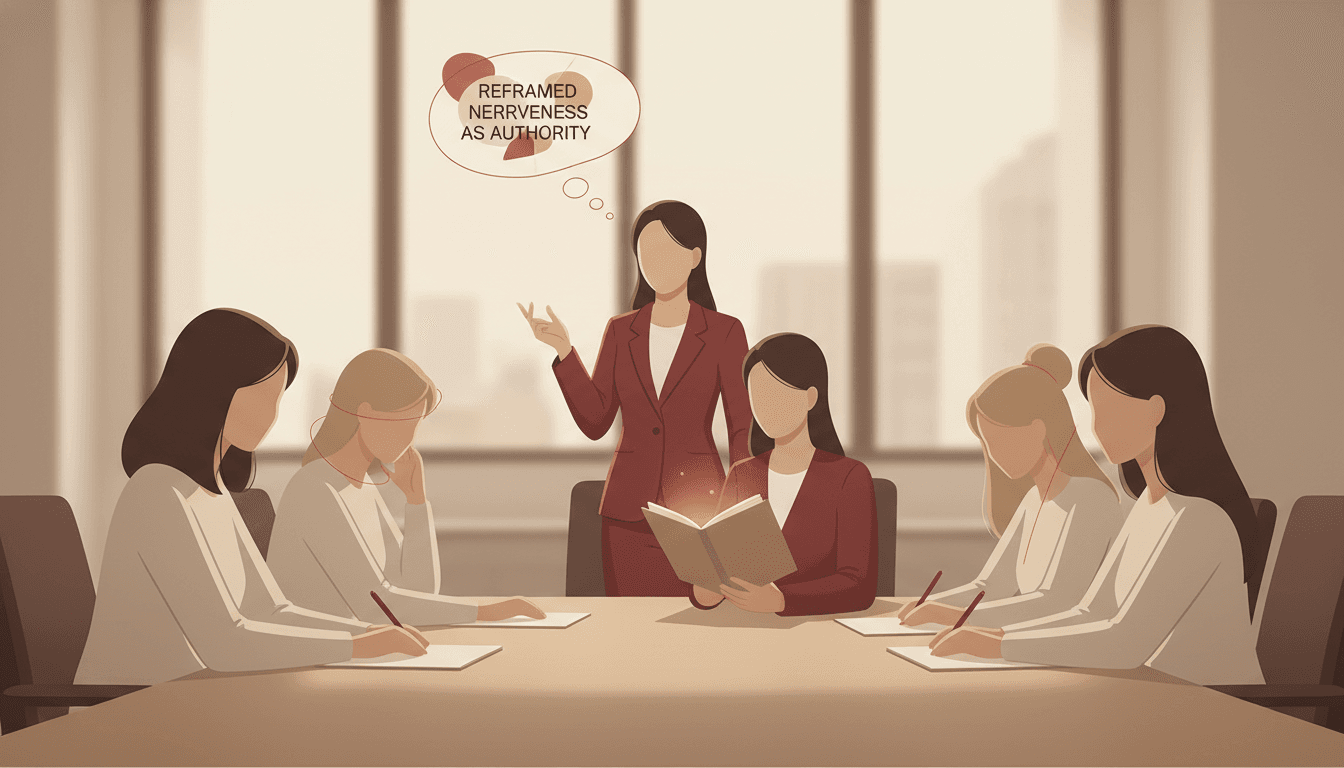
Reframing Nervousness as Authority Energy
The Anxiety-Excitement Bridge
Your body processes nervousness and excitement with nearly identical physiological responses: elevated heart rate, adrenaline release, heightened focus. Research by Alison Wood Brooks at Harvard Business School found that people who reframed anxiety as excitement performed significantly better in public speaking tasks than those who tried to calm down.
Before your next meeting, try saying to yourself—out loud if possible—"I'm excited about this meeting." It sounds simplistic, but the linguistic reframe genuinely shifts your cognitive appraisal of the situation. You're not trying to eliminate the butterflies. You're redirecting them.
Detach Your Identity from Your Ideas
One reason meetings feel so high-stakes is that we fuse our self-worth with our contributions. When an idea gets shot down, it feels personal. The fix is practicing what psychologists call "cognitive defusion"—separating yourself from your thoughts.
Try framing contributions as experiments rather than declarations:
- Instead of: "I think we should do X." (identity-attached)
- Try: "Here's one option worth stress-testing: X." (idea-detached)
This framing invites discussion rather than debate, reduces your emotional exposure, and paradoxically makes you sound more confident—because you're demonstrating intellectual flexibility rather than rigid defensiveness.
Build a Post-Meeting Confidence Log
After each meeting, write down three things:
- One moment you contributed effectively.
- One thing you'd do differently.
- One thing you noticed about how confident communicators in the room behaved.
This practice builds self-awareness over time and creates tangible evidence that counters imposter syndrome. Within a month, you'll have a written record proving that you do, in fact, contribute valuable ideas—even on the days it doesn't feel that way. This kind of evidence-building is central to building professional credibility, especially if you're new to a role or organization.
Advanced Tactics: From Participant to Meeting Leader
Anchor the Conversation with Frameworks
One of the fastest ways to establish credibility in communication during a meeting is to introduce a simple framework. Frameworks organize scattered thinking and position you as a structured thinker.
Examples:
- "I see three buckets here: cost, timeline, and risk. Can we address each one?"
- "Let's use a quick pros-and-cons lens before we decide."
- "It might help to separate the short-term fix from the long-term strategy."
You don't need to invent anything original. Simply naming the structure of the conversation gives you outsized influence over its direction. This is a hallmark of executive communication skills that anyone can adopt.
Follow Up in Writing
Your meeting confidence doesn't end when the meeting does. Sending a brief follow-up email—summarizing key decisions, action items, or your own contributions—extends your visibility and reinforces your authority. It also creates a paper trail that ensures your ideas are attributed to you, not to whoever rephrased them louder.
A simple template:
"Thanks for a productive discussion. Here's my summary of what we aligned on: [2-3 bullet points]. I'll take the lead on [specific action item] and have an update by [date]. Let me know if I missed anything."
This takes three minutes and positions you as the person who drives outcomes—not just the person who attended.
Request Specific Roles in Recurring Meetings
If you attend the same meeting weekly, ask to own a recurring segment. It could be a project update, a data review, or a brief market scan. Having a defined role eliminates the ambiguity of when to speak and gives you a built-in platform.
This is particularly powerful for introverts. Instead of competing for airtime in an unstructured discussion, you have a designated slot where preparation meets delivery—your natural strength.
Frequently Asked Questions
How can introverts build confidence in meetings?
Introverts build meeting confidence through preparation, not personality change. Use the 3-Point Preparation Method (one insight, one question, one position) before every meeting. Speak within the first five minutes to break the silence spiral. Choose strategic seats near decision-makers, and follow up in writing to extend your visibility beyond the meeting itself. Introversion is a communication style, not a limitation.
What should I do when I get talked over in meetings?
Use a strategic interrupt. Lean forward physically, make eye contact, and use bridge phrases like "I want to add to that—" or "Before we move on, I have relevant data." Pair your words with confident body language. If interruptions are chronic, address the pattern directly with your manager or request structured turn-taking in meeting norms.
Confidence in meetings vs. confidence in presentations: what's the difference?
Presentations are prepared, one-directional, and scripted. Meetings are dynamic, multi-directional, and often unpredictable. Meeting confidence requires real-time thinking, the ability to respond to challenges on the fly, and comfort with unstructured interaction. Both benefit from preparation, but meeting confidence leans more heavily on adaptability, active listening, and strategic timing.
How do I stop saying "sorry" and filler words in meetings?
Start by building awareness. Record yourself in a low-stakes meeting (with permission) or ask a trusted colleague to track your filler words. Replace "sorry" with direct alternatives: instead of "Sorry, but I disagree," say "I see it differently." Replace "um" and "like" with brief pauses—silence is more powerful than filler. Practice in low-pressure settings first, then carry the habit into higher-stakes rooms.
How long does it take to build confidence in meetings?
Most professionals notice a meaningful shift within four to six weeks of consistent practice. The key is repetition: prepare before every meeting, contribute within the first five minutes, and log your performance afterward. Confidence isn't a switch you flip—it's a muscle you build through deliberate, repeated action in real professional settings.
Can meeting confidence actually affect my career advancement?
Absolutely. Research from Korn Ferry indicates that meeting performance is one of the top settings where leadership potential is assessed. Professionals who contribute visibly and strategically in meetings are more likely to be tapped for promotions, stretch assignments, and leadership roles. Your ideas only advance your career if people hear them.
Featured Image Alt Text: Professional confidently speaking during a team meeting in a modern conference room, making eye contact with colleagues around the table.
Never Be Caught Without the Right Words Again
50 word-for-word scripts for being talked down to, interrupted, dismissed, and put on the spot at work, plus five worksheets. PDF, 50 pages.
Get The Pushback Playbook — $27Related Articles

How to Handle Being Talked Down to at Work Professionally
To handle being talked down to at work, stay calm and address the behavior directly using neutral, assertive language. Name the specific behavior without attacking the person by saying something like, "I'd appreciate it if we could discuss this as equals—I have relevant expertise here." Set clear boundaries, document patterns of condescension, and escalate to HR if the behavior continues. The goal is to protect your credibility and professional standing without matching their tone or becoming re

How to Speak Up in Meetings as an Introvert: 8 Methods
Being an introvert in a meeting-heavy workplace doesn't mean your ideas should go unheard. To speak up in meetings as an introvert, focus on strategies that work *with* your natural strengths: prepare key points in advance, use the first five minutes to make an early contribution, leverage written follow-ups, ask strategic questions instead of making declarations, and build on others' comments to ease into the conversation. You don't need to become an extrovert — you need a system that lets your

How to Handle Being Interrupted in Meetings Professionally
When you're interrupted in a meeting, pause briefly, maintain open body language, and use a calm redirect phrase such as "I'd like to finish my point" or "Let me complete this thought." The key is responding without escalating—combining assertive language with composed delivery signals confidence and commands respect. Chronic interrupters can be managed through proactive strategies like pre-framing your contributions, building alliances, and addressing the pattern directly in private.