
How to Negotiate Deadlines Professionally (Scripts Included)

What Is Professional Deadline Negotiation?
Professional deadline negotiation is the process of renegotiating a project timeline through clear, solution-oriented communication that protects both the quality of work and the working relationship. It's not about saying "no"—it's about redirecting the conversation toward what's possible.
Unlike simply pushing back or complaining about workload, professional deadline negotiation involves presenting data, proposing alternatives, and framing the discussion around shared goals. It's a core skill of assertive communication at work and one that separates respected professionals from those who get steamrolled—or burned out.
Why Professionals Struggle to Push Back on Deadlines
The Fear of Looking Incompetent

Most professionals don't struggle with deadlines because they lack time management skills. They struggle because they fear that pushing back signals weakness or incapability. A 2023 study by the American Psychological Association found that 64% of working adults reported work as a significant source of stress, with unrealistic expectations being a top contributor. Yet many silently absorb those expectations rather than speak up.
The irony? Accepting every deadline without question actually erodes your credibility over time. When you consistently overpromise and underdeliver—or deliver mediocre work on time—people notice. As we explore in why people don't take you seriously at work, credibility is built on consistent, high-quality follow-through, not on being agreeable.
Confusing Assertiveness with Aggression
Another common barrier is the belief that negotiating a deadline means creating conflict. But there's a critical difference between assertiveness and aggression. Assertiveness says, "I want to make sure we get the best outcome—let's talk about how." Aggression says, "That's not happening."
Research from Columbia Business School shows that professionals who use assertive (not aggressive) negotiation tactics are perceived as 30% more competent by their peers and managers. The key is tone, framing, and preparation—all of which we'll cover with exact scripts below.
If you tend to default to people-pleasing in high-pressure conversations, our guide on how to be assertive at work without being aggressive is a strong companion to this article.
The REFRAME Method: A 5-Step Framework for Deadline Negotiation
Instead of winging it, use this structured approach every time you need to negotiate a timeline. The REFRAME method ensures you stay professional, solution-focused, and credible.
Step 1: Recognize the Request (Don't React)
When you receive an unrealistic deadline, pause. Don't immediately agree, and don't immediately object. Acknowledge the request so the other person feels heard.
Script: "Thank you for bringing this to me. I want to make sure I understand the full scope and priority before I commit to a timeline."This buys you time and signals professionalism. According to Harvard Business Review, professionals who pause before responding in negotiations achieve outcomes that are 9% more favorable on average than those who respond immediately.
Step 2: Evaluate the Real Constraints
Before you respond, map out the actual bottleneck. Is it scope? Resources? Dependencies on other teams? Your own bandwidth? Be specific, because vague pushback ("I'm just really busy") undermines your authority.
Ask yourself:
- What specifically makes this timeline unrealistic?
- What would need to change to make it feasible?
- What's the cost of rushing (quality, errors, burnout)?
Step 3: Frame the Alternative Around Their Goals
This is where most people fail. They focus on their own constraints instead of the stakeholder's priorities. Flip the script: show how adjusting the timeline serves their interests.
Script: "I know the priority here is [their goal—e.g., a flawless client launch]. To deliver at that level, I'd recommend we target [new date]. That gives us time to [specific benefit—e.g., complete QA testing and incorporate stakeholder feedback]. If the original date is firm, here's what I'd suggest we adjust in scope…"This is the same principle behind how to communicate with the C-suite: lead with their priorities, not your problems.
Step 4: Anchor With Data, Not Emotion
Support your proposed timeline with specifics. Reference past projects, team capacity, or industry benchmarks. Numbers are harder to argue with than feelings.
Script: "Based on our last two projects of similar scope, the development phase alone took 12 business days. The current timeline gives us 7. I want to flag that gap now rather than hit it mid-project."Step 5: Offer Options, Not Ultimatums
Always present at least two paths forward. This gives the decision-maker agency while keeping you in control of the framing.
Script: "I see two paths here: Option A—we keep the original deadline but reduce scope to [X and Y]. Option B—we extend to [date] and deliver the full scope. I'd recommend Option B, but I'm happy to align with whichever serves the team best."Exact Scripts for 4 Common Deadline Scenarios
Scenario 1: Your Manager Assigns an Unrealistic Deadline
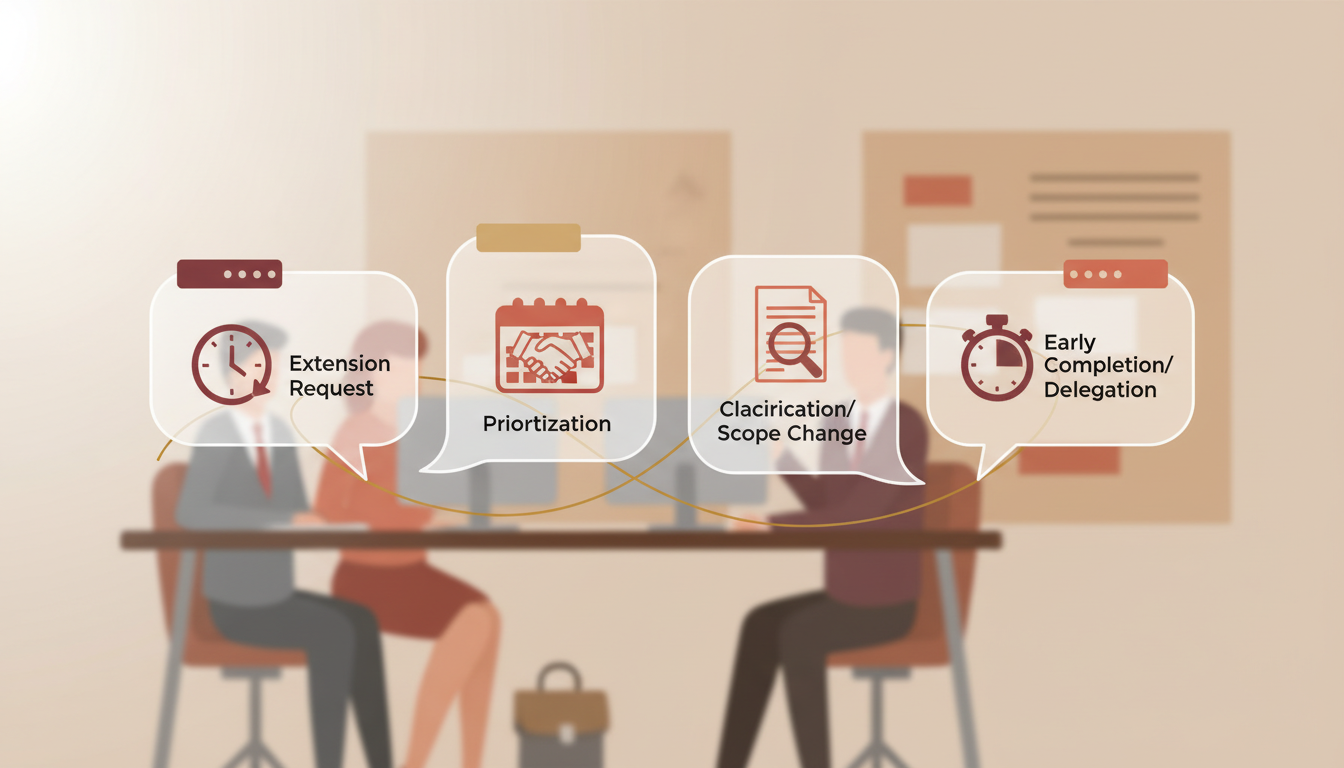
This is the most common—and most anxiety-inducing—situation. You want to push back without seeming like you can't handle the work.
Script: "I appreciate you trusting me with this. I want to deliver something we're both proud of. Looking at the scope, I think [new date] is more realistic to hit the quality bar we'd want. Here's what I'm factoring in: [list 2-3 specifics]. Does that timeline work, or should we discuss trimming scope?" Why it works: You lead with appreciation, signal ownership, and provide specifics. You end with a collaborative question, not a demand.Scenario 2: A Client Pushes for Faster Delivery
Client-facing deadline negotiations require extra diplomacy. Your credibility—and your company's reputation—is on the line.
Script: "We want to make sure this exceeds your expectations. Based on the requirements we've scoped, our recommended timeline is [date]. This ensures [specific benefit to client—e.g., thorough testing, compliance review]. We could accelerate to [earlier date] if we adjust the deliverable to [reduced scope]. Which approach aligns best with your priorities?"For more on managing high-stakes client conversations, see our guide on confidence in high-stakes conversations.
Scenario 3: A Cross-Functional Team Sets a Timeline Without Your Input
This happens frequently in matrixed organizations—someone commits your team to a deadline you weren't consulted on.
Script: "I want to make sure we're set up for success on this. I noticed the timeline was set at [date]. Based on my team's current capacity and the scope involved, I'd like to propose [new date] so we can deliver without compromising [specific quality factor]. Can we discuss this in our next sync?"Scenario 4: You've Already Agreed but Realize the Deadline Is Unworkable
This requires the most courage—and the most urgency. The longer you wait, the worse it gets. A PMI (Project Management Institute) survey found that 48% of projects that fail to meet their original goals cite unrealistic timelines as a contributing factor. Flagging problems early is a sign of leadership, not failure.
Script: "I want to flag something early rather than let it become a bigger issue. After diving deeper into [project], I've identified [specific blocker]. To maintain the quality standard, I'd recommend we adjust the deadline to [new date]. Here's my proposed plan to get there: [brief outline]. I wanted to bring this to you now so we have options."This kind of proactive communication is a hallmark of leadership presence under pressure.
How to Maintain Credibility While Negotiating Timelines
Deliver on the Deadlines You Do Accept
Negotiating deadlines only works if you're known for keeping the ones you commit to. Every time you renegotiate a timeline and then deliver on the new date with quality work, you build trust. According to a 2022 Gallup workplace study, employees who consistently meet commitments are rated 2.5x more likely to be promoted than those with inconsistent track records.
The equation is simple: negotiate less often, but always deliver on what you promise.
Use Your Voice and Body Language to Reinforce Authority
The words matter, but delivery matters equally. When you negotiate a deadline in person or on video, your vocal authority and body language determine whether your message lands as confident or apologetic.
Key principles:
- Speak at a measured pace. Rushing signals nervousness.
- Use downward inflection at the end of statements. Upward inflection turns your proposal into a question.
- Maintain steady eye contact. It signals conviction.
- Avoid hedging language. Replace "I was kind of thinking maybe we could…" with "I recommend we…"
For a deeper dive, explore our guide on how to sound more authoritative.
Document Everything
After a verbal agreement, send a follow-up email summarizing the new timeline and any scope adjustments. This protects you and eliminates ambiguity.
Email template: "Hi [Name], thanks for the discussion today. To confirm, we've aligned on [new deadline] for [project/deliverable], with [any scope changes]. I'll send a progress update by [mid-point date]. Let me know if anything shifts on your end."This habit ties directly into executive email writing with authority—a skill that compounds your professional reputation over time.
Build the Communication Skills That Accelerate Your Career. Deadline negotiation is one piece of the puzzle. Discover The Credibility Code to master the full spectrum of professional authority—from meetings and presentations to high-stakes conversations and executive communication. Discover The Credibility Code
Frequently Asked Questions
How do I negotiate a deadline without sounding like I'm making excuses?
Focus on solutions, not problems. Instead of listing reasons you can't meet the deadline, propose an alternative timeline with a clear rationale tied to project quality or stakeholder goals. Use data (past project timelines, resource availability) rather than subjective statements like "I'm overwhelmed." Leading with "Here's what I recommend to get the best result" reframes the conversation entirely.
What if my manager says the deadline is non-negotiable?
If the date truly can't move, negotiate scope instead. Ask: "Given the timeline, which deliverables are highest priority?" This shifts the conversation from time to trade-offs. You're still demonstrating negotiation confidence by ensuring expectations are realistic—even if the date stays fixed.
Negotiating deadlines vs. negotiating scope: what's the difference?
Deadline negotiation asks for more time with the same deliverables. Scope negotiation keeps the deadline but reduces or reprioritizes what's delivered. The best approach often combines both: "We can deliver X and Y by the original date, or X, Y, and Z by [later date]." Offering both options positions you as a strategic thinker, not just someone asking for more time.
How far in advance should I raise deadline concerns?
As early as possible—ideally within 24-48 hours of identifying the risk. The earlier you flag it, the more options everyone has. Waiting until the last minute destroys trust and makes you look disorganized. Early communication, even when the news is uncomfortable, is a core trait of credible professionals.
Can negotiating deadlines hurt my career?
Done poorly (last-minute, no alternatives, emotional), yes. Done well (early, data-driven, solution-focused), it actually helps your career. Leaders value team members who manage expectations proactively. The key is frequency and follow-through: negotiate only when genuinely necessary, and always deliver on the revised commitment.
How do I negotiate deadlines in email vs. in person?
In-person or video conversations are better for complex or sensitive negotiations because tone and body language reinforce your confidence. Email works for straightforward timeline adjustments or for documenting agreements after a verbal discussion. For high-stakes situations, start the conversation live and follow up with a written summary.
Negotiate From a Position of Credibility
The Credibility Code shows you how to state your case without hedging, so your ask is heard as a professional position rather than a favor.
Discover The Credibility CodeRelated Articles

Negotiation Confidence for Introverts: A Quiet Guide
Negotiation confidence for introverts doesn't require becoming louder or more aggressive. Introverts can negotiate with remarkable effectiveness by leveraging their natural strengths: deep preparation, active listening, and strategic silence. This guide provides specific frameworks, scripted phrases, and tactical methods designed for professionals who prefer thoughtful communication over confrontational debate — so you can advocate for yourself firmly without performing extroversion.

How to Negotiate Without Getting Emotional: 8 Strategies
To negotiate without getting emotional, prepare anchoring statements in advance, use cognitive reframing to separate the issue from your identity, and rely on structured language patterns that keep you focused on outcomes rather than feelings. The key is not eliminating emotions — that's impossible — but building systems that prevent emotions from hijacking your words and decisions. These eight strategies give you a repeatable framework for staying composed, credible, and effective in any high-s

How to Negotiate Without Being Pushy: Firm Yet Respectful
Negotiating without being pushy means replacing demands and pressure tactics with collaborative framing, calibrated questions, and confident language patterns that protect relationships while advancing your position. The key is to anchor your requests in shared interests and objective criteria rather than personal insistence. You don't need to be aggressive to be effective — research shows that negotiators who use integrative (win-win) strategies consistently achieve better outcomes than those w