
Confidence in High-Stakes Conversations: A Proven Method

Building confidence in high-stakes conversations comes down to a repeatable three-phase method: strategic preparation, mental rehearsal, and controlled delivery. Whether you're navigating a board presentation, a performance review, or a tense client escalation, the professionals who consistently perform under pressure aren't naturally fearless—they follow a system. This article breaks down that system step by step so you can walk into any career-defining conversation with composure and credibility.
What Is a High-Stakes Conversation?
A high-stakes conversation is any professional interaction where the outcome carries significant consequences—for your career, your team, or your organization. These include board presentations, client escalations, salary negotiations, difficult feedback sessions, and moments where you need to challenge a senior leader's decision.
What makes these conversations "high-stakes" isn't just the topic. It's the combination of visibility, consequence, and emotional intensity. Your credibility is on the line, the audience has power or influence, and the margin for error feels razor-thin. Confidence in these moments is the practiced skill of managing your internal state—nerves, self-doubt, reactive emotions—so that your external communication remains credible, strategic, and persuasive.
Why High-Stakes Conversations Derail Even Experienced Professionals
You'd think seniority would solve the confidence problem. It doesn't. The issue isn't competence—it's the gap between what you know and how you perform under pressure.

The Neuroscience of Pressure
When a conversation feels high-stakes, your brain's amygdala registers it as a threat. This triggers a cascade of stress hormones—cortisol and adrenaline—that impair your prefrontal cortex, the area responsible for clear thinking, working memory, and measured speech. Research published in the Journal of Experimental Psychology found that this kind of pressure can significantly degrade cognitive performance on complex tasks (Beilock & Carr, 2005).
The result? You go blank mid-sentence. You over-explain. You agree to things you shouldn't. You speak too fast or too softly. This is a neurological response, not a character flaw. The professionals who seem effortlessly composed in high-pressure moments have simply trained themselves to interrupt this cycle before it takes over.
The Credibility Trap
Many mid-career professionals fall into what we call the credibility trap: they wait to speak up until they feel 100% certain their point is bulletproof. But in fast-moving conversations, that moment never arrives. The window closes, someone else makes the point, and they leave the room frustrated. Silence isn't safe—it's costly.
If you recognize yourself in this pattern, you may also be undermining your credibility in subtler ways. Check out our guide on 12 weak communication habits that undermine your credibility for a deeper audit.
The Three Confidence Killers
Three specific patterns derail most professionals in high-stakes moments:
- Under-preparation: Relying on expertise alone without rehearsing the specific conversation structure, objections, and transitions.
- Emotional reactivity: Letting surprise, defensiveness, or frustration hijack your delivery in real time.
- Status anxiety: Fixating on the power dynamic—who's more senior, who holds the decision—instead of focusing on the value of your message.
Each of these is solvable with the right method. The framework below addresses all three.
The 3-Phase Method for Confidence in High-Stakes Conversations
This is the core framework. It divides your preparation and delivery into three distinct phases: Strategic Preparation, Mental Rehearsal, and Controlled Delivery. Each phase has specific, repeatable steps.
Phase 1: Strategic Preparation (The Day Before)
Most people "prepare" for a big conversation by reviewing their talking points. That's necessary but insufficient. Strategic preparation means engineering the conversation architecture—not just what you'll say, but how the conversation will flow.
Step 1: Define Your Single Desired Outcome (SDO). Before anything else, write down the one outcome that would make this conversation a success. Not three outcomes. One. A performance review SDO might be: "Secure agreement to a promotion timeline with a specific date." A client escalation SDO might be: "Retain the account with a revised scope and clear next steps." Your SDO becomes your compass. Every point you make should move the conversation toward it. Step 2: Map the Stakeholder's Priorities. What does the other person need from this conversation? What pressures are they under? Who will be in the room, and what are their communication preferences and political concerns? Write down their top two concerns and prepare to address them directly. Understanding your audience isn't optional—it's the foundation of persuasion. For a deeper dive into executive-level communication, see our guide on how to communicate with senior executives. Step 3: Establish Your Core Message. Every high-stakes conversation needs a single, clear throughline. If the audience remembers only one thing, what should it be? Use this formula: [Position] + [Reason] + [Evidence]. For example: "We should delay the product launch by two weeks (position) because our QA testing revealed three critical bugs (reason), and shipping with known defects cost us $2.3M in returns last year (evidence)." Write your core message down. Say it out loud. Trim it until it takes fewer than 20 seconds to deliver. Conciseness is a credibility signal—learn more in our post on how to speak concisely at work. Step 4: Prepare for the Three Most Likely Objections. Don't just anticipate pushback—draft your responses. Use this format: Acknowledge the concern → Reframe with evidence → Redirect to your SDO. For example, if you're presenting ideas to senior management and expect budget objections, your prepared response might be: "I understand budget constraints are real this quarter. The data shows this initiative pays for itself within six months through reduced churn. That directly supports the retention target we've committed to." Step 5: Design Your Opening. The first 30 seconds of a high-stakes conversation set the tone for everything that follows. Don't open with throat-clearing, apologies, or excessive context. Open with your position or a compelling framing statement. Weak opening: "So, I've been thinking about this for a while, and I know there are a lot of opinions, but I wanted to share some thoughts on the timeline..." Strong opening: "I want to flag a risk with our current timeline that could cost us our two largest accounts."The second version commands attention because it signals confidence, specificity, and stakes.
Phase 2: Mental Rehearsal (The Morning Of)
Mental rehearsal is not positive thinking. It's a structured visualization protocol used by elite athletes, military operators, and top executives. A meta-analysis published in Psychological Bulletin found that mental practice improves performance across skill-based tasks, with the strongest effects in tasks that combine cognitive and motor components—exactly like high-stakes communication (Driskell, Copper & Moran, 1994).
Here's the protocol:
Step 1: Visualize the Environment. Close your eyes for 60–90 seconds. Picture the room, the seating arrangement, the faces of the people involved. This reduces novelty, which reduces your brain's threat response when you actually walk in. Step 2: Rehearse Your Opening and Closing. These are the two moments with the highest anxiety. Mentally walk through your first 30 seconds—your greeting, your opening statement, your tone. Then rehearse your closing: how you'll summarize, propose next steps, and end with authority. If you struggle with strong openings, learning how to introduce yourself professionally in any setting can give you a reliable foundation. Step 3: Rehearse the Hardest Moment. Identify the single most uncomfortable moment you anticipate—the pushback, the awkward silence, the emotional reaction. Visualize yourself navigating it with composure. See yourself pausing, breathing, and responding with your prepared language. This is the most important step. It builds what psychologists call "stress inoculation"—exposure to the stressor in a safe context so it loses its power in the real one.The final principle of rehearsal is knowing when to let go. Preparation doesn't mean scripting every word. Over-rehearsing makes you rigid and disconnected. Trust your preparation and stay present in the room. This balance—thorough preparation with in-the-moment flexibility—is the hallmark of professionals with genuine leadership presence.
Know exactly what to say next time. The Pushback Playbook has 50 word-for-word scripts for moments like this one: what they say, what you say, why it works, and what to do if they push back. Get The Pushback Playbook — $27
Phase 3: Controlled Delivery (In the Room)
Preparation gets you to the door. Delivery is what happens once you walk through it. Controlled delivery is about managing your physiology, your language, and your pacing in real time.
Technique 1: The Breathing Reset. When you feel your composure slipping—a surprise question, an aggressive tone, an unexpected objection—use a breathing reset. A study published in Frontiers in Psychology found that controlled breathing techniques significantly reduced self-reported anxiety in high-pressure performance situations (Ma et al., 2017). Before entering the room, you can use a longer protocol (inhale for 4 seconds, hold for 7, exhale for 8). In the moment, a quick 4-second version works: inhale for 2 seconds through your nose, exhale for 2 seconds through your mouth. This activates your parasympathetic nervous system and interrupts the stress response. Those few seconds feel like an eternity to you but look like thoughtful composure to everyone else. For a full toolkit of pre-performance calming strategies, read our guide on how to calm nerves before a presentation. Technique 2: Physical Grounding. When adrenaline spikes during the conversation, use physical grounding. Press your feet firmly into the floor. Feel the weight of your body in the chair. Touch your thumb to your index finger under the table. These micro-actions pull your attention out of spiraling thoughts and back into your body, giving your prefrontal cortex a chance to re-engage. Technique 3: Anchor Phrases. Prepare 2–3 anchor phrases that buy you time and project confidence when you're caught off guard. Examples: "That's an important point—let me address it directly." "I want to make sure I give that the response it deserves." "Here's how I see it." These phrases serve a dual purpose: they give your brain a few seconds to organize a response while signaling to the room that you're in control. Technique 4: Vocal Authority Under Pressure. When adrenaline hits, your voice naturally rises in pitch and speeds up. Both undermine your authority. Consciously focus on three vocal adjustments: lower your pitch slightly by speaking from your chest rather than your throat; slow your pace by 15–20% (it will feel unnaturally slow to you but sounds measured and confident to listeners); and finish your sentences with a downward inflection—upspeak (ending statements like questions) is one of the fastest ways to lose credibility. For a comprehensive vocal toolkit, see our deep dive on vocal authority and how to sound like a leader. Technique 5: Status-Neutral Body Language. Research from Princeton's psychology department shows that people form judgments about competence and trustworthiness within 100 milliseconds of visual contact (Willis & Todorov, 2006). In high-stakes conversations, your body language either reinforces or undermines every word you say. Keep your hands visible and still. Maintain steady (not aggressive) eye contact—in a group, hold eye contact with one person for a full sentence before moving to the next. Sit or stand with an open chest. Take up appropriate space: rest your arms on the table, lean slightly forward when making your key point. Avoid self-soothing gestures like touching your face or crossing your arms. Our full breakdown of body language for leadership presence covers this in depth. Technique 6: The Bridge Technique for Unexpected Challenges. Even the best preparation can't predict every curveball. When you're put on the spot with a question you didn't anticipate, use this three-step approach: Acknowledge the question ("That's an important consideration"), Bridge to what you know ("What I can tell you based on our current data is..."), and Commit to follow up if needed ("I'll get you the specific numbers by end of day"). This keeps you honest without making you look unprepared. For a complete framework on handling surprise questions, see our post on how to respond when put on the spot at work.Applying the Method: Five High-Stakes Scenarios
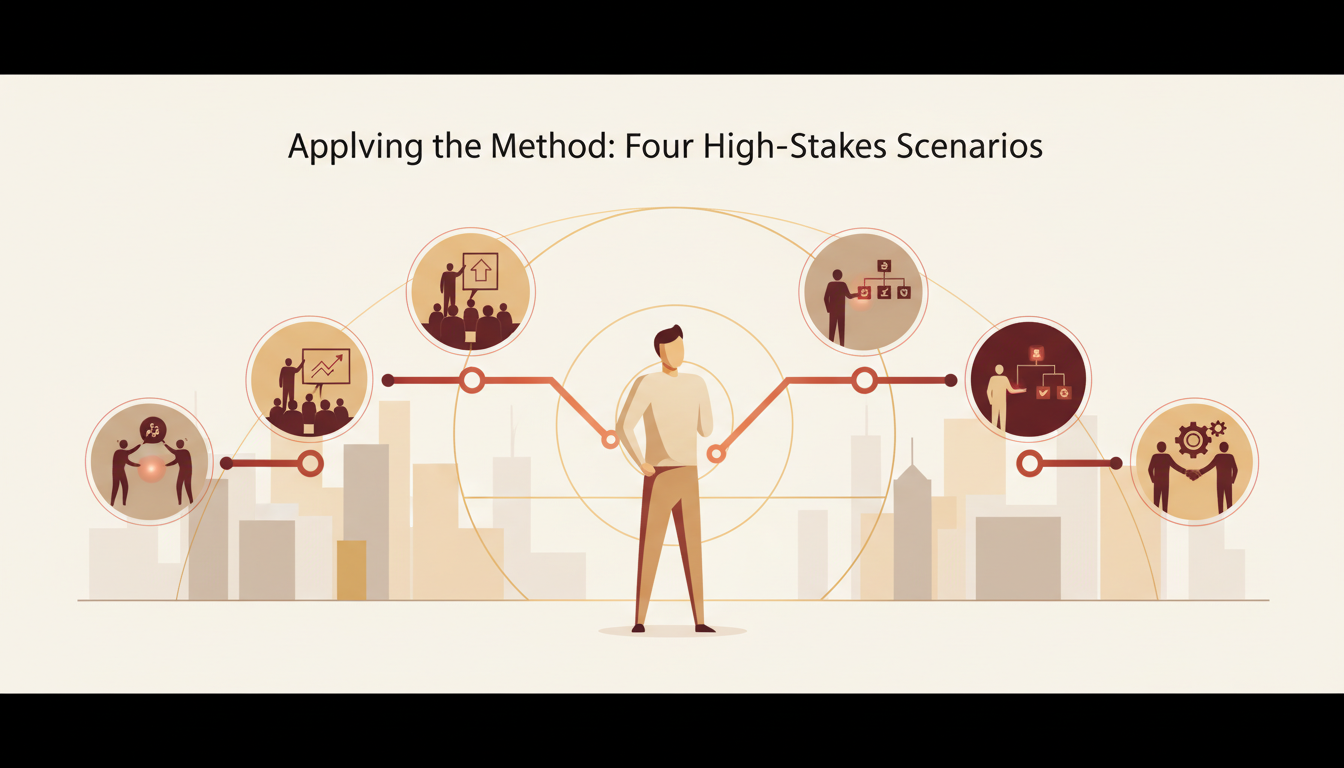
Frameworks are useful. Seeing them applied to real situations is better. Here's how this method works across five common high-stakes scenarios.
Scenario 1: The Performance Review Where You Push for a Promotion
SDO: Secure a specific promotion timeline. Preparation: Document three measurable contributions from the past year. Anticipate the objection: "We don't have budget right now." Prepare the reframe: "I understand timing. What I'm asking for is a committed timeline and the specific criteria I need to meet. That way we both have clarity." Mental rehearsal focus: Visualize yourself stating your case without hedging language ("I think maybe I might be ready..."). Replace it with direct language: "Based on my results this year, I'm ready for this step." Delivery: Use the breathing reset if your manager deflects. Return to your SDO with an anchor phrase: "I appreciate that context. Let's talk about what a realistic timeline looks like."Being assertive at work without being aggressive is the skill that separates professionals who get promoted from those who get overlooked.
Scenario 2: The Board Presentation Under Scrutiny
SDO: Secure board approval for a strategic initiative. Preparation: Lead with the business case, not the details. Boards care about risk, return, and timeline. Prepare for the question: "What happens if this fails?" with a specific mitigation plan. Open with the business problem, not your solution: "We're losing significant market share in our core segment. If this trend continues, we'll fall below profitability threshold within 18 months." Let the problem create urgency, then present your recommendation as the logical response to the evidence. Mental rehearsal focus: Visualize the moment a board member challenges your data. See yourself pausing, acknowledging the question, and responding with evidence. Delivery: Speak in short, declarative sentences. Research from Princeton found that texts using simpler, more direct language were associated with higher perceived intelligence by readers (Oppenheimer, 2006). Avoid filler words and hedging. For a detailed structure on executive-level presentations, see our framework on how to structure a presentation for executives.Scenario 3: The Client Escalation
SDO: Retain the client with a revised agreement. Preparation: Review the full history of the issue. Prepare an ownership statement: "Here's what happened, here's what we've done, and here's what we're committing to going forward." Clients in escalation mode need to feel heard before they'll listen. Mental rehearsal focus: Visualize the client expressing frustration. See yourself absorbing it without defensiveness, then redirecting to solutions. Delivery: Mirror the client's concern back to them before offering solutions. "I hear you—the delays have cost you real revenue, and that's unacceptable. Here's our corrective plan." This technique—acknowledge, own, redirect—defuses most escalations within the first two minutes.Scenario 4: The Difficult Feedback Session
SDO: Deliver clear, actionable feedback while preserving the relationship. Preparation: Write down the specific behavior, its impact, and the change you're requesting. Avoid vague language. "Your communication style needs work" is useless. "In the last three client calls, you interrupted the client an average of four times, which led to two complaints" is actionable. Mental rehearsal focus: Visualize the other person becoming defensive. See yourself staying calm and redirecting: "I'm sharing this because I believe in your potential and want to help you grow." Delivery: Use the SBI framework (Situation-Behavior-Impact) to structure your feedback. Keep your tone steady and warm but direct. If you want to go deeper on delivering tough messages without damaging relationships, read our article on how to disagree professionally without burning bridges.Scenario 5: Pushing Back on a Senior Leader's Decision
SDO: Raise a legitimate concern without damaging the relationship or your standing. Preparation: Lead with shared goals, not opposition. Frame your alternative as a way to achieve the same outcome with lower risk. Delivery: "I'm fully aligned with the efficiency goals behind this restructuring. I want to flag a retention risk I'm seeing that could undermine those goals." Then present your data—turnover costs, team sentiment, competitor hiring trends.Building Long-Term Confidence in High-Stakes Conversations
One successful high-stakes conversation builds confidence. A repeatable system builds career authority. The method above works for individual conversations, but lasting confidence comes from consistent practice and reflection.
The Post-Conversation Debrief
Within 24 hours of any high-stakes conversation, spend 10 minutes on a written debrief. Answer three questions:
- What worked? Which preparation steps, phrases, or techniques served me well?
- What surprised me? What did I not anticipate, and how did I handle it?
- What would I do differently? If I could replay one moment, what would I change?
This debrief is what separates professionals who grow from conversation to conversation from those who repeat the same mistakes. Over time, your debrief notes become a personal playbook—a record of what works for you specifically.
Expanding Your Pressure Tolerance
Confidence in high-stakes conversations is like a muscle. It grows through progressive exposure. Seek out opportunities to practice: volunteer for the client presentation, ask for the difficult conversation, put yourself in rooms where the stakes are slightly above your comfort zone.
Frequently Asked Questions
How do I build confidence in high-stakes conversations quickly?
The fastest path is structured preparation. Define your single desired outcome, establish your core message, anticipate the top three objections, and mentally rehearse the hardest moment you expect. Even 20 minutes of focused preparation using this method can significantly shift your composure and clarity. Confidence isn't a personality trait—it's the result of removing uncertainty before you walk into the room.
What is the difference between confidence and arrogance in professional conversations?
Confidence is grounded in preparation, evidence, and respect for the other person's perspective. Arrogance dismisses other viewpoints and relies on status rather than substance. Confident communicators listen actively, acknowledge valid concerns, and support their positions with data. The key difference is whether you're seeking to persuade or to dominate.
How do I stay calm when someone challenges me in a high-stakes meeting?
Use the breathing reset to interrupt your stress response and give your prefrontal cortex time to re-engage. Then use an anchor phrase like "That's an important point—let me address it directly." If you need physical grounding, press your feet into the floor or touch your thumb to your index finger under the table. Having pre-prepared responses to likely objections also reduces the surprise factor that triggers emotional reactivity.
How do I recover if I freeze or lose my train of thought during a high-stakes conversation?
First, pause. A two-second pause feels like an eternity to you but barely registers with your audience. Then use a recovery phrase: "Let me restate my key point" or "To bring this back to the core issue..." These phrases buy you time and signal intentionality. If you genuinely lose the thread, it's perfectly credible to say, "I want to give that question the attention it deserves—let me come back to you with a thorough answer by end of day."
Can introverts be confident in high-stakes conversations?
Absolutely. Introverts often excel in high-stakes conversations because they tend to prepare thoroughly and listen carefully—two of the most important skills in these moments. The key is to leverage preparation as your superpower: write your core message in advance, rehearse it aloud, and commit to delivering your opening within the first five minutes so the window doesn't close. Our guide on how to build confidence in meetings as an introvert offers specific strategies tailored to introverted communication styles.
How much preparation time do I need for a high-stakes conversation?
For a major board presentation or client escalation, allocate at least 2–3 hours of preparation time, including research, message structuring, objection planning, and at least one verbal rehearsal. For a difficult feedback conversation or a meeting where you need to raise a concern, 30–60 minutes is usually sufficient. The framework in this article can be completed in as little as 20 minutes for lower-complexity situations.
How long does it take to get better at high-stakes conversations?
Most professionals notice a measurable improvement after applying this method to just three to five conversations. The preparation phase creates immediate results because it eliminates the most common cause of poor performance: uncertainty. The mental rehearsal and delivery techniques compound over time. Within three months of consistent practice and post-conversation debriefs, most professionals report a significant shift in how they show up under pressure.
What's the difference between high-stakes conversations and difficult conversations?
All high-stakes conversations are difficult, but not all difficult conversations are high-stakes. A difficult conversation might involve an awkward personal topic with a colleague. A high-stakes conversation specifically involves significant professional consequences—career impact, financial outcomes, or organizational decisions. High-stakes conversations require more structured preparation, audience analysis, and composure management because the consequences of underperforming are magnified.
Never Be Caught Without the Right Words Again
50 word-for-word scripts for being talked down to, interrupted, dismissed, and put on the spot at work, plus five worksheets. PDF, 50 pages.
Get The Pushback Playbook — $27Related Articles

How to Handle Being Talked Down to at Work Professionally
To handle being talked down to at work, stay calm and address the behavior directly using neutral, assertive language. Name the specific behavior without attacking the person by saying something like, "I'd appreciate it if we could discuss this as equals—I have relevant expertise here." Set clear boundaries, document patterns of condescension, and escalate to HR if the behavior continues. The goal is to protect your credibility and professional standing without matching their tone or becoming re

How to Handle Being Interrupted in Meetings Professionally
When you're interrupted in a meeting, pause briefly, maintain open body language, and use a calm redirect phrase such as "I'd like to finish my point" or "Let me complete this thought." The key is responding without escalating—combining assertive language with composed delivery signals confidence and commands respect. Chronic interrupters can be managed through proactive strategies like pre-framing your contributions, building alliances, and addressing the pattern directly in private.

How to Stop Shrinking in High-Stakes Conversations
To stop shrinking in high-stakes conversations, identify the specific verbal and physical habits that undermine your presence—hedging language, collapsed posture, trailing off mid-sentence, and over-qualifying your ideas—then replace each with a confident alternative. The key is building awareness of your default stress responses and practicing deliberate replacement behaviors until they become automatic. Below, you'll find a complete framework with a self-assessment checklist and practice drill