
How to Introduce Yourself Professionally in Any Setting

To introduce yourself professionally, lead with your name, state your role and the specific value you deliver, and tailor your message to the audience in front of you. The best professional introductions are under 30 seconds, focus on credibility rather than job titles alone, and end with a connection point — a question, shared interest, or clear reason the listener should care. This "credibility-first" approach replaces forgettable introductions with ones that signal authority and invite conversation.
What Is a Professional Introduction?
A professional introduction is a brief, intentional statement that communicates who you are, what you do, and why it matters — all within the first moments of a new interaction. It goes beyond reciting your job title; it positions you as a credible, relevant person worth listening to.
Think of it as your verbal business card, except a great professional introduction does something a business card never can: it creates an immediate emotional impression. Research from Princeton psychologists Janine Willis and Alexander Todorov found that people form judgments about trustworthiness and competence in as little as 100 milliseconds — meaning your introduction isn't just what you say, it's the entire package of how you say it.
Why Most Professional Introductions Fall Flat
The Title-and-Company Trap

The most common mistake professionals make is defaulting to a template: "Hi, I'm Sarah, I'm a project manager at Accenture." It's accurate, but it's forgettable. It tells people your label, not your value. In a room of 50 people at a conference, every other person is doing the same thing — and nobody remembers any of them.
The problem isn't a lack of confidence. It's a lack of structure. Without a framework, most people fall back on the safest, blandest version of themselves.
Underselling vs. Overselling
There's a second trap: swinging too far in either direction. Underselling sounds like, "I'm just an analyst in the finance department." Overselling sounds like, "I'm a visionary thought leader disrupting the future of data." Both destroy credibility — one signals insecurity, the other signals inauthenticity.
According to a 2023 survey by LinkedIn, 70% of professionals say they find it difficult to talk about their accomplishments without feeling like they're bragging. This tension is real, and it's exactly why you need a repeatable formula rather than improvisation. If you've struggled with this balance, learning how to be taken seriously at work starts with how you present yourself in the first seconds of any interaction.
The Credibility-First Introduction Formula
Here's a framework you can use in any professional setting. We call it the NAME + NEED + NOTABLE formula.
Step 1: NAME — State Your Name with Authority
Say your first and last name. Say it clearly. Don't rush it, mumble it, or add a nervous laugh after it. Your name is the anchor of your introduction, and how you say it sets the tone for everything that follows.
Pause briefly after your name. This micro-pause signals confidence and gives the listener time to register who you are. Research on body language for leadership presence shows that pacing and pauses are among the most powerful nonverbal credibility signals.
Step 2: NEED — Name the Problem You Solve
Instead of stating your title, state the need you address. This reframes your role in terms of value, not hierarchy.
- Title version: "I'm a senior marketing analyst."
- Need version: "I help B2B companies figure out which marketing channels actually drive revenue — and cut the ones that don't."
The second version is specific, memorable, and immediately tells the listener why they should care. It works because it answers the unspoken question every person has when they meet you: "What's in this for me?"
Step 3: NOTABLE — Add a Credibility Marker
Close with one concrete proof point. This could be a result, a recognizable client, a relevant accomplishment, or a current project that signals expertise.
- "Last quarter, our team's analysis saved $2.3 million in wasted ad spend."
- "I'm currently leading the data strategy for our EMEA expansion."
- "I've spent the last eight years specializing in healthcare SaaS growth."
This isn't bragging — it's evidence. A study published in the Journal of Experimental Social Psychology (Scopelliti et al., 2015) found that people who share accomplishments in a matter-of-fact, relevant way are perceived as more competent and no less likable than those who stay vague.
Full example: "I'm Marcus Chen. I help enterprise sales teams close deals faster by redesigning their proposal process — last year, my clients shortened their average sales cycle by 34%."That's 25 seconds. It's specific. It's credible. And it gives the other person three things to ask about.
How to Adapt Your Introduction to Different Settings
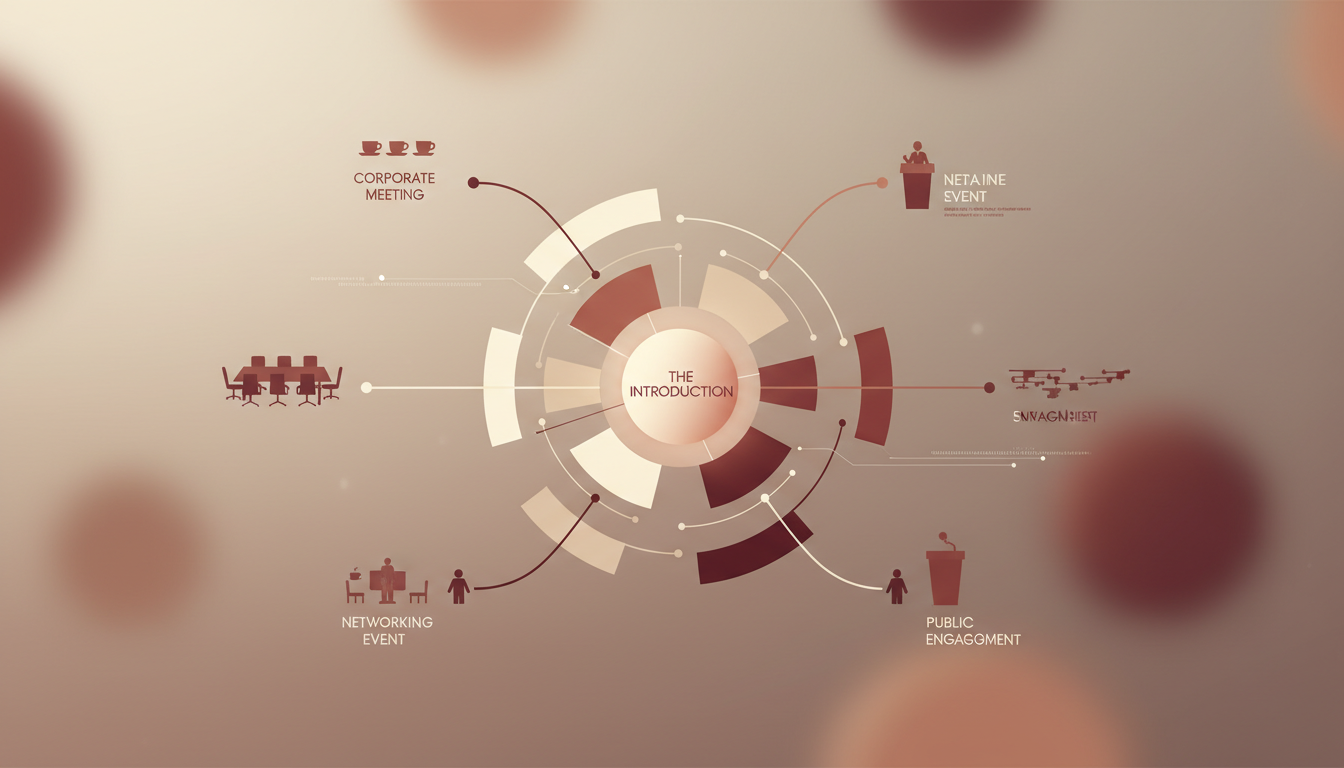
A great professional introduction isn't one-size-fits-all. The core formula stays the same, but the emphasis shifts depending on context.
Job Interviews
In an interview, your introduction is your opening argument. Hiring managers form a strong initial impression within the first 30 seconds, and according to a 2018 study published in the Journal of Occupational and Organizational Psychology, structured first impressions significantly predict interview outcomes.
Interview formula: NAME + Role You're Pursuing + Why You're Uniquely Qualified Example: "I'm Priya Desai. I've spent the last six years building customer success programs at high-growth SaaS companies, and I've been drawn to this role because your team is tackling the exact retention challenges I helped solve at my last company — where we improved net revenue retention from 94% to 112%."Notice: no filler, no "I'm so excited to be here," no rambling autobiography. Just clear, confident positioning. If you want to sharpen this kind of concise delivery, our guide on how to speak concisely at work breaks down the exact framework.
Networking Events and Conferences
At networking events, the goal is conversation, not a monologue. Keep your introduction shorter and end with a hook — a question or shared-interest statement that invites dialogue.
Networking formula: NAME + NEED (brief) + Connection Hook Example: "I'm David Okafor. I run leadership development programs for mid-size tech companies. I'm curious — are you seeing the same thing I am, where managers are getting promoted faster than they're getting trained?"The hook turns your introduction from a broadcast into a conversation. It also subtly positions you as someone who thinks about industry-level problems, which builds professional credibility without you having to state it directly.
Meetings with Senior Leadership
When introducing yourself to executives, respect their time and signal that you understand what matters to them. Executives care about outcomes, not process.
Executive formula: NAME + Your Relevance to Their Priority + One Result Example: "I'm Jenna Walsh, the product lead on Project Atlas. We're the team that reduced onboarding friction by 40% last quarter — and I'm here to walk you through what we're doing next."This approach aligns with the principles in how to communicate with executives effectively: lead with relevance, be specific, and demonstrate that you understand the bigger picture.
Virtual Meetings and Video Calls
On Zoom or Teams, you lose much of your nonverbal presence. Compensate by being slightly more deliberate with your pacing, using your camera effectively (eye-level, good lighting, neutral background), and keeping your introduction 15-20 seconds max.
According to a 2022 report from Grammarly and The Harris Poll, 74% of business leaders say poor communication is the leading cause of lost productivity — and virtual meetings amplify every communication weakness. Your introduction on video needs to be tighter and more polished than in person.
Advanced Techniques: What Sets Great Introductions Apart
Use Strategic Specificity
Vague introductions fade from memory instantly. Specific ones stick. Compare:
- Vague: "I work in consulting."
- Specific: "I help hospital systems cut patient wait times — our last project reduced ER wait times by 28 minutes."
Specificity signals expertise. It tells the listener you don't do "a little of everything" — you do something well enough to measure it.
Master the Vocal Delivery
What you say matters, but how you say it can matter just as much. Three vocal habits that undermine professional introductions:
- Upspeak — ending statements with a rising tone, as if asking a question. It signals uncertainty.
- Filler words — "um," "like," "so basically" erode authority. Learn how to stop using filler words with targeted practice.
- Speed-talking — rushing through your introduction tells people you don't think your words are worth their time.
Practice your introduction out loud at a measured pace. Record yourself. The goal is to sound conversational, not rehearsed — but preparation is what makes that possible.
End with Intentional Energy
The last three seconds of your introduction are what people carry forward. Don't let your energy trail off. Maintain eye contact, keep your voice steady through the final word, and — if appropriate — smile or offer a firm handshake.
This kind of composed finish is a hallmark of leadership presence. It signals that you're someone who is in control of the moment, not someone who's relieved it's over.
Your Introduction Is Just the Beginning. The Credibility Code gives you a complete system for building authority in every professional interaction — from introductions to negotiations to high-stakes presentations. Discover The Credibility Code
Common Mistakes to Avoid
Apologizing Before You Start
"Sorry, I'm not great at this" or "I know this is awkward" immediately frames you as someone without confidence. Skip the disclaimer and go straight into your introduction.
Reciting Your Resume
Nobody wants a chronological work history in conversation. Your introduction should be a highlight reel — one or two relevant points, not a comprehensive timeline. Think of it as a movie trailer, not the full film.
Forgetting to Listen
The best networkers and leaders don't just introduce themselves well — they make the other person feel heard immediately after. Ask a genuine follow-up question. Show curiosity. A professional introduction is the door; listening is what gets you invited inside.
If you want to deepen your ability to hold authority in two-way conversations, especially in high-stakes moments, explore our guide on how to negotiate without being pushy — the same principles apply to any professional dialogue where credibility is on the line.
Frequently Asked Questions
How do you introduce yourself professionally in an email?
Lead with your name, your role, and the reason you're reaching out — in that order. Keep it to two or three sentences. For example: "My name is Alex Rivera, and I lead partnerships at [Company]. I'm reaching out because your work on X aligns with a project we're launching this quarter." For more on written authority, see our guide on executive email writing.
What is the best professional introduction for a job interview?
The best interview introduction combines your name, a concise summary of your relevant experience, and one measurable accomplishment that aligns with the role. Avoid generic statements like "I'm a hard worker." Instead, lead with evidence: "I've spent six years in product management, most recently leading a team that grew user retention by 30%."
Professional introduction vs. elevator pitch — what's the difference?
A professional introduction identifies who you are and what you do in 15-30 seconds. An elevator pitch is a persuasive message designed to sell an idea, product, or yourself for a specific opportunity, usually 30-60 seconds. Your introduction opens the door; your elevator pitch makes the case. In practice, the NAME + NEED + NOTABLE formula bridges both.
How long should a professional introduction be?
Aim for 15-30 seconds in conversation — roughly 40-75 words. In written form (email or LinkedIn), keep it to two or three sentences. Research consistently shows that concise communicators are perceived as more confident and competent. The goal is to say enough to be memorable, not so much that you lose attention.
How do I introduce myself professionally if I'm new to a job?
Focus on your name, your role, and what you're eager to contribute — not what you don't know yet. For example: "I'm Jordan Lee, the new data engineer on the platform team. I spent the last four years building real-time analytics pipelines, and I'm looking forward to digging into the migration project." For more on building credibility quickly, read our guide on building professional credibility fast at a new job.
How can introverts introduce themselves professionally with confidence?
Preparation is an introvert's superpower. Write your introduction using the NAME + NEED + NOTABLE formula, practice it until it feels natural, and focus on one-on-one interactions where you can build depth. Introverts often excel at listening and asking thoughtful questions — lean into that strength right after your introduction. Our guide on building confidence in meetings as an introvert offers additional strategies.
Make Your Expertise Obvious in the First Minute
The Credibility Code helps you describe your work with clarity and authority, whether you are introducing yourself, interviewing, or presenting.
Discover The Credibility CodeRelated Articles

How to Introduce Yourself Professionally: Authority Scripts
To introduce yourself in a professional setting with authority, use this three-part formula: Lead with your name and role, state the specific value you deliver, and connect it to your audience's context. For example: "I'm Sarah Chen, Head of Product at Meridian — I help enterprise teams cut product launch cycles by 40%." Skip generic job descriptions. Instead, frame your introduction around outcomes, relevance, and a clear reason for the other person to remember you.

Personal Brand Elevator Pitch: 10 Powerful Examples
A personal brand elevator pitch is a 30-to-60-second statement that communicates who you are, what you do, and the unique value you bring — all in a way that makes people remember you. The best pitches don't just describe your job title; they position you as an authority. Below you'll find 10 customizable elevator pitch examples for networking events, interviews, leadership meetings, and more, plus a proven framework for building your own from scratch.

Personal Brand Statement Examples for Leaders (With Formula)
A personal brand statement for leaders is a concise 1-2 sentence declaration that communicates who you are, the specific value you deliver, and the unique leadership perspective you bring. The best formula is: "I help [audience] achieve [outcome] through [unique approach]." Below, you'll find 15+ real-world examples across industries and seniority levels, a proven three-part formula, and a self-guided worksheet to craft your own authority-building brand statement today.