
How to Stop Using Filler Words in Professional Speaking

To stop using filler words in professional speaking, you need to first identify your specific filler patterns (um, uh, like, so, basically), then systematically replace them with intentional pauses. The most effective approach combines self-awareness through recording, deliberate pause practice, and structured speaking exercises over a 30-day period. Confident pauses signal authority, while filler words signal uncertainty — and research shows listeners perceive speakers who pause intentionally as more credible and competent.
What Are Filler Words in Professional Speaking?
Filler words are unnecessary sounds, words, or phrases that speakers insert into their sentences when they're thinking, transitioning, or feeling uncertain. Common examples include "um," "uh," "like," "you know," "basically," "actually," "so," and "I mean."
In professional speaking contexts — meetings, presentations, negotiations, and one-on-ones — filler words act as verbal placeholders. They fill silence that the speaker finds uncomfortable, but they come at a real cost: they dilute your message, slow your delivery, and undermine the perception of your expertise. Understanding this distinction between comfortable noise and confident silence is the foundation of sounding confident at work.
Why Filler Words Destroy Your Professional Credibility
The Neuroscience of Listener Perception

When you say "um" or "uh," your listener's brain doesn't just ignore it. Research from the University of Michigan found that speakers who used frequent filler words were rated as less credible, less prepared, and less convincing than those who paused silently instead (University of Michigan, 2014). Your audience is making split-second judgments about your competence, and filler words tip that judgment against you.
Think about the last time you watched a senior executive deliver a keynote. They likely paused — sometimes for two or three full seconds — without a single "um." That silence felt powerful, not awkward. Your brain interpreted those pauses as confidence and control.
The Credibility Tax You're Paying
A study published in the Journal of Nonverbal Behavior found that speakers who used five or more filler words per minute were perceived as 30% less competent than those who used fewer than two per minute (Brennan & Williams, 1995). That's a steep credibility tax for a habit most professionals don't even realize they have.
Here's what that looks like in practice: You're presenting a quarterly strategy update to senior leadership. You say, "So, basically, what we're seeing is, um, a significant shift in, like, customer behavior." Compare that to: "What we're seeing is a significant shift in customer behavior." Same information. Dramatically different impact. If you're preparing for high-stakes presentations, our guide on presenting to senior leadership covers this in depth.
The Gender and Seniority Dynamic
Research from the Harvard Business Review indicates that filler words disproportionately affect how women and younger professionals are perceived in workplace settings (HBR, 2018). While a senior male executive might get a pass for an occasional "um," emerging leaders — especially women — face harsher credibility penalties for the same habit. This makes eliminating filler words not just a communication skill, but a career strategy.
The 5 Most Common Filler Word Patterns (And What Triggers Them)
Pattern 1: The Stalling Sounds — "Um" and "Uh"
These are the classic fillers. They typically appear when your brain is searching for the next word or idea. The trigger is almost always a gap between your thinking speed and your speaking speed.
Common scenario: You're asked an unexpected question in a meeting. "Um, so, uh, I think the timeline is... uh... about six weeks." What's really happening: Your brain needs a moment to retrieve information, and you've trained yourself to fill that moment with sound instead of silence.Pattern 2: The Hedging Words — "Just," "Kind of," "Sort of"
These fillers signal that you're softening your message — often unconsciously. They're especially common among professionals who want to appear collaborative but end up sounding uncertain instead.
Common scenario: "I just kind of feel like we should sort of reconsider the budget." This pattern directly undermines assertiveness, which is why learning to be more assertive in meetings requires addressing these hedging words first.Pattern 3: The Qualifiers — "Basically," "Actually," "Honestly"
These words promise clarity or emphasis but deliver neither. "Basically" implies you're oversimplifying. "Actually" suggests surprise at your own statement. "Honestly" implies that your other statements might not be honest.
Pattern 4: The Connectors — "So," "Like," "You Know"
These fillers masquerade as transitions. Starting every sentence with "So..." or peppering your speech with "like" creates a verbal rhythm that sounds casual at best and unprofessional at worst.
Pattern 5: The Repetition Loop
Some professionals don't use traditional filler words — they repeat phrases instead. "What I'm saying is... what I'm saying is..." or "The thing is... the thing is..." This pattern is harder to detect because it uses real words, but it signals the same underlying uncertainty.
Say it once, and be taken seriously. The Authority Toolkit gives you 8 frameworks, the 7 shifts that make speech sound sure, and 100+ phrases for meetings and email, so the point lands the first time you make it. Get The Authority Toolkit — $27
The 30-Day Filler Word Elimination Framework
Week 1: Awareness and Baseline (Days 1-7)

You can't fix what you can't see. The first week is entirely about building awareness of your specific filler patterns.
Day 1-2: Record yourself. Record at least three real conversations or meetings (with permission) and one solo practice session where you explain a work topic for two minutes. Play them back and tally every filler word. Most professionals are shocked — a study by language analytics platform Quantified Communications found that the average professional uses roughly 5 filler words per minute in unscripted speech (Quantified Communications, 2019). Day 3-4: Identify your triggers. Review your recordings and note when fillers appear. Is it when you're answering questions? Transitioning between ideas? Starting sentences? Defending a position? Your triggers reveal the specific situations to target. Day 5-7: Enlist an accountability partner. Ask a trusted colleague to give you a subtle signal — a tap on the table, a specific hand gesture — every time they hear a filler word in your next few conversations. External feedback accelerates awareness dramatically.Week 2: The Pause Replacement (Days 8-14)
Now that you know your patterns, you'll begin replacing fillers with intentional pauses. This is the hardest week because silence feels uncomfortable at first.
The 2-Second Rule: Every time you feel a filler word coming, close your mouth and pause for a full two seconds. Two seconds feels like an eternity to you. To your listener, it feels like confidence. Practice this in low-stakes conversations first — ordering coffee, chatting with colleagues, phone calls with friends. The Breath Anchor Technique: When you pause, take a short breath through your nose. This gives your pause a physical anchor, makes it feel purposeful to you, and provides your brain the oxygen it needs to find the next word. This technique pairs powerfully with the body language strategies for leadership presence that reinforce your verbal confidence. Daily Practice: Spend five minutes each day speaking aloud about a work topic — explaining a project, summarizing a meeting, pitching an idea. Record it. Count the fillers. Aim to reduce your baseline count by 25% by the end of Week 2.Week 3: Structured Speaking Drills (Days 15-21)
This week introduces targeted exercises that build the muscle memory of clean, filler-free speech.
Drill 1: The One-Minute Monologue. Set a timer for 60 seconds. Pick a random topic (your weekend plans, a book you read, a process at work) and speak about it with zero filler words. If you catch a filler, stop, pause, and restart the sentence. Do this three times daily. Drill 2: The Question Gauntlet. Have a colleague or friend fire rapid questions at you. Before answering each one, pause for two full seconds. This trains you to resist the urge to fill the gap between hearing a question and delivering your answer. This is especially critical for professionals working on executive communication skills. Drill 3: The Transition Bridge. Practice moving between ideas using clean transitions instead of fillers. Replace "So, um, moving on..." with a silent pause followed by "The next consideration is..." or simply a pause and the next sentence. Write out five clean transition phrases and practice them until they feel natural.Week 4: Real-World Integration (Days 22-30)
The final week is about taking your practice into high-stakes professional situations.
Day 22-24: Apply your filler-free speaking in one meeting per day. Don't try to be perfect — aim for a 50% reduction from your baseline. Day 25-27: Volunteer to present or lead a discussion. This puts your skills under pressure, which is where real growth happens. If you're preparing for a leadership presentation, our guide on public speaking for leaders provides a complementary framework. Day 28-30: Record yourself in a real professional conversation and compare it to your Day 1 recording. Most professionals who follow this framework see a 60-80% reduction in filler words within 30 days.Advanced Techniques for High-Stakes Situations
The Power of the Pre-Planned Pause
Before any important meeting, presentation, or negotiation, identify three to four moments where you'll intentionally pause. These might be after your opening statement, before your key recommendation, or after delivering a critical number. Pre-planned pauses prevent fillers from creeping in during your most important moments.
According to research by presentation coach Carmine Gallo, the most effective TED speakers average roughly 2.5 pauses per minute, each lasting one to three seconds (Gallo, Talk Like TED, 2014). These pauses aren't accidents — they're strategic.
The Cognitive Load Reduction Strategy
Filler words spike when your brain is overloaded — when you're trying to remember data, read the room, and formulate your next point simultaneously. Reduce cognitive load by:
- Preparing three key points before any meeting (not a script — just three anchors)
- Using notes without apology — glancing at a notecard is far more professional than filling gaps with "um"
- Simplifying your sentence structure — shorter sentences mean fewer opportunities for fillers to sneak in
The Recovery Protocol
Even after 30 days of practice, you'll occasionally slip. When you catch yourself using a filler word, don't apologize or draw attention to it. Simply pause, take a breath, and continue with a clean sentence. The recovery is invisible to your audience if you handle it with composure. This kind of in-the-moment composure is a hallmark of professionals who have learned to be taken seriously at work.
Frequently Asked Questions
How long does it take to stop saying "um" and "uh"?
Most professionals see a significant reduction — 50-60% fewer filler words — within two to three weeks of deliberate practice. Full elimination in high-pressure situations typically takes six to eight weeks. The key is consistent daily practice, not occasional effort. Recording yourself regularly accelerates the process because awareness is the primary driver of change.
Are filler words ever acceptable in professional speaking?
In casual, low-stakes conversations, occasional filler words are natural and won't damage your credibility. The problem arises in high-stakes situations — presentations, negotiations, executive meetings — where every word shapes perception. The goal isn't robotic perfection. It's having the ability to speak cleanly when it matters most.
Filler words vs. verbal pauses: What's the difference?
Filler words ("um," "uh," "like") are sounds or words that add no meaning. Verbal pauses are intentional moments of silence between thoughts. Filler words signal uncertainty; pauses signal confidence. Research consistently shows that listeners perceive silent pauses as more authoritative than filled pauses. The goal is to replace fillers with deliberate silence.
Can filler words actually cost you a promotion or job opportunity?
Yes. A 2019 survey by communication analytics firm Quantified Communications found that executives rated candidates who used fewer filler words as significantly more "leadership-ready" than those who relied on them heavily. In competitive promotion decisions and job interviews, polished communication often serves as a proxy for competence and preparation.
What's the best app or tool to track filler words?
Several tools can help: Poised and Ummo are apps specifically designed to detect filler words in real time. Otter.ai transcribes your speech so you can search for filler patterns. For a low-tech approach, simply recording voice memos on your phone and reviewing them daily is remarkably effective. The tool matters less than the consistency of your practice.
How do I stop using filler words when I'm nervous?
Nervousness accelerates filler word use because anxiety increases cognitive load. Combat this by preparing three anchor points before any speaking situation, practicing box breathing (inhale 4 seconds, hold 4, exhale 4, hold 4) before you begin, and giving yourself permission to pause. Silence feels longer to you than to your audience. A two-second pause that feels uncomfortable to you reads as composed confidence to everyone else.
Stop Sounding Uncertain in Everyday Conversations
8 communication frameworks, the 7 speech shifts with 30 before-and-after rewrites, 6 email templates, and 100+ phrases for speaking and writing with calm authority at work. PDF.
Get The Authority Toolkit — $27Related Articles

How to Sound Authoritative: 9 Vocal & Language Shifts
To sound authoritative, focus on nine specific shifts: lower your pitch at the end of sentences, eliminate filler words, use the strategic pause, speak at a measured pace, project from your diaphragm, replace hedging language with declarative statements, use precise numbers instead of vague qualifiers, structure thoughts before speaking, and match your body language to your words. These vocal and language changes signal confidence, competence, and credibility — without sounding aggressive.
How to Communicate With Authority at Work: 10 Habits
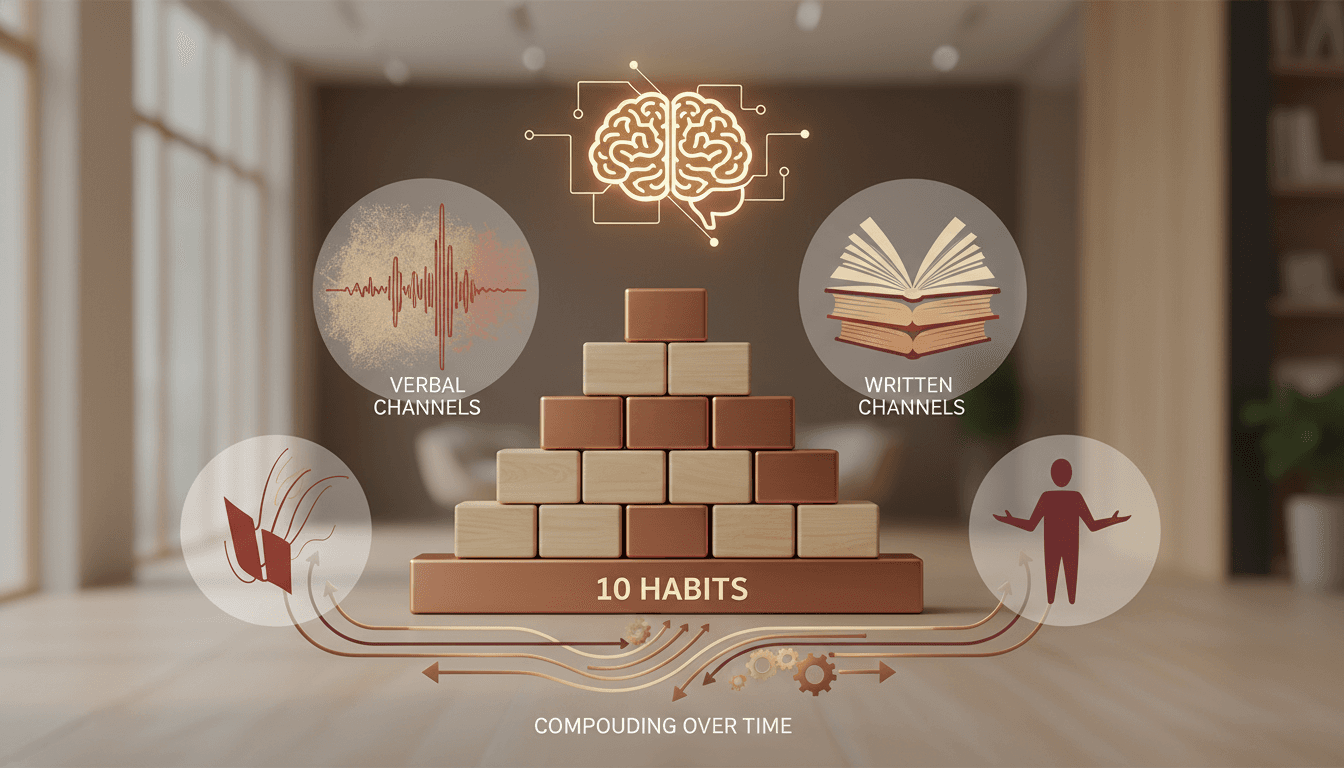
To communicate with authority at work, build ten daily habits across verbal, written, and nonverbal channels: lead with your conclusion, eliminate hedging language, use strategic pauses, anchor your body language, control your vocal tone, write concisely, prepare a point of view before every meeting, ask high-value questions, set verbal boundaries, and follow through visibly. These small, repeatable actions compound over time to build a lasting reputation for credibility and leadership presence.

How to Speak With Authority at Work: 8 Daily Practices
To speak with authority at work, focus on eight daily practices: anchoring your voice in a lower register, eliminating hedging language, using declarative sentence structures, pausing strategically before key points, leading with conclusions, structuring thoughts in threes, practicing assertive body language, and rehearsing high-stakes statements aloud. These habits, practiced consistently over 30 days, transform how colleagues perceive your credibility and competence in every professional inter