
How to Be More Assertive in Meetings (Without Being Aggressive)

What Is Assertive Communication in Meetings?
Assertive communication in meetings is the ability to express your ideas, opinions, and needs clearly and directly while respecting the perspectives of others in the room. It sits in the middle ground between passive communication (staying silent, deferring constantly) and aggressive communication (talking over people, dismissing ideas, dominating the conversation).
In a meeting context, assertiveness looks like contributing your viewpoint without apology, pushing back on ideas you disagree with using logic rather than emotion, and holding your ground when challenged. It's the communication style most associated with leadership credibility and professional influence. For a deeper dive into this framework, see our guide on assertive communication at work with scripts and frameworks.
Why Most Professionals Struggle With Assertiveness in Meetings
The Fear of Being "Too Much"
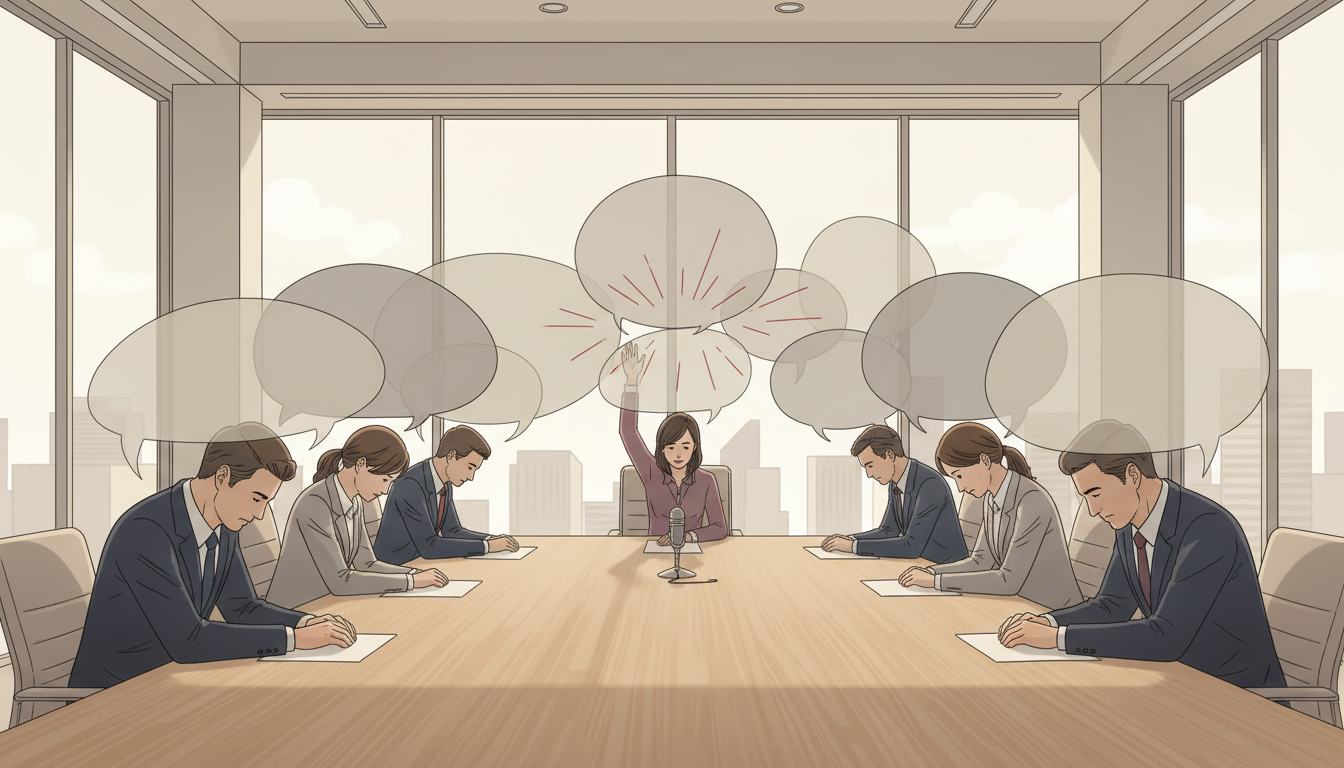
Many professionals — especially women, introverts, and early-career leaders — hold back in meetings because they worry about being perceived as aggressive, pushy, or difficult. A 2023 survey by Catalyst found that 45% of women leaders reported it was difficult to speak up in virtual meetings, and 20% reported feeling overlooked during discussions. This fear creates a self-silencing cycle: you stay quiet, others fill the space, and your contributions go unheard.
The irony is that silence rarely reads as politeness. It reads as disengagement. Colleagues and leaders often interpret a lack of input as a lack of ideas — or worse, a lack of competence.
Confusing Assertiveness With Aggression
The biggest misconception about assertiveness is that it requires force. Aggression involves pushing your agenda at the expense of others. Assertiveness involves advocating for your perspective while making room for dialogue. According to research published in the Journal of Personality and Social Psychology, individuals who communicate assertively (not aggressively) are rated as more competent and more likable by peers.
Understanding this distinction is the first step. If you've been holding back because you don't want to be "that person," you've been solving the wrong problem. The goal isn't to be louder. It's to be clearer.
The Confidence Gap in Group Settings
Group dynamics amplify self-doubt. When you're surrounded by senior leaders or vocal colleagues, the internal narrative shifts from "I have something valuable to say" to "Someone else probably knows more." A study by Hewlett-Packard found that men apply for jobs when they meet 60% of the qualifications, while women apply only when they meet 100%. The same pattern plays out in meetings: many professionals only speak up when they feel 100% certain, which means they rarely speak up at all.
If this resonates, our guide on how to build confidence in meetings, even as an introvert offers additional strategies for overcoming this gap.
5 Techniques to Speak Up Assertively in Any Meeting
1. Prepare Your "Power Three" Before Every Meeting
Assertiveness starts before you enter the room. Review the agenda and identify three points you want to make. Write them down as clear, one-sentence statements — not questions, not hedges. For example:
- Instead of: "I was wondering if maybe we should consider the Q3 timeline?"
- Say: "I recommend we extend the Q3 timeline by two weeks to account for the testing phase."
This preparation eliminates the mental scramble that causes most people to stay silent. You're not improvising; you're executing.
2. Use the "Claim-Evidence-Impact" Framework
When you speak in meetings, structure matters more than volume. The Claim-Evidence-Impact (CEI) framework gives your ideas instant weight:
- Claim: State your position directly. ("We should prioritize the enterprise segment.")
- Evidence: Back it up with data or experience. ("Enterprise deals have a 35% higher close rate and 2x the lifetime value.")
- Impact: Connect it to what the room cares about. ("This shift could increase annual revenue by $1.2M.")
This framework works because it mirrors how executives communicate. It signals that you've thought critically, not just emotionally. For more on this executive communication style, explore our post on how to communicate like an executive.
3. Replace Weak Language With Direct Language
The words you choose signal your confidence level. Research from Harvard Business Review found that professionals who use hedging language ("I just think," "This might be wrong, but," "Sorry, can I add something?") are perceived as less competent and less promotable — even when the substance of their ideas is identical to those delivered with direct language.
Here's a quick reference:
| Weak Phrasing | Assertive Phrasing |
|---|---|
| "I just wanted to mention..." | "I want to highlight..." |
| "Sorry, but I disagree." | "I see it differently." |
| "Does that make sense?" | "Here's why this matters." |
| "I'm not sure, but maybe..." | "Based on the data, I recommend..." |
| "Can I jump in?" | "I'd like to add to that." |
Practice these swaps until they become automatic. They change how people receive your message without changing the message itself. Our article on how to sound confident at work goes deeper into verbal confidence techniques.
4. Anchor Your Body Language to Your Words
Your body communicates before your mouth opens. According to a study by Albert Mehrabian (often cited in communication research), nonverbal cues account for a significant portion of how messages are received, particularly when verbal and nonverbal signals conflict. If you say "I recommend we move forward" while slouching, avoiding eye contact, and speaking softly, the room will trust your body over your words.
Assertive body language in meetings includes:
- Sitting upright with both feet on the floor (signals groundedness)
- Making eye contact with the person you're addressing (signals conviction)
- Using open hand gestures (signals openness, not aggression)
- Pausing before speaking (signals control and thoughtfulness)
- Taking up appropriate physical space (don't shrink into your chair)
For a complete breakdown, see our guide on body language for leadership presence.
Say it once, and be taken seriously. The Authority Toolkit gives you 8 frameworks, the 7 shifts that make speech sound sure, and 100+ phrases for meetings and email, so the point lands the first time you make it. Get The Authority Toolkit — $27
5. Practice the "First Five Minutes" Rule
The longer you wait to speak in a meeting, the harder it becomes. Momentum builds against you. Every minute of silence raises the psychological bar for your first contribution. Make it a personal rule to contribute within the first five minutes of every meeting — even if it's a brief comment, a clarifying question, or a build on someone else's point.
This does two things: it signals to the room that you're engaged and it signals to your own brain that you've "broken the seal." After your first contribution, the second and third come much more easily.
How to Handle Interruptions Without Losing Your Cool
The Calm Redirect Technique

Interruptions are one of the most common meeting frustrations. Research from George Washington University found that men interrupted 33% more often when speaking with women than with other men. But interruptions happen across all dynamics, and how you respond defines your presence.
When interrupted, use the Calm Redirect:
- Pause (don't raise your voice or speed up)
- Acknowledge briefly: "I hear you, Mark."
- Reclaim the floor: "Let me finish this point, and then I'd like to hear your perspective."
This approach is assertive without being combative. It respects the other person while making it clear that you expect the same respect in return.
Building Allies in the Room
Assertiveness doesn't have to be a solo act. Before important meetings, align with a trusted colleague. Agree to amplify each other's points ("I want to build on what Sarah said...") and redirect when someone gets interrupted ("I'd like to hear Sarah finish her thought."). This "amplification strategy" was famously used by women in the Obama White House and has since been adopted in corporate settings worldwide.
When to Let It Go vs. When to Push Back
Not every interruption or disagreement warrants a response. Assertiveness includes discernment. Ask yourself:
- Is this point central to my role or expertise? Push back.
- Is someone misrepresenting my idea? Correct the record.
- Is someone simply adding to the conversation? Let it flow.
- Is a pattern of interruption undermining your credibility? Address it directly, either in the meeting or privately afterward.
Strategic assertiveness means choosing your moments. The person who pushes back on everything loses credibility just as quickly as the person who never speaks up.
Assertiveness in Virtual Meetings: Special Considerations
Overcoming the "Mute Button" Barrier
Virtual meetings add a unique challenge: the physical and psychological distance makes it easier to stay silent. A 2022 study by Microsoft's WorkLab found that 56% of remote workers felt it was harder to contribute in virtual meetings compared to in-person ones. The mute button becomes a comfort zone.
Combat this by keeping yourself unmuted during active discussion portions (when appropriate), using the chat function strategically to reinforce verbal points, and turning your camera on. Visibility drives accountability — when people can see you, they're more likely to invite your input, and you're more likely to give it.
Using the Chat as an Assertiveness Tool
The meeting chat isn't just for links and emojis. It's a second channel for assertiveness. Use it to:
- Summarize your key point in writing after stating it verbally
- Flag data or evidence that supports your position
- Ask direct questions that redirect the conversation
This is especially powerful for professionals who process ideas more slowly or prefer written communication. It's not a workaround — it's a strategic communication channel.
How to Assert Your Ideas Without Alienating Colleagues
Lead With Curiosity, Then State Your Position
One of the most effective assertiveness techniques is to ask a question before making your statement. This isn't hedging — it's strategic framing. For example:
- "What's driving the decision to launch in Q2?" (pause for response) "Based on what I'm seeing in the pipeline data, a Q3 launch gives us a stronger position. Here's why..."
This approach shows that you're engaged with the group's thinking before presenting an alternative. It reduces defensiveness and increases the likelihood that your idea gets a fair hearing.
Use "And" Instead of "But"
The word "but" negates everything that comes before it. "That's a great idea, but I think we should go a different direction" tells the other person their idea isn't actually great. Replace "but" with "and" to build rather than tear down:
- "That's a strong approach, and I think we can strengthen it further by adding a pilot phase."
This small linguistic shift keeps you in collaborative territory while still asserting a different direction. It's a hallmark of leaders who influence without alienating — a core skill covered in our guide on how to be taken seriously at work.
Follow Up After the Meeting
Assertiveness extends beyond the meeting room. Send a brief follow-up email summarizing your key points and any action items you committed to. This reinforces your contributions in writing, creates accountability, and ensures your ideas don't get lost in the noise of a busy discussion. It also positions you as someone who follows through — a critical component of long-term credibility.
Frequently Asked Questions
How can I be assertive in meetings without being rude?
Focus on your message, not your volume. Use direct language ("I recommend..." rather than "I just think maybe..."), maintain calm body language, and acknowledge others' perspectives before presenting your own. Assertiveness is about clarity and respect — rudeness involves dismissing or belittling others. If you're expressing your ideas clearly while listening to others, you're being assertive, not rude.
What is the difference between assertive and aggressive communication?
Assertive communication expresses your needs, ideas, and boundaries while respecting others. Aggressive communication pushes your agenda at others' expense — through interrupting, dismissing, raising your voice, or using intimidation. The key distinction is respect: assertive communicators seek dialogue, while aggressive communicators seek dominance. Both may involve directness, but only aggression involves disregard for others.
How do I stop getting interrupted in meetings?
Use the Calm Redirect technique: pause, briefly acknowledge the interrupter ("I hear you"), then reclaim the floor ("Let me finish this point first"). If interruptions are a recurring pattern, address it directly: "I've noticed I'm getting cut off frequently — I'd appreciate the space to finish my thoughts." You can also build meeting allies who amplify your points and redirect when you're interrupted.
How can introverts be more assertive in meetings?
Introverts can leverage preparation as their superpower. Write down your key points before the meeting, commit to speaking in the first five minutes, and use the chat function in virtual meetings to reinforce your ideas. Assertiveness doesn't require extroversion — it requires clarity. Many of the most assertive communicators are introverts who prepare thoroughly and speak with precision rather than frequency.
What should I say when I disagree with my boss in a meeting?
Frame your disagreement with respect and evidence. Try: "I see the logic in that approach. I'd like to offer an alternative perspective based on [specific data or experience]." Avoid making it personal or emotional. Focus on the idea, not the person. Most effective leaders welcome well-reasoned pushback — it signals that you're thinking critically, not just complying.
How long does it take to become more assertive?
Like any communication skill, assertiveness improves with deliberate practice. Most professionals notice a meaningful shift within four to six weeks of consistent effort — using direct language, preparing for meetings, and practicing techniques like the Calm Redirect. The key is repetition: each meeting is a practice opportunity. Over time, assertive communication becomes your default, not something you have to consciously activate.
Stop Sounding Uncertain in Everyday Conversations
8 communication frameworks, the 7 speech shifts with 30 before-and-after rewrites, 6 email templates, and 100+ phrases for speaking and writing with calm authority at work. PDF.
Get The Authority Toolkit — $27Related Articles

How to Communicate With Authority at Work: A Framework
To communicate with authority at work, you need to master four pillars: language precision (eliminating weak words and using decisive phrasing), vocal delivery (controlling pace, pitch, and pauses), structural clarity (organizing ideas so they land instantly), and conviction signaling (aligning body language, tone, and message). This framework gives you specific, repeatable techniques for each pillar—with before-and-after examples for presenting ideas, giving feedback, and handling pushback.

How to Communicate With Authority at Work: 10 Habits
To communicate with authority at work, build ten daily habits across verbal, written, and nonverbal channels: lead with your conclusion, eliminate hedging language, use strategic pauses, anchor your body language, control your vocal tone, write concisely, prepare a point of view before every meeting, ask high-value questions, set verbal boundaries, and follow through visibly. These small, repeatable actions compound over time to build a lasting reputation for credibility and leadership presence.

How to Sound Confident on Phone Calls: 9 Pro Tips
To sound confident on phone calls, focus on three core areas: vocal delivery, strategic preparation, and active conversation control. Lower your pitch slightly, slow your speaking pace by 10–15%, and eliminate filler words like "um" and "so." Prepare key talking points before every call, stand while speaking to project more energy, and use deliberate pauses instead of rushing to fill silence. These techniques work for client calls, virtual meetings, and internal conversations alike.