
How to Speak Concisely at Work: The Clarity Framework

To speak concisely at work, lead with your main point first (bottom-line-up-front), structure supporting details using the rule of three, and cut filler words ruthlessly. The most respected communicators in any workplace share one trait: they say more by saying less. This article gives you a proven Clarity Framework — including specific techniques, before/after examples, and daily practice methods — so every word you speak earns attention and respect.
What Is Concise Communication?
Concise communication is the ability to express your ideas in the fewest, clearest words possible — without losing meaning, nuance, or impact. It means stripping away filler, tangents, and unnecessary qualifiers so your listener grasps your point immediately.
In the workplace, concise communication isn't about being brief for the sake of brevity. It's about being precise. When you speak concisely, you signal confidence, preparation, and respect for other people's time — three hallmarks of executive-level communication.
Why Concise Speaking Matters More Than You Think
The Cost of Rambling in Professional Settings

Rambling doesn't just waste time — it actively erodes your credibility. According to a 2023 Grammarly and Harris Poll report, poor communication costs U.S. businesses an estimated $1.2 trillion annually, with miscommunication and unclear messaging cited as leading factors. Every time you over-explain in a meeting, you're contributing to that problem.
Think about the last meeting you sat through. Who did you respect most — the person who talked for five minutes to make one point, or the person who made the same point in thirty seconds? The answer is always the same.
What Concise Communicators Earn
Professionals who speak concisely earn three things their long-winded peers don't:
- Attention. People actually listen when they know you won't waste their time.
- Credibility. Brevity signals mastery. You can only be brief when you truly understand a topic.
- Influence. Decision-makers act on clear recommendations, not meandering explanations.
A study published in the Harvard Business Review found that executives consistently rank "the ability to communicate clearly and concisely" as the single most important skill for career advancement. If you want to be taken seriously at work, concise speaking is non-negotiable.
The Psychology Behind Brevity and Trust
There's a psychological reason brevity builds trust. Researchers at the University of Michigan found that speakers who use fewer words to convey a message are perceived as more competent and more confident than those who over-explain. Our brains associate wordiness with uncertainty. When someone rambles, we unconsciously assume they're unsure of their own point.
This is why learning how to speak concisely at work isn't just a communication tactic — it's a credibility strategy.
The Clarity Framework: 4 Steps to Speak Concisely at Work
Here's the framework I recommend to any professional who wants to eliminate rambling and start communicating with authority. It's built on four steps: Lead, Limit, Layer, Land.
Step 1: Lead With the Bottom Line (BLUF)
The Bottom-Line-Up-Front method, originally developed by the U.S. military for efficient communication, is the single most powerful concise speaking technique.
The rule is simple: State your conclusion, recommendation, or key point first. Then provide supporting context only if needed. Before (rambling): "So I've been looking at the Q3 numbers and comparing them to last quarter, and there are some interesting trends with customer acquisition costs going up in the paid channels, and I think we might need to rethink our budget allocation because the organic channels are actually performing better than expected, so my recommendation would be to shift 20% of the paid budget to content marketing." After (BLUF): "I recommend we shift 20% of our paid budget to content marketing. Our Q3 data shows organic channels are outperforming paid on customer acquisition cost."The "after" version is 60% shorter and 100% clearer. The listener gets the point immediately and can ask follow-up questions if they want more detail.
This technique is especially critical when you're communicating with executives, who are notoriously time-pressed and impatient with buildup.
Step 2: Limit to the Rule of Three
Cognitive research consistently shows that people retain information best in groups of three. When you need to support your main point, give three reasons, three examples, or three data points — not seven.
Template: "There are three reasons I recommend this: First… Second… Third…"This structure works in meetings, presentations, emails, and even hallway conversations. It forces you to prioritize and signals to your listener that you've organized your thinking.
Example in a team meeting: "We should delay the product launch by two weeks. Three reasons: First, the QA team found critical bugs in the checkout flow. Second, our marketing assets won't be ready until the 15th. Third, a two-week delay still puts us ahead of the competitor launch on March 1st."Clean. Structured. Persuasive.
Step 3: Layer Details — Don't Front-Load Them
One of the biggest reasons professionals ramble is they try to share every piece of context before getting to the point. The Clarity Framework flips this.
Think of your communication like an inverted pyramid:
- Top layer: Your main point or recommendation (Step 1)
- Middle layer: Three supporting reasons (Step 2)
- Bottom layer: Granular details, data, or backstory — only if asked
This "layered" approach respects your listener's attention. Most of the time, they only need the first two layers. If they want the third, they'll ask. And when they do ask, you'll look even more prepared because you have the details ready.
Say it once, and be taken seriously. The Authority Toolkit gives you 8 frameworks, the 7 shifts that make speech sound sure, and 100+ phrases for meetings and email, so the point lands the first time you make it. Get The Authority Toolkit — $27
Step 4: Land With a Clear Close
Concise communicators don't trail off. They land. Every time you speak — whether it's a 30-second update or a 10-minute presentation — end with a clear closing statement.
Three powerful closers:- The action close: "So the next step is for Sarah to send the revised proposal by Friday."
- The decision close: "I need a go/no-go from this group by end of day."
- The summary close: "In short, we're on track, and the one risk to watch is vendor delivery."
Trailing off with "so, yeah…" or "that's basically it, I guess" destroys the authority you just built. A strong close is what separates someone who speaks concisely from someone who just speaks less.
For more techniques on commanding a room from start to finish, see our guide on leadership presence.
Daily Habits That Build Concise Speaking Skills
The 30-Second Rehearsal

Before any meeting, take 30 seconds to silently answer one question: "If I could only say one sentence, what would it be?" That sentence is your lead. Everything else is supporting detail.
According to research by Dr. Sabina Nawaz, an executive coach who has worked with C-suite leaders at companies like Microsoft and Qualcomm, professionals who mentally rehearse their key point before speaking are 40% less likely to ramble.
This takes almost no time. Do it before every meeting for one week, and you'll notice a dramatic shift.
Record and Audit Yourself
Most people have no idea how much they ramble until they hear themselves. Record a voice memo of yourself explaining a work project in under 60 seconds. Then listen back. Count the filler words. Identify where you repeated yourself. Notice where you buried the lead.
If you want to go deeper on eliminating verbal clutter, our guide on how to stop using filler words gives you a complete system.
The Email-to-Speech Pipeline
Here's a counterintuitive practice: improve your speaking by improving your writing first. Before a meeting, draft your key point as if it were a two-sentence email. That forced brevity translates directly to how you speak.
This habit also improves your executive email writing, creating a virtuous cycle where your written and spoken communication both sharpen.
Real-World Before/After Scenarios
Scenario 1: The Status Update
Before: "So we've been working on the migration project and things have been going pretty well overall, although we did hit a snag with the database last week, but the team worked through the weekend to fix it, and now we're back on track, and I think we should be able to hit the original deadline, assuming nothing else comes up." (54 words) After: "The migration project is on track to hit our original deadline. We resolved a database issue last week — the team patched it over the weekend. No outstanding risks." (29 words) Result: 46% fewer words. The same information. Twice the impact.Scenario 2: The Pitch to Leadership
Before: "I've been thinking about this for a while and I wanted to bring it to the group because I think there's an opportunity here that we might be missing. Basically, our competitors are investing heavily in video content and we're not really doing much in that space, and I think if we allocated some budget to it we could see some good results." (63 words) After: "I recommend we allocate $50K to video content this quarter. Three reasons: our top three competitors have doubled their video output this year, our audience engagement on video posts is 3x higher than static content, and we have in-house production capacity that's currently underutilized." (44 words) Result: The "after" version is specific, structured, and actionable. It's the kind of communication that gets a "yes" from senior management.Scenario 3: Pushing Back in a Meeting
Before: "I mean, I don't want to be difficult or anything, and I see where you're coming from, but I'm not sure if that's the best approach because there are some potential issues that I think we should probably consider before moving forward with that plan." (44 words) After: "I see two risks with that approach. First, it assumes the vendor can deliver by March, which isn't confirmed. Second, it doesn't account for the compliance review, which typically adds two weeks. I'd suggest we build in a buffer." (39 words) Result: Assertive without being aggressive. For more on this balance, read our guide on how to be assertive at work without being aggressive.Common Traps That Make You Ramble (And How to Avoid Them)
The Over-Justification Trap
Many professionals — especially women and early-career employees — feel they need to justify every statement with excessive context. This often stems from imposter syndrome or a fear of being challenged.
The fix: Trust your point to stand on its own. State it. Pause. Let the silence work for you. A 2022 study from the Journal of Experimental Social Psychology found that speakers who paused after key statements were rated as significantly more confident and persuasive than those who filled silence with additional justification.
The Thinking-Out-Loud Trap
Some people process their thoughts verbally. They start talking before they know where they're going. The result is a winding, stream-of-consciousness monologue that loses the room.
The fix: Use the 30-second rehearsal from the habits section above. If you're caught off guard, it's perfectly acceptable to say, "Let me take a moment to think about that" before responding. That pause signals thoughtfulness, not weakness.
The Hedge-Word Trap
Words like "just," "kind of," "sort of," "basically," and "I think maybe" dilute your message. They're verbal hedges that signal uncertainty.
Hedged: "I just kind of think we should maybe consider looking at the data before we basically make a decision." Direct: "We should review the data before making a decision."Cutting hedge words is one of the fastest ways to sound more confident at work.
Frequently Asked Questions
How long should a meeting update be?
A standard meeting update should take 30-60 seconds. Lead with the bottom line (on track, off track, or needs input), give one to three supporting details, and state any action items. If stakeholders need more, they'll ask. Respecting time limits signals professionalism and builds your reputation as a concise communicator.
How can I speak concisely when I'm nervous?
Nervousness triggers rambling because your brain tries to fill silence. Combat this with two techniques: prepare your opening sentence in advance (so you start strong), and practice intentional pausing. A two-second pause feels long to you but sounds confident to your audience. Over time, this rewires your nervous response. For more strategies, explore our guide on building confidence in meetings.
What's the difference between concise communication and being too brief?
Concise communication delivers a complete message in minimal words. Being too brief means omitting critical information, which causes confusion and follow-up questions. The test: after you speak, does your listener have what they need to act or decide? If yes, you were concise. If they're confused, you were too brief. The Clarity Framework's layering technique prevents both problems.
Is concise speaking more important in emails or meetings?
Both — but the stakes are different. In meetings, rambling wastes everyone's time in real time and damages your presence. In emails, wordiness means your message won't get read. According to a 2019 Boomerang study, emails between 50-125 words had the highest response rates. The same principle applies to speaking: shorter, structured messages get better results.
How do I practice speaking concisely every day?
Start with the 30-second rehearsal before every meeting. Then try the "headline test" — before you speak, ask yourself, "What's the headline?" Say that first. Finally, record yourself once a week explaining a project in under 60 seconds and review for filler words and tangents. Consistency matters more than intensity. Two weeks of daily practice creates a noticeable shift.
Can you be concise and still show personality at work?
Absolutely. Concise speaking isn't robotic speaking. You can be warm, humorous, and personable while still being brief. The key is to cut the filler, not the flavor. A well-placed story or analogy — kept to two or three sentences — can be both concise and memorable. Personality builds connection; brevity builds respect. The best communicators deliver both.
Stop Sounding Uncertain in Everyday Conversations
8 communication frameworks, the 7 speech shifts with 30 before-and-after rewrites, 6 email templates, and 100+ phrases for speaking and writing with calm authority at work. PDF.
Get The Authority Toolkit — $27Related Articles
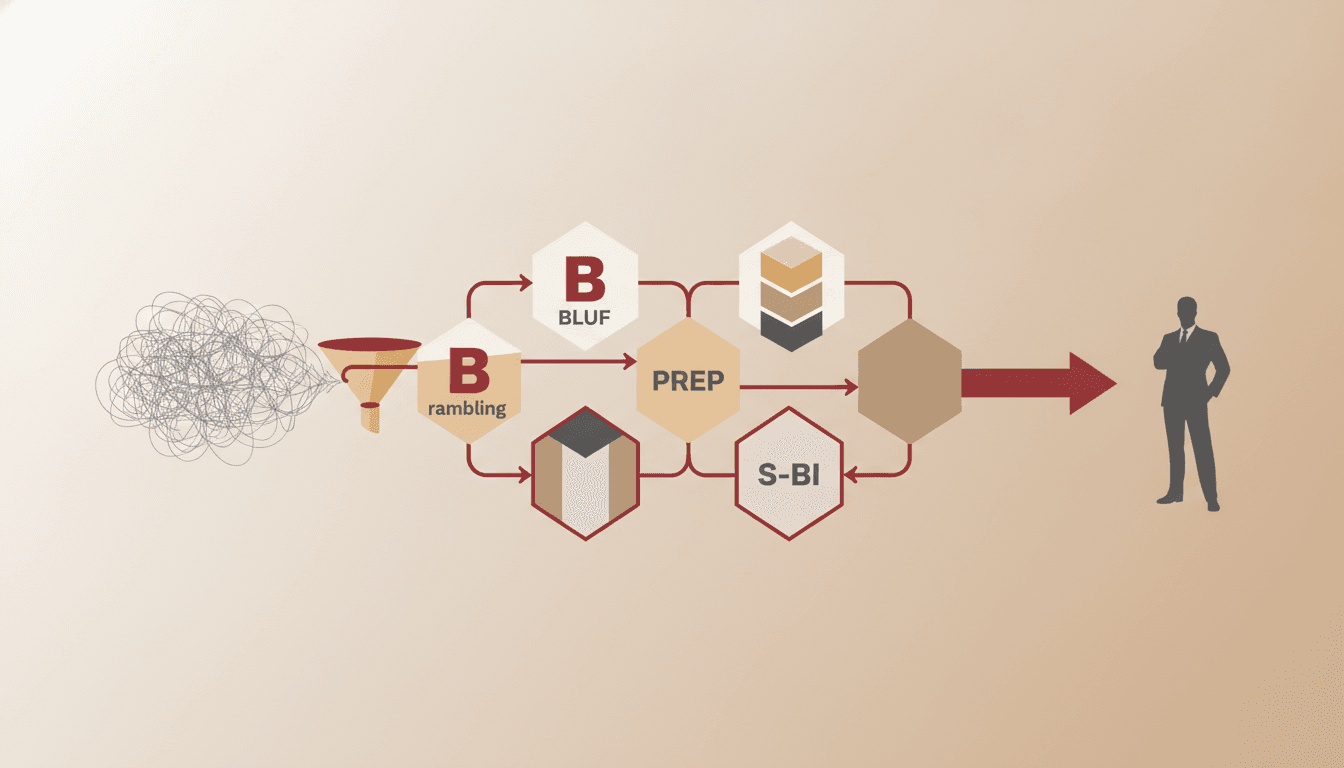
How to Speak Concisely in Meetings: 6 Clarity Frameworks
To speak concisely in meetings, use a structured communication framework that forces you to lead with your point and cut filler. The most effective approach is BLUF (Bottom Line Up Front): state your conclusion first, then provide only the supporting evidence your audience needs. Pair this with the PREP, SBI, What-So What-Now What, Rule of Three, and CEO frameworks outlined below to match any meeting scenario—from status updates to executive briefings.

How to Communicate With Authority at Work: 10 Habits
To communicate with authority at work, build ten daily habits across verbal, written, and nonverbal channels: lead with your conclusion, eliminate hedging language, use strategic pauses, anchor your body language, control your vocal tone, write concisely, prepare a point of view before every meeting, ask high-value questions, set verbal boundaries, and follow through visibly. These small, repeatable actions compound over time to build a lasting reputation for credibility and leadership presence.

How to Sound Confident on the Phone: 9 Pro Techniques
To sound confident on the phone, focus on three core areas: vocal control, strategic preparation, and conversational structure. Lower your pitch slightly, slow your speaking pace by 10–15%, eliminate filler words, and stand while you talk. Prepare a brief agenda or talking points before every call. Use declarative statements instead of hedging language. These techniques work for client calls, conference calls, negotiations, and impromptu conversations — and they can be practiced starting today.