
Words That Make You Sound Less Confident at Work

The words you choose in meetings, emails, and presentations either build your credibility or quietly dismantle it. Certain filler phrases — like "just," "I think," "sorry, but," "does that make sense?" and "I'm no expert, but" — signal uncertainty and invite others to question your authority. These linguistic hedges soften your message, shrink your presence, and train colleagues to overlook your contributions. Below, you'll find the most common confidence-killing words, why they undermine you, and the exact replacement phrases that project authority instead.
What Are Confidence-Undermining Words?
Confidence-undermining words are specific words, phrases, and linguistic hedges that weaken your professional message by signaling doubt, deference, or uncertainty — even when you feel sure of what you're saying. They include qualifiers ("just," "kind of"), unnecessary apologies ("sorry, but"), permission-seeking phrases ("does that make sense?"), and disclaimers ("I'm no expert, but").
These verbal habits are often unconscious. Research from the University of Texas at Austin's Pennebaker Lab shows that function words — the small, structural words we use without thinking — reveal more about our psychological state and social status than the content words we carefully choose. When these hedges stack up in your communication, they create a pattern that colleagues and leaders interpret as a lack of conviction, competence, or authority.
The 12 Words and Phrases That Silently Destroy Your Credibility
"Just" — The Minimizer
"Just" is the single most common confidence killer in professional communication. It shrinks whatever follows it.
Before: "I just wanted to check in on the timeline." After: "I'm checking in on the timeline." Before: "I just have a quick question." After: "I have a question."When you say "just," you're unconsciously apologizing for taking up space. You're signaling that your request, idea, or presence is an imposition. A study published in the Journal of Language and Social Psychology found that hedging language significantly reduces how competent and authoritative a speaker is perceived to be — regardless of the actual quality of their idea.
Remove "just" from your emails and meeting vocabulary entirely. It almost never adds meaning. For more on cleaning up email language specifically, see our guide on how to sound confident in emails.
"I Think" and "I Feel" — The Uncertainty Flags
There's a critical difference between "I think we should move the launch date" and "We should move the launch date." The first invites debate about your confidence. The second invites debate about the idea — which is where the conversation should be.
Before: "I think this approach could work." After: "This approach will work. Here's why." Before: "I feel like the budget is too low." After: "The budget is too low. Here's the data."Use "I think" only when you're genuinely expressing an uncertain opinion and want to signal openness. In most professional settings, you've already done the thinking. State your conclusion.
"Sorry, But" — The Unnecessary Apology
Over-apologizing is one of the most researched confidence killers in workplace communication. A 2010 study in Psychological Science by Karina Schumann and Michael Ross found that women, in particular, apologize more frequently — not because they offend more, but because they have a lower threshold for what constitutes an offense.
Before: "Sorry, but I disagree with that approach." After: "I see it differently. Here's my perspective." Before: "Sorry to bother you, but could you review this?" After: "Could you review this by Thursday?"Reserve apologies for genuine mistakes. When you apologize for having an opinion, asking a question, or doing your job, you train people to see your contributions as intrusions. Our deep dive on how to stop over-apologizing at work provides a complete replacement framework.
"Does That Make Sense?" — The Confidence Check That Backfires
This phrase puts the burden of clarity on the listener while simultaneously questioning your own ability to communicate. It sounds like you doubt your own explanation.
Before: "So the rollout happens in three phases. Does that make sense?" After: "The rollout happens in three phases. What questions do you have?"The replacement — "What questions do you have?" — assumes your explanation was clear and invites engagement from a position of authority rather than uncertainty.
Say it once, and be taken seriously. The Authority Toolkit gives you 8 frameworks, the 7 shifts that make speech sound sure, and 100+ phrases for meetings and email, so the point lands the first time you make it. Get The Authority Toolkit — $27
The Hidden Hedges: Phrases You Don't Realize Are Weakening You
"I'm No Expert, But…" and Other Disclaimers

Disclaimers like "I'm no expert," "This might be a dumb question," and "I could be wrong, but" are preemptive self-defense mechanisms. You're trying to protect yourself from judgment by lowering expectations. But in professional settings, these phrases do the opposite of what you intend — they give people a reason to dismiss you before you've even made your point.
Before: "I'm no expert, but shouldn't we test this first?" After: "We should test this first. Here's the risk if we don't."According to a 2020 study by Wharton professor Cynthia Lee and colleagues published in the Academy of Management Journal, professionals who use self-deprecating qualifiers in team settings are rated as less competent and are less likely to have their ideas adopted — even when the ideas are identical to those presented without qualifiers.
"Kind Of," "Sort Of," "Maybe," and "Probably"
These qualifiers dilute your message by degrees. One "maybe" in a presentation won't destroy you. But when these words become habitual — and they do — they create a pattern of vagueness that erodes trust.
Before: "This will probably increase revenue by about 15%." After: "This will increase revenue by 15%, based on Q3 data." Before: "We sort of need to rethink the strategy." After: "We need to rethink the strategy."Notice how the confident versions are also shorter. Precision and brevity are two hallmarks of how executives communicate differently from mid-level professionals.
"Actually" — The Surprise Qualifier
"Actually" often signals that you're surprised by your own contribution, as if your competence is the exception rather than the rule.
Before: "I actually have experience with this." After: "I have experience with this." Before: "That's actually a great point." After: "That's a great point."Removing "actually" makes your statements sound deliberate rather than accidental.
Before-and-After Scripts: Emails, Meetings, and Presentations
Email Rewrites
Emails are where hedging language does the most cumulative damage because it's written, re-readable, and forwardable. One weak email gets shared with five people. Now five people have a diminished impression of your authority.
Weak email:Hi Sarah, I just wanted to follow up on the proposal. I think the numbers look good, but I could be wrong. Sorry to bother you — does the timeline make sense? Let me know what you think!Strong email:
Hi Sarah, following up on the proposal. The numbers are strong — revenue projections exceed target by 12%. I'd like to confirm the timeline: launch by March 15, with Phase 2 by April 30. What questions do you have?
The strong version is the same length but communicates three times the authority. For a complete framework, read our guide on writing emails that get executive responses.
Meeting Scripts
Weak: "Sorry, can I just jump in? I kind of think we might want to maybe consider another option." Strong: "I want to flag an alternative approach. Here's what I recommend and why." Weak: "I'm not sure if this is relevant, but I feel like the data shows something different." Strong: "The data tells a different story. Let me walk you through it."If speaking up in meetings feels difficult, especially with senior leaders, our strategy guide on how to speak up in meetings with senior leaders offers specific frameworks for contributing with impact.
Presentation Phrases
Weak: "So, I'm just going to talk a little bit about our Q3 results. I think they're pretty good, actually." Strong: "Let me walk you through our Q3 results. We exceeded target in three of four categories."A study by quantified communications firm Quantified found that speakers who use fewer hedging words are rated 28% more persuasive by audiences. Precision in presentations isn't just about confidence — it directly impacts whether your recommendations get adopted.
Why We Use These Words (And Why Awareness Isn't Enough)
The Psychology Behind Hedging
Hedging language serves real psychological functions. It manages social risk. By softening your statements, you reduce the chance of being seen as aggressive, wrong, or presumptuous. This is especially true for women and professionals from underrepresented groups, who face documented backlash for speaking with the same directness as their peers.
Research by linguist Robin Lakoff, whose foundational work on language and gender identified "hedging" as a key feature of powerless speech, shows these patterns are often learned early and reinforced by social feedback. You hedge because, at some point, hedging kept you safe.
But in leadership contexts, the cost of hedging outweighs the safety it provides. The goal isn't to become aggressive — it's to become precise. For a deeper exploration of this balance, see our article on how to be more assertive at work without being rude.
Building a Replacement Habit System
Awareness alone doesn't change language patterns. You need a system. Here's a practical three-step method:
- Audit: Record yourself in three meetings or review your last 10 sent emails. Highlight every hedge word. Count them. Most professionals are shocked — the average is 4-7 hedges per email and 10+ per meeting.
- Replace: Create a personal "swap sheet" of your top five hedges with specific replacements. Keep it visible during calls and while drafting emails.
- Rehearse: Before important meetings or presentations, speak your key points aloud and deliberately remove hedges. This primes your brain to use the stronger phrasing in real time.
This system aligns with the daily habit-building approach in our guide on communicating with confidence at work through daily habits.
The Words That Build Confidence Instead
Power Phrases That Replace Hedges

Once you remove the weak language, fill the gap with phrases that project authority:
- Instead of "I think" → "Based on the data," "My recommendation is," "Here's what I've found"
- Instead of "Sorry, but" → "I'd like to add," "Here's a different perspective," "I see it this way"
- Instead of "Does that make sense?" → "What questions do you have?" or "Here's the key takeaway"
- Instead of "Just" → Delete it. The sentence works without it.
- Instead of "I'm no expert" → "Based on my experience," "In my work on [X]," or simply state your point
The Confidence Language Formula
Use this three-part structure for any professional statement:
Claim + Evidence + Direction- Claim: State your position directly. ("We should delay the launch.")
- Evidence: Support it with data or experience. ("Customer feedback from beta shows three unresolved issues.")
- Direction: Tell people what happens next. ("I recommend we fix these by the 15th and relaunch on the 22nd.")
This formula eliminates hedging by design because every element requires specificity. It's one of the core patterns explored in our guide on how to speak with authority and confidence.
Frequently Asked Questions
What are the most common words that make you sound less confident?
The most common confidence-undermining words are "just," "I think," "sorry but," "does that make sense?", "kind of," "sort of," "maybe," "probably," "actually," and disclaimers like "I'm no expert, but." These hedges signal uncertainty and invite others to question your competence, even when your ideas are strong. Removing or replacing them with direct, specific language immediately increases how authoritative you sound.
How do I stop saying "just" and "sorry" in work emails?
Start with an audit: search your sent emails for "just" and "sorry" and count how often they appear. Then create a replacement list — swap "just checking in" for "checking in" and "sorry to bother you" for a direct request. Before hitting send, re-read every email once and delete unnecessary softeners. Within two weeks of deliberate practice, the habit starts to shift. Our guide on how to be more assertive in emails offers 12 specific before-and-after examples.
Is hedging language always bad in professional settings?
No. Strategic hedging has its place. When you're genuinely uncertain, exploring ideas collaboratively, or navigating sensitive political situations, some softening language can be appropriate. The problem arises when hedging becomes your default mode — when every statement is qualified regardless of your actual confidence level. The goal is intentional language: hedge when you choose to, not because it's a habit.
Hedging language vs. assertive language: what's the difference?
Hedging language softens, qualifies, and minimizes ("I kind of think maybe we should consider..."). Assertive language is direct, specific, and takes ownership ("I recommend we..."). Hedging invites others to dismiss your point; assertive language invites them to engage with it. Assertive communication isn't aggressive — it's clear. It respects both your position and your listener's time.
Can changing my words really make me sound more confident at work?
Yes, and the research supports it. Studies from Quantified Communications show that speakers who eliminate hedging language are perceived as up to 28% more persuasive. Language shapes perception, and perception shapes opportunity. When you speak and write with precision, colleagues, managers, and executives treat your contributions with more weight — which creates a positive feedback loop that builds genuine confidence over time.
Do women need to worry more about hedging language at work?
Research consistently shows that women use more hedging language in professional settings and face a double bind: hedging reduces perceived competence, but overly direct language can trigger backlash. The solution isn't to mimic aggressive communication styles — it's to develop precise, evidence-backed language that projects authority without triggering social penalties. Our guide on how to speak with authority as a woman in leadership addresses this challenge directly.
Stop Sounding Uncertain in Everyday Conversations
8 communication frameworks, the 7 speech shifts with 30 before-and-after rewrites, 6 email templates, and 100+ phrases for speaking and writing with calm authority at work. PDF.
Get The Authority Toolkit — $27Related Articles

Communication Mistakes That Quietly Hurt Your Credibility
The most damaging professional communication mistakes that hurt credibility aren't dramatic blunders—they're subtle habits you repeat daily without realizing it. Hedging language ("I just wanted to…"), chronic over-apologizing, weak email structure, uptalk, filler words, and closed-off body language silently signal uncertainty to colleagues and leaders. Over time, these micro-habits train people to see you as less authoritative, even when your ideas are strong. The good news: each one has a spec

How to Communicate With Authority at Work: A Framework
To communicate with authority at work, you need to master four pillars: language precision (eliminating weak words and using decisive phrasing), vocal delivery (controlling pace, pitch, and pauses), structural clarity (organizing ideas so they land instantly), and conviction signaling (aligning body language, tone, and message). This framework gives you specific, repeatable techniques for each pillar—with before-and-after examples for presenting ideas, giving feedback, and handling pushback.
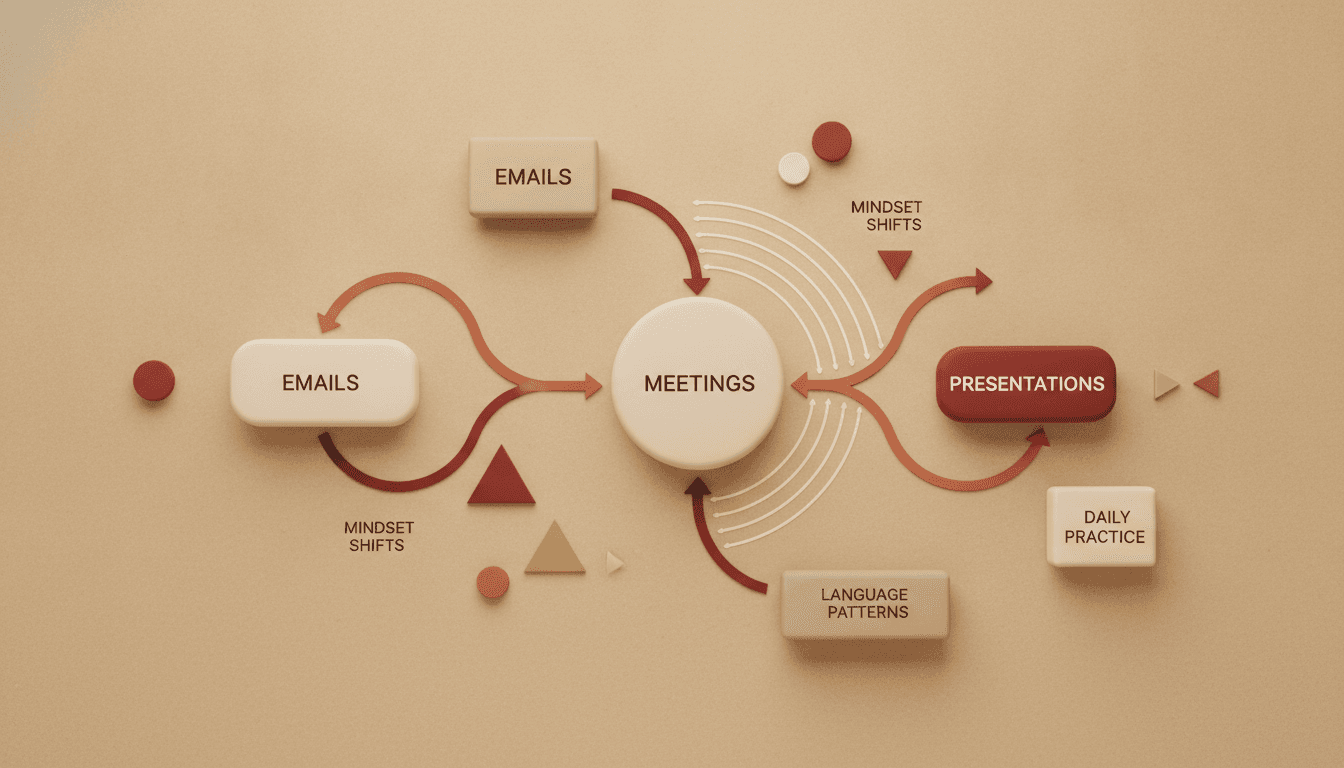
How to Communicate With Confidence at Work: A Complete System
Communicating with confidence at work requires a systematic approach across four dimensions: mindset, language, delivery, and daily practice. Start by eliminating hedging words ("I just think," "sorry, but") from your vocabulary. Then adopt structured speaking frameworks like the Point-Reason-Example-Point method for meetings and presentations. Build a daily practice routine that includes vocal warm-ups, pre-meeting preparation, and post-interaction reflection. Confidence isn't a personality tra