
Be More Assertive at Work Without Being Rude: A Framework
Being more assertive at work without being rude comes down to one principle: advocate for your position while respecting the other person's. The framework that makes this practical is the ACR Method—Acknowledge, Communicate, Reinforce. First, acknowledge the other person's perspective. Then, communicate your position with clear, direct language. Finally, reinforce the relationship by proposing a path forward. This approach lets you hold your ground, set boundaries, and speak up—without damaging trust or burning bridges.
What Is Assertive Communication at Work?
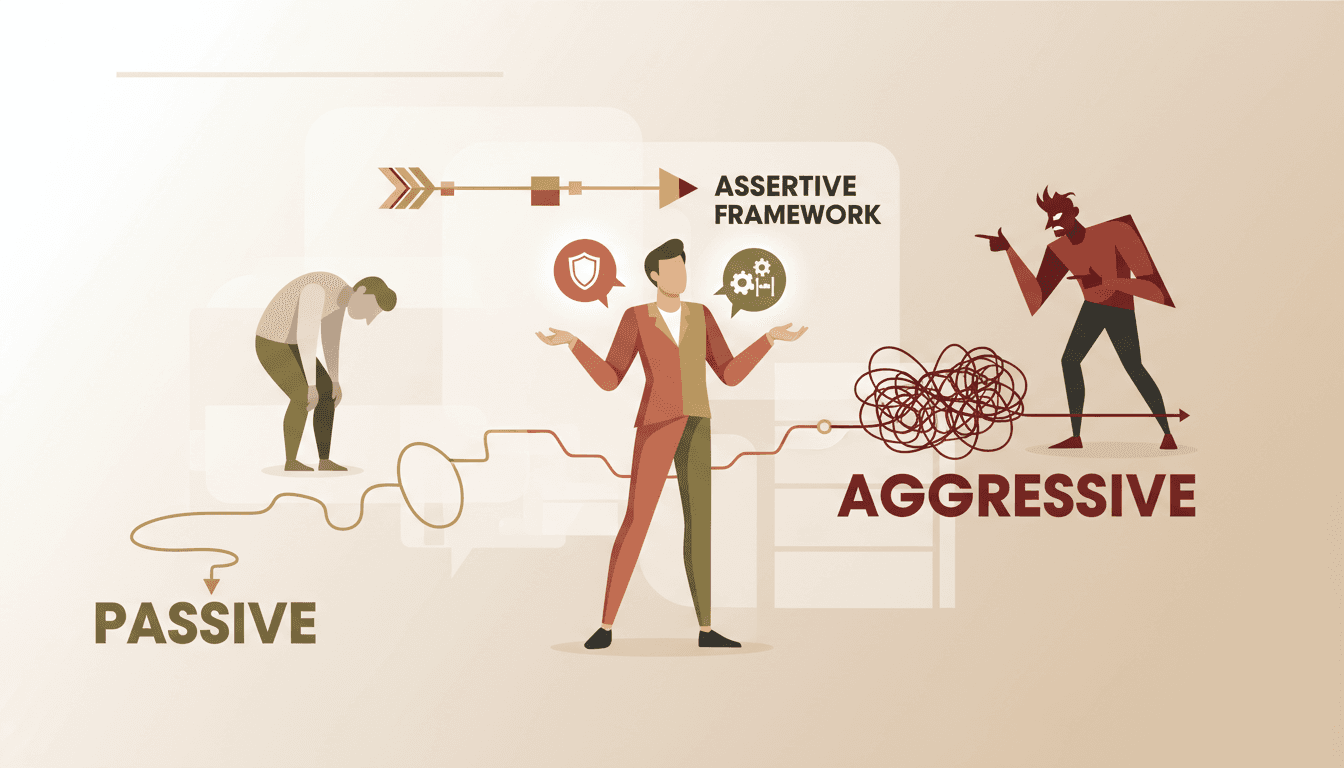
Assertive communication at work is the practice of expressing your needs, opinions, and boundaries clearly and directly while maintaining respect for others. It sits between passivity (staying silent, deferring to everyone) and aggression (dominating, dismissing, or intimidating).
Think of it as professional honesty with a backbone. You say what you mean, you stand behind it, and you do it in a way that invites dialogue rather than shutting it down. Assertiveness isn't a personality trait you're born with—it's a communication skill you build through deliberate practice and the right frameworks.
Why Most Professionals Struggle With Assertiveness
The Rudeness Fear

The number-one reason professionals hold back from assertiveness is the fear of being perceived as rude, aggressive, or difficult. A 2023 survey by VitalSmarts (now Crucial Learning) found that 53% of employees handle crucial conversations by going silent rather than speaking up, often because they fear damaging relationships or their reputation.
This fear is understandable. Most of us have seen someone cross the line from assertive to aggressive, and we don't want to be that person. But the cost of silence is real: missed promotions, resentment, burnout, and a reputation as someone who can be easily overlooked. If you've ever felt that people don't take your contributions seriously, this guide on why people don't take you seriously at work breaks down the root causes.
The Assertiveness–Aggression Confusion
Many people conflate assertiveness with aggression because they've never seen a clean model for the difference. Here's a simple distinction:
- Passive: "Sure, I can take on that project." (while already overwhelmed)
- Aggressive: "That's not my job. Figure it out yourself."
- Assertive: "I understand this project is a priority. Right now, I'm committed to X and Y. Can we discuss which takes priority, or find another solution?"
Assertiveness protects the relationship. Aggression damages it. For a deeper dive into this distinction, see our breakdown of how to be assertive at work without being aggressive.
Cultural and Gender Dynamics
Research from Harvard Business Review shows that women who assert themselves at work face a "likability penalty"—they're rated as less likable when they negotiate or push back, while men exhibiting the same behavior are rated as competent. Similarly, professionals from collectivist cultural backgrounds often report that directness feels disrespectful in their context.
These dynamics are real, but they don't mean assertiveness is off the table. They mean you need a calibrated approach—one that's direct enough to be effective but nuanced enough to navigate social complexity. Our guide on leadership presence for women addresses these dynamics head-on.
The ACR Framework: Acknowledge, Communicate, Reinforce
This is the core framework for assertive communication that protects both your position and your relationships.
Step 1: Acknowledge
Before stating your position, acknowledge the other person's perspective, request, or feelings. This isn't about agreeing—it's about signaling that you've heard them.
Why it works: According to negotiation research from the Harvard Program on Negotiation, people become significantly more receptive to opposing viewpoints when they feel their own perspective has been genuinely heard. Acknowledgment disarms defensiveness. Examples:- "I can see this deadline is important to the team."
- "I understand you need additional support on this project."
- "I appreciate you thinking of me for this."
Step 2: Communicate Your Position
State your boundary, need, or disagreement using "I" statements and factual language. Avoid hedging words like "maybe," "sort of," or "I just think." Be direct without being blunt.
Key principles:- Lead with facts, not emotions
- Use "I" language ("I need," "I'm not able to," "I see it differently")
- Keep it concise—over-explaining signals insecurity
- "I'm not able to take this on before Thursday without delaying the Henderson report."
- "I see the data pointing in a different direction, and I want to share my analysis."
- "I need to protect my bandwidth this week to deliver on my existing commitments."
For more on speaking with this kind of directness, check out how to sound authoritative: 9 habits that earn respect.
Step 3: Reinforce the Relationship
Close with a collaborative statement that shows you're invested in a good outcome for everyone. This is what separates assertiveness from aggression—you hold your ground AND extend an olive branch.
Examples:- "Can we look at the timeline together and find a solution that works?"
- "I'd like to find a way to support this that doesn't compromise our other deliverables."
- "I value this project and want to make sure we set it up for success."
Know exactly what to say next time. The Pushback Playbook has 50 word-for-word scripts for moments like this one: what they say, what you say, why it works, and what to do if they push back. Get The Pushback Playbook — $27
Scripts for 5 Common Assertiveness Scenarios
Frameworks are useful, but scripts are what you'll actually reach for in the moment. Here are five situations where mid-career professionals most often need assertiveness—with exact language you can adapt.

Scenario 1: Pushing Back on an Unreasonable Deadline
The situation: Your manager assigns a project due Friday. It's Wednesday. The scope is a week's worth of work. The passive response: "Okay, I'll try my best." (Then you work until midnight and deliver something mediocre.) The assertive response using ACR:"I understand this is urgent, and I want to deliver quality work on it. (Acknowledge) Based on the scope, I'd need until next Wednesday to do this properly. If Friday is firm, I can deliver [specific reduced scope] by then. (Communicate) Which approach would you prefer? I want to make sure we're aligned on expectations. (Reinforce)"
Scenario 2: Declining a Request From a Colleague
The situation: A peer asks you to take over a task that isn't your responsibility—again. The assertive response:"I appreciate you reaching out, and I know this task is time-sensitive. (Acknowledge) I'm not able to take this on right now—I'm at capacity with [specific commitments]. (Communicate) Have you checked with [appropriate person], or would it help if I pointed you to the right resource? (Reinforce)"
Notice the assertive "no" includes a redirect, not an apology. You're helpful without absorbing someone else's workload.
Scenario 3: Holding Your Ground in a Disagreement
The situation: In a strategy meeting, a senior colleague dismisses your recommendation without engaging with the data. The assertive response:"I hear your concern, and I respect your experience on this. (Acknowledge) I'd like to walk through the data behind my recommendation, because I think it addresses the risk you're flagging. (Communicate) Can I have two minutes to share the analysis? I think it'll give us a stronger basis for the decision either way. (Reinforce)"
For more on navigating disagreements without damaging relationships, see our piece on how to disagree professionally without burning bridges.
Scenario 4: Addressing Being Interrupted in Meetings
The situation: A colleague consistently talks over you in team meetings. The assertive response (in the moment):"I'd like to finish my point—I'll be brief. (Communicate)"The assertive response (in private, after a pattern):
"I've noticed in our last few meetings that I've been cut off before finishing my points. (Acknowledge the pattern) I'd appreciate the space to complete my thoughts, even if we disagree. (Communicate) I think it'll make our discussions more productive for everyone. (Reinforce)"
According to a study published in the Journal of Language and Social Psychology, men interrupt 33% more often than women in mixed-gender professional conversations. If this is a recurring issue, addressing it directly is not rude—it's necessary.
Scenario 5: Negotiating Your Workload With Your Manager
The situation: You've been absorbing extra responsibilities without a title change or compensation adjustment. The assertive response:"I've really valued the opportunity to take on [specific responsibilities] over the past six months. (Acknowledge) I'd like to have a conversation about aligning my role and compensation with the scope of what I'm doing now. (Communicate) I'm committed to this team and want to make sure we set up a structure that's sustainable for the long term. (Reinforce)"
For a deeper dive into this kind of conversation, our negotiation confidence guide offers eight specific tactics for holding your ground.
The Body Language of Assertiveness
What Your Posture and Tone Communicate
Words are only part of the equation. Research by Albert Mehrabian (often cited, frequently misquoted) found that when verbal and nonverbal messages conflict, people trust the nonverbal cue over the words. You can deliver a perfectly assertive script while your body language screams uncertainty.
Key nonverbal signals that reinforce assertiveness:
- Steady eye contact (not staring—natural, confident engagement)
- Open posture (uncrossed arms, shoulders back, feet planted)
- Controlled pace (assertive speakers don't rush; they let their words land)
- Lower vocal register (a slightly lower pitch signals authority; avoid upspeak)
What Undermines Your Assertiveness
Watch for these common nonverbal saboteurs:
- Nervous laughter after making a serious point
- Qualifying body language (tilting your head, shrugging while stating a position)
- Breaking eye contact downward when challenged (looking down signals submission; looking to the side signals thought)
- Fidgeting with pens, phones, or hair
Our comprehensive guide on body language for leadership presence covers the full spectrum of nonverbal authority signals.
Building an Assertiveness Practice: From Framework to Habit
Start With Low-Stakes Situations
Don't debut your new assertiveness in a high-stakes negotiation with the CEO. Start small:
- Stating your restaurant preference when the group asks "Where should we eat?"
- Offering your opinion first in a low-pressure team meeting
- Saying "no" to a minor request without over-explaining
A 2019 study in the Journal of Personality and Social Psychology found that behavioral confidence builds faster through repeated small actions than through occasional large ones. Assertiveness is a muscle. Train it progressively.
Track Your Wins
Keep a brief log of moments where you practiced assertiveness. Note what you said, how it landed, and what you'd adjust. This does two things: it builds self-awareness, and it gives you evidence that assertiveness works—which counteracts the fear of being perceived as rude.
Reframe the Internal Narrative
If your inner voice says "I'm being difficult," replace it with: "I'm being clear." If it says "They'll think I'm rude," replace it with: "They'll know where I stand." Assertiveness reframing isn't about toxic positivity—it's about accuracy. Stating your needs clearly is a professional skill, not a character flaw.
If imposter syndrome is fueling your hesitation, our guide on overcoming imposter syndrome at work provides a structured approach to silencing that inner critic.
Frequently Asked Questions
How can I be assertive at work without sounding rude?
Use the ACR Method: Acknowledge the other person's perspective first, Communicate your position with "I" statements and factual language, then Reinforce the relationship with a collaborative close. This structure ensures your message is direct but respectful. Avoid accusatory "you" language, keep your tone steady, and always propose a path forward rather than just saying no.
What is the difference between assertiveness and aggression at work?
Assertiveness respects both your needs and the other person's. Aggression prioritizes your needs at the other person's expense. An assertive person says, "I need to push back on this timeline—here's why." An aggressive person says, "That deadline is ridiculous." The key difference is whether you're inviting dialogue or shutting it down. Assertiveness builds trust; aggression erodes it.
How do I say no to my boss without getting in trouble?
Frame your "no" as a prioritization conversation, not a refusal. Say: "I want to do this well. Here's what's currently on my plate—can we discuss which takes priority?" This shows commitment and professionalism. Most managers respect employees who proactively manage their workload rather than silently drowning. Always come with a proposed solution, not just a problem.
Can introverts be assertive at work?
Absolutely. Assertiveness is a communication skill, not a personality type. Introverts often excel at assertiveness because they tend to think before speaking, choose words carefully, and listen well—all strengths in assertive communication. The key is preparation: rehearse your ACR scripts before meetings, and use written communication (like email) as an assertiveness channel where you feel more comfortable. See our guide on building confidence in meetings as an introvert.
How long does it take to become more assertive?
Most professionals notice a shift within 2-4 weeks of deliberate practice. Start with one low-stakes assertive action per day—stating a preference, offering an opinion, or setting a small boundary. Research suggests that behavioral habits begin to solidify after roughly 66 days of consistent repetition (Phillippa Lally, European Journal of Social Psychology, 2009). The discomfort fades faster than you expect.
Is it okay to be assertive with senior leadership?
Yes—and senior leaders typically prefer it. Executives value direct communication because it saves time and builds trust. The key is calibration: be respectful of hierarchy while being honest about your perspective. Use data to support your points, and frame your assertiveness as being in service of the team's goals, not just your own. Our article on how to communicate with executives effectively covers the nuances.
Never Be Caught Without the Right Words Again
50 word-for-word scripts for being talked down to, interrupted, dismissed, and put on the spot at work, plus five worksheets. PDF, 50 pages.
Get The Pushback Playbook — $27Related Articles
How to Be Assertive at Work Without Being Aggressive
Being assertive at work without being aggressive comes down to one skill: expressing your needs, opinions, and boundaries with clarity and respect—while staying open to others' perspectives. The key is shifting from reactive emotion to intentional communication. Use "I" statements instead of "you" accusations, state facts before feelings, and propose solutions rather than issuing demands. Assertiveness protects your credibility; aggression destroys it. The difference lies in your delivery, not y

How to Handle Being Talked Down to at Work Professionally
To handle being talked down to at work, stay calm and address the behavior directly using neutral, assertive language. Name the specific behavior without attacking the person by saying something like, "I'd appreciate it if we could discuss this as equals—I have relevant expertise here." Set clear boundaries, document patterns of condescension, and escalate to HR if the behavior continues. The goal is to protect your credibility and professional standing without matching their tone or becoming re

How to Be More Assertive in Workplace Conversations
Being more assertive in workplace conversations starts with understanding the difference between assertiveness and aggression—then practicing specific language patterns that communicate confidence without hostility. Assertiveness means stating your needs, boundaries, and opinions clearly while respecting others. It requires replacing passive habits like hedging and over-apologizing with direct, composed language. The good news: assertiveness is a skill you can build through daily practice, not a