
Leadership Presence vs Executive Presence: Key Differences

What Is Leadership Presence?
Leadership presence is the ability to create trust, inspire action, and influence outcomes through how you show up—in conversations, meetings, and relationships. It is not tied to a title or seniority level.
A project manager who rallies a cross-functional team through a product launch crisis has leadership presence. A junior analyst who calmly reframes a heated debate in a meeting has it too. Leadership presence is about impact on people, not position on an org chart.
According to a 2023 study by the Center for Creative Leadership (CCL), 91% of leaders who scored high on "relational leadership" competencies were also rated as highly effective by their direct reports—regardless of their formal authority. That's leadership presence in action.
For a deeper dive into the foundations, read our guide on leadership presence: what it is and how to build it.
The Core Components of Leadership Presence
Leadership presence rests on three pillars:
1. Authenticity. People follow leaders they trust. Authenticity means your words, actions, and values are aligned. You don't perform confidence—you communicate from a place of genuine conviction. 2. Connection. Leadership presence requires emotional intelligence. You read the room, acknowledge others, and adapt your communication style to meet people where they are. 3. Influence without authority. The hallmark of leadership presence is the ability to move people toward a goal when you have no formal power to compel them. This is why it's so valued in matrixed organizations and cross-functional teams.Who Needs Leadership Presence Most?
Leadership presence is critical for mid-career professionals, team leads, project managers, and individual contributors who want to be seen as leaders before they hold the title. If you've ever been told "you're not ready for the next level" without a clear explanation, a gap in leadership presence is often the real issue.
It's also essential for anyone navigating how to be seen as a leader without a title at work.
What Is Executive Presence?
Executive presence is the combination of gravitas, communication skill, and professional image that signals readiness for senior leadership. It's a narrower, more performance-oriented concept than leadership presence.

The term was popularized by Sylvia Ann Hewlett's research at the Center for Talent Innovation (now Coqual). Her 2012 study found that executive presence accounts for 26% of what it takes to get promoted to senior roles—making it the single largest factor after performance results.
Executive presence is what the C-suite evaluates, consciously or not, when deciding who gets a seat at the table.
The Three Pillars of Executive Presence
Hewlett's research identified three dimensions, and they remain the most widely cited framework:
1. Gravitas (67% of executive presence). This is the ability to project confidence, decisiveness, and composure under pressure. It includes showing you can handle tough questions, make hard calls, and stay calm when stakes are high. 2. Communication (28%). This means speaking concisely, commanding a room, and adapting your message for senior audiences. It's not about charisma—it's about clarity and authority. 3. Appearance (5%). While appearance carries the least weight, it still matters. It signals that you understand the norms and expectations of senior environments.For a structured approach to building this, explore our 5-pillar framework for executive presence.
Who Needs Executive Presence Most?
Executive presence is most critical for directors, VPs, senior managers, and anyone being evaluated for C-suite or board-level roles. If you're already a strong people leader but keep getting passed over for senior promotions, executive presence is likely the gap.
It's also vital for professionals who need to present to C-suite executives or communicate upward regularly.
Leadership Presence vs Executive Presence: A Side-by-Side Comparison
Understanding the differences between these two competencies is essential for knowing where to invest your development energy. Here's a direct comparison across the dimensions that matter most.
Scope and Audience
Leadership presence is broad. It applies in every direction—with peers, direct reports, cross-functional partners, and even people outside your organization. It's about how you influence any room you're in. Executive presence is narrower and more vertical. It's primarily about how you're perceived by senior leaders, boards, and external stakeholders. The audience is "up and out," not "down and across."A 2022 Harvard Business Review article noted that professionals who develop leadership presence first often build stronger teams, while those who develop executive presence first tend to advance faster—but sometimes struggle with team loyalty. The ideal is to build both, sequentially.
Communication Style
Leadership presence communication is connective. You listen actively, ask questions that unlock insight, and create space for others. You might say, "I want to hear from everyone before we decide."
Executive presence communication is directive. You lead with the conclusion, speak concisely, and project certainty. You might say, "Here's my recommendation and the three reasons behind it."
Consider this scenario: A senior manager is presenting a quarterly strategy update. With leadership presence, she opens by acknowledging the team's challenges and asking for input. With executive presence, she opens with a crisp summary of results, a clear recommendation, and handles pushback with composure.
Both approaches are effective—but in different contexts. Learn more about how executives communicate vs managers to see these differences in practice.
How Each Is Evaluated
Leadership presence is typically assessed through 360-degree feedback, team engagement scores, and peer reviews. It shows up in how people talk about you when you're not in the room: "She's someone I'd follow anywhere." Executive presence is assessed through promotion readiness reviews, board evaluations, and senior stakeholder impressions. It shows up in how decision-makers talk about you: "He's ready for the next level."According to a 2023 Korn Ferry report, 72% of organizations use some form of executive presence assessment in succession planning—but only 34% formally assess leadership presence, even though both predict long-term leadership effectiveness.
The Development Path: How to Build Each One
Knowing the difference is step one. The real question is: how do you actually develop each competency? The paths overlap in places but diverge in critical ways.

Building Leadership Presence: The Inside-Out Approach
Leadership presence develops from the inside out. It starts with self-awareness and expands through relationships.
Step 1: Audit your impact. Ask three trusted colleagues: "What's it like to be in a meeting with me?" Their answers will reveal whether you're creating connection or just taking up space. Step 2: Practice active listening at scale. In your next three meetings, speak 30% less and ask 30% more questions. Track how the energy in the room shifts. Step 3: Lead without directing. Find one project where you have no formal authority and practice influencing the outcome through alignment, not instruction. This is the fastest way to build the "influence without authority" muscle. Step 4: Develop emotional range. Leadership presence requires you to match the emotional register of the moment—calm during crisis, energized during launches, empathetic during setbacks. Practice naming the emotion in the room before responding to it.For more on this, see our framework for how to develop leadership presence.
Building Executive Presence: The Outside-In Approach
Executive presence develops from the outside in. It starts with how you're perceived and works backward to the skills that create that perception.
Step 1: Study the room you want to enter. Observe how the most respected executives in your organization communicate. Note their pace, structure, and what they don't say. Executive presence is often about restraint. Step 2: Master the executive communication structure. Lead with the conclusion, support with 2-3 key points, and end with a clear ask or recommendation. This is the "pyramid principle" used in every top consulting firm and most boardrooms. Step 3: Build composure under pressure. Practice handling challenging questions without flinching. The technique: pause for two seconds, restate the core question, then answer directly. This signals gravitas more than any other single behavior. Step 4: Curate your visibility. Executive presence requires strategic exposure. Volunteer for presentations to senior leaders, write executive summaries, and seek sponsors (not just mentors) who can advocate for you in rooms you're not yet in.Our guide on how to speak with authority in any meeting offers specific techniques for Step 2 and Step 3.
Self-Assessment: Which Do You Need to Build First?
Use this diagnostic to identify your primary development area. For each pair of statements, choose the one that resonates more with your current experience.
The Diagnostic Framework
Round 1: Influence Direction- (A) "I struggle to get buy-in from peers and direct reports on my ideas."
- (B) "I struggle to get noticed or taken seriously by senior leaders."
If you chose A, you likely need leadership presence first. If B, you need executive presence.
Round 2: Communication Gap- (A) "People say I'm competent but hard to connect with."
- (B) "People say I'm likable but not authoritative enough."
A points to a leadership presence gap (connection). B points to an executive presence gap (gravitas).
Round 3: Meeting Behavior- (A) "I tend to dominate discussions without drawing others in."
- (B) "I tend to hold back and miss opportunities to share my perspective."
A signals a need for leadership presence (making space for others). B signals a need for executive presence (projecting confidence).
Round 4: Feedback Patterns- (A) "I've been told I need to 'develop my people' or 'build stronger relationships.'"
- (B) "I've been told I need more 'gravitas,' 'polish,' or 'executive readiness.'"
A is a direct flag for leadership presence. B is a direct flag for executive presence.
Interpreting Your Results
If you chose mostly A's, start with leadership presence. Your career will benefit most from deepening your ability to connect, listen, and influence laterally.
If you chose mostly B's, start with executive presence. Your career will benefit most from sharpening how you communicate upward, project confidence, and signal readiness for senior roles.
If your answers were split evenly, focus on building your personal brand for career growth—which sits at the intersection of both competencies.
Find Your Starting Point The Credibility Code provides a structured 5-phase system for building both leadership and executive presence—starting with whichever gap matters most for your career right now. Discover The Credibility Code
Common Mistakes When Developing Presence
Even motivated professionals make predictable errors when trying to build presence. Here are the three most damaging—and how to avoid them.
Mistake 1: Confusing Performance with Presence
Many professionals assume that strong results automatically create presence. They don't. A 2021 McKinsey report on leadership development found that high performers who lacked presence signals were 40% less likely to be promoted to senior roles than peers with comparable results but stronger presence.
Results get you noticed. Presence gets you promoted.
Mistake 2: Copying Someone Else's Style
Trying to mimic a charismatic CEO's speaking style when you're naturally reserved will backfire. Presence must be authentic to be sustainable. The goal isn't to become someone else—it's to amplify the most authoritative version of yourself.
If you're naturally quiet, explore our guide on leadership presence without charisma for an approach that works with your temperament, not against it.
Mistake 3: Developing Only One
Leadership presence without executive presence creates "the beloved manager who never advances." Executive presence without leadership presence creates "the polished executive nobody trusts." You need both—the question is which to build first, not which to build instead.
Frequently Asked Questions
Is executive presence the same as leadership presence?
No. Executive presence is a subset of broader leadership qualities, focused specifically on gravitas, polished communication, and professional image that signal readiness for senior roles. Leadership presence is wider—it includes the ability to inspire, connect, and influence at every level, regardless of title. Think of executive presence as the "upward-facing" dimension of a leader's overall presence.
Can you have leadership presence without a leadership title?
Absolutely. Leadership presence is defined by impact, not position. Individual contributors, project managers, and mid-level professionals demonstrate leadership presence when they influence outcomes, build trust across teams, and create alignment without relying on formal authority. In fact, building leadership presence before you have the title is one of the strongest predictors of eventually earning one.
Which is more important for career advancement—leadership presence or executive presence?
It depends on your career stage. For mid-career professionals moving into management, leadership presence is more immediately valuable because it builds team effectiveness and peer credibility. For senior managers and directors aiming for VP or C-suite roles, executive presence becomes the primary differentiator. The most successful leaders develop both sequentially.
How long does it take to develop executive presence?
Most executive coaches and leadership development programs suggest 6-12 months of focused practice to see meaningful shifts in how others perceive your executive presence. A 2020 study published in the Journal of Leadership & Organizational Studies found that structured executive presence interventions produced measurable perception changes in as few as 90 days—but lasting change required sustained effort over 6+ months.
What's the fastest way to improve leadership presence in meetings?
Start with two shifts: speak less and listen more deliberately, and ask one high-quality question per meeting that reframes the discussion. These two behaviors signal confidence, emotional intelligence, and strategic thinking—all core components of leadership presence. For more specific techniques, see our guide on leadership presence in meetings.
Can introverts develop strong executive presence?
Yes. Executive presence is not about being extroverted or charismatic. The gravitas dimension—which accounts for 67% of executive presence—favors composure, decisiveness, and thoughtful communication. Introverts often excel at these. The key is learning to project confidence in high-visibility moments rather than trying to be "on" all the time.
Build Presence People Notice Before You Say a Word
The Credibility Code gives you the specific verbal and nonverbal habits that make people treat you as the senior person in the room.
Discover The Credibility CodeRelated Articles

Body Language for Leadership Presence: A Complete Guide
Body language for leadership presence is the intentional use of nonverbal cues—posture, eye contact, gestures, facial expressions, and spatial positioning—to project authority, confidence, and credibility in professional settings. Research from UCLA professor Albert Mehrabian found that up to 55% of communication impact comes from nonverbal signals. This guide gives you a complete framework for mastering the physical cues that make people listen, trust, and follow your lead in meetings, presenta
Leadership Presence vs Charisma: Key Differences Explained
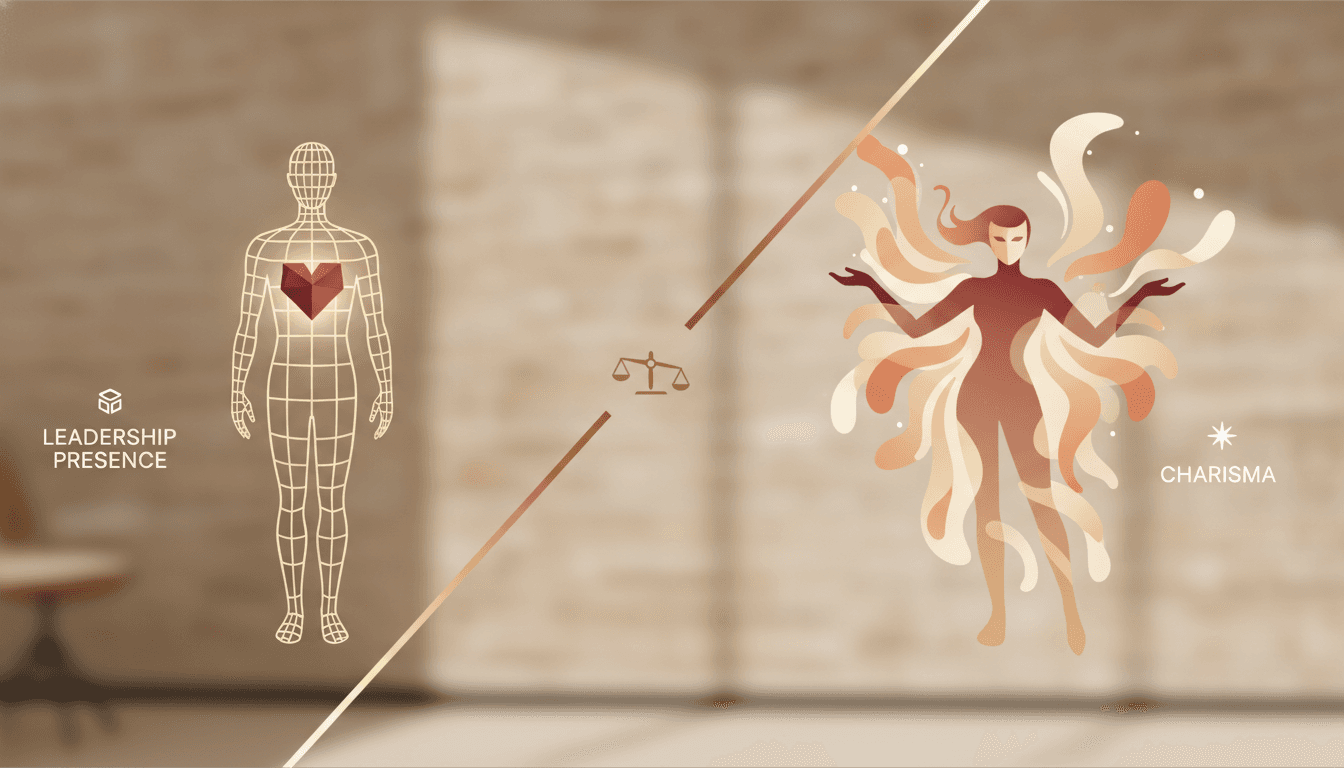
Leadership presence and charisma are often confused, but they are fundamentally different. Charisma is a personality-driven magnetism that draws people in through energy and charm. Leadership presence is a credibility-based authority built on consistency, competence, and composure. The critical difference: charisma is largely innate and situational, while leadership presence is learnable, sustainable, and rooted in trust. Professionals who understand this distinction can stop chasing charm and s

Leadership Presence: What It Is and How to Build It
Leadership presence is the ability to project confidence, competence, and composure in a way that inspires trust and commands attention — even before you speak. It combines gravitas, communication skills, professional appearance, and emotional composure into a unified impression that signals authority. Unlike charisma, leadership presence is a learnable set of behaviors, not an innate personality trait. This article defines each component and gives you a practical framework to develop your own.