
How to Stop Sounding Unsure When Speaking at Work
To stop sounding unsure when speaking at work, eliminate five specific habits: uptalk (rising intonation on statements), hedging phrases ("I think," "sort of," "maybe"), excessive qualifiers ("just," "actually," "kind of"), over-apologizing before sharing ideas, and trailing off at the end of sentences. Replace each with direct, declarative language and practice deliberate pauses instead of filler. These shifts can be trained in as little as two weeks with daily practice.
What Is "Sounding Unsure" in Professional Communication?
Sounding unsure is the pattern of using vocal habits and linguistic choices that signal uncertainty, deference, or low conviction — even when you know your material. It includes rising intonation on statements, hedging words, unnecessary apologies, and weak sentence endings that invite others to dismiss or override your contributions.
This isn't about personality or introversion. It's a set of trainable speech patterns that many professionals develop unconsciously, often as social politeness strategies that backfire in professional settings. The good news: because these are habits, they can be systematically identified and replaced.
Why Professionals Sound Unsure (And Why It Matters)
The Social Conditioning Behind Uncertain Speech

Most people don't sound unsure because they lack knowledge. They sound unsure because they've been socially conditioned to soften their speech to avoid seeming aggressive, presumptuous, or overly confident. This is especially common among professionals who were promoted for technical competence rather than communication skills.
Research from the University of California, San Diego found that uptalk — the rising intonation pattern that makes statements sound like questions — has increased significantly in professional settings over the past two decades, with both men and women using it to signal approachability (Linneman, 2013, Gender & Society). The problem is that approachability and authority often work against each other.
The Career Cost of Uncertain Speech
Sounding unsure doesn't just affect how people perceive your ideas in the moment. It compounds over time. A study published in the Journal of Language and Social Psychology found that speakers who used hedging language were rated as significantly less competent, less hirable, and less persuasive — regardless of the actual quality of their ideas (Hosman & Siltanen, 2011).
Consider the professional consequences: your proposal gets passed over in a meeting. A colleague restates your idea with more conviction and gets the credit. You're described in performance reviews as "needing to develop more executive presence." These aren't random outcomes. They're directly linked to how certainty and uncertainty are communicated through speech patterns.
If you've ever felt overlooked in meetings, uncertain speech habits may be a root cause you haven't examined.
The Confidence-Competence Gap
Here's what makes this frustrating: you may be the most knowledgeable person in the room, but if your delivery signals doubt, listeners will trust their ears over your expertise. Psychologist Albert Mehrabian's widely cited communication research suggests that vocal tone accounts for roughly 38% of how emotional content is interpreted — far more than the words themselves.
This creates a confidence-competence gap. You have the competence, but your vocal delivery doesn't match it. Closing that gap is the single fastest way to change how you're perceived at work.
The 5 Speech Habits That Make You Sound Unsure
Habit 1: Uptalk (Rising Intonation on Statements)
Uptalk turns every statement into a question. Instead of "We should launch in Q3" (downward inflection), it becomes "We should launch in Q3?" (upward inflection). This pattern unconsciously asks the listener for approval or validation.
Before: "The data suggests we should pivot our strategy?" ↗️ After: "The data suggests we should pivot our strategy." ↘️The fix is straightforward but requires practice: consciously drop your pitch at the end of declarative sentences. Record yourself in a low-stakes setting — a voice memo summarizing your day — and listen for rising patterns. Mark every sentence that goes up when it should go down.
Habit 2: Hedging Language
Hedging words are verbal safety nets. They let you share an idea while simultaneously distancing yourself from it, so if it's rejected, you feel less exposed.
Common hedges include:
- "I think maybe we could..."
- "I'm not sure, but..."
- "This might be wrong, but..."
- "I feel like perhaps..."
- "It sort of seems like..."
A study by Textio analyzing over 25,000 workplace communications found that professionals who used fewer hedging phrases were 27% more likely to have their recommendations adopted (Textio Language Bias Report, 2019). The words you wrap around your ideas directly affect whether those ideas gain traction.
For a deeper dive into the specific words undermining your authority, see our guide on 12 words that undermine your credibility at work.
Habit 3: Excessive Qualifiers
Qualifiers are close cousins of hedges, but they operate differently. While hedges express doubt about your idea, qualifiers minimize you or your contribution.
The worst offenders:
- "Just" — "I just wanted to mention..." (minimizes your input)
- "Actually" — "I actually have experience in this." (implies surprise that you'd be competent)
- "Kind of" / "Sort of" — "I sort of led that project." (diminishes your role)
- "Basically" — "Basically, what I'm saying is..." (implies you're oversimplifying)
The difference is stark. The first version contains four qualifiers in a single sentence. The second contains zero — and communicates twice the authority in half the words.
Habit 4: Over-Apologizing Before Contributing
Prefacing your contributions with apologies signals that you believe your input is an imposition. This is one of the most damaging patterns because it frames your value as a burden before you've even delivered it.
Before: "Sorry, can I just jump in here? I'm sorry, but I think there might be an issue with the timeline." After: "There's a timeline issue we need to address."According to a study published in Psychological Science, women apologize more frequently than men in professional settings — not because they believe they've done more wrong, but because they have a lower threshold for what constitutes an offense (Schumann & Ross, 2010). However, this pattern affects professionals of all genders, particularly those in mid-career roles navigating new levels of visibility.
We cover this topic in depth in our article on how to stop over-apologizing at work and what to say instead.
Say it once, and be taken seriously. The Authority Toolkit gives you 8 frameworks, the 7 shifts that make speech sound sure, and 100+ phrases for meetings and email, so the point lands the first time you make it. Get The Authority Toolkit — $27
Habit 5: Trailing Off and Weak Endings
How you end a sentence matters as much as how you start it. Trailing off — letting your voice drop in volume (not pitch) and energy at the end of a statement — signals that you've lost confidence in your own point mid-sentence.
Common trailing-off patterns:
- Starting strong, then fading: "We need to rethink the budget because... you know... it's just not working..."
- Adding unnecessary tags: "We should move forward with this plan, right? Don't you think? I don't know."
- Ending with filler: "So that's basically what I was thinking, so, yeah."
The fix: land your sentences. Treat the last three words of every statement as the most important. Practice saying your final word with the same energy and volume as your first.
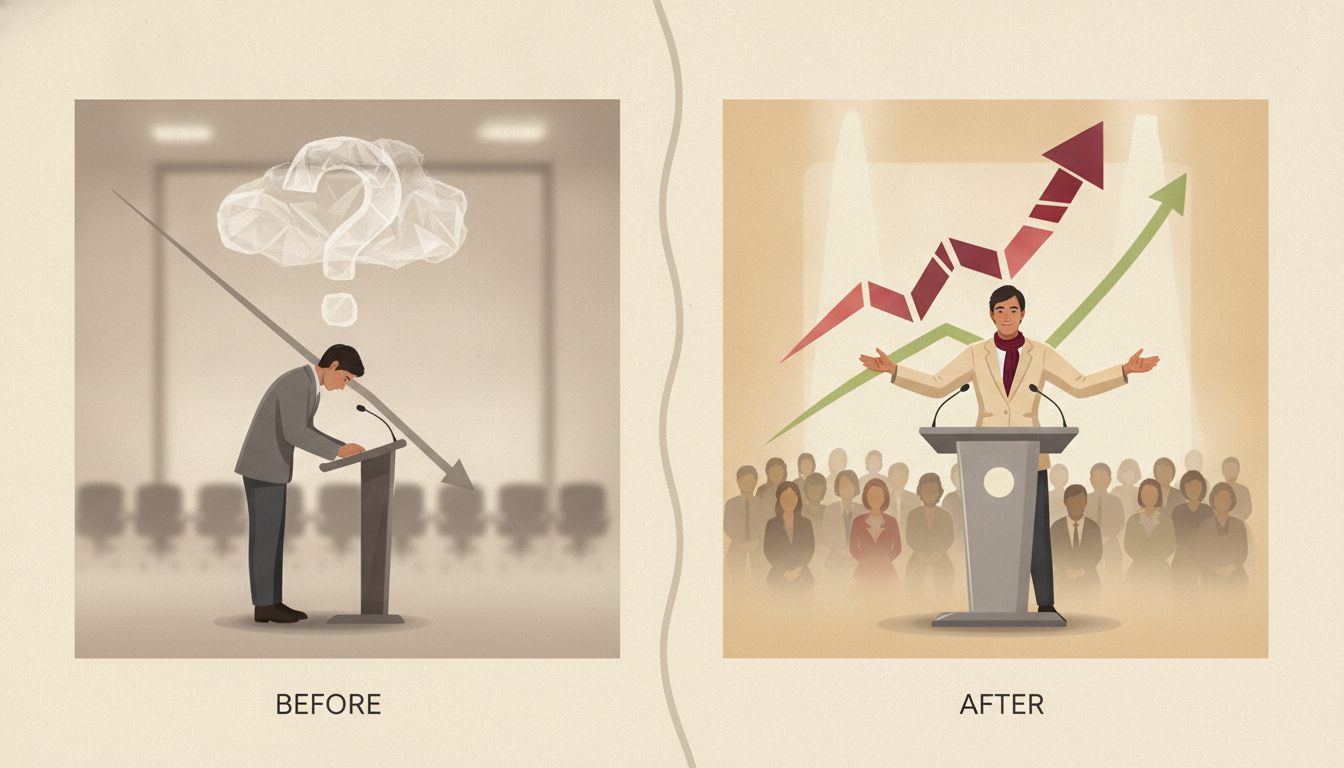
The Before-and-After Framework: 10 Real Workplace Transformations
Meetings and Group Discussions
| Unsure Version | Authoritative Version |
|---|---|
| "Sorry, I just had a quick thought..." | "I want to add something here." |
| "I could be wrong, but maybe the data shows...?" | "The data shows a 15% decline. Here's what I recommend." |
| "Does that make sense? I don't know." | "Here's what that means for our Q3 plan." |
| "I feel like maybe we should consider..." | "I recommend we consider two options." |
| "This is probably a dumb question, but..." | "I have a question about the methodology." |
Presentations and Pitches
| Unsure Version | Authoritative Version |
|---|---|
| "So, um, I'm going to try to talk about..." | "Today I'll walk you through three findings." |
| "I'm not really an expert on this, but..." | "Based on my analysis of the data..." |
| "Hopefully that made sense? Any questions, I guess?" | "That's the core recommendation. I'll take questions." |
| "I think this sort of shows that maybe..." | "This data confirms a clear trend." |
| "Sorry this is taking so long..." | "Let me walk you through the final point." |
Notice the pattern: every authoritative version is shorter. Confidence is concise. Uncertainty is wordy. If you want to go deeper on vocal shifts for meetings specifically, explore our guide on how to sound confident in a meeting with 9 vocal shifts.
Daily Drills to Build Vocal Certainty
The Morning Declaration Drill (5 Minutes)
Before your workday begins, practice making ten declarative statements out loud. These can be about anything — your morning routine, the weather, your plans for the day. The only rule: every sentence must end with a downward inflection and no qualifiers.
Example sequence:- "I'm starting the day with my highest-priority project."
- "The report is due Thursday and I'll finish it by Wednesday."
- "I have three meetings today and I'm prepared for each one."
This drill rewires your default speech pattern. Within two weeks, downward inflection on statements will feel natural rather than forced.
The Record-and-Review Method
Once per week, record yourself in a real work conversation (with permission) or during a practice run of a presentation. Listen back with a tally sheet and count:
- Uptalk instances
- Hedge words
- Qualifiers ("just," "actually," "kind of")
- Apologies before contributions
- Trailing-off endings
Research on deliberate practice from psychologist Anders Ericsson shows that targeted feedback loops — identifying specific errors and correcting them — accelerate skill development by 2-3x compared to general practice (Ericsson, 2008, Cambridge Handbook of Expertise). You can't fix what you can't hear.
The Pause Replacement Technique
Most uncertain speech habits exist because silence feels uncomfortable. When you'd normally fill a pause with "um," "sort of," "I think," or "you know," replace it with a deliberate one-second pause instead.
Uncertain: "So, um, I think, you know, we should probably, like, revisit the strategy." With pauses: "We should revisit the strategy. [pause] Here's why."Pauses don't make you sound uncertain — they make you sound thoughtful. Senior leaders use pauses strategically to signal that their words carry weight. For more on this technique, see our article on how to stop rushing when presenting.
The Power Phrase Bank
Build a personal bank of strong opening phrases to replace your default uncertain starters. Keep this list visible during meetings and calls until the phrases become automatic.
Replace these starters:- "I just think..." → "My recommendation is..."
- "Sorry, but..." → "I want to flag something."
- "I'm not sure, but..." → "Based on what I've seen..."
- "This might not be right..." → "Here's my read on this."
- "Can I just say..." → "Here's what I'd add."
Advanced Strategies: Speaking With Authority Under Pressure
When You're Challenged or Put on the Spot
The hardest time to sound certain is when someone pushes back on your idea or asks a question you didn't expect. This is where uncertain speech habits flood back — because the social pressure to hedge is highest.
Use the ACE framework for high-pressure moments:
- Acknowledge the question directly: "That's an important consideration."
- Clarify your position with evidence: "The data from our pilot shows a 22% improvement."
- End with a clear stance: "I stand by this recommendation."
What you don't do is equally important: don't start with "That's a great question" (stalling), don't say "I could be wrong" (undermining), and don't trail off into "so, yeah" (weak ending).
For more frameworks on handling pressure moments, check out our guide on how to respond when put on the spot at work.
When You Genuinely Don't Know the Answer
Sounding certain doesn't mean pretending to know everything. It means communicating what you do know with confidence, and handling what you don't know without undermining your overall credibility.
Uncertain response: "Um, I'm not really sure about that... I think maybe the number is around 40%? Sorry, I should have looked that up." Confident response: "I don't have that specific figure in front of me. I'll confirm it and follow up by end of day. What I can tell you is that the trend line is moving in our favor."The confident version admits the gap, commits to a resolution, and immediately redirects to what you do know. This is a hallmark of how senior leaders communicate — they're comfortable with what they don't know because they're certain about what they do.
Building Long-Term Vocal Authority
Eliminating uncertain speech is the first step. Building genuine vocal authority — the kind that makes people lean in when you speak — requires developing what communication experts call "vocal gravitas."
Three elements of vocal gravitas:
- Pace control: Speak 10-15% slower than conversational speed in professional settings. Rushing signals anxiety.
- Volume consistency: Maintain steady volume from the first word to the last. Don't let energy drain at sentence endings.
- Strategic emphasis: Stress the words that carry your core message. "We need to act now" hits differently than "we need to act now" delivered in monotone.
For a complete system on developing your vocal authority, explore our framework on how to speak with authority in any meeting.
Frequently Asked Questions
How long does it take to stop sounding unsure when speaking?
Most professionals notice a significant shift within two to four weeks of daily practice. The key is targeted repetition — not just awareness, but actively drilling replacement phrases and vocal patterns. Recording yourself weekly accelerates progress because you can track specific improvements. Complete habit replacement typically takes 60-90 days of consistent practice.
What's the difference between sounding unsure and being humble?
Humility is acknowledging what you don't know while still communicating what you do know with clarity and conviction. Sounding unsure undermines everything you say — including things you're certain about. You can be humble and authoritative simultaneously: "I haven't analyzed every angle yet, but based on what I've reviewed, I recommend we proceed." That's humble. "I could be wrong, but maybe we should, like, think about proceeding?" That's uncertain.
Why do I sound unsure even when I know the material?
This is almost always a habit issue, not a knowledge issue. Your brain has automated certain speech patterns — hedging, uptalk, qualifiers — as social safety mechanisms. Under pressure, these default patterns activate regardless of your expertise level. The solution isn't more preparation; it's retraining your default speech patterns through deliberate vocal practice.
Can sounding unsure affect my chances of getting promoted?
Yes. A 2019 survey by the Center for Talent Innovation found that executive presence — which includes how you communicate — accounts for 26% of what senior leaders say it takes to get promoted. Uncertain speech directly undermines perceived leadership readiness. Decision-makers consistently promote people who communicate with conviction, even when those people have comparable or lesser technical skills.
How do I stop sounding unsure in emails, not just speaking?
Many of the same linguistic patterns — hedging, over-qualifying, apologizing — appear in written communication too. Audit your sent emails for phrases like "just wanted to check," "sorry to bother you," and "I was wondering if maybe." Replace them with direct alternatives. For a complete email transformation guide, see our article on how to stop sounding unsure in emails.
Does sounding unsure affect men and women differently at work?
Research shows that both men and women use uncertain speech patterns, but women are penalized more harshly for them. A Georgetown University linguistics study found that women's use of uptalk and hedging was more likely to be interpreted as incompetence, while men using the same patterns were sometimes perceived as collaborative. This makes eliminating uncertain speech especially high-impact for women in leadership — though the strategies benefit everyone equally.
Stop Sounding Uncertain in Everyday Conversations
8 communication frameworks, the 7 speech shifts with 30 before-and-after rewrites, 6 email templates, and 100+ phrases for speaking and writing with calm authority at work. PDF.
Get The Authority Toolkit — $27Related Articles

How to Sound Confident on Phone Calls: 9 Pro Tips
To sound confident on phone calls, focus on three core areas: vocal delivery, strategic preparation, and active conversation control. Lower your pitch slightly, slow your speaking pace by 10–15%, and eliminate filler words like "um" and "so." Prepare key talking points before every call, stand while speaking to project more energy, and use deliberate pauses instead of rushing to fill silence. These techniques work for client calls, virtual meetings, and internal conversations alike.
How to Communicate With Authority at Work: 10 Habits
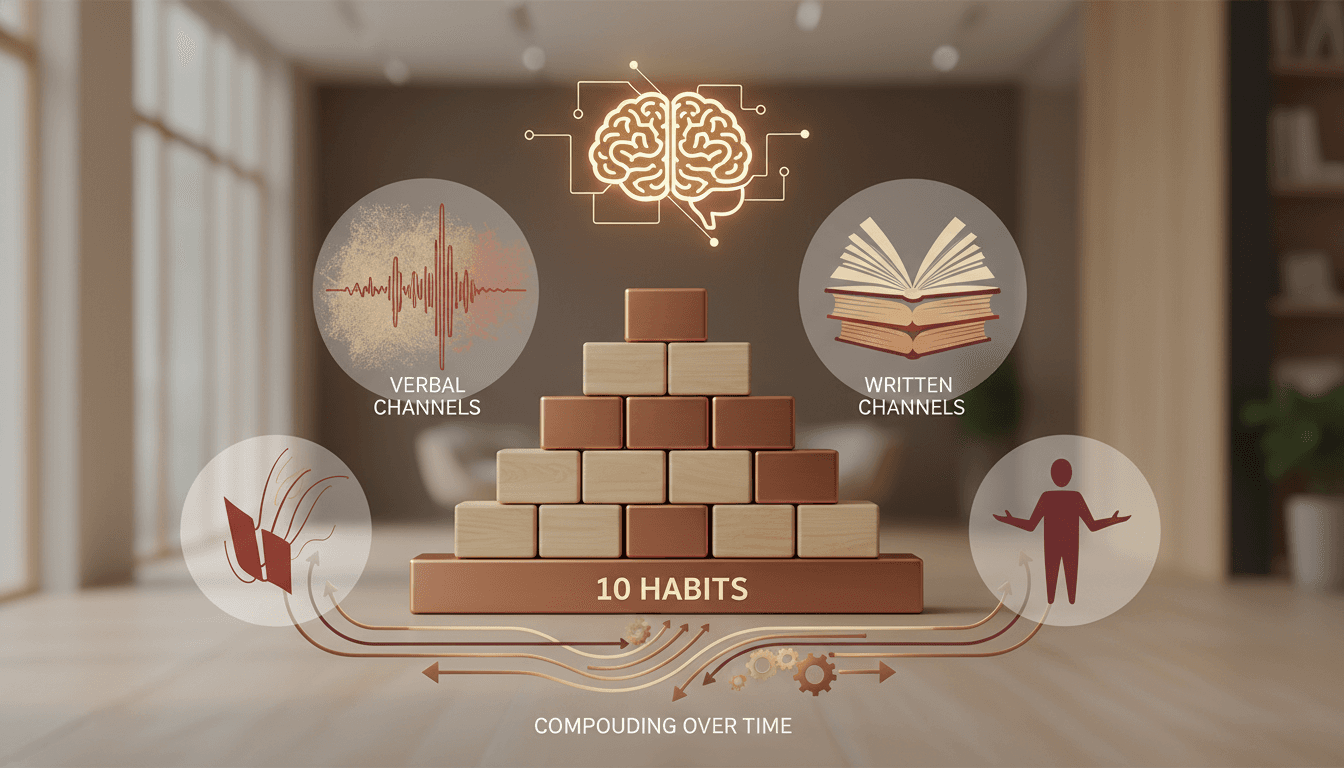
To communicate with authority at work, build ten daily habits across verbal, written, and nonverbal channels: lead with your conclusion, eliminate hedging language, use strategic pauses, anchor your body language, control your vocal tone, write concisely, prepare a point of view before every meeting, ask high-value questions, set verbal boundaries, and follow through visibly. These small, repeatable actions compound over time to build a lasting reputation for credibility and leadership presence.

How to Speak With Authority at Work: 8 Daily Practices
To speak with authority at work, focus on eight daily practices: anchoring your voice in a lower register, eliminating hedging language, using declarative sentence structures, pausing strategically before key points, leading with conclusions, structuring thoughts in threes, practicing assertive body language, and rehearsing high-stakes statements aloud. These habits, practiced consistently over 30 days, transform how colleagues perceive your credibility and competence in every professional inter