
How to Stop Rushing When Presenting: 6 Pro Fixes
You rush through presentations because your nervous system interprets public speaking as a threat, triggering a fight-or-flight response that accelerates your heart rate, breathing, and speech. To stop rushing when presenting, use these six proven fixes: breath anchoring before and during your talk, strategic pausing at key transitions, chunking your content into digestible segments, audience-focused eye contact to regulate pace, mental rehearsal at half-speed, and physical grounding techniques. Each method retrains your body and mind to deliver with calm, commanding authority.
What Is Rushing in Presentations?
Rushing in presentations is the involuntary acceleration of speech rate, often caused by nervous energy, that compresses your message, eliminates natural pauses, and reduces audience comprehension. It typically manifests as speaking above 170 words per minute, skipping planned content, racing through slides, and ending well before your allotted time.
Rushing is not simply "talking fast." Some speakers are naturally quick yet perfectly clear. The distinction is control. A rushed presenter has lost deliberate command of their pacing, and the audience can feel it. The result: your credibility drops, your key points blur together, and listeners disengage—even when your content is excellent.
Why Professionals Rush Through Presentations
The Nervous System Hijack

When you stand in front of a room—or a camera—your amygdala can register the experience as a social threat. According to research published in the Journal of Experimental Social Psychology, public speaking activates the hypothalamic-pituitary-adrenal (HPA) axis, producing cortisol spikes that mirror acute stress responses (Kirschbaum et al., 1993). That cortisol surge accelerates your internal clock. What feels like a comfortable pace to you sounds like an auctioneer to your audience.
This is why you might finish a 20-minute presentation in 12 minutes and genuinely believe you nailed the timing. Your perception of time compresses under stress.
The "Get It Over With" Instinct
Many professionals unconsciously treat presentations as something to survive rather than something to command. This survival mindset creates a subconscious goal: finish as fast as possible. You skip transitions, barrel through evidence, and rush your conclusion—all to escape the discomfort.
If this resonates, you're not alone. A Chapman University survey found that 25.3% of Americans report being "very afraid" of public speaking, making it one of the most common fears nationwide (Chapman University Survey of American Fears, 2023). That fear drives speed, and speed erodes the authority you've worked to build.
Over-Preparation Backfires
Ironically, memorizing every word can make rushing worse. When your brain has a rigid script, it defaults to recitation mode—rapid, monotone, and disconnected from the audience. You're no longer communicating; you're reciting. And recitation has one gear: fast.
Fix 1: Breath Anchoring
The Technique
Breath anchoring is the practice of using deliberate, controlled breaths as pacing markers throughout your presentation. Unlike generic "take a deep breath" advice, this method ties specific breathing patterns to specific moments in your talk.
Here's the protocol:
- Before you begin: Take three slow breaths (4 counts in, 6 counts out) while standing at your speaking position. This activates your parasympathetic nervous system and lowers your baseline heart rate.
- At every major transition: Take one full breath before starting your next section. This creates a natural pause and resets your pace.
- After making a key point: Exhale fully before continuing. This prevents you from steamrolling your own best material.
Why It Works
A study published in Psychophysiology found that controlled breathing at a rate of approximately 6 breaths per minute significantly reduces sympathetic nervous system activity and self-reported anxiety (Zaccaro et al., 2018). When your nervous system calms, your speech rate naturally decelerates.
Real-World Application
Imagine you're presenting quarterly results to your leadership team. You've rehearsed your opening. You walk to the front, and your heart rate spikes. Without breath anchoring, you launch immediately—fast, tight, rushed. With it, you plant your feet, take three measured breaths, make eye contact with one person, and begin. The first sentence comes out slower. Grounded. The room leans in.
This is the same principle behind controlling nervous energy before speaking—your body leads, and your voice follows.
Fix 2: Strategic Pausing
The Power of Silence
Most rushed presenters treat silence as failure. In reality, silence is one of the most powerful tools in professional communication. A well-placed pause signals confidence, gives your audience time to absorb your point, and projects the kind of executive gravitas that separates leaders from everyone else.
Research from the University of Michigan found that speakers who paused for 2-3 seconds at key moments were rated as more credible and more competent by listeners compared to those who spoke continuously (Carpenter & Harwood, 2018).
The Three-Pause Framework
Use these three types of pauses strategically:
- The Opening Pause: After you're introduced or step up to speak, wait 2-3 seconds before saying anything. Look at your audience. This signals control.
- The Emphasis Pause: After stating a critical number, insight, or recommendation, pause for 2 full seconds. Let the point land.
- The Transition Pause: Between major sections, pause and take a breath. This signals to your audience that you're moving to a new idea.
How to Practice
Record yourself delivering a 3-minute segment of your presentation. Count the pauses. If you have fewer than five, you're rushing. Re-deliver the same segment, inserting a deliberate pause after every key statement. Listen to the difference. You'll sound more commanding and authoritative—without changing a single word.
For a deeper dive into pause mechanics, see our guide on how to pause effectively in public speaking.
Fix 3: Content Chunking
What Content Chunking Looks Like
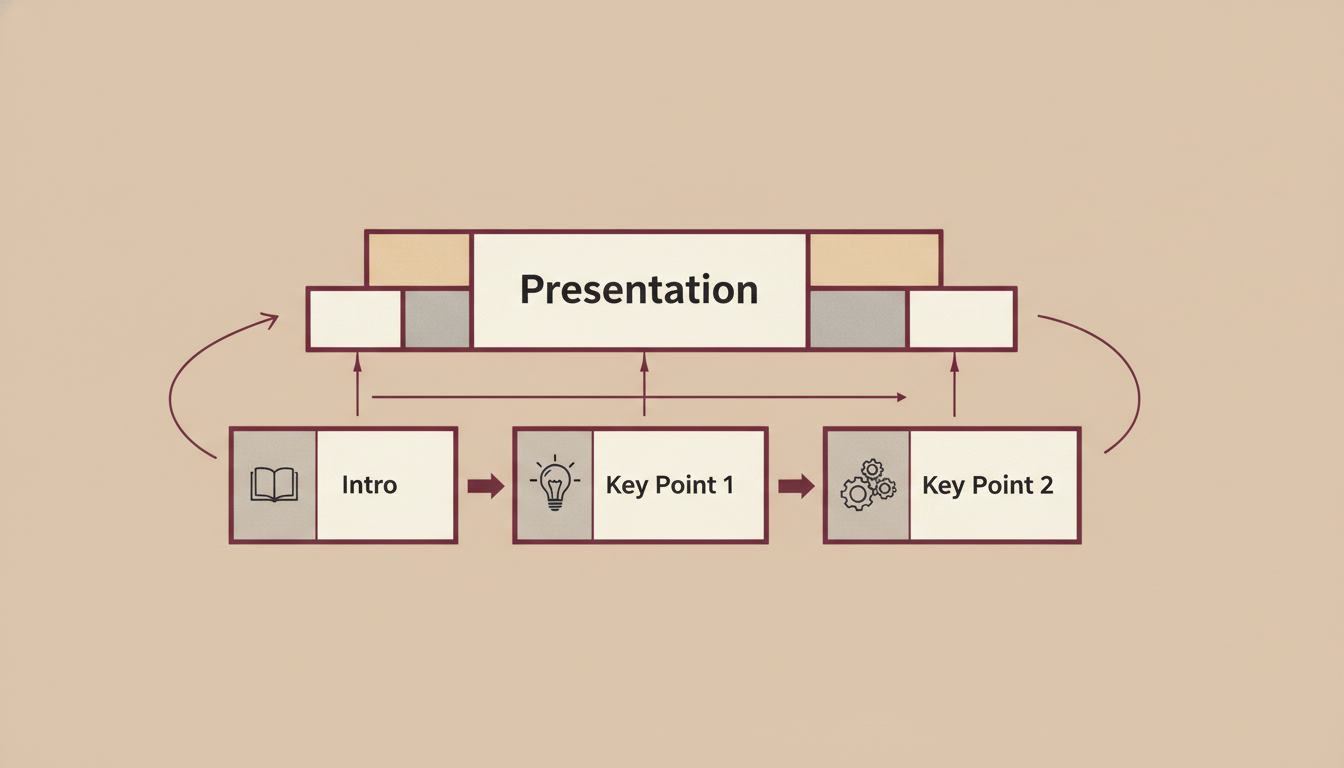
Content chunking means breaking your presentation into distinct, self-contained segments of 2-3 minutes each, with clear transitions between them. Instead of viewing your talk as one continuous 15-minute stream, you treat it as five or six mini-presentations.
This reframes the cognitive task. Your brain no longer faces "deliver a 15-minute presentation" (overwhelming) but rather "deliver this one 2-minute segment" (manageable). The manageable task produces less anxiety, and less anxiety means less rushing.
How to Chunk Your Content
- Identify your 3-5 key messages. Not slides—messages. What are the 3-5 things your audience must walk away remembering?
- Build a segment around each message. Each segment has an opening statement, supporting evidence, and a closing sentence.
- Write a transition sentence between each segment. This sentence is your speed bump—it forces you to pause, shift gears, and reset your pace.
- Assign a time target to each chunk. If your total talk is 15 minutes, each of your five chunks gets roughly 3 minutes. Practice each chunk independently until you hit the time target.
The Professional Scenario
Consider a product manager presenting a go-to-market strategy. Without chunking, she races through market analysis, competitive positioning, pricing, channel strategy, and launch timeline in one breathless stream. With chunking, she treats each topic as its own mini-presentation, pausing between them. The audience follows easily. She finishes on time. Her VP asks fewer clarifying questions because the structure did the work.
This approach aligns with how executives structure their thinking before speaking—in clear, modular blocks rather than unstructured monologues.
Fix 4: Audience-Focused Eye Contact
Why Eye Contact Slows You Down
When you rush, your eyes tend to do one of two things: stare at your slides or dart around the room without landing on anyone. Both behaviors disconnect you from your audience and remove the natural feedback loop that regulates pace.
When you make genuine eye contact with one person for a full sentence, something shifts. You're no longer performing—you're communicating. And communication has a natural, conversational pace that's almost always slower than presentation-mode speed.
The One-Person-Per-Point Method
For each key point you make, pick one person in the audience and deliver that point directly to them. Hold eye contact for one complete thought (roughly 5-8 seconds), then move to a different person for the next point.
This technique does three things simultaneously:
- Slows your pace because you're unconsciously matching conversational speed
- Increases your credibility because sustained eye contact signals confidence
- Improves audience engagement because individual listeners feel personally addressed
According to a study in the Journal of Nonverbal Behavior, speakers who maintained eye contact for 60-70% of their speaking time were rated significantly higher on measures of competence and trustworthiness (Binetti et al., 2016).
Virtual Presentations
On video calls, "eye contact" means looking at your camera lens, not at the faces on screen. Place a small sticky note next to your camera as a reminder. When you deliver a key point, look directly at the lens for 3-5 seconds. This simulates eye contact for your remote audience and naturally decelerates your delivery.
For more on projecting presence in virtual settings, explore our guide on leadership presence in virtual meetings.
Fix 5: Mental Rehearsal at Half-Speed
The Neuroscience Behind Visualization
Mental rehearsal—also called motor imagery—activates many of the same neural pathways as physical performance. A meta-analysis published in Neuroscience & Biobehavioral Reviews found that mental practice improved performance across a range of motor and cognitive tasks (Schuster et al., 2011). For presenters, this means that visualizing a slow, controlled delivery actually trains your brain to execute one.
The Half-Speed Protocol
Two to three days before your presentation, do the following:
- Close your eyes and visualize yourself at the speaking location. See the room, the audience, your materials.
- Mentally deliver your opening at half your normal speed. Hear yourself speaking slowly. Feel the pauses. Notice the audience nodding.
- Move through each section of your talk at this deliberately slow pace. If a section normally takes 3 minutes in your head, stretch it to 6.
- Visualize yourself handling a moment of anxiety—your heart racing, your impulse to speed up—and then consciously choosing to slow down, breathe, and continue at a measured pace.
- Repeat this mental rehearsal 2-3 times before the actual presentation.
Why Half-Speed Matters
Your brain calibrates "normal" based on practice. If you always rehearse at full speed (or faster, as most nervous presenters do), your brain sets a fast pace as the default. By rehearsing at half-speed, you create a new baseline. On presentation day, even when adrenaline pushes you faster, your "fast" will be closer to a comfortable, authoritative pace.
This is a technique used by elite performers across fields—and it's one of the methods we detail in our approach to sounding confident in a presentation even when nervous.
Fix 6: Physical Grounding Techniques
Anchoring Your Body to Anchor Your Voice
Rushed speech often starts with a rushed body. Presenters who pace frantically, shift their weight, fidget with a pen, or grip the podium white-knuckled are physically manifesting their anxiety—and that physical tension drives vocal speed.
Physical grounding reverses this cycle. By deliberately stabilizing your body, you send a signal to your nervous system that you are safe, in control, and unhurried.
Three Grounding Techniques
1. The Power Stance ResetBefore you begin and at each major transition, plant both feet shoulder-width apart, distribute your weight evenly, and press your toes gently into the floor. This stance activates your body's stabilizing muscles and creates a physical sense of rootedness. You can't rush when your body feels anchored.
2. The Fingertip PressIf you're standing at a table or podium, press your fingertips lightly against the surface during key moments. The tactile feedback interrupts the anxiety loop and gives your nervous system something concrete to focus on besides the urge to speed up.
3. The Gesture SlowdownDeliberately slow your hand gestures to half their normal speed. Because gesture speed and speech speed are neurologically linked, slowing your hands will slow your voice. This is a subtle but remarkably effective technique.
These physical techniques complement the vocal strategies outlined in how to control your voice when nervous presenting and the broader body language principles in our guide to confident body language for public speaking.
Your Presentation Pace Is Just the Beginning. The six fixes in this article address rushing—but true presentation authority requires a complete communication system. *The Credibility Code* gives you the frameworks, scripts, and daily practices to project confidence in every professional setting. Discover The Credibility Code
Frequently Asked Questions
How fast is too fast when presenting?
The ideal presentation pace is 130-150 words per minute, according to speech communication research. Conversational English averages about 150 wpm, so your presentation pace should match or slightly slow that rate. If you're consistently above 170 wpm, you're rushing. Record yourself for 60 seconds, count the words, and you'll have your baseline. Anything above 160 wpm during a formal presentation warrants applying the fixes above.
What's the difference between speaking fast and rushing?
Speaking fast is a deliberate choice with maintained clarity, pausing, and audience awareness. Rushing is involuntary acceleration driven by anxiety, characterized by swallowed words, eliminated pauses, and disconnection from the audience. Fast speakers modulate—they speed up and slow down intentionally. Rushers have one gear. The key test: can you slow down at will? If yes, you're fast. If no, you're rushing.
How do I stop rushing when presenting on Zoom?
Virtual presentations amplify rushing because you lose audience feedback cues. Apply three specific fixes: place a "SLOW DOWN" sticky note next to your camera, use the one-person-per-point method by looking at the camera lens for each key statement, and build in explicit verbal transitions ("Let me pause here before moving to...") that force deceleration. Also, slightly exaggerate your pauses—what feels awkwardly long on Zoom typically sounds perfectly natural to your audience.
Can practicing more actually make rushing worse?
Yes, if you practice incorrectly. Rehearsing at full speed or memorizing scripts word-for-word often increases rushing because your brain shifts into recitation mode. Instead, practice at half-speed, rehearse only key points rather than full scripts, and always practice with deliberate pauses built in. Quality of practice matters far more than quantity.
How long does it take to fix a rushing habit?
Most professionals notice significant improvement within 2-3 presentations when they consistently apply breath anchoring and strategic pausing. However, fully retraining your default pace typically takes 6-8 weeks of deliberate practice. The key is recording yourself, measuring your words per minute, and tracking improvement over time. Like any communication skill, pacing responds to consistent, targeted effort.
Does rushing affect how credible I sound?
Absolutely. Research from the University of Michigan confirms that speakers who pause strategically are perceived as more credible and competent. Rushing signals anxiety and uncertainty to your audience, even when your content is strong. Slowing down—especially during key points—projects the calm authority that audiences associate with expertise and leadership.
Speak So the Room Takes You Seriously
The Credibility Code covers the verbal patterns that make presenters sound authoritative, and the ones that make audiences tune out.
Discover The Credibility CodeRelated Articles

How to Speak Without Notes: A Professional's Guide
To speak without notes professionally, build a mental structure before you speak—not a script. Use a framework like the "Three-Point Anchor" (one opening statement, three key points, one closing action) to internalize your message. Practice retrieval, not memorization: rehearse by recalling your structure from memory rather than reading it repeatedly. Pair this with deliberate pausing and confident delivery techniques, and you'll speak with authority in any professional setting—boardroom, stage,

How to Prepare for a High-Stakes Presentation
To prepare for a high-stakes presentation, start 7–10 days out with deep audience analysis, then build a clear message architecture around one core thesis. Rehearse in three phases—content familiarity, delivery refinement, and full simulation—while layering in anxiety management techniques like controlled breathing and power posing. On the day of, follow a pre-performance ritual that anchors your confidence. The goal isn't perfection; it's commanding presence backed by rigorous preparation.
How to Speak With Authority in Presentations
To speak with authority in presentations, focus on five core areas: slow your speaking pace to 130–150 words per minute, use downward vocal inflections at the end of statements, structure your content with a clear "claim-evidence-action" framework, adopt grounded body language with planted feet and purposeful gestures, and eliminate hedging language like "I think" or "sort of." Authority isn't about volume—it's about vocal control, structural clarity, and unwavering conviction in your message.