
How to Prepare for a High-Stakes Presentation

To prepare for a high-stakes presentation, start 7–10 days out with deep audience analysis, then build a clear message architecture around one core thesis. Rehearse in three phases—content familiarity, delivery refinement, and full simulation—while layering in anxiety management techniques like controlled breathing and power posing. On the day of, follow a pre-performance ritual that anchors your confidence. The goal isn't perfection; it's commanding presence backed by rigorous preparation.
What Is a High-Stakes Presentation?
A high-stakes presentation is any professional speaking moment where the outcome significantly impacts your career, your team, or your organization. This includes board meetings, investor pitches, leadership reviews, keynote addresses, promotion panels, and client-facing proposals where decisions hinge on your ability to persuade.
What separates a high-stakes presentation from a routine update isn't just the audience—it's the asymmetric consequences. A strong performance can accelerate your career by years. A weak one can stall momentum you've spent months building. That's why preparation isn't optional—it's the single biggest predictor of success.
Build Your Preparation Timeline: The 7-Day System
Most professionals make a critical mistake: they start preparing their slides before they've done the strategic thinking. A structured timeline prevents this and ensures every element of your presentation gets the attention it deserves.
Days 7–5: Strategic Foundation
During the first phase, your job is to think—not to design. Start with three foundational questions:
- Who is in the room, and what do they care about? Map every decision-maker. Understand their priorities, concerns, and how they prefer to receive information. A CFO wants financial impact. A CEO wants strategic vision. A board wants risk mitigation.
- What is the one thing I need them to remember? Research from the Harvard Business Review shows that audiences retain only about 10% of a presentation after 48 hours. Distill your entire message into a single thesis statement—one sentence that captures your core argument.
- What decision or action do I want them to take? Every high-stakes presentation should end with a clear ask. Define this before you write a single slide.
This strategic foundation phase is where most presenters skip ahead—and where the best presenters spend the most time. If you've ever struggled to speak with confidence in front of executives, it's often because the message wasn't crystallized before the delivery was attempted.
Days 4–3: Message Architecture
Now you build the structure. Use the Pyramid Principle (developed by Barbara Minto at McKinsey): lead with your conclusion, then support it with 2–3 key arguments, each backed by evidence.
Here's what this looks like in practice:
- Thesis: "We should expand into the Southeast market by Q3."
- Pillar 1: Market demand data showing 34% growth in the region
- Pillar 2: Competitive gap analysis showing only two established players
- Pillar 3: Operational readiness—we already have distribution infrastructure
Each pillar gets one section of your presentation. No more than three pillars. Cognitive load research by George Miller famously established that working memory handles roughly 3–5 chunks of new information effectively. Three pillars keep you within that range.
Days 2–1: Refinement and Rehearsal
This is where you shift from content creation to delivery preparation. We'll cover rehearsal in depth below, but the key principle here is: your slides should be locked 48 hours before your presentation. The final two days are for practicing how you say it, not changing what you say.
Master Audience Analysis: Know the Room Before You Enter It
The difference between a good presentation and a career-defining one often comes down to how well you understand the people listening. According to a 2023 Prezi study, 70% of employed Americans who present agree that presentation skills are critical to career success—yet most presenters spend the majority of their prep time on slides rather than audience analysis.
Map the Decision-Making Landscape
Before you open PowerPoint, create an audience map. For each key person in the room, document:
- Their role and what they're accountable for — This tells you what metrics they care about.
- Their likely objections — Anticipating pushback is a sign of executive-level communication.
- Their preferred communication style — Some executives want data-dense detail. Others want the headline and the ask.
For example, imagine you're presenting a budget request to a leadership team. The VP of Finance will scrutinize your ROI projections. The VP of Operations will want to know about implementation timelines. The CEO will want to hear how this aligns with the company's three-year strategy. One presentation—three different lenses. Your job is to address all of them without making it feel fragmented.
Calibrate Your Language to the Room
A common credibility killer is using language that doesn't match your audience's level. Speaking too technically to a strategic audience makes you seem unable to see the big picture. Speaking too broadly to a technical audience makes you seem shallow.
Study the language your audience uses in their own communications—emails, town halls, strategy documents. Mirror that register. This isn't manipulation; it's communicating with gravitas by meeting people where they are.
Rehearse Like a Performer: The Three-Phase Method
Knowing your material isn't the same as being able to deliver it under pressure. Elite performers—athletes, musicians, trial lawyers—don't just practice. They simulate. Your rehearsal process should follow three distinct phases.
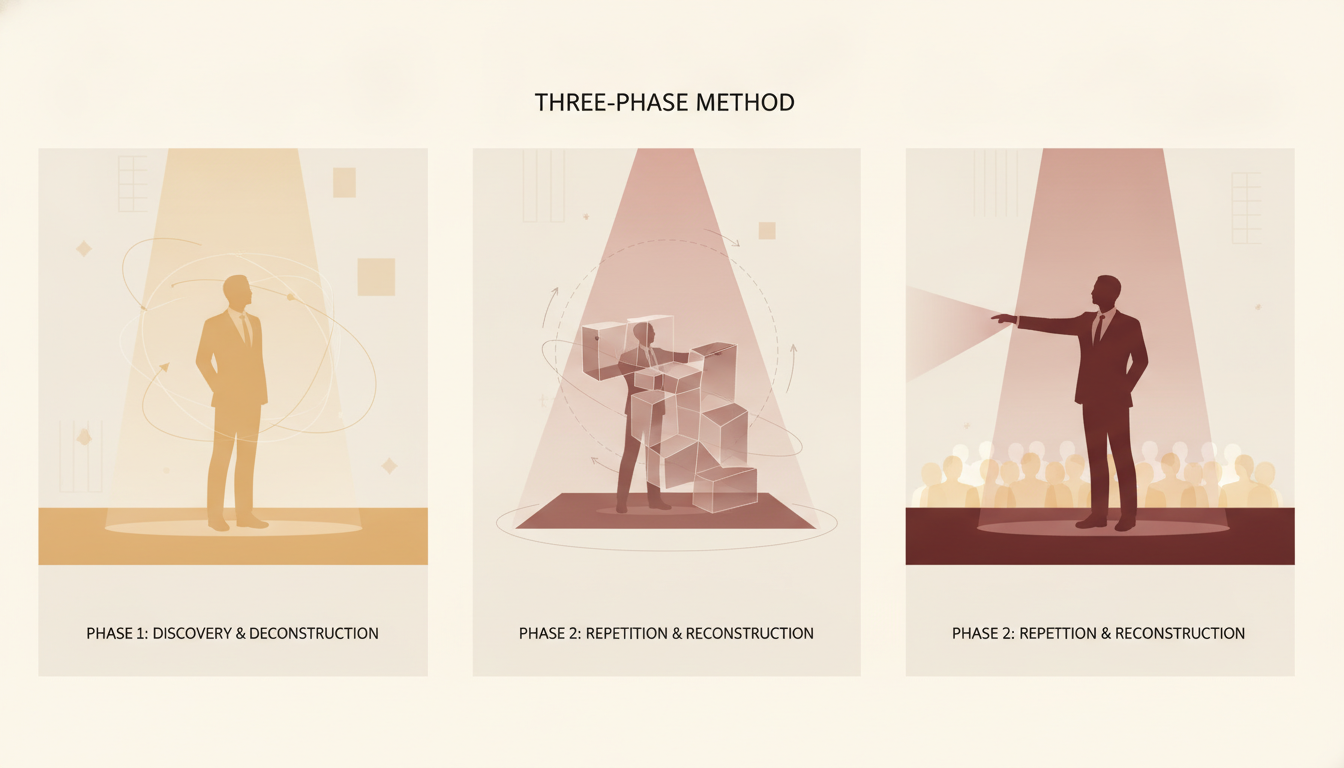
Phase 1: Content Internalization (Not Memorization)
Run through your presentation 3–4 times focusing only on the logical flow. Don't worry about exact wording. The goal is to internalize the architecture of your argument so deeply that you could deliver it even if your slides failed.
A practical test: can you explain your entire presentation in 60 seconds to a colleague without any notes? If not, your structure isn't clear enough yet. This ability to speak without notes is what separates confident presenters from slide-dependent ones.
Phase 2: Delivery Refinement
Now focus on how you say it. Record yourself on video—yes, it's uncomfortable, but research from Communications Education journal confirms that video self-review is one of the most effective methods for improving presentation delivery.
Watch for these specific elements:
- Pacing: Are you rushing through key points? Most nervous presenters speak 20–30% faster than their ideal pace. Practice strategic pausing at transitions between your main pillars.
- Vocal variety: Monotone delivery kills even the strongest content. Drop your pitch at the end of declarative statements. Raise it slightly before a key reveal.
- Filler words: Count your "ums," "uhs," and "sort ofs." One or two per minute is normal. More than that, and you need to practice replacing them with silence.
- Body language: Your physical presence signals authority before you say a word. Stand with feet shoulder-width apart. Use open hand gestures. Make deliberate eye contact with different sections of the room.
Phase 3: Full Simulation
This is the most important—and most skipped—phase. Simulate the actual conditions of your presentation as closely as possible:
- Present in the actual room if you can access it.
- Use the actual technology setup (projector, clicker, microphone).
- Invite 1–2 trusted colleagues to serve as a mock audience and ask tough questions.
- Time yourself strictly—going over time in a board meeting is a credibility hit you can't afford.
A study published in the Journal of Experimental Psychology found that practicing in conditions that match the performance environment improves recall and reduces anxiety by up to 25%. This principle, called "context-dependent memory," is why simulation matters more than rehearsing at your desk.
Manage Anxiety: From Nervous Energy to Commanding Presence
Let's be direct: if you feel nervous before a high-stakes presentation, you're normal. A survey by the National Institute of Mental Health found that approximately 73% of the population experiences some degree of glossophobia (fear of public speaking). The goal isn't to eliminate anxiety. It's to channel it.
Reframe the Physiology
The physical sensations of anxiety—elevated heart rate, adrenaline, heightened alertness—are identical to the sensations of excitement. Research by Harvard Business School professor Alison Wood Brooks demonstrated that people who reframed their anxiety as excitement ("I am excited") performed significantly better in public speaking tasks than those who tried to calm down.
Before your presentation, say out loud: "I'm excited about this." It sounds simple. The data says it works.
Use Tactical Breathing
The Navy SEALs use "box breathing" before high-pressure operations, and it's equally effective before a boardroom presentation:
- Inhale for 4 seconds
- Hold for 4 seconds
- Exhale for 4 seconds
- Hold for 4 seconds
Repeat this cycle 4–5 times in the 10 minutes before you present. It activates your parasympathetic nervous system and lowers cortisol levels. For a deeper dive into managing pre-presentation nerves, explore our guide on how to calm nerves before speaking.
Anchor Your Confidence with a Pre-Performance Ritual
Top performers don't leave their mental state to chance. Develop a 5-minute pre-presentation ritual that you use every time. This might include:
- Reviewing your opening line (the first 30 seconds should be memorized cold)
- A brief physical warm-up: shoulder rolls, jaw release, vocal hum
- A power pose: Amy Cuddy's research, while debated, still shows that expansive postures can increase subjective feelings of confidence
- A personal mantra or affirmation grounded in your preparation: "I've done the work. I know this material. I'm ready."
Consistency is the key. When your body recognizes the ritual, it shifts into performance mode automatically.
Nail the Day-Of Execution: From Entrance to Exit
Everything you've prepared converges in the moments before, during, and after your presentation. Here's how to execute with precision.
Own Your Opening
The first 60 seconds set the tone for everything that follows. According to research on primacy effects, audiences form their impression of a speaker's credibility within the first 30 seconds. Don't waste this window on "Thank you for having me" or "Let me just get my slides up."
Instead, open with one of these high-impact approaches:
- A bold, data-backed statement: "We're leaving $4.2 million on the table every quarter by not addressing this gap."
- A provocative question: "What would it mean for this company if we could cut onboarding time by 40%?"
- A brief, relevant story: "Last Tuesday, I sat across from our largest client, and they told me something that changed how I think about our strategy."
For more proven opening techniques, check out our guide on how to open a presentation with confidence.
Command the Q&A
Many presenters prepare exhaustively for the presentation itself and then fall apart during questions. The Q&A is where your credibility is truly tested—and where senior leaders form their final impression of your competence.
Prepare for Q&A by:
- Listing the 10 hardest questions someone could ask, then rehearsing concise answers for each
- Using the PREP framework for impromptu answers: Point → Reason → Example → Point (restate)
- Being honest when you don't know: "That's an important question. I don't have that specific data point today, but I'll have it to you by end of day Thursday." This is far more credible than guessing. Learn more about handling tough questions in meetings.
Close with Authority
Your closing is the second most memorable moment (after your opening). Don't let it fizzle with "So... any other questions?" or "I think that's everything."
Close by restating your thesis, summarizing your three pillars in one sentence each, and making your ask explicit: "Based on the market data, competitive gap, and our operational readiness, I'm recommending we approve the Southeast expansion with a Q3 launch. I'd like your endorsement today."
Then stop talking. Silence after a strong close signals confidence. Rambling after your conclusion signals uncertainty.
Build the Kind of Presence That Makes People Listen Preparation is the foundation—but lasting authority comes from a complete system. Discover The Credibility Code and learn the frameworks that top professionals use to communicate with confidence in every high-stakes moment. Discover The Credibility Code
Frequently Asked Questions
How far in advance should I start preparing for a high-stakes presentation?
Start at least 7–10 days before the presentation. The first 2–3 days should focus on audience analysis and message architecture—not slides. Days 4–5 are for building your content and visuals. The final 2 days should be dedicated entirely to rehearsal and simulation. For career-defining moments like board presentations or investor pitches, consider starting even earlier—up to two weeks out.
How many times should I rehearse a high-stakes presentation?
Aim for a minimum of 5–7 full run-throughs across the three rehearsal phases: content internalization, delivery refinement, and full simulation. Research suggests that presenters who rehearse at least six times perform significantly better in audience ratings of confidence and clarity. However, avoid over-rehearsing to the point where your delivery sounds robotic. The goal is confident flexibility, not memorized rigidity.
How to prepare for a high-stakes presentation vs. a regular team update?
A regular team update requires basic organization and clear communication. A high-stakes presentation demands strategic audience analysis, message architecture built around a single thesis, multiple rehearsal phases including simulation, and deliberate anxiety management. The preparation-to-delivery ratio is also different: for a routine update, you might prepare for 30 minutes. For a high-stakes presentation, expect 8–15 hours of total preparation for a 20-minute slot.
How do I handle nervousness right before presenting to executives?
Use tactical breathing (box breathing: 4 seconds inhale, 4 hold, 4 exhale, 4 hold) in the 10 minutes before you present. Reframe your anxiety as excitement—research shows this improves performance. Review your memorized opening line so you start strong, and follow a consistent pre-performance ritual. For ongoing strategies, read our guide on how to project confidence when nervous at work.
What's the biggest mistake people make when preparing for a high-stakes presentation?
Starting with slides instead of strategy. Most professionals jump straight into PowerPoint without first clarifying their audience's priorities, defining a single core thesis, or determining their specific ask. This leads to presentations that are information-dense but persuasion-light. The second biggest mistake is under-rehearsing—specifically, never doing a full simulation under realistic conditions.
How do I recover if something goes wrong during a high-stakes presentation?
Acknowledge the issue briefly, then move forward. If technology fails, say: "Let me walk you through this directly—the data tells a compelling story." If you lose your place, pause, take a breath, and return to your last pillar. Audiences respect composure far more than perfection. For more on this, explore our guide on how to recover from a bad presentation at work.
Speak So the Room Takes You Seriously
The Credibility Code covers the verbal patterns that make presenters sound authoritative, and the ones that make audiences tune out.
Discover The Credibility CodeRelated Articles

How to Stop Rushing When Presenting: 6 Pro Fixes
You rush through presentations because your nervous system interprets public speaking as a threat, triggering a fight-or-flight response that accelerates your heart rate, breathing, and speech. To stop rushing when presenting, use these six proven fixes: breath anchoring before and during your talk, strategic pausing at key transitions, chunking your content into digestible segments, audience-focused eye contact to regulate pace, mental rehearsal at half-speed, and physical grounding techniques.

How to Speak Without Notes: A Professional's Guide
To speak without notes professionally, build a mental structure before you speak—not a script. Use a framework like the "Three-Point Anchor" (one opening statement, three key points, one closing action) to internalize your message. Practice retrieval, not memorization: rehearse by recalling your structure from memory rather than reading it repeatedly. Pair this with deliberate pausing and confident delivery techniques, and you'll speak with authority in any professional setting—boardroom, stage,

How to Present to Executives Without Slides: Verbal Guide
To present to executives without slides, structure your message using a verbal framework: lead with the bottom line, provide three supporting points with evidence, anticipate the two or three questions they'll ask, and close with a specific ask or decision needed. Executives prefer concise, insight-driven conversations over slide decks. Master the structure, control your delivery, and you'll command the room with nothing but your voice and clarity of thought.