
How to Open a Presentation With Confidence: 8 Openers

What Is a Confident Presentation Opening?
A confident presentation opening is the first 15–60 seconds of your talk, deliberately designed to signal authority, capture attention, and set the emotional tone for everything that follows. It replaces filler phrases like "So, um, thanks for having me" with a purposeful, rehearsed statement that tells the audience: this person is worth listening to.
A strong opening does three things simultaneously: it hooks attention, establishes credibility, and previews the value the audience will receive. According to research published in the Journal of Experimental Social Psychology, listeners form judgments about a speaker's competence within the first few seconds of hearing them speak — meaning your opener isn't just a nice-to-have, it's a credibility decision point.
Why the First 30 Seconds Make or Break Your Presentation
The Neuroscience of First Impressions
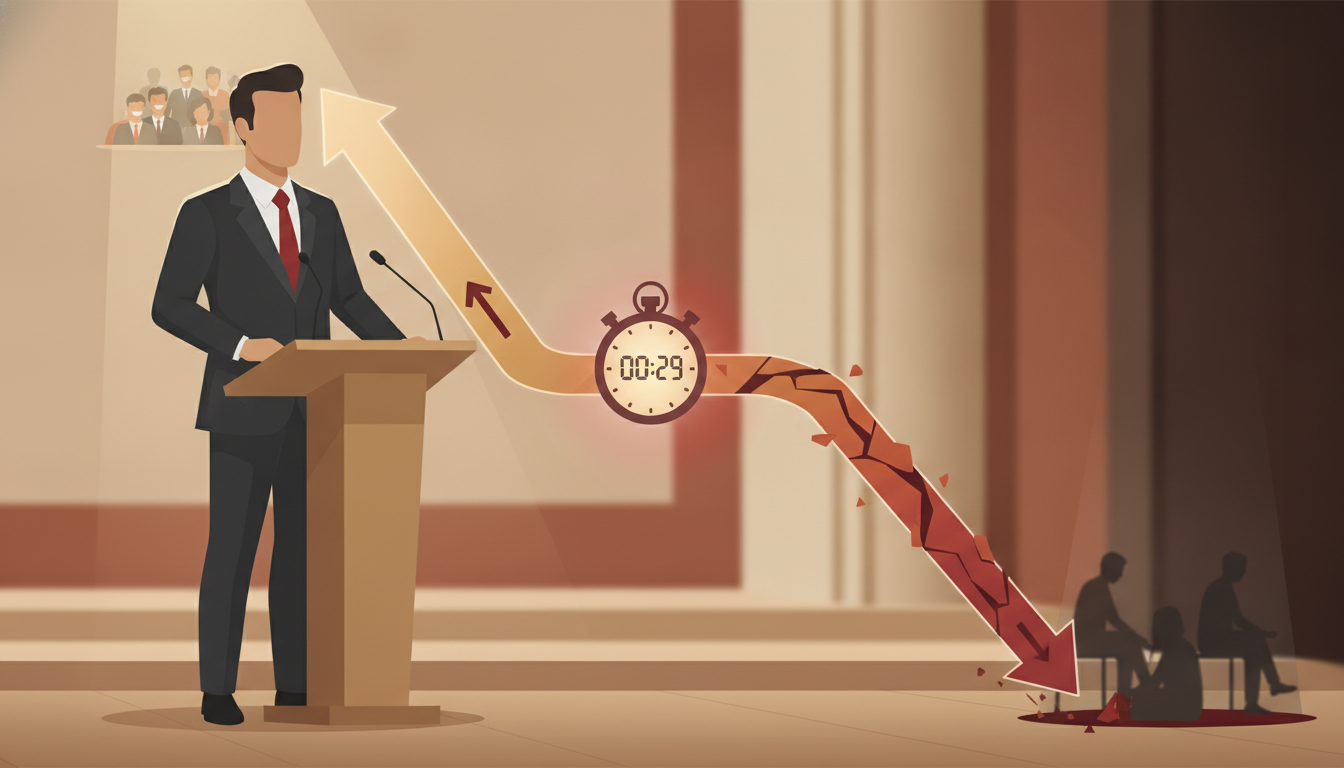
Your audience's brain is working against you before you say a word. Princeton psychologist Alexander Todorov's research shows that people form trait judgments — including competence and trustworthiness — in as little as 100 milliseconds. In a presentation context, this means the audience is already deciding whether to lean in or tune out before you finish your first sentence.
A weak opening — "Hi everyone, sorry, can you hear me okay?" — triggers a competence downgrade that's difficult to reverse. A strong opening does the opposite. It creates what psychologists call a "primacy effect," where the first information received disproportionately shapes overall perception.
The Cost of a Weak Opening
A 2023 Prezi survey found that 70% of employed Americans agree that presentation skills are critical for career success. Yet most professionals default to openings that actively undermine their credibility: apologizing, reading the agenda slide, or narrating their own nervousness.
The cost is real. When you open weakly, you spend the next five minutes trying to earn back attention you could have captured in the first fifteen seconds. If you've ever felt like your audience was distracted or disengaged, the problem likely started with your opening — not your content.
If you want to sound credible in meetings and presentations alike, the discipline of a strong opening is non-negotiable.
What Confident Speakers Do Differently
Confident speakers don't wing their openings. They script them, rehearse them, and select them based on context. They also do three physical things before speaking: they plant their feet, pause for two full seconds, and make eye contact with three different people in the room. This micro-ritual signals composure and authority before a single word is spoken.
This aligns with what executive communication coaches call leadership presence — the ability to command attention through intentional behavior rather than relying on title or volume.
The 8 Proven Presentation Openers
Opener 1: The Bold Statement
What it is: A declarative sentence that stakes a clear position or delivers a surprising truth. Script example: "Eighty percent of the strategy decks created in this company will never influence a single decision. Today, I'm going to show you how to make sure yours does." Why it works: Bold statements create cognitive tension. The audience's brain needs to resolve the surprise, which means they're listening. This opener works best when you're presenting to peers, leadership, or cross-functional teams where you need to establish authority quickly. Delivery note: Say it slowly. Drop your vocal pitch at the end of the sentence. Do not smile — let the weight of the statement land. If you tend to sound uncertain at work, this opener forces you into a declarative mode that overrides hedging habits. Best for: Strategy presentations, internal pitches, leadership updates.Opener 2: The Relevant Statistic
What it is: A single, surprising data point that reframes the audience's understanding of the problem. Script example: "According to McKinsey, companies in the top quartile for diversity are 36% more likely to outperform their peers financially. And yet, our leadership pipeline has gotten less diverse in each of the last three years. Let's talk about why — and what we're going to do about it." Why it works: Statistics create instant credibility because they signal preparation and evidence-based thinking. A 2019 study from Cornell University found that including numerical evidence in arguments increases perceived persuasiveness by up to 40%, even when the underlying argument remains the same. Delivery note: Cite your source verbally. Saying "According to McKinsey" or "Harvard Business Review found" signals that you've done your homework. Pause after the number to let it register. Best for: Data-driven audiences, executive briefings, business case presentations.Opener 3: The Story
What it is: A brief, relevant narrative — ideally personal — that illustrates the core problem or insight of your presentation. Script example: "Last quarter, I sat in a client meeting where our team had prepared for three weeks. Forty slides. Detailed analysis. And within two minutes, the CFO said, 'Just tell me what you need.' We lost the room because we buried the lead. That experience changed how I think about presenting — and it's why I'm standing here today." Why it works: Stories activate the brain's neural coupling mechanism, which means the listener's brain literally mirrors the speaker's brain patterns. Stanford research by Jennifer Aaker found that stories are up to 22 times more memorable than facts alone. This opener is especially powerful when you want to build trust and relatability. Delivery note: Keep the story under 45 seconds. Use present tense for immediacy ("I sit in a client meeting..."). End the story with a clear bridge to your topic. Best for: Team meetings, all-hands presentations, training sessions, conference talks.Opener 4: The Provocative Question
What it is: A question that challenges assumptions or forces the audience to confront an uncomfortable truth. Script example: "When was the last time you sat through a presentation and actually changed your mind about something? ... If you can't remember, that tells us something important about how most presentations fail." Why it works: Questions shift the audience from passive listening to active thinking. A rhetorical question creates a mental gap the audience wants to fill. A direct question (with a pause for actual reflection) creates engagement. Delivery note: Ask the question, then stop talking. Count to three silently. The pause is what makes this opener powerful. If you rush past it, you lose the effect. For more on using pauses strategically, see this guide on how to pause effectively in public speaking. Best for: Workshops, persuasion-oriented presentations, change management talks.Opener 5: The Quotation
What it is: A brief, relevant quote from a recognized authority that frames your presentation's thesis. Script example: "Peter Drucker once said, 'The most important thing in communication is hearing what isn't said.' Today, I want to talk about the three things your customers are not telling you — and how that silence is costing us revenue." Why it works: Quotations borrow authority. When you cite a recognized expert, you create an implicit association between their credibility and your message. This works especially well when you're presenting to an audience that may not yet see you as the subject matter expert. Delivery note: Don't read the quote from a slide. Memorize it. Deliver it while making eye contact. Then pause before transitioning to your own words. This signals that you've internalized the idea, not just Googled it. Learning to speak without notes dramatically amplifies the impact of this opener. Best for: Keynotes, thought leadership presentations, client-facing talks.Opener 6: The "What If" Scenario
What it is: A hypothetical future state that invites the audience to imagine a better (or worse) outcome. Script example: "What if every customer interaction your team had next quarter resulted in a follow-up meeting? Not 30%. Not 50%. Every single one. That's not a fantasy — it's what happens when you fix one specific part of the sales conversation. Let me show you which part." Why it works: "What if" scenarios activate the brain's simulation network — the same neural pathways used for planning and prediction. This makes the audience feel the outcome before you present the evidence. It creates desire and forward momentum. Delivery note: Lean into the specificity. Vague "what ifs" fall flat. The more concrete the scenario, the more real it feels. Best for: Sales presentations, innovation pitches, proposals for new initiatives.Opener 7: The Contrarian Claim
What it is: A statement that directly contradicts conventional wisdom or a commonly held belief in your industry. Script example: "Most leadership advice tells you to lead with empathy. I'm going to argue that empathy without clarity is actually the fastest way to lose your team's trust." Why it works: Contrarian claims create intellectual friction. The audience thinks, "Wait — that can't be right," and leans in to hear your reasoning. This opener positions you as a thinker, not just a presenter. It works particularly well for professionals working to position themselves as experts. Delivery note: You must follow through. If you make a contrarian claim, your next 60 seconds need to provide evidence or a compelling argument. Otherwise, you lose credibility instead of building it. Best for: Thought leadership talks, conference presentations, internal strategy challenges.Opener 8: The Silence-Then-Speak Technique
What it is: You walk to the front of the room, stand still, make eye contact with the audience, and say nothing for 3–5 seconds before delivering your first line. Script example: [3-5 seconds of deliberate silence, eye contact, composed posture] "Everyone in this room has one thing in common. You've all been asked to do more with less. Today, I'm going to show you how to actually do it." Why it works: Silence is the most underused tool in public speaking. It signals supreme confidence because most nervous speakers rush to fill the void. A 2015 study from the University of Groningen found that even four seconds of silence during a speech increased audience perceptions of the speaker's confidence and competence. Delivery note: This is the hardest opener to execute because it requires you to resist every instinct telling you to start talking. Practice it in low-stakes settings first. Stand, breathe, scan the room, and then speak. The effect is magnetic. Best for: High-stakes presentations, board meetings, any context where commanding a room is essential.How to Choose the Right Opener for Your Audience
Match the Opener to the Audience Type
Not every opener works in every context. Here's a decision framework:
| Audience Type | Best Openers | Avoid |
|---|---|---|
| Senior executives | Bold Statement, Statistic, Silence-Then-Speak | Long stories, vague questions |
| Peers / cross-functional teams | Story, Provocative Question, Contrarian Claim | Overly formal quotations |
| External clients | "What If" Scenario, Statistic, Quotation | Contrarian claims about their industry |
| Large conference audience | Story, Bold Statement, Silence-Then-Speak | Questions that require actual responses |
| Training / workshop | Provocative Question, Story, "What If" | Silence technique (can feel awkward in casual settings) |
Match the Opener to Your Comfort Level
If you're new to confident presenting, start with the Statistic or Quotation openers. They're structured, easy to rehearse, and don't require advanced delivery skills. As your confidence grows, work toward the Bold Statement, Contrarian Claim, and Silence-Then-Speak techniques.
The key is to rehearse your chosen opener at least five times out loud — not in your head. Rehearsing silently doesn't train your voice, your pacing, or your body language. If you struggle with nervous energy before speaking, a well-rehearsed opener acts as an anchor that steadies you through the first critical moments.
Combine Openers for Maximum Impact
Advanced presenters often layer two openers together. For example:
- Silence + Bold Statement: Stand silently for three seconds, then deliver a declarative claim.
- Statistic + Provocative Question: Share a surprising number, then ask the audience what it means.
- Story + Contrarian Claim: Tell a brief narrative, then use it to challenge a common assumption.
Layering creates depth and makes your opening feel polished rather than formulaic.
Your opening sets the ceiling for your entire presentation. If you want a complete system for projecting confidence and credibility in every professional interaction — not just presentations — The Credibility Code gives you the scripts, frameworks, and daily habits to make authority your default setting. Discover The Credibility Code
Common Opening Mistakes That Kill Credibility
Apologizing or Self-Deprecating
"Sorry, I'm not great at presentations" is not humility — it's a credibility withdrawal. You're telling the audience to lower their expectations before you've even started. If you feel the urge to apologize, replace it with a statement of purpose: "I'm here to walk you through three findings that will change how we approach Q3."
This is one of the 12 weak communication habits that undermine credibility — and it's the easiest to fix because it only requires you to delete a sentence.
Reading the Agenda Slide
"So today we'll cover background, methodology, findings, and next steps" is not an opening. It's a table of contents. No one has ever been hooked by a table of contents. Save the agenda for after your opener, if you include one at all.
Starting With "So..." or Filler Words
The word "So" has become the default presentation opener for an entire generation of professionals. It signals that you haven't planned your opening and are thinking out loud. The same applies to "Um," "Okay," and "Alright." For a deeper dive into eliminating these habits, see our guide on how to stop using filler words in professional speaking.
Narrating Your Nervousness
"I'm a little nervous" might feel honest, but it redirects the audience's attention from your message to your emotional state. They'll now spend the next five minutes watching for signs of nervousness instead of listening to your content. Channel that energy into your delivery instead.
How to Rehearse Your Opener for Maximum Confidence
The 5-3-1 Rehearsal Method
Five days before: Write out your opener word-for-word. Read it aloud three times. Adjust any phrasing that feels unnatural when spoken. Three days before: Rehearse the opener standing up, without reading it. Practice your opening posture: feet planted, shoulders back, hands at your sides or on the lectern. Record yourself on your phone and watch it back. One day before: Deliver the opener to another person — a colleague, a friend, or even a mirror. Focus on three things: eye contact, vocal pace (slower than you think), and the pause after your opening line.This method ensures that by presentation day, your opener is automatic. You don't have to think about what to say — you just say it. This frees your cognitive resources for reading the room, managing your energy, and delivering the rest of your content with authority.
Anchor Your Body Language
Your body speaks before your mouth does. Before delivering your opener, set your physical foundation:
- Plant your feet shoulder-width apart. No swaying, no shifting.
- Drop your hands to your sides. Resist the urge to clasp, fidget, or grip notes.
- Breathe once — a slow inhale through the nose, exhale through the mouth.
- Make eye contact with one person in the center of the room.
- Speak.
This five-step physical reset takes about four seconds and transforms how the audience perceives you. For a complete guide to physical presence, explore confident body language for public speaking.
Frequently Asked Questions
How do you start a presentation if you're nervous?
Choose a structured opener — like a statistic or quotation — that you can memorize word-for-word. Rehearse it at least five times out loud. When you step up to speak, plant your feet, take one breath, and deliver the line you've practiced. Having a scripted opener eliminates the "what do I say first?" panic that causes most opening-moment anxiety. Your nerves won't disappear, but they won't control your first impression.
What is the best opening line for a professional presentation?
There's no single best line — the right opener depends on your audience and context. For executive audiences, a bold statement or surprising statistic works best. For peer groups, a brief story creates connection. For large audiences, the silence-then-speak technique is highly effective. The best opening line is one you've rehearsed until it feels natural and that matches the tone of your audience.
Bold statement opener vs. storytelling opener: which is more effective?
Bold statements are faster and work well in time-constrained, results-oriented settings like board meetings. Stories take longer but create deeper emotional connection and memorability — Stanford research shows stories are 22 times more memorable than facts. Use bold statements when you need to establish authority quickly. Use stories when you need to build trust and relatability. For maximum impact, combine both: open with a bold claim, then support it with a brief narrative.
How long should a presentation opening be?
A strong opening should last 15–60 seconds. That's enough time to hook attention and establish your credibility without delaying your core content. If you're presenting to senior leaders, aim for the shorter end — executives value brevity. For conference talks or team presentations, you have slightly more room. Regardless of length, every word in your opening should be intentional and rehearsed.
Can introverts open presentations with confidence?
Absolutely. Confidence in a presentation opening isn't about being extroverted or loud — it's about preparation and intentional delivery. Introverts often excel with the Statistic, Quotation, and Silence-Then-Speak openers because these techniques rely on composure and precision rather than high energy. Many of the most commanding presenters are introverts who've learned to build leadership presence quietly.
How do I recover if my opening doesn't land?
Pause. Take a breath. Move forward with your next point as if nothing happened. Audiences are far more forgiving than you think — they're not analyzing your opener with a rubric. If a joke falls flat or a statistic doesn't get the reaction you expected, the worst thing you can do is acknowledge the failure ("Well, that didn't work..."). Simply transition with confidence: "Here's why this matters..." and keep going. Your recovery is the confidence signal.
Speak So the Room Takes You Seriously
The Credibility Code covers the verbal patterns that make presenters sound authoritative, and the ones that make audiences tune out.
Discover The Credibility CodeRelated Articles

How to Command a Room When Presenting: 8 Proven Methods
To command a room when presenting, master these eight techniques: own the space physically before you speak, open with a power move that disrupts expectations, use strategic silence instead of filler words, control vocal dynamics through pace and pitch variation, deploy purposeful eye contact patterns, structure your content with executive-level clarity, use spatial anchoring to reinforce key points, and close with a statement that lingers. Each method is trainable—and the difference between a f

How to Handle Q&A After a Presentation Like a Pro
To handle Q&A after a presentation like a pro, prepare for likely questions in advance, use a structured response framework (like the PREP method: Point, Reason, Example, Point), and maintain confident body language throughout. When you don't know an answer, say so honestly and offer to follow up. Set clear ground rules at the start of Q&A, repeat each question for the audience, and always end on your terms by closing with a prepared final statement that reinforces your core message.

How to Answer Questions You Don't Know (Without Faking)
When you're asked a question you can't fully answer—in a meeting, presentation, or interview—use the Acknowledge-Bridge-Commit method: briefly acknowledge what you don't know, bridge to what you *do* know or what's relevant, then commit to a specific follow-up action with a timeline. This approach preserves your credibility because it shows intellectual honesty, strategic thinking, and accountability. The worst thing you can do is bluff—audiences detect it faster than you think.