
12 Weak Communication Habits That Undermine Your Credibility

Weak communication habits at work — like hedging language, upspeak, over-apologizing, and passive phrasing — silently erode your professional credibility even when your ideas are strong. Research from the Harvard Business Review shows that how you communicate accounts for a significant portion of how competent others perceive you to be. The good news: these habits are fixable. Below, you'll find the 12 most damaging weak communication habits at work, why each one undermines your authority, and the concrete replacement strategies that will transform how colleagues perceive you.
What Are Weak Communication Habits at Work?
Weak communication habits at work are recurring verbal, written, and nonverbal patterns that diminish your perceived authority, competence, and credibility — even when the substance of your message is sound. They include hedging phrases ("I just wanted to…"), upspeak (ending statements as questions), over-qualifying opinions, and passive body language.
These habits are "weak" not because they reflect low intelligence, but because they signal uncertainty to listeners. Over time, they train colleagues and leaders to overlook your contributions, question your judgment, and pass you over for high-visibility opportunities. Identifying and replacing these patterns is one of the fastest ways to build professional credibility.
The Hidden Cost of How You Communicate
Why Substance Alone Isn't Enough

Most professionals assume that good work speaks for itself. It doesn't. A 2012 study published in the Journal of Language and Social Psychology found that speakers who used hedging language ("I think," "sort of," "maybe") were rated as significantly less competent and less hireable — even when the content of their answers was identical to speakers who used direct language.
Your ideas compete for attention in every meeting, email, and presentation. When weak communication habits wrap those ideas in uncertainty, decision-makers unconsciously discount them.
The Credibility Tax You're Paying
Think of weak communication habits as a "credibility tax." Every hedge, filler word, and apologetic opener costs you a small amount of perceived authority. Individually, each instance seems harmless. Cumulatively, they create a reputation problem.
According to a 2023 survey by Grammarly and The Harris Poll, 97% of business professionals said that communication impacts their trust in colleagues. When trust drops, so does your influence — regardless of your technical expertise or track record.
Self-Awareness Is the Starting Point
The challenge is that most weak communication habits operate below conscious awareness. You don't notice that you start every email with "Sorry to bother you" or that your voice rises at the end of declarative statements. That's why the first step isn't behavior change — it's pattern recognition.
Record yourself in your next meeting or ask a trusted colleague for candid feedback. The habits below will give you a precise checklist of what to listen for.
The 12 Weak Communication Habits (and What to Do Instead)
Habit 1: Hedging Your Statements
What it sounds like: "I kind of think we should consider maybe shifting the timeline."Hedging language — words like "kind of," "sort of," "maybe," "I think," "perhaps" — softens your position before anyone has challenged it. You're preemptively retreating from your own idea.
The replacement: State your position directly, then invite discussion. "I recommend we shift the timeline. Here's why." You can still be collaborative without undermining your own point. For more on this shift, explore our guide on power language at work.Habit 2: Over-Apologizing
What it sounds like: "Sorry, but I have a question." "Sorry to jump in." "Sorry, I just wanted to add…"A 2010 study in Psychological Science found that women tend to apologize more frequently than men — not because they offend more, but because they have a lower threshold for what warrants an apology. Regardless of gender, chronic apologizing in professional settings signals that you believe your contributions are an imposition.
The replacement: Replace "sorry" with "thank you" or simply remove it. "Thank you for your patience" instead of "Sorry for the delay." "I'd like to add…" instead of "Sorry to jump in." We cover this in depth in our article on how to stop over-apologizing at work.Habit 3: Upspeak (Turning Statements Into Questions)
What it sounds like: "We should launch in Q3?" (with a rising intonation, as if seeking permission)Upspeak transforms confident recommendations into uncertain requests. Listeners hear a question and instinctively feel they need to validate your point — which shifts authority away from you.
The replacement: Practice ending declarative sentences with a downward vocal inflection. Record yourself reading a paragraph of recommendations and listen for rising tones. Consciously drop your pitch at the end of each statement. Our guide on vocal authority walks you through specific vocal exercises.Habit 4: Using Filler Words Excessively
What it sounds like: "So, um, basically, what I'm trying to say is, like, we need more resources."Everyone uses filler words occasionally. The problem is frequency. Research from the University of Michigan found that speakers who used excessive fillers were perceived as less prepared, less credible, and less persuasive. A few fillers are human; a pattern of them signals lack of preparation.
The replacement: Embrace the pause. When you feel the urge to say "um" or "like," simply stop speaking for a beat. A one-second pause feels like an eternity to you but sounds confident and deliberate to your audience. Learn the full technique in our article on how to stop using filler words.Say it once, and be taken seriously. The Authority Toolkit gives you 8 frameworks, the 7 shifts that make speech sound sure, and 100+ phrases for meetings and email, so the point lands the first time you make it. Get The Authority Toolkit — $27
Habit 5: Over-Qualifying Your Expertise
What it sounds like: "I'm no expert, but…" "This might be a dumb question, but…" "I could be wrong, but…"These qualifiers are meant to sound humble. Instead, they give your audience explicit permission to dismiss what follows. If you tell people you're no expert, they'll believe you.
The replacement: Drop the qualifier entirely. If you want to acknowledge uncertainty, do it with confidence: "Based on what I've seen, here's my recommendation." This signals thoughtfulness without self-sabotage.Habit 6: Burying Your Point
What it sounds like: A three-minute preamble that finally arrives at the actual recommendation in the last sentence.Senior leaders consistently cite this as their top communication frustration. According to a 2019 report from the Economist Intelligence Unit, 28% of executives said poor communication led to failure to complete projects on time — and a key driver was messages that lacked clarity and directness.
The replacement: Use the "Bottom Line Up Front" (BLUF) framework. State your conclusion or recommendation first, then provide supporting context. "I recommend we delay the launch by two weeks. Here are the three reasons." This is especially critical when you communicate with senior executives.Habit 7: Passive Phrasing
What it sounds like: "It was decided that the project would be paused." "Mistakes were made."Passive voice removes the actor from the sentence. In professional settings, this signals avoidance of ownership and accountability — two pillars of credibility.
The replacement: Use active voice and name the subject. "The leadership team decided to pause the project." "I made an error in the forecast, and here's how I'm correcting it." Owning your actions — including mistakes — actually increases trust.Habit 8: Asking for Permission When You Don't Need It
What it sounds like: "Would it be okay if I shared my perspective?" "Can I just say something?"There's a difference between respecting the flow of conversation and asking permission to exist in it. If you're in a meeting, you've already been invited to contribute.
The replacement: Contribute directly with a transition phrase: "I'd like to build on that point." "Here's another angle to consider." This is a core skill we cover in how to speak with authority in a group.Habit 9: Nervous Laughter After Serious Points
What it sounds like: "We really need to address this budget shortfall — haha."Nervous laughter after a substantive point sends a contradictory signal. It tells listeners, "Don't take what I just said too seriously." Over time, it trains colleagues to treat your contributions as lightweight.
The replacement: After making a serious point, pause. Let the weight of the statement land. Silence after a strong statement amplifies it. Laughter after a strong statement cancels it.Habit 10: Excessive Email Softeners
What it sounds like: "Just checking in!" "Just wanted to follow up." "No worries if not!" "Hope this isn't too much trouble."Written communication is where weak habits often hide in plain sight. These softeners reduce the urgency and importance of your message. A study by Grammarly found that professionals who used more direct, concise language in emails received faster responses and were rated as more competent by recipients.
The replacement: Be warm but direct. "Following up on the Q3 report — can you send your section by Thursday?" Remove "just" and "no worries if not" from your default vocabulary. For a full framework, see our guide on how to sound confident in emails.Habit 11: Failing to Hold Silence
What it sounds like: Rushing to fill every pause, speaking faster when nervous, or immediately conceding a point when met with silence from others.Silence is one of the most powerful communication tools available. When you can't tolerate it, you signal discomfort with your own authority. In negotiations, the person who speaks first after a proposal is usually the one who concedes.
The replacement: Practice the "3-Second Rule." After you make a point or ask a question, silently count to three before speaking again. This gives your words room to resonate and puts productive pressure on the other party to respond.Habit 12: Deflecting Compliments and Credit
What it sounds like: "Oh, it was nothing." "The team did all the work." "I just got lucky."Generosity is admirable. Chronic deflection of credit is not — it's a credibility leak. When you consistently minimize your contributions, people stop associating you with results.
The replacement: Accept credit graciously, then share it strategically. "Thank you — I'm proud of how this turned out. The team's execution was outstanding, and I'm glad the strategy came together." This acknowledges your role while also being generous. It's a key part of positioning yourself as an expert at work.How to Audit Your Own Communication Habits
The 7-Day Recording Method
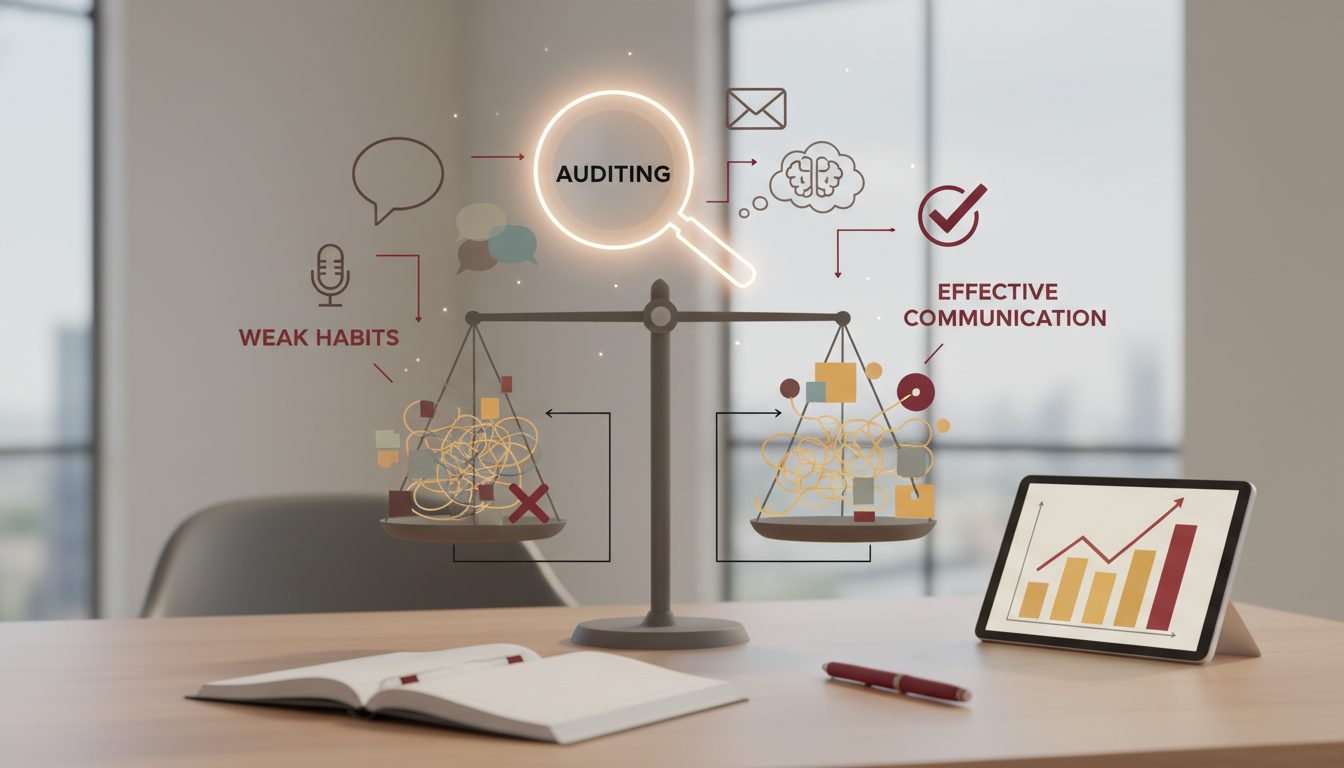
For one week, record yourself in at least one meeting per day (with appropriate permissions). At the end of each day, listen to the recording and tally instances of the 12 habits above. Most professionals are shocked by the frequency — the average person uses 5-8 filler words per minute in unscripted speech, according to research from Toastmasters International.
Create a simple spreadsheet: list the 12 habits in rows, days of the week in columns, and track your count. By day three, you'll have identified your top two or three offenders.
The Trusted Feedback Loop
Ask a colleague you trust to observe you in meetings for one week. Give them the list of 12 habits and ask them to note which ones they hear most. External observation catches what self-awareness misses — especially habits like upspeak and nervous laughter that you may not register in the moment.
The Replacement Practice Protocol
Don't try to fix all 12 habits at once. Pick the one or two that appear most frequently in your audit and focus exclusively on those for two weeks. Use the specific replacement phrases listed above. Once the new pattern becomes automatic, move to the next habit.
This incremental approach is more sustainable and more effective than trying to overhaul your entire communication style overnight. For a broader framework on building confident communication, our step-by-step guide walks you through the full transformation.
Why These Habits Persist (and How to Break the Cycle)
The Likability Trap
Many weak communication habits originate from a desire to be liked. Hedging, apologizing, and softening feel socially safe. They signal, "I'm not a threat." But in professional settings — especially as you move into leadership — likability without credibility leads to being seen as pleasant but not promotable.
The shift isn't from likable to aggressive. It's from approval-seeking to respect-earning. You can be warm, collaborative, and direct simultaneously. Our guide on being assertive without being aggressive shows you exactly how.
Cultural and Gender Dynamics
Research consistently shows that socialization plays a role in communication habits. Women and professionals from certain cultural backgrounds are more likely to hedge, apologize, and defer — not because they lack confidence, but because they've been trained to prioritize harmony. Awareness of these dynamics isn't about assigning blame; it's about choosing intentionally rather than defaulting to patterns that no longer serve you.
The Identity Shift Required
Ultimately, eliminating weak communication habits requires a small but meaningful identity shift. You must move from "person who has ideas" to "person whose ideas deserve airtime." This isn't arrogance — it's professional responsibility. If your ideas are good, weak communication habits aren't modesty. They're a disservice to the people who would benefit from hearing those ideas clearly.
Frequently Asked Questions
What are the most common weak communication habits at work?
The most common weak communication habits at work include hedging language ("I think," "sort of"), over-apologizing, upspeak, excessive filler words ("um," "like"), burying your main point, passive phrasing, over-qualifying statements ("I'm no expert, but…"), and using too many email softeners. These habits signal uncertainty and reduce your perceived competence, even when your ideas are strong.
How do weak communication habits affect career growth?
Weak communication habits directly impact career growth by reducing your perceived credibility and leadership potential. According to the Grammarly/Harris Poll survey, 97% of professionals say communication affects their trust in colleagues. When leaders don't trust your communication, they're less likely to assign you high-visibility projects, sponsor your promotion, or include you in strategic conversations.
Weak communication habits vs. poor communication skills — what's the difference?
Poor communication skills refer to fundamental gaps like inability to organize thoughts, lack of listening, or failure to tailor messages to an audience. Weak communication habits are specific, often unconscious patterns — hedging, apologizing, filler words — layered on top of otherwise competent communication. The distinction matters because habits are easier to fix. You don't need communication training; you need pattern recognition and targeted replacement strategies.
How long does it take to break a weak communication habit?
Research on habit formation suggests it takes an average of 66 days to form a new automatic behavior, according to a 2009 study published in the European Journal of Social Psychology by Phillippa Lally and colleagues at University College London. However, most professionals notice meaningful improvement in their communication patterns within two to three weeks of focused practice on a single habit.
Can you be too direct at work?
Yes, directness without warmth can come across as blunt or dismissive. The goal isn't to eliminate all softening — it's to eliminate unnecessary softening that undermines your credibility. Effective communicators pair directness with respect: "I disagree with that approach, and here's why" is both direct and professional. Our guide on how to disagree professionally provides scripts for this balance.
How do I know if my communication habits are hurting my credibility?
Key warning signs include: being interrupted frequently, having your ideas repeated by others who receive credit, being described as "nice" but not "strategic," receiving feedback that you need more "executive presence," or noticing that peers with similar expertise advance faster. If any of these resonate, a communication audit using the 7-day recording method described above will reveal which specific habits are at play.
Stop Sounding Uncertain in Everyday Conversations
8 communication frameworks, the 7 speech shifts with 30 before-and-after rewrites, 6 email templates, and 100+ phrases for speaking and writing with calm authority at work. PDF.
Get The Authority Toolkit — $27Related Articles

12 Credibility Killers in Workplace Communication to Fix Now
Credibility killers in workplace communication are the subtle habits that quietly erode your professional authority—things like upspeak, excessive qualifiers ("I just think maybe…"), slow email responses, apologizing before sharing ideas, and rambling in meetings. Most professionals unknowingly commit at least three of these daily. The good news: each one has a concrete fix. Below, we break down the 12 most damaging credibility killers and show you exactly how to eliminate them starting today.

Communication Mistakes That Quietly Hurt Your Credibility
The most damaging professional communication mistakes that hurt credibility aren't dramatic blunders—they're subtle habits you repeat daily without realizing it. Hedging language ("I just wanted to…"), chronic over-apologizing, weak email structure, uptalk, filler words, and closed-off body language silently signal uncertainty to colleagues and leaders. Over time, these micro-habits train people to see you as less authoritative, even when your ideas are strong. The good news: each one has a spec

How to Speak With Gravitas: 9 Shifts That Command Respect
Speaking with gravitas means communicating with a weight and authority that makes people stop, listen, and take you seriously. It's not about being loud or dominating—it's about making every word count. To speak with gravitas, you need to make nine deliberate shifts: slow your pace, lower your pitch, eliminate filler words, use declarative language, pause with purpose, anchor your body language, lead with insight, speak concisely, and own the room's silence. These shifts transform how others per