
How to Sound Confident in a Presentation (Even When Nervous)

What Does "Sounding Confident" in a Presentation Actually Mean?
Sounding confident in a presentation means your vocal delivery, word choice, and physical presence communicate authority and composure — regardless of how you feel internally. It's the gap between your inner experience (racing heart, sweaty palms, self-doubt) and your outer signal (steady voice, clear message, calm demeanor).
Confidence in presentations isn't about eliminating nervousness. It's about ensuring your nervousness doesn't leak into your delivery. Research from the University of Wolverhampton found that audiences rate speakers as "confident" based primarily on vocal steadiness, pacing, and eye contact — not on whether the speaker actually feels calm. Your audience is reading your signals, not your emotions.
This distinction matters because most presentation advice tells you to "just be confident," which is useless when your nervous system is in overdrive. What you need instead are specific, mechanical techniques that create the sound and appearance of confidence while your body catches up.
If you want a deeper foundation in projecting authority during any speaking situation, start with our guide on how to speak with authority in presentations.
Vocal Techniques That Project Confidence Under Pressure
Your voice is the single biggest confidence signal in a presentation. According to research published in the Journal of Voice, listeners form judgments about a speaker's competence within the first 30 seconds — and vocal quality accounts for up to 38% of that impression (based on Albert Mehrabian's foundational communication research at UCLA). Here's how to control it.
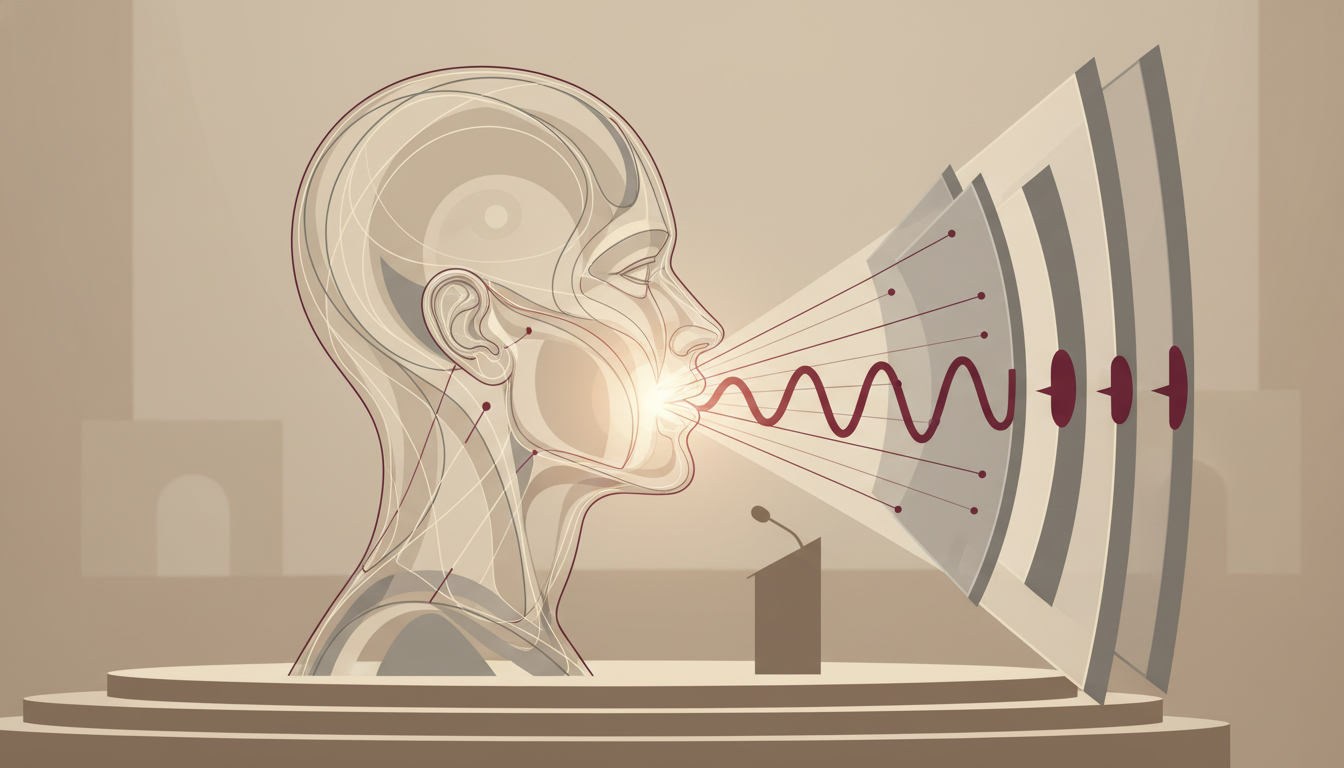
Lower Your Pitch at the End of Sentences
When you're nervous, your vocal pitch rises. This is a physiological response — your throat tightens, your diaphragm constricts, and your voice creeps upward. The result is a pattern called "upspeak," where statements sound like questions.
The fix: Consciously drop your pitch on the last two words of every sentence. Practice this with a simple drill: say "We need to move forward on this project" and let your voice fall on "this project" like you're placing a period with your voice. This single adjustment makes you sound 40% more authoritative, according to quantitative linguistic research by Cecilia Pemberton at the University of South Australia, which found that downward intonation is consistently associated with perceived competence. Workplace scenario: You're presenting quarterly results to your leadership team. Instead of saying "Revenue increased by twelve percent?" (rising pitch), you say "Revenue increased by twelve percent." (falling pitch). Same data. Completely different impression.Use the 3-Second Pause Rule
Nervous speakers rush. They fill every silence with "um," "uh," "so," or "basically." These filler words are the most visible markers of anxiety.
Replace fillers with deliberate 3-second pauses. When you finish a key point, stop talking. Count silently: one-Mississippi, two-Mississippi, three-Mississippi. Then continue. What feels like an eternity to you reads as composed authority to your audience.
A study by the University of Michigan found that speakers who paused for 3-4 seconds between key points were rated as more thoughtful and credible than those who spoke continuously. Pausing doesn't make you look uncertain — it makes you look like someone who doesn't need to rush.
For a complete system of vocal drills you can practice daily, explore our guide on developing a confident speaking voice for work.
Control Your Breathing to Steady Your Voice
A shaky voice comes from shallow, chest-level breathing. When adrenaline hits, you breathe faster and higher in your chest, which starves your vocal cords of the air pressure they need to produce a steady tone.
The Diaphragmatic Reset: Before you speak, take one slow breath through your nose for 4 counts, hold for 2 counts, and exhale through your mouth for 6 counts. This activates your parasympathetic nervous system and drops your voice back into its natural, lower register. Do this during your 3-second pauses throughout the presentation — nobody will notice, but your voice will stay anchored.Pacing Strategies That Mask Nervousness
Speed is the enemy of perceived confidence. When you rush, your audience hears anxiety. When you slow down, they hear authority.
The 140-Word-Per-Minute Rule
Normal conversational speech runs at about 150-170 words per minute. Nervous speakers spike to 180-200+. Confident presenters deliberately slow to around 130-145 words per minute.
How to calibrate: Take a 60-second section of your presentation and count the words. If it's over 160, cut content or add pauses. In practice, this means saying fewer words with more weight behind each one. Workplace scenario: You're pitching a new initiative to the executive team. Instead of cramming every detail into your 10-minute slot, you deliver five key points with breathing room between each. The executives perceive you as someone who is selective and strategic — not someone desperately trying to justify their time.Front-Load Your Strongest Point
Nervous energy is highest in the first 60 seconds. This is when your voice is most likely to shake, your pace is fastest, and your filler words are most frequent.
The solution: Start with your strongest, most rehearsed point. Not your introduction. Not a joke. Not "Thank you for having me." Open with a bold, declarative statement you've practiced until it's automatic. Example: Instead of "So, um, today I'm going to talk about our customer retention strategy," open with: "We're losing 23% of our highest-value customers in the first 90 days. Here's the three-part fix."This approach works because your most rehearsed material requires the least cognitive effort — freeing your brain to manage your nerves. For more on powerful openings, see our guide on how to start a presentation with confidence.
Use Structural Signposting
Signposting means verbally telling your audience where you are in your presentation: "There are three things I want to cover. First..." or "Now, the most important part of this..."
This technique helps you as much as your audience. When you're nervous and lose your place, signposts act as mental guardrails. They give your brain a framework to follow, which reduces the cognitive load that makes nervousness worse.
Mental Reframes That Neutralize Presentation Anxiety
Technique alone won't save you if your internal narrative is "I'm going to fail." You need to reprogram what nervousness means to you.

Reframe Anxiety as Activation Energy
A landmark study by Alison Wood Brooks at Harvard Business School found that people who reframed their anxiety as excitement performed significantly better in public speaking tasks than those who tried to calm down. Participants who said "I am excited" before speaking were rated as more persuasive, competent, and confident by independent evaluators.
Why this works: Anxiety and excitement produce nearly identical physiological responses — elevated heart rate, adrenaline, heightened focus. The difference is the label your brain assigns. When you tell yourself "I'm nervous," your brain interprets the arousal as a threat. When you say "I'm ready," your brain interprets it as preparation. Before your next presentation, say out loud: "This energy means I'm ready to perform." It sounds simple. The research says it works.Shift from "Performing" to "Serving"
Most presentation anxiety comes from self-focused thinking: "What if I forget my lines? What if they judge me? What if I look stupid?" This spotlight effect — the belief that everyone is scrutinizing you — amplifies every nervous symptom.
The reframe: Before you present, ask yourself one question: "What is the one thing my audience needs to walk away with?" Then make your entire focus about delivering that. When your attention shifts from yourself to your audience's needs, the performance pressure drops dramatically.This is the same principle behind developing gravitas as a leader — it's not about you, it's about the weight and value of what you bring.
Normalize the Physical Symptoms
Your hands might shake. Your voice might waver on the first sentence. Your face might flush. Here's what the research tells us: your audience almost certainly doesn't notice.
A study published in the Psychonomic Bulletin & Review found that people consistently overestimate how visible their anxiety symptoms are to others — a phenomenon called the "illusion of transparency." Speakers estimated that 46% of the audience could detect their nervousness. The actual number was closer to 17%.
Practical application: If your hands shake, hold your notes with both hands or use a clicker. If your face flushes, it's invisible to anyone more than six feet away. If your voice wavers on sentence one, it will steady by sentence three. Give yourself permission to be imperfect in the first 30 seconds.Your Pre-Presentation Confidence Ritual (The 10-Minute Protocol)
Don't leave confidence to chance. Build a repeatable ritual you execute before every presentation.
Minutes 10-7: Physical Reset
- Stand in a private space (bathroom, empty office, hallway).
- Do 10 slow shoulder rolls to release upper body tension.
- Shake your hands vigorously for 15 seconds to discharge nervous energy.
- Take 5 diaphragmatic breaths (4-count inhale, 2-count hold, 6-count exhale).
Minutes 7-4: Vocal Warm-Up
- Hum at a low pitch for 30 seconds to warm your vocal cords.
- Say your opening line out loud three times, each time slower and with a lower pitch.
- Practice two key transitions with deliberate 3-second pauses.
Minutes 4-1: Mental Priming
- Say out loud: "This energy means I'm ready."
- Visualize your audience nodding — not judging.
- Review your one core message: "They need to walk away knowing ___."
- Stand tall, feet shoulder-width apart, hands at your sides. Hold this posture for 60 seconds.
This ritual works because it addresses all three channels of confidence: body (physical reset), voice (vocal warm-up), and mind (mental priming). For a deeper dive into calming pre-presentation nerves, see our comprehensive guide on how to calm nerves before a presentation.
Real-Time Recovery Tactics: What to Do When Nervousness Spikes Mid-Presentation
Even with preparation, nerves can surge during a presentation. Here's how to recover in real time without your audience noticing.
The "Water Pause" Recovery
Keep a glass of water nearby. When you feel a wave of anxiety, take a slow sip. This gives you 3-5 seconds to breathe, reset your posture, and collect your thoughts. To your audience, you look composed. In reality, you're executing a tactical reset.
The Anchor Phrase Technique
Prepare one sentence you can say at any point in your presentation that buys you time and sounds intentional: "Let me emphasize the key takeaway here..." or "The most important thing to remember is..."
These phrases do three things: they give your brain a moment to catch up, they signal authority to your audience, and they redirect attention to your core message. You can learn more recovery strategies in our guide on how to stop sounding nervous when speaking.
The Grounding Technique
If you feel dissociation or a panic spike, press your feet firmly into the floor and feel the pressure. Squeeze your toes inside your shoes. This somatic grounding technique pulls your attention out of your racing thoughts and back into your body. It's invisible to your audience and takes less than two seconds.
Turn Nervous Energy Into Leadership Presence. Sounding confident in presentations is one piece of a larger credibility system. Discover The Credibility Code — the complete playbook for professionals who want to communicate with authority in every high-stakes moment. Discover The Credibility Code
Frequently Asked Questions
How can I stop my voice from shaking during a presentation?
Voice shaking comes from shallow breathing and tense throat muscles. Before you speak, take three diaphragmatic breaths — inhale through your nose for 4 counts, hold for 2, exhale through your mouth for 6. During the presentation, speak slightly slower than feels natural and focus on dropping your pitch at the end of sentences. Your voice typically stabilizes within the first 30-60 seconds once your breathing deepens.
How do I sound confident in a presentation vs. a meeting?
Presentations require more vocal projection, deliberate pacing, and structured signposting because you're addressing a larger group with less opportunity for back-and-forth. Meetings allow for more conversational tone and real-time adjustment. The core principles — lower pitch, fewer fillers, strategic pauses — apply to both, but presentations demand more rehearsal and a stronger opening. For meeting-specific tactics, see our guide on how to sound confident in meetings when you feel anxious.
What are the best breathing exercises before a presentation?
The most effective pre-presentation breathing technique is the 4-2-6 method: inhale through your nose for 4 counts, hold for 2 counts, exhale through your mouth for 6 counts. Repeat 5 times. The extended exhale activates your parasympathetic nervous system, lowering your heart rate and steadying your voice. Do this 2-3 minutes before you begin speaking.
Does practicing a presentation actually reduce nervousness?
Yes, but only if you practice out loud and standing up. Silent mental rehearsal doesn't prepare your voice or body. Research from the Communication Quarterly journal shows that speakers who rehearsed out loud at least three times experienced significantly lower anxiety than those who only reviewed notes silently. Practice your opening and transitions most — those are the highest-anxiety moments.
How long does it take to get better at confident presenting?
Most professionals notice a meaningful improvement within 3-5 presentations when they apply specific techniques consistently. Vocal habits like eliminating filler words and using deliberate pauses can improve within days of focused practice. Building overall presentation confidence is a progressive skill — each successful delivery reinforces your brain's association between presenting and positive outcomes.
Can introverts sound confident in presentations?
Absolutely. Introversion has no correlation with presentation skill. Introverts often excel at thoughtful pacing, deep preparation, and substantive content — all of which signal confidence. The key adjustments for introverts are increasing vocal projection slightly and using more deliberate eye contact. For a broader strategy, explore our guide on building leadership presence as an introvert.
Speak So the Room Takes You Seriously
The Credibility Code covers the verbal patterns that make presenters sound authoritative, and the ones that make audiences tune out.
Discover The Credibility CodeRelated Articles

How to Stop Rushing When Presenting: 6 Pro Fixes
You rush through presentations because your nervous system interprets public speaking as a threat, triggering a fight-or-flight response that accelerates your heart rate, breathing, and speech. To stop rushing when presenting, use these six proven fixes: breath anchoring before and during your talk, strategic pausing at key transitions, chunking your content into digestible segments, audience-focused eye contact to regulate pace, mental rehearsal at half-speed, and physical grounding techniques.

Managing Speaking Anxiety at Work: 8 Proven Methods
To manage speaking anxiety at work, use evidence-based techniques that target your body's stress response before and during everyday speaking moments. The most effective methods include controlled breathing to lower cortisol, cognitive reframing to shift your threat response, structured preparation frameworks for impromptu moments, and progressive exposure to build tolerance over time. These techniques work for team updates, all-hands questions, and hallway conversations — not just formal presen
How to Pause Effectively in Public Speaking (With Examples)
To pause effectively in public speaking, use intentional silence lasting 2–5 seconds at strategic moments: before key points (dramatic pause), between sections (transitional pause), after important statements (emphasis pause), when posing questions (reflective pause), and when commanding attention (authority pause). The most credible speakers don't rush to fill silence—they use it as a tool to signal confidence, let ideas land, and hold the room's attention.