
How to Stop Sounding Nervous When Speaking: Quick Fixes

To stop sounding nervous when speaking, target the five vocal patterns that betray anxiety: filler words ("um," "uh," "like"), uptalk (rising pitch at sentence ends), rushed pacing, shallow breathing, and vocal fry under stress. The fix isn't "just relax"—it's retraining specific vocal habits. Use diaphragmatic breathing to steady your voice, insert deliberate pauses instead of fillers, and drop your pitch at the end of statements. These mechanical corrections work even when your nerves are still firing.
What Does "Sounding Nervous" Actually Mean?
Sounding nervous is the collection of vocal and verbal patterns that signal uncertainty, anxiety, or lack of authority to your listeners—even when you know your material cold. It includes audible cues like a shaky or thin voice, rushed speech, excessive filler words, and rising intonation on declarative statements.
Here's the critical insight: sounding nervous and being nervous are two different problems. You can feel anxious and still sound completely composed. The goal isn't to eliminate nerves—it's to eliminate the vocal leaks that broadcast them. According to research published in the Journal of Voice (2019), listeners form judgments about a speaker's competence within the first 30 seconds, based largely on vocal quality rather than content.
When you learn to speak with confidence at work through daily shifts, you're essentially closing the gap between what you know and how you sound.
The 5 Vocal Patterns That Make You Sound Nervous
Before you can fix the problem, you need to identify exactly which patterns are undermining you. Most professionals have one or two dominant "nervous tells"—not all five.
Filler Words: The Credibility Drain
"Um," "uh," "like," "so," "you know," and "basically" are the most recognized nervous speech patterns. A study from the University of Texas found that speakers who use frequent filler words are rated as less competent, less prepared, and less hirable—even when their actual content is identical to filler-free speakers.
What's really happening: Your brain is searching for the next word, and instead of tolerating silence, it fills the gap with noise. It's a habit loop—your mouth has learned that silence is dangerous. Real-world example: Imagine you're presenting quarterly results to your VP. You say: "So, basically, um, revenue was up, like, 12 percent, which is, you know, pretty solid." You just delivered good news and made it sound uncertain. The same sentence without fillers—"Revenue was up 12 percent. That's a strong quarter."—lands with authority.For a deep dive into eliminating this specific habit, see our guide on how to stop using filler words in professional speaking.
Uptalk: Turning Statements Into Questions
Uptalk is the pattern of raising your pitch at the end of a declarative sentence, making it sound like a question. "We should move forward with vendor B?" instead of "We should move forward with vendor B." Research from Pearson's Communication Studies journal found that speakers who use uptalk are perceived as 25% less authoritative by listeners, regardless of their actual expertise.
What's really happening: You're unconsciously seeking approval or checking whether your audience agrees before you commit to your own point. It's vocal hedging. Real-world example: A project manager in a status meeting says, "We're on track to deliver by Friday?" The team hears hesitation. The client hears uncertainty. One small pitch change—dropping your voice at the period—transforms the perception entirely.Rushing: The Speed Trap
When adrenaline hits, most people accelerate. Words blur together, pauses disappear, and your audience struggles to process what you're saying. The National Communication Association reports that the optimal speaking rate for comprehension and credibility is 140–160 words per minute. Nervous speakers routinely hit 180–200+ wpm.
What's really happening: Your fight-or-flight response is telling your body to "get through this as fast as possible." Your speech rate is a direct reflection of your stress response.Breathlessness and Vocal Shake
A thin, breathy, or trembling voice is perhaps the most physically obvious sign of nerves. When you're anxious, your breathing shifts from deep diaphragmatic breaths to shallow chest breathing. This starves your vocal cords of the air pressure they need to produce a full, resonant sound.
What's really happening: Stress triggers tension in the muscles around your larynx and diaphragm. Less air support means less vocal power, more breathiness, and audible shakiness.Vocal Fry Under Stress
Vocal fry—that low, creaky, popping sound at the ends of sentences—often intensifies when speakers are nervous and running out of breath. A 2014 study published in PLOS ONE found that speakers with vocal fry were perceived as less competent, less educated, and less trustworthy than those with a normal modal voice.
What's really happening: You're pushing through sentences without enough breath support, causing your vocal cords to vibrate irregularly at the tail end of phrases.In-the-Moment Fixes: What to Do When Nerves Hit
These techniques work in real time—during presentations, meetings, and high-stakes conversations. No preparation required.

The 4-4-6 Breath Reset
This is the single most effective in-the-moment technique for stopping nervous voice. Before you speak (or during any natural pause), breathe in through your nose for 4 seconds, hold for 4 seconds, and exhale slowly through your mouth for 6 seconds. The extended exhale activates your parasympathetic nervous system, which directly counteracts the fight-or-flight response.
When to use it: Before standing up to present. During a transition slide. While someone else is asking a question. Before responding in a tense meeting.One breath cycle takes 14 seconds. That's all you need to noticeably lower your heart rate and steady your voice. For a complete set of pre-speaking calming strategies, explore our guide on how to calm nerves before speaking.
The Power Pause
Replace every filler word with silence. This sounds simple but feels terrifying at first—because nervous speakers interpret silence as failure. In reality, a 1–2 second pause between sentences signals confidence, gives your audience time to absorb your point, and gives your brain time to find the next word without resorting to "um."
The reframe: Pauses don't make you look unprepared. They make you look deliberate. Watch any TED talk by a seasoned speaker—pauses are their most powerful tool. Learn more about how to pause effectively in public speaking. Practice drill: Record yourself answering the question "Tell me about your current project" for 60 seconds. Count your fillers. Then do it again, replacing every filler with a full stop of silence. You'll sound dramatically more composed on the second take.The Pitch Drop Technique
At the end of every declarative sentence, consciously drop your pitch. Think of the vocal pattern of a news anchor delivering a headline—the voice goes down at the period. This single adjustment eliminates uptalk and instantly makes you sound more authoritative.
Quick exercise: Say this sentence out loud three times, dropping your pitch lower on the final word each time: "We need to move the timeline up by two weeks." Feel the difference between ending on a downward note versus an upward one. The content is identical. The authority is not.Daily Training Exercises to Rewire Nervous Speech Habits
In-the-moment fixes manage the symptoms. These daily exercises address the root cause by retraining your vocal muscle memory.
The 5-Minute Morning Voice Warm-Up
Your voice is a physical instrument. Like any instrument, it performs better when warmed up. A cold, tight voice is more susceptible to nervous patterns.
The routine (5 minutes total):- Humming (1 minute): Hum at a comfortable pitch, feeling the vibration in your chest and face. This warms up your vocal cords and promotes resonance.
- Lip trills (1 minute): Blow air through closed lips while vocalizing, sliding from low to high pitch. This releases tension in the jaw and lips.
- Diaphragmatic breathing (1 minute): Place one hand on your chest and one on your belly. Breathe so only the belly hand moves. This trains the breath support that prevents breathlessness and vocal fry.
- Power phrases (2 minutes): Read 3–5 sentences from a news article out loud, focusing on ending each sentence with a downward pitch and pausing for a full beat between sentences.
Do this before any day where you have a meeting, presentation, or important conversation. It takes five minutes and the difference is measurable.
The Recording and Playback Method
Most people have never actually heard their nervous speech patterns. Recording yourself is uncomfortable—and irreplaceable.
How to do it:- Record yourself answering common work questions: "What's the status of the project?" "Why should we invest in this initiative?" "Walk me through your recommendation."
- Play it back and mark every filler word, every instance of uptalk, and every moment you rushed.
- Re-record with corrections. Compare the two versions.
According to a meta-analysis in Communication Education (2018), speakers who used video self-review improved their delivery skills 28% faster than those who relied on feedback from others alone.
The Deliberate Slow-Down Drill
Set a metronome app to 80 beats per minute. Practice speaking one word per beat. This will feel absurdly slow—that's the point. You're recalibrating your internal speedometer. After two minutes at this pace, speak at your "normal" pace. You'll find your natural rate has slowed to a more composed, credible tempo.
This technique is especially useful if you tend to sound unsure when you speak at work and want to build a more deliberate communication style.
Advanced Strategies for High-Stakes Situations
Everyday meetings are one thing. Board presentations, executive briefings, and high-visibility moments demand a higher level of vocal control.
The First-Sentence Anchor
Your first sentence sets the vocal tone for everything that follows. If your first sentence is rushed, breathy, or filled with qualifiers, you'll spend the rest of the presentation trying to recover credibility.
The technique: Memorize and rehearse your opening sentence until you can deliver it in your sleep. Make it short—no more than 10 words. Deliver it slowly, with a downward pitch at the end, after a full breath. Example: Instead of "So, um, thanks for having me, I'm going to talk about our Q3 results and, you know, where we're headed," try: "Q3 was our strongest quarter in three years." Full stop. Pause. Then continue.For more on commanding openings, see our guide on how to start a presentation with confidence.
The Grounding Stance
Physical tension feeds vocal tension. Before and during speaking, plant both feet flat on the floor, shoulder-width apart. Unlock your knees. Drop your shoulders away from your ears. Unclench your jaw.
This isn't just body language advice—it's vocal mechanics. A grounded stance allows your diaphragm to move freely, which gives your voice the air support it needs to sound full and steady. When your body is braced and tight, your voice reflects that tension.
The "Talk to One" Technique
In a room of 20 people, don't speak to the room. Speak to one person for one complete thought—usually 1–2 sentences. Then shift to another person for the next thought. This transforms a terrifying "performance" into a series of manageable one-on-one conversations. Your voice naturally relaxes because your brain processes it as talking to a single person, not addressing a crowd.
Build Unshakable Speaking Presence The Credibility Code gives you the exact frameworks, scripts, and daily practices to communicate with authority—even when your nerves are screaming. Discover The Credibility Code
How to Measure Your Progress
You can't improve what you don't track. Here's a simple system for monitoring your vocal confidence over time.
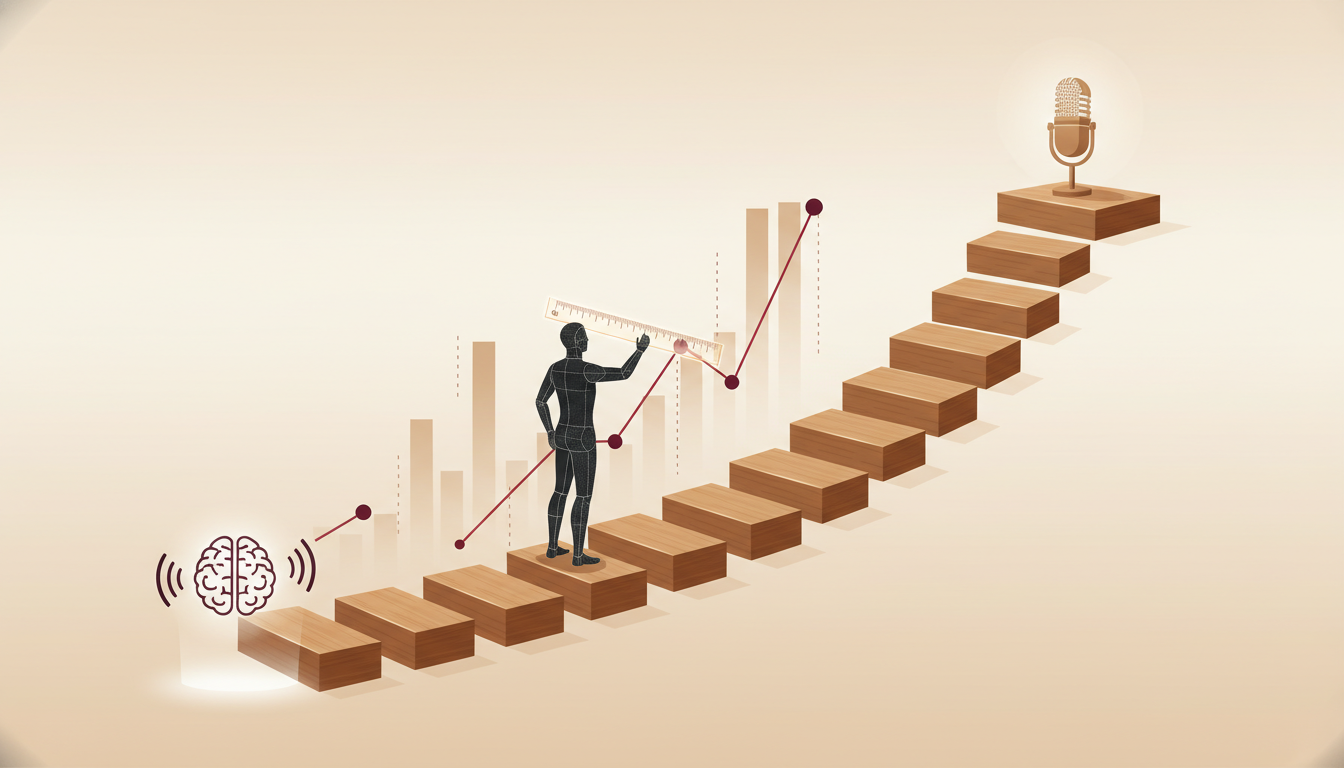
The Weekly Self-Audit
Every Friday, record yourself for two minutes answering one question: "What did I accomplish this week?" Play it back and score yourself on five criteria:
| Pattern | Score 1 (Frequent) | Score 5 (Rare/None) |
|---|---|---|
| Filler words | More than 8 per minute | 0–1 per minute |
| Uptalk | Most sentences rise | All statements drop |
| Rushing | Over 180 wpm | 140–160 wpm |
| Breathlessness | Audible gasping | Smooth, steady tone |
| Vocal fry | Creaky endings on most sentences | Clean endings |
Track your scores weekly. Most professionals see noticeable improvement within 3–4 weeks of deliberate practice.
Get External Feedback
Ask a trusted colleague to listen for one specific pattern during your next meeting. Don't ask "How did I sound?"—that's too vague. Ask: "Did you notice me using filler words?" or "Did my sentences end with a rising pitch?" Specific questions yield specific, useful feedback.
Building this kind of vocal authority is a core part of developing a commanding presence in daily practice.
Frequently Asked Questions
Why do I sound nervous even when I'm not?
Sounding nervous is often a habit, not a reflection of your actual emotional state. If you learned to use filler words, uptalk, or rushed pacing early in your career, those patterns persist even when you feel calm. The fix is vocal retraining—recording yourself, identifying specific patterns, and practicing corrections until the new patterns become automatic. Your voice may be on a 5-year delay from your actual confidence level.
How long does it take to stop sounding nervous when speaking?
Most professionals notice a meaningful difference within 2–4 weeks of daily practice (5–10 minutes per day). Filler words typically reduce first because they respond well to awareness-based training. Uptalk and pacing take slightly longer—usually 4–6 weeks. Complete vocal retraining to the point where composed speech is your default under pressure typically takes 2–3 months of consistent effort.
Sounding nervous vs. being nervous: what's the difference?
Being nervous is an internal emotional and physiological state—elevated heart rate, adrenaline, sweaty palms. Sounding nervous is the external expression of that state through vocal patterns like filler words, uptalk, rushing, and breathlessness. They often overlap, but not always. Many confident speakers still sound nervous because of ingrained habits, and many anxious speakers have trained themselves to sound composed. The techniques in this article target the external signals specifically.
Can breathing exercises really change how my voice sounds?
Yes—and the evidence is strong. Diaphragmatic breathing directly increases subglottic air pressure, which is the air pressure beneath your vocal cords that determines vocal power, stability, and resonance. A 2020 study in the Journal of Voice found that participants who practiced diaphragmatic breathing for just two weeks showed measurable improvements in vocal steadiness and reduced perceived nervousness. Breathing is the foundation of every other vocal fix.
What's the fastest fix if I have to speak in 5 minutes?
Do three rounds of the 4-4-6 breath (inhale 4 seconds, hold 4, exhale 6). Memorize your first sentence and practice saying it slowly with a downward pitch. Plant your feet, drop your shoulders, and unclench your jaw. Speak to one person at a time instead of scanning the room. These four actions take under three minutes and will noticeably reduce how nervous you sound. For a more complete pre-speaking routine, see our guide on how to calm nerves before a presentation.
Does speaking anxiety get worse with seniority?
It can. As you advance, the stakes of each speaking moment increase—you're presenting to boards, leading town halls, and representing your organization externally. A 2023 survey by Bravely found that 63% of senior leaders still experience speaking anxiety in high-stakes settings. The difference is that experienced leaders have developed techniques to manage the sound of nervousness, even when the feeling persists. Seniority doesn't eliminate anxiety—it raises the bar for managing it.
Speak So the Room Takes You Seriously
The Credibility Code covers the verbal patterns that make presenters sound authoritative, and the ones that make audiences tune out.
Discover The Credibility CodeRelated Articles

How to Sound Confident in a Presentation: 9 Proven Tactics
To sound confident in a presentation, focus on three pillars: vocal delivery, verbal precision, and structural clarity. Slow your speaking pace to 130–150 words per minute, use strategic pauses instead of filler words, replace hedging language ("I think maybe…") with power phrases ("The data shows…"), and open with your strongest point. Confidence isn't about feeling fearless — it's about controlling the signals your audience receives.

How to Sound Confident in a Presentation: 9 Pro Secrets
To sound confident in a presentation, focus on three pillars: vocal delivery, language structure, and psychological preparation. Slow your speaking pace by 10–15%, eliminate hedging phrases like "I think" or "sort of," and anchor your opening with a declarative statement rather than an apology. Use strategic pauses instead of filler words, drop your pitch at the end of sentences, and structure your content around no more than three core points. Confidence is less about feeling fearless and more

How to Sound Confident in a Presentation: 9 Proven Methods
To sound confident in a presentation, focus on these core techniques: lower your vocal pitch slightly, slow your speaking pace to 130–150 words per minute, pause deliberately instead of using filler words, control your breathing from your diaphragm, and open with a strong declarative statement. These methods work even when you feel nervous because confidence is a skill of *delivery*, not a reflection of your internal state. The audience hears your voice — not your heartbeat.