
How to Calm Nerves Before a Presentation: 11 Proven Methods
What Is Presentation Anxiety?
Presentation anxiety — sometimes called glossophobia or performance anxiety — is the physiological and psychological stress response triggered by the prospect of speaking in front of an audience. It manifests as a racing heart, shallow breathing, sweaty palms, vocal trembling, and cognitive fog.
Unlike general anxiety, presentation anxiety is situational and highly treatable. According to the National Institute of Mental Health, roughly 73% of the population experiences some degree of glossophobia, making it one of the most common social fears. The good news: the techniques that manage it are well-researched, specific, and learnable.
Why "Just Relax" Doesn't Work (And What Does)
The Problem With Suppression
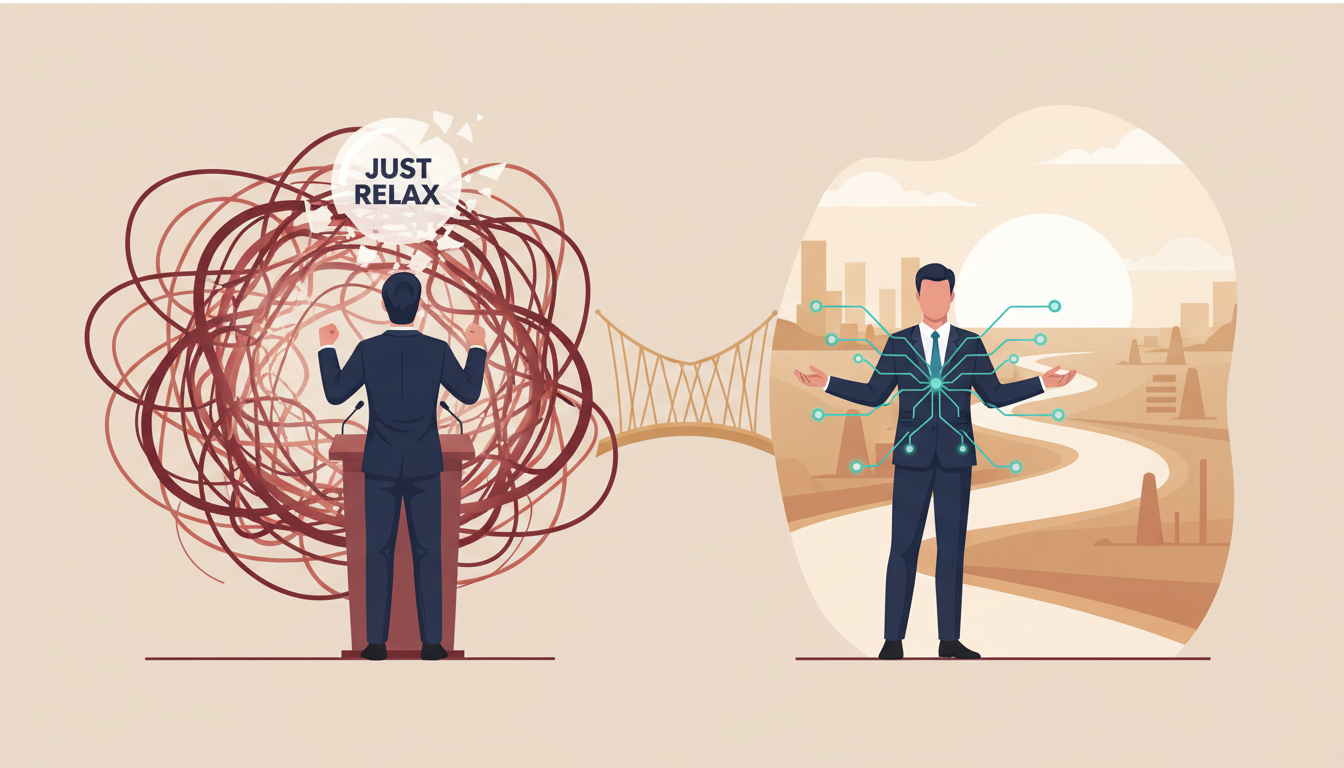
Most advice tells you to calm down. But telling your brain to suppress a stress response is like telling yourself not to think about a white bear — it backfires. Research from Harvard Business School professor Alison Wood Brooks found that people who tried to calm down before a stressful performance actually performed worse than those who reframed their anxiety as excitement.
Your nervous system doesn't distinguish between "I'm terrified" and "I'm thrilled." Both states produce adrenaline, elevated heart rate, and heightened alertness. The difference is the story you tell yourself about those sensations.
Cognitive Reappraisal: The Reframe That Works
Cognitive reappraisal means changing the meaning you assign to your physical sensations. Instead of thinking, "My heart is pounding because I'm going to fail," you think, "My heart is pounding because my body is preparing me to perform at a high level."
Brooks's 2014 study, published in the Journal of Experimental Psychology: General, showed that participants who said "I am excited" before a public speaking task were rated as more persuasive, more competent, and more confident by independent evaluators — compared to those who said "I am calm."
Here's how to apply it in a real scenario: You're about to present a quarterly strategy update to senior leadership. Your hands are shaking. Instead of fighting it, say out loud (or under your breath): "I'm excited about this. My body is getting ready to deliver." This single reframe shifts your brain from threat mode to opportunity mode.If you want to go deeper on commanding the room in high-stakes moments, our guide on presenting to senior leadership covers the full framework.
The 11 Proven Methods to Calm Nerves Before a Presentation
Method 1: Physiological Sighs (The Fastest Reset)
Neuroscientist Andrew Huberman at Stanford popularized this technique, which is the fastest known way to voluntarily lower your heart rate. Here's the protocol:
- Double inhale through your nose — one full breath in, then a second short sniff on top to fully inflate your lungs.
- Long, slow exhale through your mouth, taking twice as long as the inhale.
- Repeat two to three times.
This works because the extended exhale activates your parasympathetic nervous system. A 2023 study in Cell Reports Medicine by Balban et al. found that just five minutes of cyclic physiological sighing significantly reduced anxiety and improved mood — outperforming even mindfulness meditation in the same trial.
When to use it: In the 60 seconds before you walk to the front of the room or unmute on a video call.Method 2: The 10-Minute Power Priming Routine
Elite speakers don't wing their warm-up. They follow a structured pre-performance routine. Here's a 10-minute version you can use before any presentation:
- Minutes 1–3: Physical reset. Stand up. Shake out your hands. Roll your shoulders. Adopt an expansive posture — feet shoulder-width apart, chest open, chin level. Research by Carney, Cuddy, and Yap (2010) found that holding expansive postures for two minutes increased testosterone by 20% and decreased cortisol by 25%.
- Minutes 4–6: Vocal warm-up. Hum at a low pitch for 30 seconds. Then read your opening lines out loud three times, each time projecting slightly more. This prevents the "thin voice" that comes from a tight throat. Our article on vocal authority has a complete vocal warm-up sequence.
- Minutes 7–10: Mental rehearsal. Close your eyes. Visualize yourself walking to the front, making eye contact, delivering your first three sentences with clarity and conviction. See the audience nodding. Feel the confidence in your chest.
Method 3: The "First 30 Seconds" Script
Most presentation anxiety peaks in the first 30 seconds. After that, your brain adjusts and the fear subsides. The solution: script and memorize your first 30 seconds word for word.
This doesn't mean reading from notes. It means knowing your opening so well that you could deliver it in your sleep. When you don't have to think about what to say, your cognitive bandwidth frees up to focus on how you say it — your tone, pace, eye contact, and presence.
Example: Instead of winging an opening like "So, um, today I'm going to talk about our Q3 results," you rehearse: "Our Q3 revenue grew 14% — the strongest quarter in three years. I'm going to walk you through the three decisions that made that possible."Method 4: Grounding Through the 5-4-3-2-1 Technique
This sensory grounding exercise pulls your brain out of catastrophic future-thinking and anchors it in the present moment:
- 5 things you can see
- 4 things you can touch
- 3 things you can hear
- 2 things you can smell
- 1 thing you can taste
It takes about 60 seconds and is especially effective for people who experience "blank mind" anxiety — that terrifying moment where you forget everything you planned to say.
Method 5: Arrival Anchoring
Where you are when you present matters. If possible, arrive early and spend time in the room before anyone else shows up. Stand at the front. Touch the podium or table. Walk the space. Sit in the audience's chairs.
This technique — called environmental habituation — reduces the novelty response your brain triggers in unfamiliar settings. By the time the audience arrives, your nervous system has already categorized the space as "safe."
Method 6: Strategic Caffeine Management
This one is simple but overlooked. Caffeine amplifies your sympathetic nervous system — the same system driving your anxiety. A study published in Psychosomatic Medicine found that 300mg of caffeine (roughly two to three cups of coffee) significantly increased cortisol and self-reported anxiety in stressful situations.
The rule: Cut your normal caffeine intake in half on presentation day. If you normally drink two cups, have one — and finish it at least 90 minutes before your talk.Method 7: The Anxiety Disclosure Technique
Counterintuitively, briefly naming your nervousness can neutralize it. This doesn't mean opening with "I'm so nervous right now" — that undermines your credibility. Instead, use a confident reframe:
"I've been looking forward to this conversation — there's a lot of energy in the room."
This acknowledges the heightened state without labeling it as weakness. For more on how to sound confident at work even when you're not feeling it, we've written a detailed guide.
Method 8: Bilateral Stimulation (The Butterfly Tap)
Borrowed from EMDR therapy, bilateral stimulation involves alternately tapping your left and right knees (or crossing your arms and tapping your shoulders) for 30 to 60 seconds. This cross-body movement engages both brain hemispheres and has been shown to reduce emotional intensity.
It's discreet enough to do while seated at a conference table, waiting for your turn to speak.
Method 9: Outcome Visualization vs. Process Visualization
Most people visualize the outcome — a standing ovation, a nodding CEO. But research from UCLA psychologist Shelley Taylor found that process visualization (mentally rehearsing the steps of your performance) is significantly more effective at reducing anxiety and improving outcomes than outcome visualization alone.
Instead of imagining applause, imagine yourself making eye contact with three specific people in the audience. Imagine pausing after your key point. Imagine clicking to your most important slide and delivering the insight behind it.
Method 10: The Pre-Presentation Conversation
Have a brief, friendly conversation with someone in the audience before you begin. Ask them about their day, their role, or what they're hoping to get from the session.
This does two things: it shifts your brain from "performer vs. evaluators" to "human talking with humans." And it gives you a friendly face to look at during your opening — an anchor point that feels safe.
Method 11: Post-Presentation Debrief (Building Long-Term Resilience)
Calming nerves isn't just about the moment before — it's about building a track record of evidence that you can do this. After every presentation, write down three things that went well and one thing you'd adjust.
Over time, this debrief practice rewires your brain's prediction model. Instead of defaulting to "this is going to go badly," your brain starts referencing a growing library of evidence that says, "actually, I've done this before and it went fine."
This is closely connected to overcoming imposter syndrome at work — the more evidence you collect, the harder it becomes for self-doubt to override reality.
Building a Pre-Presentation Routine That Fits Your Schedule
The 30-Minute Routine (Ideal)
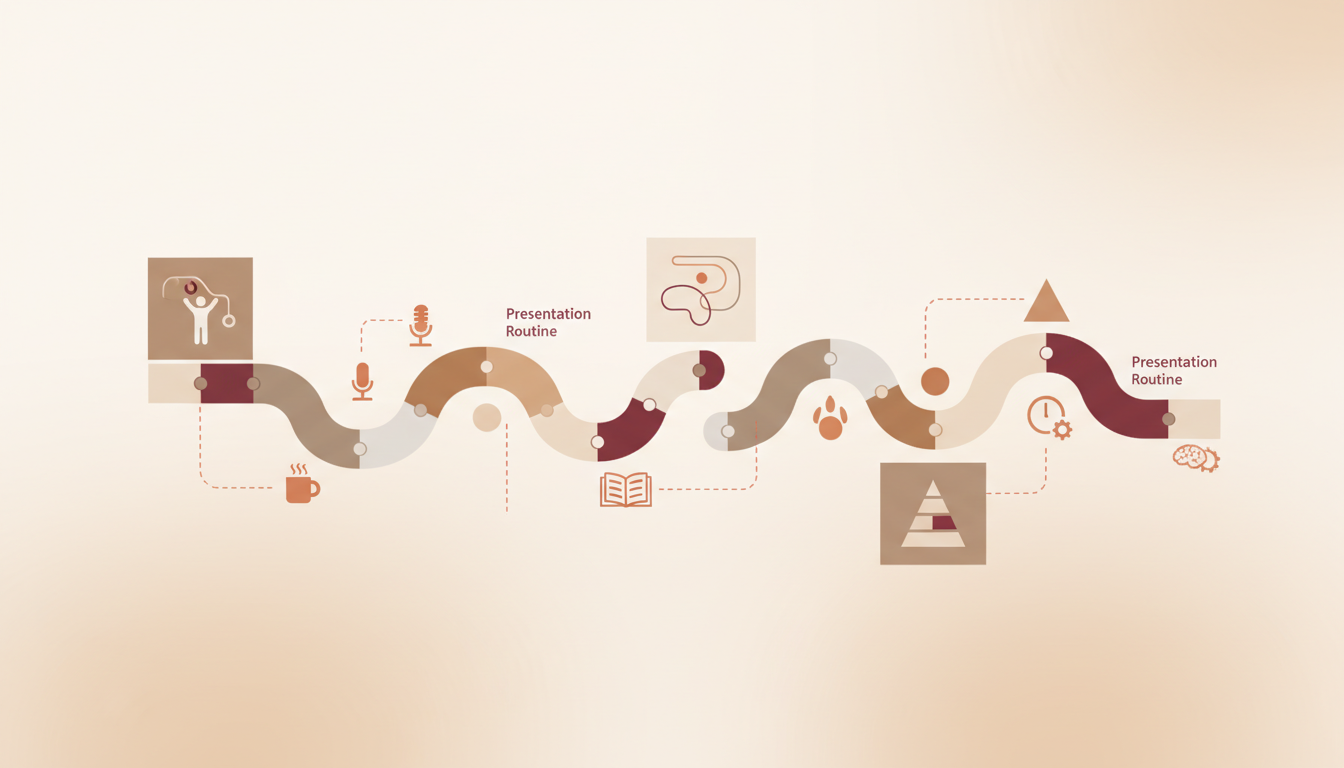
If you have 30 minutes before your talk, here's the optimal sequence:
- T-30 min: Arrive at the room. Walk the space. Set up your materials.
- T-20 min: Have a brief conversation with an early-arriving audience member.
- T-10 min: Run the Power Priming Routine (posture, vocal warm-up, mental rehearsal).
- T-2 min: Three cycles of physiological sighs.
- T-0: Deliver your scripted first 30 seconds.
The 5-Minute Emergency Routine
Sometimes you get pulled into a meeting with zero warning. Here's your compressed protocol:
- Physiological sighs — three cycles (30 seconds).
- Cognitive reappraisal — say "I'm excited about this" (5 seconds).
- Recall your key message — what's the one thing you want them to remember? (30 seconds).
- Posture reset — feet flat, shoulders back, chin level (10 seconds).
Even this abbreviated routine can dramatically shift your state. For more strategies on performing under pressure, see our guide on confidence in high-stakes conversations.
Customizing for Virtual Presentations
Virtual presentations carry unique anxiety triggers — you can see your own face, you can't read the room, and technical glitches feel catastrophic. Adjust your routine:
- Turn off self-view on Zoom or Teams. Watching yourself speak increases self-consciousness and anxiety.
- Stand up even if you're on camera from the waist up. Standing activates more confident vocal patterns and body language for leadership presence.
- Place a sticky note next to your camera lens with your opening line. This serves as both a teleprompter and a visual anchor.
The Long Game: Reducing Baseline Anxiety Over Time
Exposure Stacking
The single most effective long-term treatment for presentation anxiety is repeated exposure. But not all exposure is equal. Exposure stacking means gradually increasing the stakes:
- Present to one trusted colleague.
- Present to your immediate team.
- Present at a department meeting.
- Present to senior leadership.
- Present at an external event.
Each successful repetition recalibrates your threat-detection system. According to a meta-analysis published in Psychological Bulletin (Hofmann et al., 2012), exposure-based interventions remain the most effective approach for social and performance anxiety, with large effect sizes across multiple studies.
Building Your Speaker Identity
Anxiety often persists because you haven't updated your self-concept. You still see yourself as "someone who gets nervous" rather than "someone who speaks with authority."
Actively building your professional identity as a confident communicator — through practice, feedback, and establishing credibility quickly in any room — creates a new default. Over time, the question shifts from "How do I survive this presentation?" to "How do I make this presentation great?"
Frequently Asked Questions
How long before a presentation should I start calming my nerves?
Begin your pre-presentation routine 20 to 30 minutes before your talk if possible. This gives you time for environmental habituation, a vocal warm-up, and mental rehearsal. If you only have a few minutes, focus on physiological sighs and cognitive reappraisal — these two techniques alone can shift your state in under 60 seconds.
Does presentation anxiety ever fully go away?
For most people, no — and that's actually a good thing. A moderate level of arousal improves performance (known as the Yerkes-Dodson law). The goal isn't to eliminate nervousness but to manage it so it fuels your energy rather than undermining your delivery. Even seasoned TEDx speakers report pre-talk nerves.
Presentation anxiety vs. imposter syndrome: what's the difference?
Presentation anxiety is a situational stress response to the act of speaking publicly. Imposter syndrome is a broader pattern of doubting your qualifications and fearing exposure as a "fraud." They often overlap — imposter syndrome can amplify presentation anxiety — but they require different interventions. Anxiety responds well to physiological and behavioral techniques; imposter syndrome requires cognitive work around self-concept and evidence collection.
What should I eat before a presentation?
Avoid heavy meals, excess sugar, and high caffeine within two hours of your talk. Opt for a balanced snack with protein and complex carbs — like nuts, a banana, or yogurt — about 60 to 90 minutes beforehand. This stabilizes blood sugar without triggering a crash or amplifying jitteriness.
Can beta-blockers help with presentation anxiety?
Beta-blockers like propranolol are sometimes prescribed off-label for performance anxiety. They block the physical symptoms — racing heart, trembling hands, shaky voice — without affecting cognitive function. However, they require a prescription and aren't a substitute for building long-term presentation skills. Consult your physician before considering this option.
How do I calm nerves for a virtual presentation specifically?
Virtual presentations require the same physiological techniques plus a few adjustments: stand up to activate confident posture, turn off self-view to reduce self-consciousness, and place a visual anchor (like a photo or sticky note with your key message) near your camera. Arriving early to test your technology also eliminates a major source of virtual presentation anxiety.
Turn presentation anxiety into commanding presence. The Credibility Code is the complete system for professionals who want to communicate with authority, confidence, and impact — whether you're presenting to five people or five hundred. Discover The Credibility Code
Featured image alt text: Professional standing confidently at a podium before a presentation, demonstrating calm body language and open posture in a modern conference room setting.
Speak So the Room Takes You Seriously
The Credibility Code covers the verbal patterns that make presenters sound authoritative, and the ones that make audiences tune out.
Discover The Credibility CodeRelated Articles

Control Nervous Energy Before Public Speaking: 9 Methods
To control nervous energy before public speaking, use evidence-based techniques that work with your body's stress response rather than against it. The most effective methods include physiological sighing (a double-inhale followed by a long exhale), cognitive reappraisal (relabeling anxiety as excitement), somatic grounding exercises, and structured pre-speech rituals. These approaches don't eliminate nervous energy—they channel it into focused, commanding stage presence that makes you a more dyn

How to Stop Rushing When Presenting: 6 Pro Fixes
You rush through presentations because your nervous system interprets public speaking as a threat, triggering a fight-or-flight response that accelerates your heart rate, breathing, and speech. To stop rushing when presenting, use these six proven fixes: breath anchoring before and during your talk, strategic pausing at key transitions, chunking your content into digestible segments, audience-focused eye contact to regulate pace, mental rehearsal at half-speed, and physical grounding techniques.

How to Speak Without Notes: A Professional's Guide
To speak without notes professionally, build a mental structure before you speak—not a script. Use a framework like the "Three-Point Anchor" (one opening statement, three key points, one closing action) to internalize your message. Practice retrieval, not memorization: rehearse by recalling your structure from memory rather than reading it repeatedly. Pair this with deliberate pausing and confident delivery techniques, and you'll speak with authority in any professional setting—boardroom, stage,