
How to Sound Confident in a Presentation (Even If You're Not)
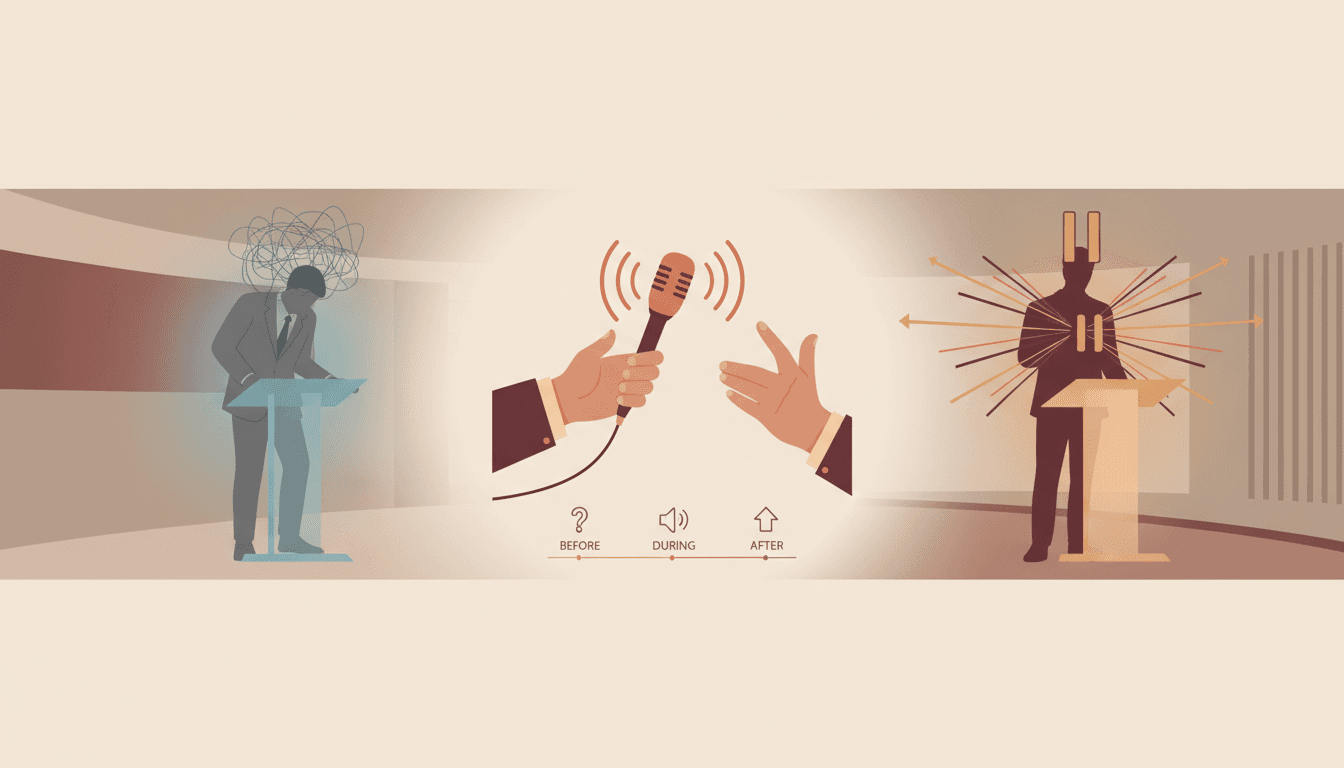
To sound confident in a presentation, focus on three vocal pillars: slow your pace by 20%, use deliberate pauses instead of filler words, and drop your pitch at the end of sentences instead of rising. Pair these with structured preparation—knowing your first 30 seconds cold—and grounded body language. Confidence in a presentation isn't about feeling fearless; it's about controlling the signals your audience reads as authority, even when nerves are running high.
What Does It Mean to "Sound Confident" in a Presentation?
Sounding confident in a presentation means your vocal delivery, word choice, and physical presence signal credibility and authority to your audience—regardless of how you actually feel inside. It's the gap between internal experience and external perception.
This distinction matters. Research from the University of Wolverhampton found that 38% of a speaker's impact comes from vocal quality alone, echoing Albert Mehrabian's foundational communication research. Your audience doesn't have access to your racing heart or sweaty palms. They only have access to what they can see and hear. That means confidence is a set of deliverable skills, not a personality trait.
When you learn to speak with gravitas through vocal and language mastery, you're not faking anything. You're choosing which version of yourself your audience encounters.
Before the Presentation: Building Your Confidence Foundation
The work of sounding confident starts long before you stand up to speak. What you do in the hours and days before your presentation determines 80% of how you'll come across.

Script Your First 30 Seconds Word-for-Word
The opening of your presentation is when your nerves peak and your audience forms their first impression. Don't leave it to chance. Write out your first two to three sentences and rehearse them until they feel automatic.
Here's why this works: cognitive load theory shows that when your brain doesn't have to search for words, it frees up mental bandwidth for delivery—eye contact, vocal control, posture. You sound confident because your brain isn't scrambling.
Example: Instead of walking up and saying, "So, um, today I'm going to talk about our Q3 results, which were, you know, pretty interesting…" you open with: "Our Q3 results tell a clear story: we grew 14% in a market that contracted. Here's how we did it and what it means for next year."For a deeper dive into strong openings, explore how to start a presentation with confidence using 8 proven openers.
Use the "3-Point Anchor" Preparation Method
Confident speakers don't memorize scripts—they internalize structure. The 3-Point Anchor method works like this:
- Identify three core messages your audience must walk away with.
- Attach one story, example, or data point to each message.
- Practice transitions between the three points until they feel natural.
This gives you a skeleton to lean on when nerves hit. You'll never lose your place because you always know which of three anchors you're heading toward. A study published in the International Journal of Business Communication (2019) found that speakers who used structured frameworks were rated 32% more credible by audiences than those who presented the same information without clear structure.
Rehearse Out Loud—Standing Up
Silent reading is not rehearsal. Your mouth, diaphragm, and posture need practice too. Stand up, speak at full volume, and time yourself. Record it on your phone and listen back. You'll catch filler words, rushing, and vocal patterns you'd never notice otherwise.
Rehearse a minimum of three times out loud. By the third run, your body starts to remember the rhythm, and that physical memory becomes your safety net during the real thing.
Vocal Techniques That Project Confidence Instantly
Your voice is the single most powerful tool for projecting confidence. Audiences unconsciously evaluate your authority based on pace, pitch, volume, and pauses within the first few seconds.
Lower Your Pitch at the End of Sentences
One of the most common confidence killers is "upspeak"—ending declarative statements with a rising pitch, as if you're asking a question. It signals uncertainty.
Practice this shift:- Weak: "We recommend expanding into the European market?" (rising pitch)
- Confident: "We recommend expanding into the European market." (dropping pitch)
Record yourself reading five sentences from your presentation. Listen for any upward inflection on statements. Then re-record, consciously dropping your pitch on the final word of each sentence. According to a 2020 study in the Journal of Voice, speakers with a lower fundamental frequency at sentence endings were perceived as significantly more competent and trustworthy.
Master the Power Pause
Nervous presenters rush. They fill every silence with "um," "so," "basically," or "you know." Confident presenters do the opposite—they pause deliberately.
The power pause works in three places:
- After your opening statement — Lets it land. Shows you're not rushing.
- Before a key number or insight — Creates anticipation.
- After a question to the audience — Gives space and shows command.
A two-second pause feels like an eternity to the speaker but reads as authority to the audience. Practice by inserting a pause after every third sentence during rehearsal. For specific techniques on pausing effectively in public speaking with examples, we've built a complete guide.
Control Your Volume and Pace
Two simple rules transform how confident you sound:
- Speak 20% slower than feels natural. When adrenaline hits, your internal clock speeds up. What feels slow to you sounds measured and deliberate to your audience.
- Project to the back row. Even in a small conference room, speak as if the person farthest from you needs to hear every word without straining. This naturally engages your diaphragm and gives your voice resonance.
A Harvard Business School study by Amy Cuddy and colleagues found that speakers who used slower, more deliberate pacing were rated as more persuasive and more competent than fast-talking peers—even when the content was identical.
If you want to develop these vocal habits beyond presentations, our guide on how to develop a commanding voice at work covers daily vocal exercises.
During the Presentation: Real-Time Confidence Strategies
Even with perfect preparation, the live moment introduces variables. Here's how to maintain the perception of confidence no matter what happens.

Use Grounded Body Language
Your body speaks before your mouth does. Three physical adjustments instantly project confidence:
- Plant your feet. Stand with feet hip-width apart, weight evenly distributed. Don't sway, pace, or shift from foot to foot.
- Open your hands. Gesture with open palms facing slightly upward. Avoid crossing arms, gripping the podium, or putting hands in pockets.
- Make deliberate eye contact. Hold eye contact with one person for a full thought (3-5 seconds), then move to another. Don't scan the room like a lighthouse.
Research from Princeton University's Todorov Lab demonstrates that audiences form judgments about a speaker's competence in as little as 100 milliseconds—largely based on facial expressions and body positioning. For a comprehensive breakdown, see our guide on confident body language for public speaking.
Eliminate Filler Words with the "Pause and Breathe" Swap
Every "um" and "uh" is your brain buying time. Instead of filling silence with noise, replace it with a breath. Here's the technique:
- When you feel a filler word coming, close your mouth.
- Take one silent breath through your nose.
- Then continue speaking.
This takes practice, but it's transformational. Track your filler words by asking a colleague to tally them during your next rehearsal or meeting. Most people are shocked—the average speaker uses 5 filler words per minute (Toastmasters International data). Cutting that to 1-2 per minute dramatically increases perceived confidence.
Our deep dive on how to stop using filler words in professional speaking gives you a 30-day practice plan.
Handle Mistakes Without Breaking Character
Confident speakers don't apologize for small errors. They correct and move forward. The audience doesn't have your script—they don't know you skipped a slide, said "Q2" instead of "Q3," or forgot a data point.
Framework for handling mistakes in real time:| Situation | What NOT to do | What to do instead |
|---|---|---|
| You lose your place | "Sorry, I lost my train of thought…" | Pause. Glance at your notes. Continue. |
| You misspeak a number | "Oh wait, sorry, that's wrong…" | "To clarify—that figure is 14%, not 12%." |
| Tech fails | Apologize repeatedly | "Let's skip ahead while we sort this out. Here's the key point…" |
The principle is simple: never narrate your nervousness. Your audience will mirror your energy. If you treat a mistake as minor, they will too. If you want to go deeper on recovery strategies, read how to recover from a bad presentation at work.
Mental Reframing: The Psychology of Sounding Confident
Technique only gets you so far if your internal narrative is working against you. The most powerful confidence shift happens between your ears.
Reframe Nervousness as Excitement
Harvard Business School professor Alison Wood Brooks published a landmark 2014 study showing that participants who reframed anxiety as excitement performed significantly better in public speaking tasks than those who tried to calm down. The physiological states of anxiety and excitement are nearly identical—elevated heart rate, adrenaline, heightened focus. The difference is the label you apply.
Before your next presentation, say out loud: "I'm excited about this." Not "I need to calm down." This simple reframe shifts your brain from threat mode to opportunity mode.
Adopt the "Expert Advisor" Mindset
Instead of thinking, "I have to perform and everyone is judging me," reframe your role: "I'm here to help these people understand something important."
This shifts your focus from self-consciousness to service. When you're focused on being useful rather than being perfect, your delivery naturally becomes more grounded, your eye contact improves, and your vocal tone warms.
If you struggle with the internal critic, our article on how to stop seeking validation at work through 7 mindset shifts addresses the deeper patterns behind presentation anxiety.
Visualize the First Two Minutes
Elite athletes use visualization because it works. Spend five minutes before your presentation with your eyes closed, mentally walking through your entrance, your opening line, and your first transition. See yourself standing still, speaking slowly, pausing with purpose.
Neuroscience research from the Journal of Neurophysiology confirms that mental rehearsal activates the same neural pathways as physical practice. You're literally training your brain to execute confidence before you step into the room.
After the Presentation: Building Long-Term Confidence
Sounding confident isn't a one-time performance—it's a skill you compound over time.
Debrief with the "3-1 Review"
Within 24 hours of every presentation, write down:
- 3 things that went well (specific moments, not vague feelings)
- 1 thing to improve next time (one concrete, actionable change)
This ratio matters. Most people fixate on what went wrong and ignore what worked. The 3-1 review trains your brain to recognize evidence of competence, which builds genuine confidence for next time.
Record and Review Selectively
Record your presentations when possible. But don't watch the entire thing looking for flaws. Instead, watch only the first 60 seconds and one section you felt went well. Note your pace, pauses, and posture. This builds a realistic self-image rather than the distorted, hyper-critical one most people carry.
Build Lasting Presentation Authority If you're ready to move beyond tips and build a complete system for commanding credibility in every professional setting,. It's the framework mid-career professionals use to become the person everyone listens to. Discover The Credibility Code
Stack Your Skills Across Contexts
Presentation confidence transfers. The vocal control you develop for formal presentations makes you more authoritative in meetings, on calls, and in one-on-one conversations. Practice these techniques in low-stakes settings—team updates, casual check-ins, even voicemails—so they become second nature when the stakes rise.
For strategies that extend beyond the stage, explore how to sound confident in meetings even when you're not.
Frequently Asked Questions
How can I sound confident in a presentation when I'm nervous?
Focus on what your audience can observe: slow your pace by 20%, pause instead of using filler words, and drop your pitch at the end of sentences. Rehearse your opening word-for-word so your first 30 seconds are automatic. Reframe your nerves as excitement—research shows this simple mindset shift improves speaking performance. Your audience can't feel your heartbeat; they can only hear your voice and see your body language.
What is the best vocal technique for sounding confident while presenting?
The single most impactful technique is the power pause. Replacing filler words ("um," "so," "like") with deliberate two-second silences instantly signals authority. Pair this with downward pitch inflection at the end of statements. Together, these two shifts eliminate the most common vocal patterns that undermine credibility.
How do I stop saying "um" during a presentation?
Use the "Pause and Breathe" swap: when you feel a filler word coming, close your mouth, take one silent breath through your nose, then continue. Track your filler words during rehearsal by recording yourself or asking a colleague to count them. Most speakers reduce fillers by 60-70% within two weeks of conscious practice.
Sounding confident vs. being confident: what's the difference?
Being confident is an internal feeling of self-assurance. Sounding confident is the set of external signals—vocal pace, pitch, pauses, word choice, body language—that your audience interprets as authority. The good news: you can control the external signals regardless of how you feel internally. Over time, consistently sounding confident actually builds genuine internal confidence through a feedback loop psychologists call "behavioral confirmation."
How long does it take to improve presentation confidence?
Most professionals notice a measurable difference within 2-3 presentations if they practice specific techniques (power pauses, pace control, structured openings) and debrief using the 3-1 review method. Significant, lasting improvement typically takes 6-8 weeks of regular practice. The key is deliberate repetition in both high-stakes and low-stakes settings.
Can introverts sound confident in presentations?
Absolutely. Introverts often excel at preparation, structured thinking, and thoughtful delivery—all of which signal confidence. The techniques in this guide (scripted openings, power pauses, the 3-Point Anchor method) play to introverted strengths. Many of the most compelling presenters are introverts who've learned to channel their natural depth into deliberate, authoritative delivery.
Speak So the Room Takes You Seriously
The Credibility Code covers the verbal patterns that make presenters sound authoritative, and the ones that make audiences tune out.
Discover The Credibility CodeRelated Articles

How to Sound Confident in a Presentation: 9 Proven Tactics
To sound confident in a presentation, focus on three pillars: vocal delivery, verbal precision, and structural clarity. Slow your speaking pace to 130–150 words per minute, use strategic pauses instead of filler words, replace hedging language ("I think maybe…") with power phrases ("The data shows…"), and open with your strongest point. Confidence isn't about feeling fearless — it's about controlling the signals your audience receives.

How to Sound Confident in a Presentation: 9 Proven Methods
To sound confident in a presentation, focus on these core techniques: lower your vocal pitch slightly, slow your speaking pace to 130–150 words per minute, pause deliberately instead of using filler words, control your breathing from your diaphragm, and open with a strong declarative statement. These methods work even when you feel nervous because confidence is a skill of *delivery*, not a reflection of your internal state. The audience hears your voice — not your heartbeat.

How to Sound Confident in a Presentation: 9 Pro Secrets
To sound confident in a presentation, focus on three pillars: vocal delivery, language structure, and psychological preparation. Slow your speaking pace by 10–15%, eliminate hedging phrases like "I think" or "sort of," and anchor your opening with a declarative statement rather than an apology. Use strategic pauses instead of filler words, drop your pitch at the end of sentences, and structure your content around no more than three core points. Confidence is less about feeling fearless and more