
Executive Communication Frameworks: 5 Models Leaders Use

Executive communication frameworks are structured models that help leaders organize their thinking and deliver messages with clarity, authority, and impact. The five most widely used frameworks are the Pyramid Principle (lead with the answer), SCQA (Situation-Complication-Question-Answer), SCR (Situation-Complication-Resolution), PREP (Point-Reason-Example-Point), and the CEO Briefing Model (headline-context-ask). Each framework serves a different communication scenario—from boardroom presentations to high-stakes emails—and mastering even two or three will transform how you're perceived as a leader.
What Are Executive Communication Frameworks?
Executive communication frameworks are repeatable structures that senior leaders use to organize complex ideas and deliver them with precision. Rather than speaking off the cuff or burying key points in lengthy explanations, these frameworks force you to lead with what matters most and support it with clear reasoning.
Think of them as blueprints for how you construct any message—whether it's a two-minute update to your CEO, a presentation to the board, or an email requesting resources. According to a 2023 study by McKinsey, executives who communicate with structured clarity are 1.5 times more likely to be rated as effective leaders by their direct reports. The framework isn't the message itself; it's the architecture that makes the message land.
Why Frameworks Matter More Than Communication "Tips"
The Gap Between Managers and Executives
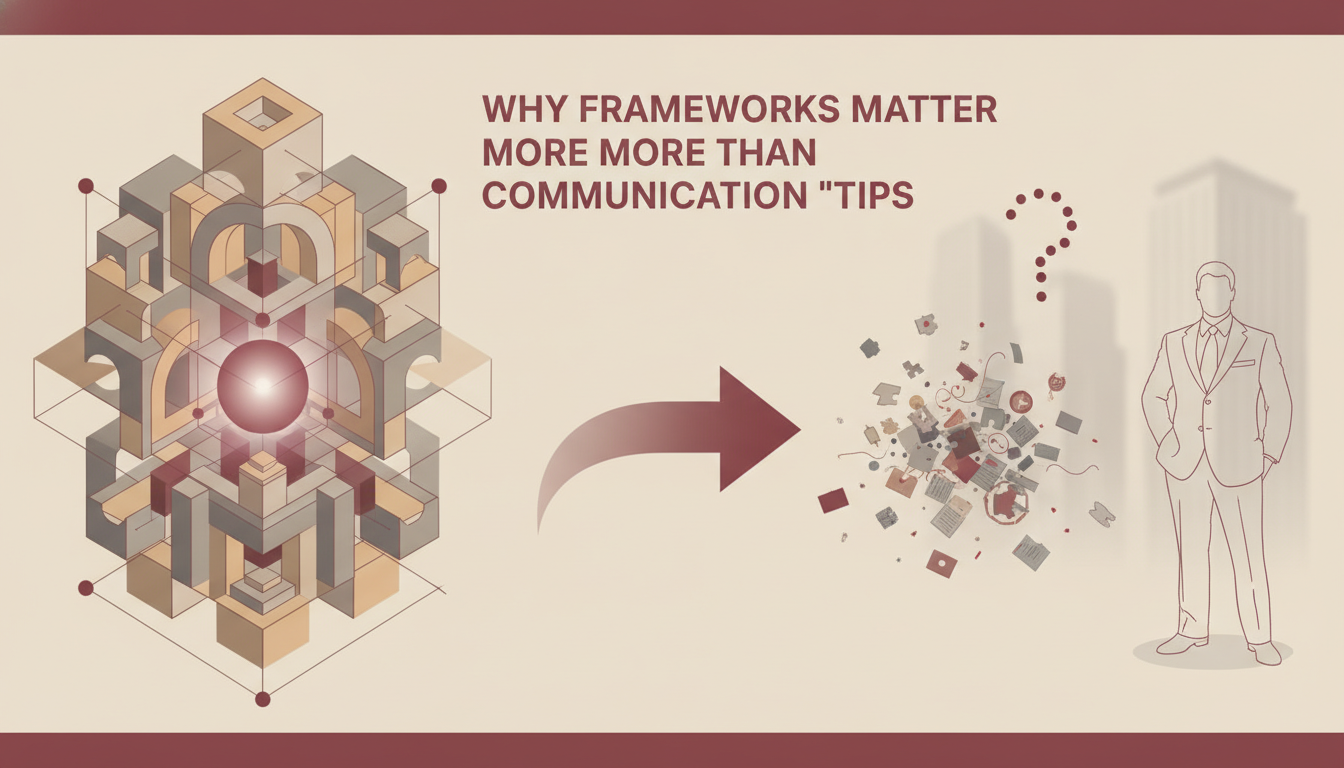
Most communication advice focuses on surface-level fixes: speak louder, make eye contact, use fewer filler words. These matter, but they miss the deeper issue. The real difference between how executives communicate versus managers is structural. Executives organize information differently before they ever open their mouths.
A Harvard Business Review analysis found that senior leaders spend an average of 80% of their workday communicating, yet the most effective ones spend significantly more time preparing what to say than actually saying it. Frameworks are how they prepare. They reduce cognitive load, eliminate rambling, and ensure every word earns its place.
What Happens Without a Framework
Without a framework, most professionals default to chronological storytelling. They start at the beginning, walk through every step, and arrive at their conclusion last. This is exactly backwards for executive audiences.
Consider this scenario: A project manager updates the VP of Operations on a delayed product launch. Without a framework, the update sounds like this: "So we started the project in January, and the vendor was late, and then we had some scope changes, and the testing took longer than expected, and basically we're going to be two weeks late." The VP has already checked out by sentence three.
With a framework—specifically, the SCR model—the same update becomes: "The product launch will be delayed by two weeks. Supply chain disruptions and expanded testing requirements pushed the timeline. I recommend we adjust the marketing calendar and notify key stakeholders by Friday. Here's the revised plan." Same information. Radically different impact.
Frameworks Build Credibility Automatically
When you use a communication framework consistently, something powerful happens: people start perceiving you as a clearer thinker. A 2022 study published in the Journal of Business Communication found that structured communicators were rated 35% more credible than unstructured ones, even when delivering identical content.
This is because frameworks signal executive-level thinking. They tell your audience, "I've done the work. I've prioritized what matters. I respect your time." That signal alone builds authority faster than any title change.
Framework 1: The Pyramid Principle
What It Is and Where It Comes From
The Pyramid Principle was developed by Barbara Minto at McKinsey & Company in the 1960s and remains the gold standard for executive communication. The core idea is deceptively simple: start with the answer, then group supporting arguments into logical clusters beneath it.
Instead of building toward your conclusion, you lead with it. Every subsequent point exists only to support, explain, or prove that top-line answer. Sub-points are grouped into mutually exclusive, collectively exhaustive (MECE) categories.
How to Use It Step by Step
Here's the Pyramid Principle in practice:
- State your main recommendation or conclusion first. This is the top of the pyramid.
- Identify 2-4 supporting arguments. These form the second tier.
- Under each supporting argument, provide evidence or data. This is the base.
- Top of pyramid: "We should enter the Southeast Asian market in Q3, starting with Singapore."
- Supporting argument 1: "Market demand is proven—Singapore's SaaS adoption grew 28% last year."
- Supporting argument 2: "We have existing infrastructure—our APAC support team already operates in the timezone."
- Supporting argument 3: "Competitive window is narrow—two major competitors plan entries in Q1 of next year."
Each supporting argument can then be broken down further with data, case studies, or risk analyses.
When to Deploy It
The Pyramid Principle works best for:
- Board presentations and executive briefings
- Strategic recommendations and proposals
- Written memos and reports for senior leadership
- Any situation where your audience is time-constrained and decision-oriented
If you want to go deeper on structuring your thinking before you speak, explore our guide on how to present ideas to senior management.
Write it the way a senior leader would. The Executive Email Kit gives you 20 templates, 30 subject lines, and 15 junior-to-senior rewrites for updates, asks, escalations, and bad news, so the executive acts on the first line. Get The Executive Email Kit — $27
Framework 2: SCQA (Situation-Complication-Question-Answer)
The Structure Explained
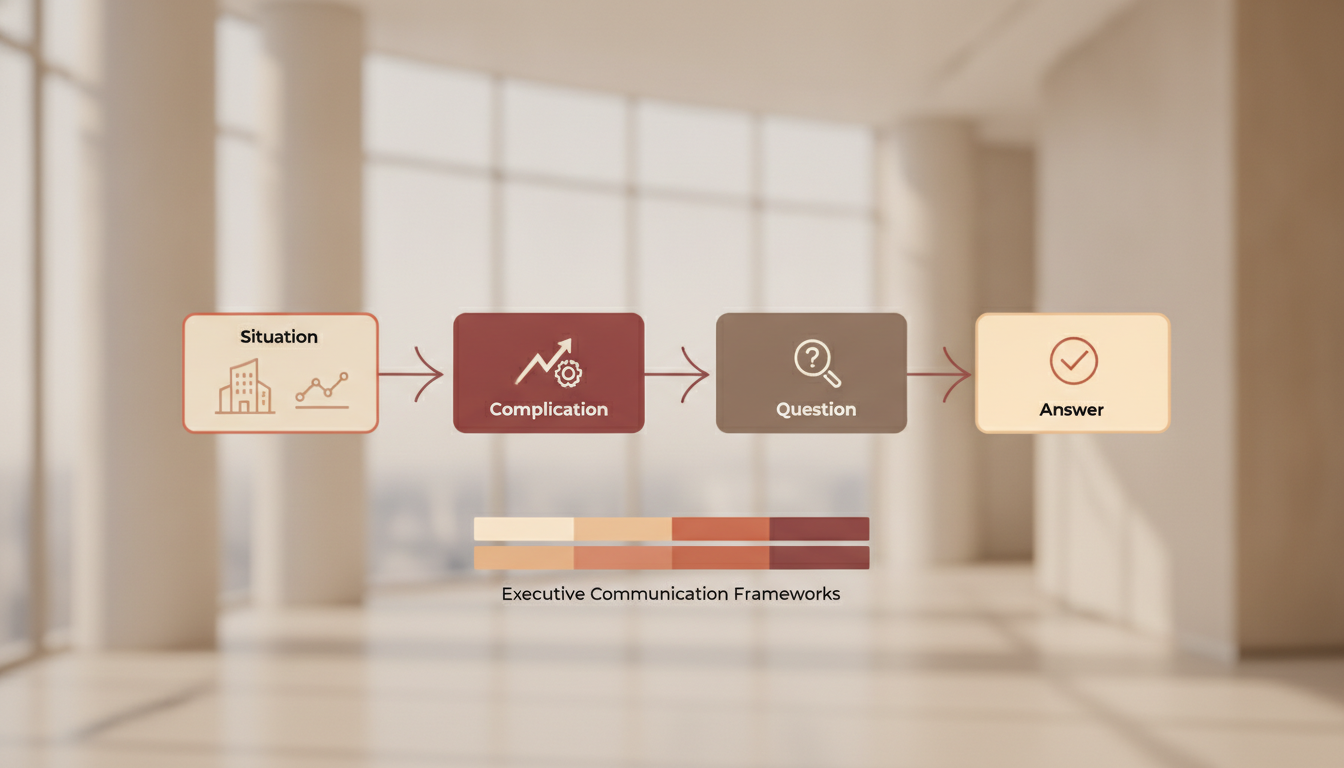
SCQA is another framework popularized by McKinsey, and it's particularly effective for persuasive communication. It works by creating a narrative arc that draws your audience into the problem before presenting your solution.
- Situation: Establish the shared context everyone agrees on.
- Complication: Introduce the problem, change, or tension.
- Question: Articulate the question that naturally arises from the complication.
- Answer: Deliver your recommendation or solution.
A Real-World Example
Imagine you're a Director of Marketing presenting to the CEO about a budget reallocation.
- Situation: "Our digital marketing spend has driven consistent lead growth for the past three years, averaging 15% year-over-year increases."
- Complication: "However, our cost per acquisition has risen 40% in the last two quarters due to increased competition in paid search, and our conversion rates on those channels have dropped by 12%."
- Question: "How do we maintain lead volume while reducing acquisition costs?"
- Answer: "I recommend shifting 30% of our paid search budget to content-led SEO and strategic partnerships, which our data shows produce leads at one-third the cost with higher lifetime value."
Notice how the SCQA framework doesn't just present a recommendation—it makes the audience feel the problem first. By the time you reach the answer, your audience is already looking for a solution. You've aligned their thinking with yours before you've even made your case.
SCQA vs. the Pyramid Principle
The Pyramid Principle is best when your audience already trusts you and wants the answer fast. SCQA is better when you need to build the case—when your audience might resist your conclusion or when the problem itself isn't well understood.
Use the Pyramid Principle for routine updates to your direct leadership. Use SCQA when you're pitching a new initiative, requesting significant resources, or communicating change to resistant teams.
Framework 3: SCR (Situation-Complication-Resolution)
How SCR Differs from SCQA
SCR is a streamlined cousin of SCQA. It drops the explicit "Question" step and moves directly from the complication to the resolution. This makes it faster and more direct—ideal for verbal communication where you have limited time.
- Situation: What's happening now.
- Complication: What's gone wrong or what's changed.
- Resolution: What you recommend.
Deploying SCR in Meetings
SCR shines in fast-paced meeting environments. According to a 2023 survey by Korn Ferry, the average executive attention span during internal meetings is approximately 8 minutes before they begin mentally multitasking. SCR respects that reality.
Example: You're in a cross-functional leadership meeting and need to flag a resource issue.- Situation: "We're on track to deliver the platform migration by March 15th as planned."
- Complication: "Our lead engineer was pulled onto the security incident last week, and we've lost 40 development hours we can't recover."
- Resolution: "I need to either extend the deadline by one week or borrow a senior developer from the infrastructure team for the next ten days. I recommend the latter, and I've already spoken with their team lead."
This took 30 seconds. It was clear, actionable, and complete. No preamble. No unnecessary context. No rambling. This is what speaking concisely in meetings actually looks like in practice.
When SCR Beats Everything Else
Use SCR when:
- You have less than two minutes to make your point
- You're delivering a status update with an embedded ask
- You're in a stand-up, huddle, or rapid-fire meeting format
- You need to flag a problem and propose a solution simultaneously
SCR is also the framework of choice for communicating bad news to senior leadership. It doesn't soften the blow, but it pairs the bad news with a clear path forward—which is exactly what executives want.
Framework 4: PREP (Point-Reason-Example-Point)
The Most Versatile Framework
PREP is the Swiss Army knife of executive communication frameworks. It's simple enough to use in real-time conversation, yet structured enough to sound polished and authoritative.
- Point: State your position clearly.
- Reason: Explain why you hold that position.
- Example: Provide a concrete example or piece of evidence.
- Point: Restate your position to drive it home.
PREP in Action
Scenario: During a leadership team discussion about remote work policy, you're asked for your perspective.- Point: "I believe we should move to a structured hybrid model—three days in office, two remote."
- Reason: "Our engagement data shows that collaboration quality peaks on in-office days, but individual productivity and retention are both higher when employees have remote flexibility."
- Example: "When we piloted this model in the engineering department last quarter, we saw a 22% reduction in attrition and project delivery times stayed flat."
- Point: "A structured hybrid model gives us the best of both worlds—collaboration when it matters, flexibility when it doesn't."
PREP works because it's circular. You begin and end with your point, which means even if your audience's attention drifts during the middle, they hear your conclusion twice. Research from the University of California found that listeners retain the first and last items in a sequence 40% better than middle items—a phenomenon known as the serial position effect.
Where PREP Excels
PREP is ideal for:
- Answering questions in Q&A sessions or town halls
- Contributing to discussions in leadership meetings
- Responding when put on the spot
- One-on-one conversations with your manager or skip-level leader
- Any scenario where you need to sound composed and credible without preparation time
If you struggle to sound authoritative in spontaneous moments, PREP is the first framework to master. It pairs well with the vocal and language shifts outlined in our guide on how to sound authoritative in conversations at work.
Framework 5: The CEO Briefing Model (Headline-Context-Ask)
Built for the Busiest Audience
The CEO Briefing Model is the most compressed framework on this list, and it's designed for one specific audience: the person who has no time. Whether you're briefing your CEO, a board member, or a time-starved SVP, this model strips communication to its absolute essentials.
- Headline: One sentence that captures the entire message.
- Context: Two to three sentences of essential background.
- Ask: What you need from this person—a decision, approval, or awareness.
How to Use It
Scenario: You need to email the CEO about a partnership opportunity.- Headline: "Proposed partnership with Acme Corp would add $2.4M in annual revenue with minimal integration cost."
- Context: "Acme Corp approached us last month about a co-selling arrangement for the enterprise segment. Our BD team has vetted the opportunity and confirmed product compatibility. Legal has reviewed the preliminary terms."
- Ask: "I need your approval to move to formal negotiation. A 15-minute briefing is available if you'd like more detail before deciding."
That entire communication is five sentences. It contains everything the CEO needs to make a decision. According to a 2021 study by the Center for Creative Leadership, executives prefer communications that can be absorbed in under 60 seconds—and the CEO Briefing Model consistently delivers on that standard.
This framework is also highly effective for writing emails that get executive responses. The headline functions as your subject line, the context is your email body, and the ask is your closing sentence.
Common Mistakes to Avoid
The most common mistake with the CEO Briefing Model is over-stuffing the "Context" section. Remember: context is not backstory. It's the minimum information needed to understand the headline and evaluate the ask. If you find yourself writing more than three sentences of context, you're probably including information that belongs in an appendix or follow-up conversation.
Another mistake is burying the ask. Some professionals, especially those who are still building confidence communicating with senior leadership, will soften or hide their request. Don't. Executives respect directness. State what you need clearly.
How to Choose the Right Framework for Any Situation
Not every framework fits every moment. Here's a decision matrix to guide your choice:
| Situation | Best Framework | Why |
|---|---|---|
| Board presentation or strategic recommendation | Pyramid Principle | Audience wants the answer first, then proof |
| Pitching a new initiative to skeptical stakeholders | SCQA | Need to build the case and create urgency |
| Quick meeting update with an embedded ask | SCR | Fast, direct, action-oriented |
| Answering questions or contributing to discussions | PREP | Works in real-time, sounds polished |
| Emailing or briefing a C-suite executive | CEO Briefing Model | Maximum compression, respects their time |
The real power comes from having multiple frameworks available and selecting the right one instinctively. This is what separates professionals who communicate with gravitas from those who simply know what to say but can't organize it effectively.
A practical tip: Start by mastering one framework—PREP is the easiest entry point—and use it deliberately for two weeks. Then add a second. Within 90 days, you can have all five in your toolkit, ready to deploy based on audience and context.Frequently Asked Questions
What is the best executive communication framework for beginners?
PREP (Point-Reason-Example-Point) is the best starting framework because it's simple, versatile, and works in both prepared and spontaneous situations. You can use it in meetings, emails, one-on-ones, and presentations without any advance preparation. Once PREP feels natural, add the Pyramid Principle or SCR to expand your range.
What is the difference between SCQA and SCR frameworks?
SCQA includes an explicit "Question" step between the complication and the answer, which makes it more persuasive and narrative-driven. SCR skips the question and moves directly to the resolution, making it faster and more direct. Use SCQA when you need to build a case; use SCR when your audience just needs the facts and a recommendation quickly.
How do executives structure their communication differently than managers?
Executives lead with conclusions and recommendations, while managers tend to lead with process and background. Executives use frameworks like the Pyramid Principle to put the answer first, then provide supporting evidence. Managers typically narrate chronologically. This structural difference is one of the most important shifts in developing executive presence.
Can I use multiple communication frameworks in one presentation?
Yes, and senior leaders often do. You might open a board presentation using the Pyramid Principle for your overall recommendation, then use SCQA within a specific section to argue for a controversial initiative, and use PREP to handle audience questions. The frameworks are modular and complementary, not mutually exclusive.
How long does it take to master an executive communication framework?
Most professionals can use a single framework competently within two to three weeks of deliberate practice. Full mastery—where the framework becomes instinctive—typically takes 60 to 90 days of consistent use. The key is choosing real situations to practice in, not just reading about the framework. Start with low-stakes meetings and work up to high-stakes presentations.
Do executive communication frameworks work in written communication like emails?
Absolutely. The CEO Briefing Model was specifically designed for written communication, and the Pyramid Principle is the foundation of most executive memo writing. SCR works well for status update emails, and PREP is effective for persuasive email arguments. Adapting these frameworks to email communication is one of the fastest ways to elevate how senior leaders perceive you.
Communicate Like Someone Who Belongs at the Senior Table
20 email templates, 30 subject-line formulas, 15 junior-to-senior rewrites, and the one-page memo and executive summary, for writing to senior leaders who have ninety seconds and a decision to make. PDF.
Get The Executive Email Kit — $27Related Articles

Executive vs Regular Communication: Key Differences
Executive communication differs from regular professional communication in six critical ways: structure, brevity, strategic framing, audience orientation, decision-focus, and authority signaling. While regular communication tends to be detail-heavy, process-oriented, and chronological, executive communication leads with the bottom line, frames everything around business impact, and drives toward decisions. Understanding these differences is the single most important shift mid-career professional

How to Brief Executives Quickly: The 60-Second Framework
To brief executives quickly, use the Context-Headline-Ask (CHA) framework: open with one sentence of context, deliver your headline (the key insight or update), and close with a clear ask or recommendation. This structure respects executive time, demonstrates strategic thinking, and positions you as someone who communicates with authority. The best executive briefings take 60 seconds or less and always lead with the conclusion, not the backstory.

Write Emails That Get Executive Attention: 5 Rules
To write emails that get executive attention, lead with your ask or key insight in the first two sentences, use an action-oriented subject line, keep the body under 125 words, structure information in the inverted pyramid format (conclusion first, details second), and close with one clear next step. Executives scan—they don't read. Every email you send either builds or erodes your professional credibility, so treat each one as a strategic communication, not a casual message.