
Executive vs Regular Communication: Key Differences

Executive communication differs from regular professional communication in six critical ways: structure, brevity, strategic framing, audience orientation, decision-focus, and authority signaling. While regular communication tends to be detail-heavy, process-oriented, and chronological, executive communication leads with the bottom line, frames everything around business impact, and drives toward decisions. Understanding these differences is the single most important shift mid-career professionals can make to accelerate into leadership.
What Is Executive Communication?
Executive communication is a strategic approach to conveying information that prioritizes clarity, brevity, and decision-readiness over completeness. It's the practice of structuring your message around what your audience needs to decide or act on—not around what you know or what you did.
In contrast, regular communication—the default mode for most professionals—tends to organize information chronologically, include extensive detail, and focus on process rather than outcome. Neither is inherently wrong. But using regular communication in executive contexts is one of the fastest ways to lose credibility and get overlooked.
According to a 2023 survey by the Harris Poll for Grammarly, business leaders reported that poor communication costs U.S. businesses an estimated $1.2 trillion annually—and the gap between how leaders and individual contributors communicate is a major contributor.
Difference #1: Bottom-Line-Up-Front vs. Chronological Delivery
The BLUF Principle
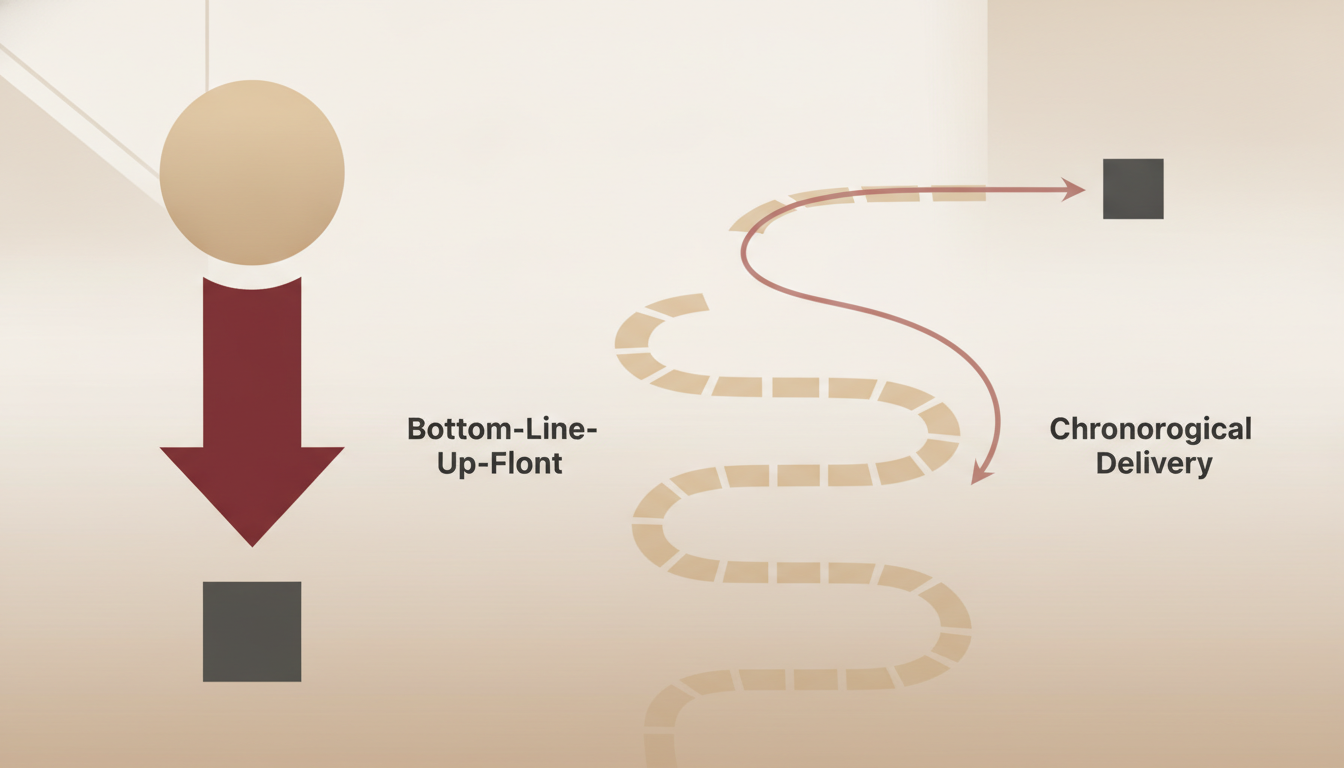
The most visible difference between executive and regular communication is where the conclusion lives. Executives lead with the answer. Regular communicators build up to it.
This principle is known as BLUF—Bottom Line Up Front—and it originates from U.S. military communication protocols designed for high-stakes, time-constrained environments. The concept is simple: state your recommendation, conclusion, or key finding in the first sentence. Then provide supporting context only as needed.
What Regular Communication Looks Like
A mid-level manager presenting a project update might say:
"We started the vendor evaluation in Q1. The team reviewed 14 vendors across three categories. We narrowed it down to five based on pricing and integration capabilities. Then we ran pilot tests with three finalists over six weeks. Based on the results, we recommend going with Vendor B."This is thorough. It's also exhausting for a senior leader who has seven more meetings today.
What Executive Communication Looks Like
The same update, delivered with executive communication:
"We recommend Vendor B. They outperformed the other two finalists on integration speed by 40% and came in 12% under budget. We're ready to sign if approved by Friday."Notice what changed: the recommendation leads. The supporting evidence is compressed to the two data points that matter most. And there's a clear ask with a timeline.
How to Practice This Shift
Before any communication—email, presentation, or meeting comment—ask yourself: "If they only hear my first sentence, will they know my point?" If not, restructure. This single habit, practiced daily, will transform how you communicate with authority at work.
Difference #2: Strategic Framing vs. Task-Level Detail
Executives Think in Outcomes, Not Activities
Regular communication tends to focus on what was done. Executive communication focuses on what it means.
A Harvard Business Review analysis found that executives spend roughly 72% of their communication time on strategic context—connecting information to business goals, risks, and opportunities—while mid-level professionals spend approximately 68% of their communication time on operational details (HBR, "How CEOs Manage Time," 2018).
This isn't because executives don't care about details. It's because their role requires them to evaluate information through a strategic lens. When you communicate at the task level to a strategic thinker, you force them to do the translation work themselves. That's a credibility tax you pay every time.
The Strategic Framing Formula
Use this three-part structure to elevate any message from operational to strategic:
- Impact Statement: What does this mean for the business?
- Key Evidence: What 2-3 data points support this?
- Decision or Action Needed: What do you need from the audience?
The data is the same. The framing is completely different. Learn more about how to make this shift in our guide on how executives structure their thinking before speaking.
Why This Matters for Your Career
When you consistently frame your communication around strategic impact, leaders start to see you as a strategic thinker—not just a doer. According to research from Korn Ferry, the ability to communicate strategic thinking is among the top three competencies that differentiate executives from mid-level managers (Korn Ferry, "The Leadership Architect," 2021).
Write it the way a senior leader would. The Executive Email Kit gives you 20 templates, 30 subject lines, and 15 junior-to-senior rewrites for updates, asks, escalations, and bad news, so the executive acts on the first line. Get The Executive Email Kit — $27
Difference #3: Brevity and Precision vs. Thoroughness
The Brevity Paradox

Most professionals believe that being thorough demonstrates competence. Executives believe that being concise demonstrates mastery.
This creates a paradox: the more you know about a topic, the more tempted you are to share everything. But executive communication demands the opposite—it requires you to compress your expertise into the fewest possible words while losing none of the meaning.
A study published in the International Journal of Business Communication (2020) found that messages under 200 words received 60% faster responses from senior leaders compared to messages over 500 words. Brevity isn't just a style preference—it's a performance variable.
The Rule of Three
Executives consistently limit their supporting points to three or fewer. This isn't arbitrary. Cognitive psychology research (specifically, George Miller's foundational work on working memory) shows that people retain information best in groups of three to five items.
Regular communication might list seven reasons a project is behind schedule. Executive communication identifies the three that matter most and presents them in order of business impact. Before: "The project is delayed due to vendor issues, team turnover, scope changes, budget constraints, a technology migration, holiday schedules, and unclear requirements." After: "The project is delayed by three weeks, driven by three factors: scope changes from the client (added 40 hours), a key developer departure (now backfilled), and a dependency on the tech migration timeline. I recommend we adjust the delivery date to March 15 and lock scope."How to Cut Without Losing Value
For every piece of information you include, apply this filter:
- Does this change the decision? If yes, keep it.
- Does this provide essential context? If yes, keep it brief.
- Does this just show my work? Cut it.
This filter is the difference between being seen as thorough and being seen as strategic. For more on this skill, explore our guide on how to speak concisely in meetings.
Difference #4: Decision-Oriented Language vs. Information Sharing
Executives Communicate to Drive Action
Regular communication often shares information without a clear purpose. Executive communication always has a purpose—and that purpose is almost always a decision, an alignment, or an action.
This is perhaps the most underrated difference. Many professionals deliver excellent analysis but fail to land it because they don't tell the audience what to do with it.
The RAPID Decision Framework in Communication
Borrowed from Bain & Company's decision-making model, you can apply RAPID thinking to every communication:
- Recommend: State what you think should happen.
- Agree: Identify who needs to agree.
- Perform: Clarify who will execute.
- Input: Acknowledge whose input you've incorporated.
- Decide: Make clear who makes the final call.
The first version transfers the cognitive load to the executive. The second version does the thinking for them and asks for a specific action. This is what communicating like a senior leader actually looks like in practice.
Verbs That Signal Executive Communication
Pay attention to the verbs you use. Regular communication tends to use passive, informational verbs: shared, updated, reviewed, looked into, discussed.
Executive communication uses action-oriented, decisive verbs: recommend, propose, decided, will implement, need approval for, escalating.
Swap your verbs, and you'll immediately sound more senior. Our deep dive on words that undermine your credibility at work covers this in detail.
Difference #5: Audience Calibration vs. One-Size-Fits-All
Executives Tailor Every Message
Regular communicators tend to deliver the same message the same way regardless of audience. Executive communicators obsessively calibrate their message to the person receiving it.
This means adjusting not just content, but structure, depth, tone, and medium based on who they're speaking to. A CFO gets numbers and risk analysis. A CMO gets market positioning and customer impact. A CEO gets strategic alignment and competitive advantage.
The Audience Calibration Matrix
Before any important communication, run through this quick matrix:
| Question | Your Answer |
|---|---|
| What does this person care about most? | (Revenue? Risk? Speed? Innovation?) |
| What decision authority do they have? | (Approve? Advise? Execute?) |
| What's their communication preference? | (Data-driven? Story-driven? Visual?) |
| What's their current context? | (Under pressure? Exploring? Evaluating?) |
A 2022 McKinsey report on organizational communication found that leaders who consistently tailor their communication to their audience are 2.3 times more likely to be rated as "highly effective" by their peers and direct reports.
Practical Application
Imagine you're presenting a new hiring plan. Here's how you'd calibrate:
To your CEO: "Adding three senior engineers will accelerate our product roadmap by two quarters, putting us ahead of Competitor X's launch timeline." To your CFO: "The $450K investment in three senior hires yields an estimated $2.1M in accelerated revenue based on our current pipeline conversion rates." To your VP of Engineering: "I've identified three senior engineer profiles that fill our critical skills gaps in cloud architecture and ML ops. Here's the proposed hiring timeline and onboarding plan."Same initiative. Three completely different messages. This is the skill that separates people who present to C-suite executives effectively from those who lose the room in the first 30 seconds.
Difference #6: Authority Signaling vs. Permission-Seeking
How You Frame Yourself Matters
The final major difference is in how communicators position themselves within their own message. Regular communication often contains subtle permission-seeking and hedging language. Executive communication signals confidence, ownership, and authority.
This isn't about arrogance. It's about linguistic patterns that either build or erode your credibility with every interaction.
Permission-Seeking Patterns to Eliminate
Watch for these common patterns in your own communication:
- "I just wanted to..." → Replace with a direct statement of purpose.
- "I think maybe we could..." → Replace with "I recommend..."
- "Sorry to bother you, but..." → Replace with the request itself.
- "Does that make sense?" → Replace with "Here's what I need from you."
- "I could be wrong, but..." → Replace with your point, stated cleanly.
These phrases feel polite. But in executive contexts, they signal uncertainty and low status. Research from the University of Texas at Austin (2019) found that professionals who used hedging language were rated 22% less competent by evaluators—even when the content of their message was identical to a confident version.
Authority Signaling in Practice
Regular communication (email): "Hi Sarah, I just wanted to follow up on the budget discussion. I was thinking maybe we could consider reallocating some funds from the Q4 marketing budget to cover the new tool. I'm not sure if that's possible, but let me know what you think? Sorry if this is premature." Executive communication (email): "Sarah—Following up on our budget discussion. I recommend reallocating $25K from the Q4 brand awareness line to fund the analytics tool. This accelerates our reporting capability by two months with minimal impact on Q4 campaign reach. Happy to walk through the trade-offs if helpful."The second version is direct, specific, and positions the sender as someone who has done the thinking and is offering a solution—not asking for permission to have an opinion. For more on this transformation, see our guide on how to sound authoritative in emails.
Building Authority Signals Into Your Daily Communication
Start with these three daily practices:
- Audit your sent emails at the end of each day. Highlight any hedging language and rewrite one email as practice.
- Prepare your first sentence before any meeting contribution. Make it a clear position statement.
- Replace questions with recommendations. Instead of "What should we do about X?" try "I recommend we do Y about X. Here's why."
These micro-shifts compound over time. Within 90 days, colleagues and leaders will notice a measurable change in how they perceive your executive presence.
How to Transition From Regular to Executive Communication
Making this shift doesn't happen overnight, but it also doesn't require years of practice. Here's a phased approach:
Phase 1: Awareness (Weeks 1-2)
Record yourself in meetings (with permission) or review your last 20 sent emails. Identify your default patterns. Are you leading with context or conclusions? Using hedging language? Sharing too much detail?
Phase 2: Structure (Weeks 3-4)
Before every communication, use the BLUF + 3 method: State your bottom line, then provide no more than three supporting points. Practice this in emails first—it's lower stakes than live communication.
Phase 3: Calibration (Weeks 5-8)
Start tailoring your messages to your audience using the calibration matrix above. Pay attention to what resonates with different leaders and adjust accordingly.
Phase 4: Authority (Ongoing)
Systematically eliminate hedging language from your vocabulary. Replace it with clear, direct, recommendation-driven language. This is the phase where your leadership presence in meetings becomes visible to everyone around you.
Frequently Asked Questions
What is the main difference between executive communication and regular communication?
The main difference is orientation. Executive communication is decision-oriented—every message leads with a recommendation, frames information around business impact, and drives toward a specific action. Regular communication is information-oriented, often sharing details chronologically without a clear ask or strategic frame. Executives communicate to move things forward; regular communicators often communicate to inform or update.
Can you use executive communication if you're not an executive?
Absolutely. Executive communication is a skill set, not a title requirement. Mid-career professionals who adopt executive communication patterns—BLUF delivery, strategic framing, decision-oriented language—are consistently perceived as more senior and more promotable. In fact, adopting these patterns early is one of the most effective ways to position yourself for a VP role or senior leadership opportunity.
How is executive communication different from executive presence?
Executive communication is one component of executive presence, but they're not identical. Executive presence encompasses your overall leadership aura—including body language, composure under pressure, appearance, and interpersonal gravitas. Executive communication specifically refers to how you structure, deliver, and frame your verbal and written messages. You can have strong executive communication skills while still developing other aspects of your executive presence.
How do I stop over-explaining when talking to senior leaders?
Apply the "decision filter" before speaking: ask yourself whether each piece of information changes the decision or action. If it doesn't, cut it. Practice the Rule of Three—limit yourself to three supporting points maximum. Prepare your BLUF sentence before meetings so you lead with your conclusion rather than building up to it. Over time, this becomes automatic. Our guide on speaking concisely in meetings offers six specific frameworks for this.
Is executive communication appropriate in all workplace situations?
Not always. Executive communication is most effective in upward communication (to senior leaders), cross-functional updates, presentations, and written communication like emails and reports. In coaching conversations, team check-ins, or brainstorming sessions, a more collaborative and exploratory communication style may be more appropriate. The key skill is knowing when to shift between modes—which is itself a hallmark of communicating with gravitas.
How long does it take to develop executive communication skills?
Most professionals see noticeable improvement within 4-8 weeks of deliberate practice. The structural changes—like leading with BLUF and limiting supporting points—can be implemented immediately. The subtler shifts—like eliminating hedging language and calibrating to your audience—take longer to become habitual. Consistent daily practice, especially in email communication, accelerates the learning curve significantly.
Communicate Like Someone Who Belongs at the Senior Table
20 email templates, 30 subject-line formulas, 15 junior-to-senior rewrites, and the one-page memo and executive summary, for writing to senior leaders who have ninety seconds and a decision to make. PDF.
Get The Executive Email Kit — $27Related Articles

Executive Communication Frameworks: 5 Models Leaders Use
Executive communication frameworks are structured models that help leaders organize their thinking and deliver messages with clarity, authority, and impact. The five most widely used frameworks are the Pyramid Principle (lead with the answer), SCQA (Situation-Complication-Question-Answer), SCR (Situation-Complication-Resolution), PREP (Point-Reason-Example-Point), and the CEO Briefing Model (headline-context-ask). Each framework serves a different communication scenario—from boardroom presentati

Write Emails That Get Executive Attention: 5 Rules
To write emails that get executive attention, lead with your ask or key insight in the first two sentences, use an action-oriented subject line, keep the body under 125 words, structure information in the inverted pyramid format (conclusion first, details second), and close with one clear next step. Executives scan—they don't read. Every email you send either builds or erodes your professional credibility, so treat each one as a strategic communication, not a casual message.

How Executives Structure Emails for Maximum Impact
Executives structure emails for impact by leading with the bottom line first, keeping messages under five sentences when possible, using decisive language free of hedging words, and closing with a single clear action item and deadline. They treat every email as a leadership signal—prioritizing clarity over courtesy padding, structuring information hierarchically so the busiest reader gets the point in seconds, and using formatting strategically to guide the eye. This approach ensures their messa