
Executive Communication Style: Real Examples & Patterns

Executive communication style is defined by strategic brevity, decisive language, and outcome-focused framing. Top executives cut filler words, lead with the bottom line, and frame every message around decisions and impact—not background or process. Below, you'll find real before-and-after examples of email tone, meeting language, decision framing, and verbal patterns that separate senior leaders from mid-level professionals, along with rewrite templates you can apply to your own communication today.
What Is Executive Communication Style?
Executive communication style is the distinct set of language patterns, structural choices, and delivery habits that senior leaders use to convey authority, clarity, and decisiveness. It prioritizes brevity over thoroughness, outcomes over process, and direction over consensus-seeking.
Unlike casual or mid-level professional communication, executive style treats every word as a strategic choice. It signals that the speaker values the audience's time, owns their position, and communicates with purpose rather than permission.
Why Executive Communication Sounds Different—The Core Principles
The Bottom-Line-First Rule
The single most recognizable trait of executive communication is leading with the conclusion. A 2023 study from the Harvard Business Review found that senior executives spend an average of just 2.5 minutes reading any single email, regardless of length. That constraint shapes everything.
Mid-level professionals tend to build up context, then arrive at a request. Executives reverse this. They state what they need, then provide only the context required to support it.
Mid-level version: "Hi team, I wanted to follow up on the Q3 planning conversation we had last Tuesday. After reviewing the market data and talking with the analytics team, I think we may need to reconsider our timeline. There are a few factors that have shifted since our last discussion. Would it be possible to move the launch from September to October?" Executive version: "I'm moving the Q3 launch to October. Market data and analytics both support the shift. I'll walk through the rationale at Thursday's sync."The executive version is 70% shorter. It leads with the decision, provides a reason, and points to next steps. No hedging. No permission-seeking. If you want to explore this pattern further, our guide on how to write like an executive breaks it down in detail.
Ownership Language vs. Hedge Language
Executives use what linguists call "agency language"—they position themselves as the actor, not the observer. Mid-level communicators tend to distance themselves from statements using passive voice, qualifiers, and attribution to others.
| Hedge Language (Mid-Level) | Ownership Language (Executive) |
|---|---|
| "I think we might want to consider..." | "I recommend we..." |
| "It seems like there could be an issue..." | "There's a risk here. Here's my plan." |
| "The team was wondering if maybe..." | "The team needs a decision on X by Friday." |
| "I'm not sure, but I feel like..." | "Based on the data, my position is..." |
Research from the Center for Creative Leadership shows that leaders who use decisive language are rated 35% higher on competence by their peers and direct reports, even when the content of their message is identical. The words you choose literally change how competent people perceive you to be.
Strategic Brevity vs. Thoroughness
Many mid-career professionals equate thoroughness with quality. Executives equate brevity with respect. This doesn't mean being vague—it means being precise with fewer words.
According to Boomerang's analysis of over 40 million emails, messages between 50 and 125 words received the highest response rates. Executives instinctively stay in this range because their communication is built around action, not documentation.
Strategic brevity means every sentence earns its place. If a sentence doesn't advance a decision, clarify an action, or provide essential context, it gets cut.
Write it the way a senior leader would. The Executive Email Kit gives you 20 templates, 30 subject lines, and 15 junior-to-senior rewrites for updates, asks, escalations, and bad news, so the executive acts on the first line. Get The Executive Email Kit — $27
Executive Email Communication: 4 Before-and-After Rewrites
The Status Update Email
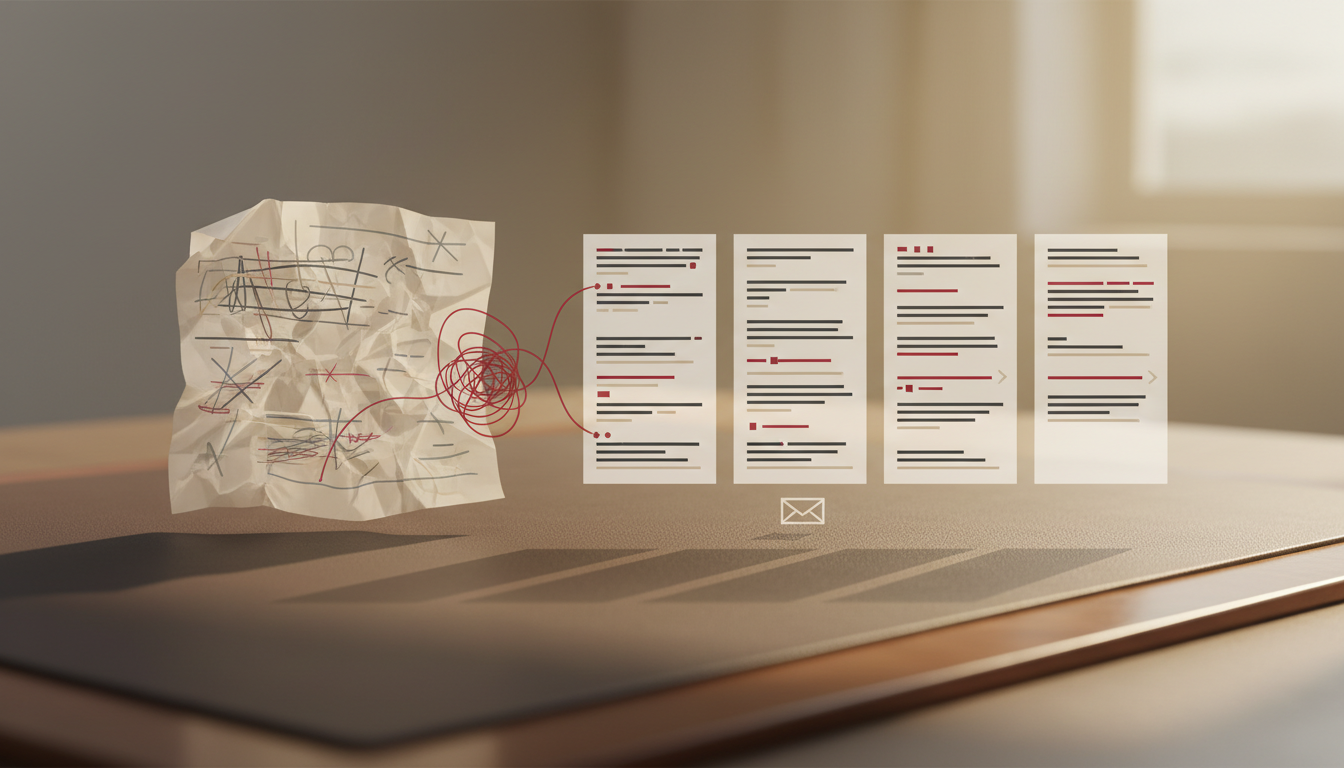
This is the most common email mid-level professionals send—and the one executives rewrite most aggressively.
Before (Mid-Level): "Hi Sarah, I wanted to give you a quick update on the Henderson project. We've been working through the vendor selection process and things are going well overall. We had a few delays last week because of some issues with procurement, but we've resolved those now. The team is feeling good about where we are. We should be on track to hit our deadline, though there's a small chance we might need an extra week depending on how the final review goes. Let me know if you have any questions!" After (Executive Rewrite): "Sarah—Henderson project update: On track for the Nov 15 deadline. Vendor selection complete. One risk: final review could push us to Nov 22. I'll flag it by Nov 8 if that's the case. No action needed from you now." What changed: The executive version leads with status (on track), names the specific deadline, identifies the single risk with a mitigation date, and tells the reader exactly what they need to do (nothing). This pattern aligns with the principles in our post on how to sound authoritative in emails.The Request Email
Before (Mid-Level): "Hi Mark, I hope you're doing well! I was wondering if you might have some time this week to chat about the budget for next quarter. I know you're really busy, so no worries if it doesn't work out. I just have a few questions about the allocation process and wanted to get your input before I finalize anything. Whenever works for you is fine with me!" After (Executive Rewrite): "Mark—I need 15 minutes this week to align on Q2 budget allocation before I finalize the plan Friday. Tuesday or Wednesday afternoon work? I'll send a one-page brief in advance." What changed: The executive version names the specific ask (15 minutes), provides the reason (align before Friday deadline), offers constrained options (Tuesday or Wednesday), and adds value (one-page brief). No apologies. No self-deprecation.The Disagreement Email
Before (Mid-Level): "Hi team, I've been thinking about the proposed restructuring and I have some concerns. I'm not sure if this is the right approach. I could be wrong, but it seems like the timeline might be too aggressive and we might lose some key people in the process. Just my two cents—happy to discuss further if anyone wants to." After (Executive Rewrite): "Team—I don't support the current restructuring timeline. Two concerns: (1) We risk losing 3 senior engineers during a critical delivery window. (2) The 60-day timeline doesn't account for the compliance review, which historically takes 45 days alone. I propose we extend to 90 days. I've outlined an alternative phased approach—attached. Let's discuss at Thursday's leadership sync." What changed: The executive version states a clear position ("I don't support"), provides numbered evidence, proposes a specific alternative, and drives toward a next step. For more on this skill, see our guide on how to disagree with leadership without losing credibility.The Delegation Email
Before (Mid-Level): "Hey Lisa, would you mind possibly taking a look at the client proposal when you get a chance? No rush, but it would be great to have another set of eyes on it. I think it's mostly fine but there might be some areas that could use improvement. Thanks so much!" After (Executive Rewrite): "Lisa—Please review the Meridian client proposal by EOD Wednesday. Focus on: (1) pricing structure competitiveness, (2) scope clarity in Section 3. Send me your redlines by Thursday AM so I can finalize before the Friday client call." What changed: Clear assignment, specific deadline, focused review areas, and a defined output. The executive version treats delegation as direction, not a favor request.Executive Meeting Language: Patterns That Command the Room
How Executives Open Meetings
A study published in the Journal of Business Communication found that the first 30 seconds of a meeting sets the perceived authority dynamic for the entire session. Executives exploit this window deliberately.
Mid-level opener: "Okay, so, um, thanks everyone for being here. I guess we should probably get started. So, the reason I called this meeting is because we need to talk about a few things related to the Q4 roadmap..." Executive opener: "We have 30 minutes and one decision to make: whether we accelerate the Q4 roadmap or hold to the current timeline. I'll lay out both options in five minutes, then I want your input."The executive version does four things in two sentences: sets a time boundary, names the decision, previews the structure, and tells people what's expected of them. This is a hallmark of leadership presence in meetings.
How Executives Respond to Pushback
When challenged in meetings, mid-level professionals often over-explain or become defensive. Executives use a pattern I call Acknowledge-Redirect-Decide:
- Acknowledge the concern without dismissing it
- Redirect to the decision framework or data
- Decide or set a clear path to decision
The executive response validates the concern, presents what's available, and makes the case for action. It doesn't seek consensus—it provides reasoning and moves forward. For more on staying composed during these moments, explore leadership presence in conflict.
How Executives Close Meetings
The most overlooked executive communication habit is the meeting close. Top leaders never let a meeting end without three things:
- Decisions made — stated explicitly
- Owners named — by name, not by team
- Deadlines set — specific dates, not "soon" or "ASAP"
This takes 20 seconds and eliminates the ambiguity that plagues most meetings.
Decision Framing: How Executives Structure Choices
The 2x2 Decision Frame
Executives rarely present open-ended problems. They present structured choices. The most common pattern is the 2x2 frame: two options, each with a clear upside and downside.
Mid-level framing: "So we have a lot of options here and I'm not sure which way to go. We could do A, B, C, or maybe even D. Each has pros and cons. What do you all think?" Executive framing: "We have two viable paths. Option A: launch in Q1 with the current feature set. Upside: first-mover advantage. Risk: product gaps. Option B: launch in Q2 with the full feature set. Upside: stronger product. Risk: competitor moves first. I recommend Option A with a fast-follow update in Q2. Here's why..."According to research from McKinsey & Company, organizations where leaders present structured decision options see 20% faster decision-making cycles than those where problems are presented open-ended. Framing isn't just style—it's strategic efficiency.
The "Recommendation + Rationale" Pattern
Executives almost never present a problem without a recommendation. Even when they genuinely want input, they anchor the conversation with their perspective first.
The pattern is simple:
- State your recommendation in one sentence
- Provide 2-3 supporting reasons (data, precedent, or strategic alignment)
- Name the primary risk and your mitigation
- Ask for input on a specific dimension, not "thoughts?"
This is how executives communicate strategic thinking in practice—not by listing problems, but by proposing solutions.
Verbal Patterns: The Micro-Habits That Signal Authority
Eliminating Softeners and Fillers

Executives systematically eliminate words that dilute authority. A study by Quantified Communications found that speakers who reduced filler words ("um," "uh," "like," "just") by 50% were rated 30% more credible by audiences.
Here are the most common softeners to eliminate, with executive replacements:
- "Just" → Remove entirely. "I just wanted to check in" becomes "Checking in on the status."
- "I think" → "My assessment is" or simply state the position directly.
- "Sorry, but" → Remove the apology. "Sorry, but I disagree" becomes "I see it differently."
- "Does that make sense?" → "What questions do you have?" or simply pause.
- "Kind of / sort of" → Remove entirely. "We're kind of behind schedule" becomes "We're behind schedule."
For a deeper dive into this habit, our post on how to stop undermining yourself at work covers 12 patterns that silently erode your credibility.
The Power of the Pause
Executives use silence strategically. Where mid-level communicators rush to fill gaps, executives pause after key statements to let them land.
The three most powerful pause points:
- After stating a decision — let the room absorb it
- Before answering a difficult question — signals thoughtfulness, not uncertainty
- After being interrupted — pause, then resume without acknowledging the interruption
A 2-3 second pause after a key statement increases audience retention of that statement by up to 40%, according to research from the University of Michigan's communication studies department.
Vocal Delivery Patterns
Executive vocal patterns share three traits:
- Downward inflection at the end of statements (not upward, which sounds like a question)
- Consistent pace — not rushed, not dragging
- Lower pitch range — not artificially deep, but grounded and steady
These patterns are trainable. Our guide on how to speak with gravitas covers the specific vocal shifts that build authority in any room.
Building Your Executive Communication Style: A 5-Step Process
Step 1: Audit Your Current Patterns
Before changing anything, spend one week collecting data on yourself. Save five emails you've sent, record one meeting (with permission), and note your verbal habits. Look specifically for:
- How many words you use to make a point
- How often you hedge, apologize, or seek validation
- Whether you lead with context or conclusions
- How you close conversations (clear next steps or open-ended?)
Step 2: Apply the "Half-Length" Rule
Take any email or talking point and cut it in half. Not by removing content—by removing filler, redundancy, and over-explanation. This single practice, done consistently for 30 days, will fundamentally shift how you communicate.
Step 3: Practice the Recommendation-First Framework
For every problem you bring to a meeting or email, attach a recommendation. Even if you're uncertain, frame it as: "My initial recommendation is X. Here's my reasoning. I'd value input on Y." This positions you as a problem-solver, not a problem-reporter.
Step 4: Restructure Your Meeting Contributions
Use this template for any meeting contribution:
- Position (one sentence): "I recommend / I believe / My assessment is..."
- Evidence (two to three points): Data, examples, or precedent
- Ask (one sentence): What you need from the room
Step 5: Get Feedback from Senior Leaders
Ask a trusted executive: "How could I communicate more effectively with senior leadership?" This question itself signals executive-level self-awareness. The feedback will be more valuable than any framework.
For a complete 30-day development plan, see our post on leadership communication skills: train yourself in 30 days.
Frequently Asked Questions
What is executive communication style?
Executive communication style is a set of language, structural, and delivery patterns used by senior leaders to convey authority and drive decisions. It's characterized by strategic brevity, bottom-line-first framing, decisive language, and outcome-focused messaging. Unlike casual professional communication, every word is chosen to advance clarity, build credibility, and move toward action.
How is executive communication different from regular professional communication?
Regular professional communication tends to prioritize thoroughness, context-building, and consensus-seeking. Executive communication prioritizes brevity, decisiveness, and outcomes. Executives lead with conclusions rather than building up to them, use ownership language instead of hedging, and frame problems as structured choices rather than open-ended questions. The content may be identical—the packaging is radically different.
How can I sound more like an executive in emails?
Start every email with the key message or request in the first sentence. Cut your word count by 50%. Replace hedge words ("just," "maybe," "I think") with direct language. End with a specific next step, owner, and deadline. Use bullet points for multiple items. Our guide on how to sound confident in emails provides nine specific techniques with before-and-after examples.
What are the biggest executive communication mistakes?
The most damaging mistakes include over-explaining (which signals insecurity), leading with caveats instead of conclusions, using passive voice to avoid ownership, failing to state a recommendation, and ending messages without clear next steps. These patterns make you sound mid-level even when your thinking is senior-level. We cover all eleven common errors in our post on executive communication mistakes.
Can introverts develop an executive communication style?
Absolutely. Executive communication style actually favors introverts in many ways—it values precision over volume, preparation over improvisation, and brevity over chattiness. Many of the most effective executive communicators are introverts who've learned to be strategic about when and how they speak. The key is quality of contribution, not quantity. See our guide on building leadership presence as an introvert.
How long does it take to develop an executive communication style?
Most professionals see noticeable shifts within 30 days of deliberate practice. Email communication improves fastest because you can edit before sending. Verbal patterns take longer—typically 60 to 90 days of consistent effort. The key accelerator is getting feedback from senior leaders and systematically applying frameworks like the recommendation-first approach and strategic brevity rules outlined above.
Communicate Like Someone Who Belongs at the Senior Table
20 email templates, 30 subject-line formulas, 15 junior-to-senior rewrites, and the one-page memo and executive summary, for writing to senior leaders who have ninety seconds and a decision to make. PDF.
Get The Executive Email Kit — $27Related Articles

Write Emails That Get Executive Attention: 5 Rules
To write emails that get executive attention, lead with your ask or key insight in the first two sentences, use an action-oriented subject line, keep the body under 125 words, structure information in the inverted pyramid format (conclusion first, details second), and close with one clear next step. Executives scan—they don't read. Every email you send either builds or erodes your professional credibility, so treat each one as a strategic communication, not a casual message.

How to Communicate With Executive Presence: A Guide
Communicating with executive presence means delivering your message with clarity, composure, and conviction so that people trust your judgment and follow your lead. It requires structuring your thoughts before speaking, managing your emotional tone under pressure, eliminating filler and hedging language, and adapting your style to senior audiences. Executive presence isn't about being the loudest voice — it's about being the most intentional one. This guide breaks down the specific communication

How to Communicate Like a Senior Leader: 10 Principles
To communicate like a senior leader, shift from sharing information to shaping decisions. Senior leaders speak with brevity, frame every message around business impact, use decisive language, and structure their thinking before they speak. They lead with the conclusion, eliminate hedging, and take ownership of their words. These ten principles will help you make that shift—whether you're preparing for a promotion or already in the role.