
How to Communicate With Gravitas: The 6 Core Pillars

What Is Gravitas in Professional Communication?
Gravitas is the quality that makes people stop, listen, and trust what you're saying—before you've even finished your sentence. In a modern professional context, gravitas is the ability to communicate with weight, substance, and steady authority so that your words carry disproportionate influence relative to your title or tenure.
It's not volume. It's not aggression. It's the rare combination of calm confidence, intellectual rigor, and emotional control that signals to others: this person knows what they're talking about, and they mean it. Research from the Center for Talent Innovation (now Coqual) found that gravitas accounts for 67% of executive presence—making it the single most important factor in how leaders are perceived.
For a deeper exploration of the distinction between presence and personality, see our guide on leadership presence vs. charisma.
Pillar 1: Composure Under Pressure
Composure is the foundation of gravitas. When the room gets tense—a client escalates, a board member challenges your numbers, a crisis breaks mid-meeting—the person who stays calm becomes the person others follow. Composure isn't the absence of stress. It's the visible management of it.
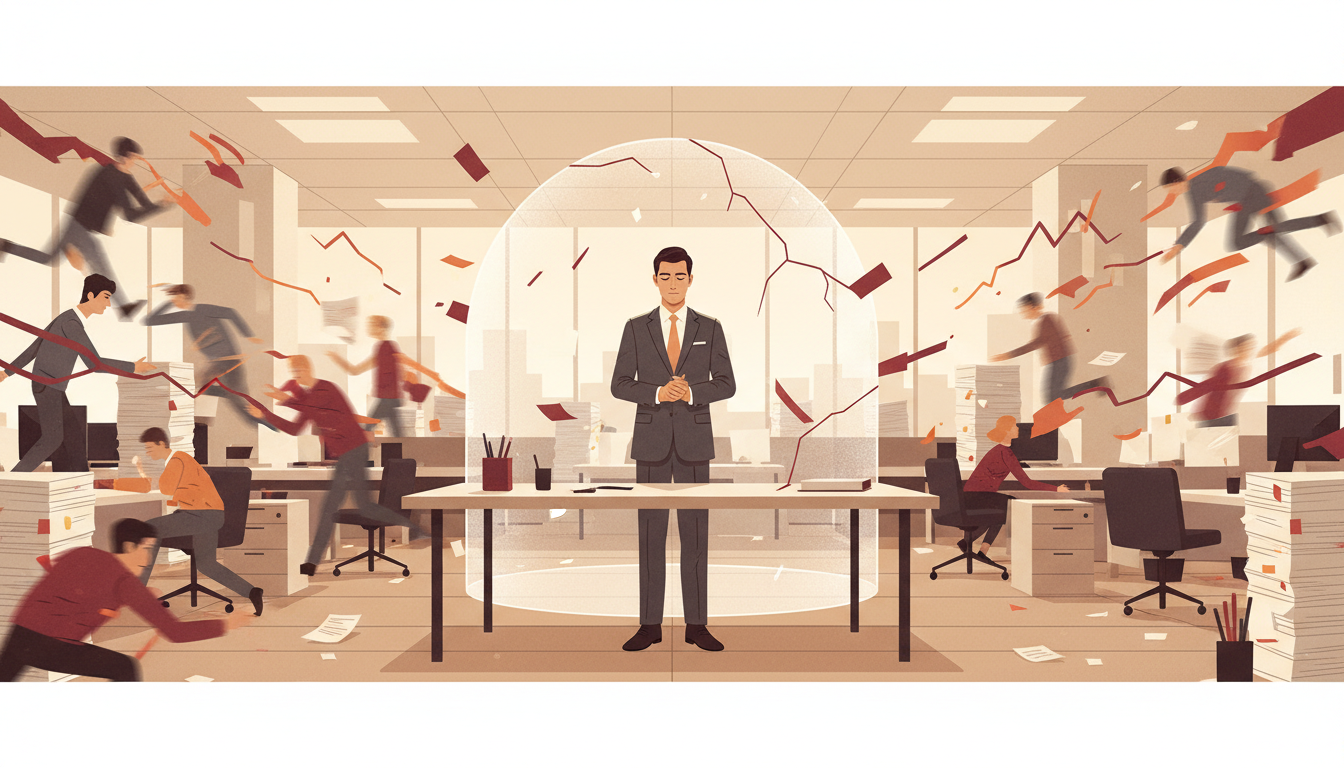
Why Composure Signals Authority
A 2022 study published in the Journal of Applied Psychology found that leaders who maintained emotional composure during high-pressure situations were rated 32% more competent and 28% more trustworthy by their teams than leaders who showed visible agitation. Composure sends a neurological signal to others: if they're calm, the situation must be manageable.
Think about the executive who, when confronted with a product recall, leans back slightly, takes a breath, and says, "Let's walk through what we know." Compare that to the manager who immediately starts assigning blame. Both may have the same information—but only one commands the room.
The 5-Second Reset Technique
When you feel pressure rising, use this micro-practice:
- Pause for a full beat before responding (1-2 seconds of silence).
- Plant your feet flat on the floor or press your fingertips together under the table.
- Drop your shoulders one inch—tension accumulates there first.
- Lower your vocal pitch by about 10%—adrenaline pushes voices higher.
- Lead with a framing statement: "Here's what I think matters most right now."
This takes five seconds. It changes everything. Practice it in low-stakes settings—a team standup, a one-on-one—so it's automatic when the stakes are real.
Daily Practice: The Composure Log
At the end of each workday, write down one moment where you felt pressure. Note what triggered it, how you responded, and what you'd do differently. Over 30 days, you'll start noticing your patterns—and interrupting them before they play out. For a comprehensive approach to staying composed in high-stakes moments, explore our framework on leadership presence in difficult conversations.
Pillar 2: Economy of Words
People with gravitas don't over-explain. They don't pad their sentences with qualifiers, caveats, or unnecessary context. They say what needs to be said—and then they stop. Economy of words isn't about being terse or cold. It's about respecting your listener's time and trusting your own point to land.
The Credibility Tax of Over-Talking
According to a study by Quantified Communications, executives who spoke concisely were perceived as 42% more effective communicators than those who used more words to make the same point. Every unnecessary word you add dilutes the ones that matter. Filler phrases like "I just wanted to mention," "I think maybe we should consider," or "Does that make sense?" act as credibility leaks.
Consider two versions of the same point in a strategy meeting:
Before: "So, I was thinking, and I'm not sure if this is the right direction, but maybe we should consider looking at the Q3 data because I think there might be some trends there that could potentially inform our approach going forward, if that makes sense?" After: "The Q3 data shows three trends that should shape our approach. Here's what I recommend."Same insight. Radically different impact.
The 3-Sentence Rule
Before speaking in any meeting, mentally structure your contribution into three sentences maximum:
- The Point: What you want them to know or do.
- The Evidence: One piece of supporting data or logic.
- The Ask or Implication: What should happen next.
This forces clarity. It also forces you to decide what actually matters—which is half the battle. If you need more than three sentences, you probably need a separate conversation or a written document.
Daily Practice: The Edit-Before-You-Speak Habit
Before every meeting contribution this week, pause and ask: Can I say this in fewer words? Before every email, delete the first sentence—it's almost always throat-clearing. For more on concise professional communication, see our guide on how to speak concisely at work.
Pillar 3: Conviction Signaling
Gravitas requires that people believe you believe what you're saying. Conviction signaling is the set of verbal and nonverbal cues that communicate certainty without arrogance. It's the difference between presenting an idea and championing one.

How Conviction Shows Up (and Doesn't)
Conviction is destroyed by hedge words. Phrases like "I feel like," "I'm not sure but," "This might be wrong," and "Sorry, but" tell your audience to discount what follows. A 2019 study from the University of Wolverhampton found that speakers who used fewer hedging phrases were rated as 35% more persuasive, regardless of the actual quality of their argument.
Conviction shows up in three channels simultaneously:
- Language: Declarative sentences. "We should invest in this market" vs. "I kind of think maybe this market could be worth exploring."
- Voice: Steady pace, downward inflection at the end of statements (not upward, which turns statements into questions), and consistent volume.
- Body: Still hands, direct eye contact, an open posture. Fidgeting and self-touching (face, hair, neck) undermine conviction instantly.
The Conviction Calibration Framework
Not every statement deserves the same level of conviction. Over-committing to minor points makes you seem rigid. Under-committing to major ones makes you seem uncertain. Use this three-tier approach:
Tier 1 — High Conviction (your core recommendation): "Based on the data, we need to restructure the sales pipeline. Here's why." No hedging. Direct eye contact. Slower pace. Tier 2 — Moderate Conviction (supporting points): "I believe the timeline is achievable, though we should build in a two-week buffer." Confident but acknowledges complexity. Tier 3 — Open Exploration (brainstorming, early-stage ideas): "One direction worth exploring is a partnership model. I'd want to stress-test it before committing." Signals intellectual honesty without undermining yourself.The key is matching your conviction level to the situation—and never defaulting to Tier 3 when the moment calls for Tier 1.
Daily Practice: The Hedge-Word Audit
Record yourself in one meeting this week (with permission) or review a recent email thread. Count how many hedge words and qualifiers you used. Replace three of them with direct, declarative alternatives. Over time, this rewires your default communication style. For more on this, explore our article on how to stop undermining yourself at work.
Pillar 4: Strategic Silence
Most professionals fear silence. They rush to fill pauses, over-explain after making a point, or jump in the moment someone else stops talking. But silence, used deliberately, is one of the most powerful tools of gravitas. It signals that you're thinking—not reacting. That you're confident enough to let your words breathe.
The Science of the Pause
Research from the University of Michigan's Institute for Social Research found that negotiators who used strategic pauses of 3-5 seconds were 17% more likely to achieve favorable outcomes than those who responded immediately. The pause creates what psychologists call a "processing gap"—it forces the other person to sit with your words, which increases their perceived weight.
Think about the most commanding speaker you've ever watched. They didn't rush. They made a point, paused, and let the room absorb it. That pause wasn't accidental—it was a deliberate tool of influence.
Three Types of Strategic Silence
1. The Pre-Response Pause: Before answering a question—especially a challenging one—wait two full seconds. This prevents reactive answers and signals that you're considering the question seriously. It also lowers your heart rate, which steadies your voice. 2. The Post-Statement Pause: After making a key point, stop talking. Don't add "Does that make sense?" or "So, yeah." Let the point land. This is especially powerful after a recommendation or a disagreement. 3. The Listening Pause: When someone else is speaking, resist the urge to formulate your response while they're still talking. Instead, wait until they finish, pause for one beat, and then respond. This signals respect and intellectual engagement—two hallmarks of gravitas.Daily Practice: The One-Pause-Per-Meeting Rule
In your next meeting, commit to using one deliberate pause. After making your most important point, stop talking for three seconds. Notice how the room responds. Most people will lean in. Some will nod. The silence amplifies your message in ways that more words never could. For techniques on using pauses in presentations, see our guide on how to pause effectively in public speaking.
Pillar 5: Intellectual Weight
Gravitas isn't just about how you communicate—it's about the substance behind your words. Intellectual weight means consistently bringing informed, well-reasoned perspectives to conversations. It means doing the thinking before the meeting, not during it.
What Intellectual Weight Looks Like in Practice
The professional with intellectual weight is the one who says, "I reviewed the competitive analysis and three things stood out," not "I haven't had a chance to look at it closely, but off the top of my head…" They reference data, name patterns, and connect dots that others miss.
According to a 2023 survey by McKinsey & Company, 78% of senior executives said the single most impressive quality in a rising leader is the ability to synthesize complex information and communicate it clearly. This isn't about being the smartest person in the room. It's about being the most prepared and the most clear.
The Preparation-to-Gravitas Pipeline
Before any important meeting, presentation, or conversation, run through this four-step preparation:
- Know the three most important facts. Not all the facts—the three that matter most to your audience.
- Anticipate the two most likely objections. Prepare a one-sentence response to each.
- Identify one insight others might miss. This is your differentiator—the observation that shows you've thought deeper than the surface.
- Prepare your opening line. The first thing you say sets the tone. Make it count.
This takes 10-15 minutes. It's the difference between being a participant and being a leader in the conversation. For a complete framework on presenting to senior leaders with this kind of preparation, see our playbook on how to present to executives without slides.
Daily Practice: The "So What?" Test
Before sharing any point in a meeting, ask yourself: So what? Why does this matter to the people in this room? If you can't answer that in one sentence, refine your thinking before you speak. This single habit will transform the quality—and the perceived weight—of every contribution you make.
Build Unshakable Professional Credibility. The Credibility Code walks you through the daily systems, scripts, and frameworks that transform how leaders perceive you—starting in your very next meeting. Discover The Credibility Code
Pillar 6: Emotional Steadiness
The final pillar of gravitas is the one most often overlooked: emotional steadiness. This isn't emotional suppression—it's emotional regulation. It's the ability to stay grounded when you receive critical feedback, when a colleague takes credit for your work, when a negotiation turns adversarial, or when you're blindsided by a question you didn't expect.
Why Emotional Volatility Destroys Gravitas
A single emotional outburst—visible frustration, defensive body language, a sharp tone—can undo months of credibility-building. Research from the Center for Creative Leadership found that "emotional self-regulation" was the number one competency that differentiated successful senior leaders from those who derailed. It wasn't intelligence, technical skill, or even strategic thinking. It was the ability to stay steady.
This doesn't mean you become a robot. It means your emotional responses are proportional and deliberate, not reactive and unfiltered.
The Emotional Steadiness Spectrum
Think of emotional expression on a spectrum:
- Too Cold (Suppression): No emotional expression at all. People can't read you, so they don't trust you. You seem detached or uncaring.
- The Gravitas Zone (Regulation): You acknowledge emotions appropriately. You can say, "I'm disappointed by these results" without raising your voice. You can express urgency without panic.
- Too Hot (Reactivity): Visible frustration, defensiveness, sarcasm, or emotional flooding. People stop listening to your message and start managing your mood.
The goal is the middle zone. You're human, relatable, and emotionally present—but never at the mercy of your emotions.
The STAR Response for Emotional Triggers
When you feel an emotional reaction building—your face flushing, your jaw tightening, your voice rising—use the STAR method:
- S — Stop. Don't respond yet. Buy yourself two seconds.
- T — Take a breath. One slow exhale resets your nervous system.
- A — Assess. Ask yourself: What response serves my long-term credibility here?
- R — Respond. Choose the response that reflects who you want to be in this room, not how you feel in this moment.
A director I once coached was blindsided in a board meeting when a peer publicly questioned her team's performance data. Her instinct was to defend immediately. Instead, she paused, took a breath, and said: "That's a fair question. Let me walk you through the methodology so we're all working from the same baseline." She didn't just survive the moment—she owned it. Her composure became the story people told afterward.
Daily Practice: The Trigger Inventory
Identify your top three emotional triggers at work. For each one, write a pre-planned response—not what you want to say, but what the most credible version of yourself would say. Rehearse these responses until they feel natural. For more on staying composed during conflict, explore our guide on leadership presence in conflict.
Bringing the Six Pillars Together
Gravitas isn't a single skill—it's a system. Each pillar reinforces the others:
- Composure gives you the platform to use strategic silence.
- Economy of words amplifies your intellectual weight.
- Conviction signaling is only credible when backed by emotional steadiness.
You don't need to master all six at once. Start with the pillar where you feel weakest. Practice one daily habit from that pillar for two weeks before adding another. Over 90 days, you'll notice a compounding effect—people will start describing you differently. Words like "credible," "commanding," and "trustworthy" will replace "nice" and "smart."
The professionals who build gravitas aren't born with it. They practice it—deliberately, daily, and with the kind of discipline that most people reserve for technical skills. The difference is that gravitas doesn't just make you better at your job. It makes you visible as someone who should be leading.
For a comprehensive roadmap to developing your overall leadership presence, see our complete guide on how to develop leadership presence.
Frequently Asked Questions
What is gravitas in the workplace?
Gravitas in the workplace is the ability to communicate with weight, substance, and calm authority so that others take your words seriously and trust your judgment. It's the combination of composure, clarity, conviction, and emotional steadiness that makes people listen—not because of your title, but because of how you carry yourself. Research shows gravitas accounts for 67% of executive presence.
How is gravitas different from charisma?
Charisma is about magnetism—drawing people in through energy, warmth, and personality. Gravitas is about weight—earning trust through substance, steadiness, and credibility. Charismatic leaders inspire enthusiasm; leaders with gravitas inspire confidence. You can have both, but gravitas is more consistently valued in high-stakes professional settings because it signals reliability and depth rather than charm.
Can introverts develop gravitas?
Absolutely. Gravitas actually favors introverts in many ways. Economy of words, strategic silence, and deep preparation—three of the six core pillars—come more naturally to introverted communicators. Introverts often struggle with conviction signaling, but this is a learnable skill. The key is leveraging your natural strengths (listening, preparation, thoughtfulness) rather than trying to mimic extroverted communication styles.
How long does it take to build gravitas?
Most professionals notice a measurable shift in how others perceive them within 30-60 days of deliberate practice. Gravitas isn't a personality overhaul—it's a set of communication habits. By focusing on one pillar at a time and practicing one specific behavior daily, you build momentum quickly. Full integration of all six pillars typically takes 3-6 months of consistent effort.
What are the biggest mistakes that undermine gravitas?
The five most common gravitas killers are: over-explaining (which signals insecurity), using hedge words like "I think maybe" (which signals uncertainty), reacting emotionally to criticism (which signals volatility), failing to prepare for meetings (which signals lack of seriousness), and filling silence with unnecessary words (which signals discomfort with authority). Eliminating even two of these habits can dramatically shift how others perceive you.
How do I communicate with gravitas in virtual meetings?
Virtual meetings require deliberate adjustments: position your camera at eye level, look directly into the lens when making key points, use a slower pace since audio compression flattens vocal nuance, eliminate visual distractions behind you, and pause longer than feels natural—screen delays make rushed speech sound even more rushed. The six pillars apply equally online, but composure and conviction signaling require more intentional effort without the benefit of full-body presence.
Build Presence People Notice Before You Say a Word
The Credibility Code gives you the specific verbal and nonverbal habits that make people treat you as the senior person in the room.
Discover The Credibility CodeRelated Articles

Project Authority Without Arrogance: A Leader's Guide
Projecting authority without arrogance comes down to leading with competence, not ego. The most credible leaders combine confident decision-making with genuine curiosity, active listening, and a willingness to share credit. Instead of demanding respect through dominance or status, they earn it by demonstrating expertise, staying composed under pressure, and elevating the people around them. The result is a commanding presence that draws people in rather than pushing them away.

Project Calm Authority Under Pressure: A Leader's Guide
To project calm authority under pressure, anchor yourself with a controlled exhale before responding, slow your speech rate by 10–15%, plant your feet or hands in a stable position, and choose deliberate language that acknowledges the situation without matching its chaos. Calm authority isn't the absence of stress—it's the visible management of it. Leaders who master this skill earn deeper trust, defuse escalations faster, and maintain decision-making clarity when it matters most.

How to Develop Executive Gravitas Quietly (No Bravado)
Quick Answer: You develop executive gravitas quietly by mastering five subtle behavioral signals: physical stillness, strategic silence, deliberate word choice, emotional composure under pressure, and consistent follow-through. These signals communicate authority without volume or bravado. The most credible leaders in any room are rarely the loudest—they're the ones who speak less, choose words carefully, hold steady eye contact, and remain composed when others react emotionally.