
How to Establish Credibility in a Presentation Fast

What Is Presentation Credibility?
Presentation credibility is the audience's perception that you are knowledgeable, trustworthy, and worth listening to. It's the invisible contract between speaker and listener that determines whether your ideas get accepted or dismissed.
Credibility isn't something you have—it's something your audience grants you based on signals you send in real time. Those signals include what you say (your content and evidence), how you say it (vocal tone, pacing, word choice), and how you carry yourself (posture, eye contact, spatial ownership). When all three align, you project what researchers call "source credibility"—the combination of competence and trustworthiness that makes people lean in rather than tune out.
According to a landmark study published in Communication Monographs, audiences form initial credibility judgments within the first 30 seconds of a speaker's opening—and those judgments are remarkably resistant to change once formed. That means the window to establish yourself as an authority is narrow and non-negotiable.
The First-60-Seconds Framework: Win Trust Before Your First Slide
The biggest mistake professionals make is treating the opening of a presentation like a warm-up. They fumble with slides, apologize for technical issues, or launch into a meandering self-introduction. By the time they get to their actual content, the audience has already decided whether to pay attention.
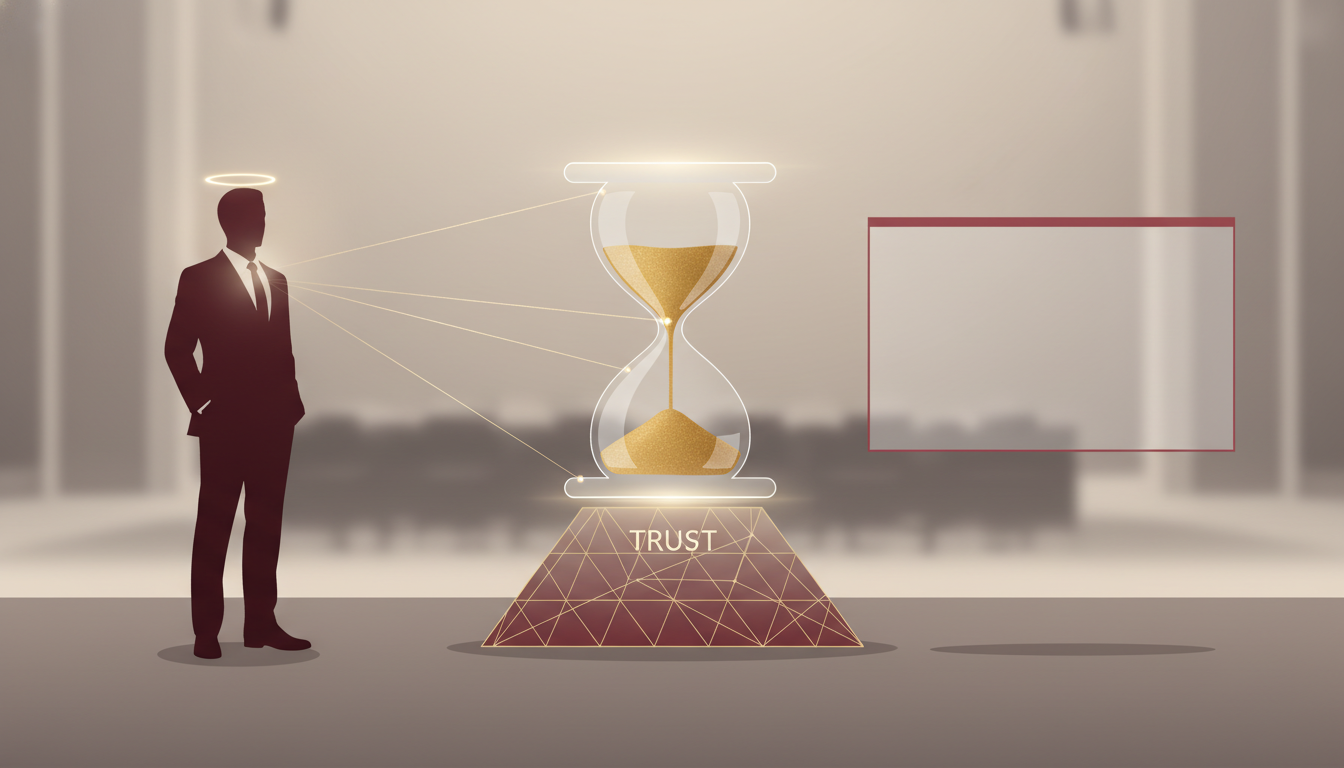
The First-60-Seconds Framework flips that script. It gives you a structured approach to commanding credibility from the moment you begin.
Step 1: Open With a Credibility Anchor
A credibility anchor is a single, specific statement that connects your expertise directly to the audience's problem. It's not your job title. It's not your company name. It's a result, an experience, or a data point that makes the audience think, "This person knows what they're talking about."
Here's the difference:
Weak opener: "Hi, I'm Sarah, and I'm the VP of Operations at Meridian Corp. Thanks for having me today." Strong credibility anchor: "Over the past three years, my team reduced fulfillment errors by 72%—saving $4.1 million annually. Today I'm going to show you exactly how we did it, and how your team can apply the same framework."The anchor works because it's specific, quantified, and immediately relevant. It tells the audience why they should listen, not just who is talking.
For more techniques on commanding the room from the very first sentence, see our guide on how to start a presentation with confidence.
Step 2: Deliver a Problem Statement the Audience Feels
Immediately after your credibility anchor, name the audience's pain point with precision. This proves you understand their world—not just your own expertise. Research from Harvard Business Review shows that speakers who demonstrate audience awareness in their opening are rated 35% more persuasive than those who lead with self-focused content.
Example: "You're sitting in quarterly reviews watching stakeholders check their phones by slide three. You know your data is solid, but you can't figure out why it's not landing. That's the gap we're closing today."When you name the problem accurately, credibility transfers instantly. The audience assumes: if you understand the problem this well, you probably understand the solution, too.
Step 3: Signal Your Structure
Credible presenters don't ramble. They signal control by previewing the structure of their talk in one or two sentences. This creates a psychological sense of competence and preparation.
Example: "I'll walk you through three shifts—how you open, how you use evidence, and how you handle pushback. Each one takes less than five minutes to learn and works immediately."This micro-move tells the audience: I've organized my thinking. I respect your time. I know where this is going. That's credibility in action.
How to Use Social Proof Without Sounding Boastful
Social proof is one of the most powerful credibility tools available to any presenter. But most professionals either avoid it entirely (out of fear of seeming arrogant) or deploy it clumsily (listing credentials like a résumé). The key is making your proof serve the audience, not your ego.
The "Bridge" Technique for Humble Authority
The Bridge Technique connects your credential to the audience's benefit in a single sentence. The structure is: [What I've done] → [Why that matters for you].
Example: "I've coached over 200 executives through high-stakes board presentations—so the frameworks I'm sharing today have been pressure-tested in rooms exactly like yours."Notice what's happening: the social proof (200 executives) is immediately bridged to relevance (pressure-tested for your context). The audience doesn't hear bragging; they hear reassurance.
A 2019 study by the Journal of Experimental Social Psychology found that social proof framed in terms of audience benefit increased speaker persuasiveness by 28% compared to self-focused credential statements. The lesson: always make your proof about them.
Third-Party Validation and Borrowed Credibility
You don't always need your own credentials. Sometimes the most effective social proof comes from citing respected sources, referencing client results, or quoting recognized authorities.
Examples:- "McKinsey's research on executive communication confirms what we've seen in practice..."
- "One of the teams I worked with at [well-known company] implemented this in two weeks and saw..."
- "As Dr. Amy Cuddy's research at Harvard demonstrated..."
This technique—called borrowed credibility—works because it associates you with trusted entities without requiring you to make personal claims. It's especially useful for emerging leaders or anyone presenting to a more senior audience.
For a deeper dive into building authority when you don't yet have a title or tenure, explore our piece on how to establish authority at work without a title.
Project Confidence Through Vocal Tone and Body Positioning
What you say matters—but research consistently shows that how you say it matters more for initial credibility judgments. A study by Albert Mehrabian (often cited in communication science) found that vocal tone accounts for roughly 38% of a listener's impression of a speaker's credibility, while body language accounts for approximately 55%. Your words? Just 7% of that first impression.

Those numbers are debated in academic circles, but the directional truth holds: non-verbal signals dominate early credibility assessments.
Vocal Techniques That Signal Authority
Lower your pitch at the end of sentences. Uptalk—ending statements with a rising inflection—signals uncertainty. Credible speakers use a downward inflection to "land" their key points. Practice this by recording yourself and listening for sentences that accidentally sound like questions. Slow your pace by 15-20%. Nervous speakers rush. Authoritative speakers let their words breathe. A study published in the Journal of Language and Social Psychology found that speakers with a moderate pace (around 140-150 words per minute) were rated significantly more credible than fast speakers (180+ wpm). Use the strategic pause. Pausing for 2-3 seconds after a key statement forces the audience to process your point. It signals that you believe what you just said is important enough to let it land. For a complete breakdown of this technique, read our guide on how to pause effectively in public speaking.Body Language That Commands the Room
Plant your feet. Stand with your feet shoulder-width apart, weight evenly distributed. Avoid swaying, pacing, or shifting. Stillness communicates control. Open your torso. Crossed arms, clasped hands in front of the body, and hunched shoulders all signal defensiveness. Keep your chest open, hands visible, and gestures purposeful. Claim the space. Move deliberately if you move at all. Step toward the audience when making a key point. Step to the side when transitioning between sections. Every movement should be intentional, not nervous. Make sustained eye contact. Hold eye contact with one person for a full thought (3-5 seconds) before moving to another. This creates the feeling of a personal conversation rather than a broadcast—and it dramatically increases perceived trustworthiness.For a comprehensive system on non-verbal authority, check out our guide on confident body language for public speaking.
Structure Your Content for Maximum Credibility
Even with a powerful opening and confident delivery, your credibility will erode if your content is disorganized or unsupported. Audiences equate clear structure with clear thinking—and clear thinking with competence.
Lead With the Conclusion
Executive audiences and senior stakeholders especially value bottom-line-up-front (BLUF) communication. State your recommendation or key finding first, then support it with evidence. This is the opposite of how most people present (building up to a conclusion), and it immediately signals strategic thinking.
Example structure:- Conclusion/recommendation (30 seconds)
- Three supporting data points (2 minutes each)
- Implications and next steps (1 minute)
This approach aligns with how presenting to executives without slides works—it respects the audience's time and demonstrates that you've distilled your thinking.
Use Evidence Strategically, Not Exhaustively
Credibility doesn't come from having the most data. It comes from having the right data, presented with confidence. A study from Stanford's Graduate School of Business found that presentations with 3 strong supporting data points were rated more persuasive than those with 7 or more—because excess evidence signals insecurity, as if the presenter doesn't trust their own argument.
Choose three pieces of evidence that are:
- Specific (exact numbers, not vague trends)
- Recent (within the last 1-2 years if possible)
- Sourced (attributed to a credible origin)
Then present each one with conviction. Don't hedge. Don't over-qualify. State the data, explain what it means, and move on.
Handle Q&A Like a Credibility Multiplier
The Q&A portion of a presentation is where many professionals lose the credibility they built. They get flustered, give rambling answers, or apologize for not knowing something.
Instead, use the AEB method:
- Acknowledge the question ("That's a critical consideration.")
- Evidence your answer with a specific data point or example
- Bridge back to your core message
If you don't know the answer, say: "I want to give you an accurate answer on that. Let me follow up with the specific data by end of day." This is more credible than guessing—because it demonstrates intellectual honesty, which audiences respect.
Build Unshakable Presentation Authority The Credibility Code includes word-for-word scripts for credibility anchors, Q&A responses, and social proof statements that work in any professional setting. Discover The Credibility Code
Avoid These 5 Credibility Killers
Knowing what to do is only half the equation. You also need to know what not to do—because a single credibility-damaging habit can undo minutes of strong delivery.
1. Opening With an Apology
"Sorry, I'm a little nervous" or "I'm not really an expert on this, but..." instantly tells the audience to lower their expectations. If you feel the urge to apologize, replace it with a credibility anchor instead.
2. Reading From Slides
Reading slides word-for-word signals that you don't know your material well enough to speak about it independently. Use slides as visual support, not a script. For a complete method on presenting without relying on slides, see our guide on how to present without reading slides.
3. Using Hedge Language
Phrases like "I think maybe," "I'm not sure, but," "This might not be right, however..." erode credibility with every use. Replace hedges with direct statements. Say "The data shows" instead of "I think the data might show." For more on eliminating language that undermines you, read how to stop undermining yourself at work.
4. Rushing Through Key Points
When you rush, the audience assumes you're either nervous or don't value your own content. Slow down at your most important moments. The pause after a key statement is where credibility compounds.
5. Avoiding Eye Contact
Looking at the floor, the ceiling, or your laptop screen tells the audience you're not confident in what you're saying. Even if you're nervous, force yourself to make eye contact with individuals in the room. It's the single fastest non-verbal credibility signal you can send.
Frequently Asked Questions
How do you establish credibility in the first 60 seconds of a presentation?
Open with a credibility anchor—a specific result, experience, or data point that directly connects your expertise to the audience's problem. Follow it immediately with a precise problem statement that shows you understand their challenges. Then signal your structure in one or two sentences. This three-step sequence (anchor → problem → structure) takes under 60 seconds and sets the frame for everything that follows.
What is the difference between credibility and confidence in a presentation?
Confidence is how you feel and how you carry yourself—your vocal tone, posture, and willingness to make direct statements. Credibility is the audience's judgment about whether you're competent and trustworthy. You can be confident without being credible (if you lack evidence or expertise), and you can be credible without appearing confident (if your delivery undermines strong content). The goal is to align both: strong content delivered with authoritative presence.
How do you build credibility when presenting to a senior audience?
Lead with bottom-line-up-front communication. Senior audiences value conciseness and strategic thinking. Open with your recommendation, support it with three specific data points, and keep your total time tight. Use borrowed credibility by referencing respected sources or relevant client results. Avoid over-explaining—it signals that you don't trust the audience to follow your reasoning. Our guide on how to communicate with senior leadership covers this in depth.
Can introverts establish credibility in presentations effectively?
Absolutely. Introverts often excel at preparation, deep expertise, and thoughtful delivery—all of which are credibility drivers. The key is leveraging your natural strengths: thorough research, precise language, and calm composure. Use strategic pauses (which feel natural to introverts) and let your evidence do the heavy lifting rather than relying on high-energy charisma. Credibility is built on substance, not volume.
How do you recover credibility after a mistake during a presentation?
Acknowledge the mistake briefly and without excessive apology. Say something like, "Let me correct that—the actual figure is..." and move on with confidence. Audiences respect speakers who handle errors with composure far more than those who either ignore mistakes or spiral into lengthy apologies. A calm correction actually increases credibility because it demonstrates intellectual honesty and poise under pressure.
How long does it take to establish credibility with a new audience?
Research suggests initial credibility judgments form within 30-60 seconds. However, those judgments can be reinforced or eroded throughout your presentation. The first minute sets the baseline; every subsequent section either compounds or diminishes it. That's why your opening, evidence quality, and delivery must all work together—credibility isn't a single moment, it's a sustained signal.
Speak So the Room Takes You Seriously
The Credibility Code covers the verbal patterns that make presenters sound authoritative, and the ones that make audiences tune out.
Discover The Credibility CodeRelated Articles

Public Speaking for Leaders: Build Trust From the Stage
Public speaking for leaders is fundamentally different from general presentation skills. While anyone can learn to deliver a polished talk, leaders must use the stage to build organizational trust, reinforce credibility, and inspire action. This means going beyond technique to master storytelling frameworks, calibrate vulnerability, and structure messages that move people. The best leadership communicators don't just inform — they create belief.

How to Sound Confident in a Presentation: 9 Pro Secrets
To sound confident in a presentation, focus on three pillars: vocal delivery, language structure, and psychological preparation. Slow your speaking pace by 10–15%, eliminate hedging phrases like "I think" or "sort of," and anchor your opening with a declarative statement rather than an apology. Use strategic pauses instead of filler words, drop your pitch at the end of sentences, and structure your content around no more than three core points. Confidence is less about feeling fearless and more

How to Sound Confident in a Presentation: 9 Proven Methods
To sound confident in a presentation, focus on these core techniques: lower your vocal pitch slightly, slow your speaking pace to 130–150 words per minute, pause deliberately instead of using filler words, control your breathing from your diaphragm, and open with a strong declarative statement. These methods work even when you feel nervous because confidence is a skill of *delivery*, not a reflection of your internal state. The audience hears your voice — not your heartbeat.