
How to Negotiate With Someone Who Has More Power

To negotiate with someone who has more power, shift your focus from positional authority to preparation-based leverage. Research their priorities, anchor the conversation in data and shared outcomes, and use credibility—not confrontation—to create value. Power imbalances shrink when you bring unique insights, clear alternatives, and composed delivery to the table. The person with the title doesn't always control the outcome; the person with the best preparation often does.
What Is Power-Imbalanced Negotiation?
Power-imbalanced negotiation is any negotiation where one party holds significantly more positional authority, decision-making control, or organizational influence than the other. This includes salary conversations with a VP, scope discussions with a demanding client, or resource requests directed at a C-suite executive.
Unlike peer-to-peer negotiations, these conversations carry an inherent structural tilt. The higher-power party can often say no with fewer consequences, which means the lower-power party must rely on preparation, credibility, and strategic framing rather than positional leverage alone.
Understanding this dynamic is the first step toward navigating it. Power-imbalanced negotiations aren't about winning a battle—they're about creating conditions where the more powerful party wants to agree.
Why Positional Power Isn't the Only Power
Most professionals overestimate how much positional power actually determines negotiation outcomes. Research from Harvard Business School found that negotiators who focused on their alternatives and preparation consistently outperformed those who relied on rank alone, regardless of their position in the hierarchy (Malhotra & Bazerman, Negotiation Genius, Harvard Business Review Press).

The Myth of the Power Holder's Advantage
When your boss or a senior executive sits across the table, it feels like they hold all the cards. But positional power has limits. A VP negotiating with a high-performing manager still needs that manager's expertise, institutional knowledge, and team loyalty. A client with a bigger budget still needs your specialized skill set.
The key insight: power in negotiation is contextual, not absolute. The person with the title may control the final decision, but they rarely control the information, alternatives, or expertise you bring.
Three Types of Leverage You Already Have
Even without a senior title, you carry leverage in three forms:
- Information leverage — You know things they don't. Market data, competitor benchmarks, project-specific insights, or customer feedback that shapes the decision.
- Expertise leverage — Your specialized knowledge makes you difficult to replace. According to a 2023 LinkedIn Workforce Report, 77% of employers say finding candidates with the right skills is their top hiring challenge. Your expertise is more valuable than you think.
- Relationship leverage — Trust, rapport, and a track record of delivering results create influence that transcends org charts.
Before any negotiation with someone who outranks you, audit these three categories. You'll almost always find more leverage than you assumed. For a deeper dive into building this kind of influence, explore our guide on how to influence senior stakeholders with 7 credibility moves.
Reframing Power as Mutual Dependence
The most effective negotiators don't think in terms of "powerful" and "powerless." They think in terms of mutual dependence. Your boss depends on you to deliver results. Your client depends on you to solve their problem. The senior executive depends on accurate information from people like you to make good decisions.
When you internalize this frame, the negotiation shifts from "asking permission" to "solving a shared problem." That shift changes your body language, your word choice, and your willingness to hold your ground.
The PRISM Framework: 5 Steps to Negotiate Upward
Use the PRISM framework to structure any negotiation where you're the lower-power party. Each step builds on the last to create a credible, composed approach.
P — Prepare Your Position with Data
Preparation is the great equalizer. A 2019 study published in the Journal of Applied Psychology found that negotiators who spent more time preparing achieved outcomes that were, on average, 12% more favorable than those who relied on improvisation.
Here's what thorough preparation looks like:
- Know their priorities. What does the other party care about most? Budget constraints? Timeline? Team morale? Optics to their own leadership?
- Benchmark your ask. Use market data, industry reports, or internal precedents to anchor your request in objective reality.
- Anticipate objections. Write down the three most likely reasons they'll say no, and prepare a response for each.
This level of preparation doesn't just give you talking points—it gives you confidence. And confidence changes how you're perceived. Learn more about building that inner steadiness in our post on how to sound confident in meetings when you feel anxious.
R — Reframe the Conversation Around Shared Outcomes
The fastest way to lose a negotiation with someone more powerful is to make it about what you want. Instead, frame every request in terms of what they need.
Compare these two approaches:
- ❌ "I need a higher budget because this project is important to me."
- ✅ "Increasing the budget by 15% positions us to hit the Q3 revenue target you've prioritized—here's the data showing why."
Reframing isn't manipulation. It's strategic alignment. You're showing the decision-maker that saying yes to your request is actually saying yes to their own goals.
I — Introduce Credibility Anchors Early
A credibility anchor is a specific, verifiable piece of evidence that establishes your authority on the topic before the negotiation deepens. Drop these early in the conversation to set the tone.
Examples of credibility anchors:
- "In the three projects I've led this year, we've averaged a 22% efficiency gain."
- "Based on the Gartner report from last month, our competitors are investing 30% more in this area."
- "When I spoke with the client last week, they specifically flagged this as a priority."
Credibility anchors work because they shift the conversation from opinion to evidence. The more powerful party may outrank you, but they can't outrank data. For more on establishing credibility fast, see our framework on how to build credibility at work.
S — Stay Composed Under Pressure
Power-imbalanced negotiations often include pressure tactics—whether intentional or not. The senior person might interrupt, dismiss your point, express frustration, or use silence to create discomfort.
Your composure is your credibility. According to research from the Stanford Graduate School of Business, negotiators who maintained emotional regulation during tense exchanges were perceived as 35% more competent by their counterparts (Neale & Lys, Getting More of What You Want, Basic Books).
Practical techniques for staying composed:
- Pause before responding. A two-second pause signals confidence, not weakness.
- Use grounding phrases. "That's a fair point—let me address it directly" buys you time while maintaining authority.
- Control your voice. Speak slightly slower and lower than your natural pace when tension rises.
If you struggle with nervousness in high-stakes conversations, our guide on how to negotiate when you feel intimidated offers a detailed framework for managing that internal pressure.
M — Map Your Walk-Away Point
Every effective negotiation requires a clear BATNA (Best Alternative to a Negotiated Agreement). This is your walk-away point—the outcome you'll pursue if the negotiation fails.
Your BATNA doesn't have to be dramatic. It might be:
- Accepting the current situation but requesting a formal review in 90 days
- Proposing a scaled-down version of your original ask
- Documenting the conversation and escalating through proper channels
The critical point: you must know your BATNA before the conversation starts. If you don't know when to walk away, you'll either concede too quickly or push too hard.
Scripts and Phrases That Work in Power-Imbalanced Negotiations
Theory matters, but words matter more in the moment. Here are tested phrases organized by situation.
When Opening the Negotiation
Start with alignment, not demands:
- "I want to make sure we're solving the same problem here. From what I understand, your top priority is [X]. Here's how I think we can get there."
- "I've done some research on this, and I'd like to share what I've found before we discuss options."
- "I respect that you have the final call here. I want to make sure you have the full picture before you make it."
Notice the pattern: each opener positions you as a partner, not a petitioner.
When Facing Pushback
Pushback is normal. Don't retreat—redirect:
- "I hear your concern about [X]. Let me show you the data that addresses that."
- "That's a valid point. And here's what I've seen work in similar situations."
- "I understand the constraints. What if we approached it this way instead?"
These phrases maintain respect while holding your ground. They're especially useful when disagreeing with your boss in a meeting.
When You Need to Hold Your Ground
Sometimes the other party will push for a quick concession. Resist the urge to fold:
- "I'm open to finding a middle ground, but I'm not comfortable going below [X] because [specific reason]."
- "I've thought carefully about this number. It reflects [market data/project scope/industry standard], and I'm confident it's fair."
- "I'd rather we take more time to find the right solution than agree to something that doesn't work for either of us."
For more on building assertive communication habits, check out our post on how to be more assertive at work without being rude.
Common Mistakes That Undermine Your Position
Even well-prepared negotiators sabotage themselves with avoidable errors. Here are the four most damaging.
Over-Apologizing and Hedging
Phrases like "I'm sorry to bring this up" or "This might be a silly question, but..." immediately signal low status. A 2022 study in Organizational Behavior and Human Decision Processes found that negotiators who used hedging language received offers that were 9% lower than those who stated their positions directly.
Replace hedging with directness:
- ❌ "I was just wondering if maybe we could possibly discuss..."
- ✅ "I'd like to discuss the budget allocation for Q4."
Making It Personal Instead of Strategic
When you frame a negotiation around personal needs ("I deserve this" or "I feel undervalued"), you give the more powerful party an easy out. They can acknowledge your feelings without changing anything.
Instead, make the business case. Frame your request around organizational impact, strategic alignment, or market reality. Personal feelings are valid—but strategic arguments are actionable.
Negotiating Without Alternatives
Walking into a negotiation without a BATNA is like playing poker with your cards face-up. The other party can sense when you have no alternative, and they'll negotiate accordingly.
Even if your alternatives aren't strong, identify them. A weak BATNA is better than no BATNA, because it gives you a mental floor below which you won't go.
Accepting the First Offer Out of Deference
Many professionals accept the first offer from a senior leader simply because they feel uncomfortable pushing back. But research from Columbia Business School shows that first offers in salary negotiations are, on average, 15-20% below what the offering party is willing to pay (Galinsky & Mussweiler, 2001, Journal of Personality and Social Psychology).
The first offer is a starting point, not a final answer. Treat it that way—respectfully, but firmly.
Negotiate From a Place of Credibility, Not Fear. If power dynamics are holding you back in critical conversations, Discover The Credibility Code — the step-by-step system for building authority that others can feel the moment you speak. Discover The Credibility Code
Advanced Tactics for High-Stakes Situations
When the stakes are highest—a career-defining negotiation, a major client conversation, or a board-level discussion—these advanced tactics give you an edge.
The "Collaborative Frame" Technique
Before making your ask, explicitly name the collaborative intent:
"I see this as a conversation where we're both trying to get to the best outcome. I'm not here to push—I'm here to problem-solve with you."
This disarms defensiveness and makes it harder for the other party to use aggressive tactics. It also signals confidence: only someone who feels secure invites collaboration.
Strategic Silence
After making your key point or stating your ask, stop talking. Most people fill silence with concessions. Let the other person respond first.
Strategic silence is especially powerful with senior leaders who are accustomed to people rushing to fill conversational gaps. Your comfort with silence signals authority. Learn more about projecting this kind of composure in our guide on leadership presence in tough conversations.
The "Conditional Concession" Move
Never concede without getting something in return. Use conditional language:
- "I can be flexible on timeline if we can agree on the budget."
- "I'm willing to take on the additional scope if we revisit compensation at the six-month mark."
- "I can adjust the deliverable format if we get access to the data I've requested."
This maintains the principle of reciprocity and prevents one-sided erosion of your position.
Frequently Asked Questions
How do you negotiate with someone who has more authority than you?
Focus on preparation over position. Research their priorities, anchor your request in data and shared outcomes, and present credibility anchors—specific evidence of your expertise or market benchmarks—early in the conversation. Maintain composure, avoid hedging language, and always know your walk-away point before the conversation begins. Authority doesn't determine outcomes; preparation and strategic framing do.
What is the difference between positional power and negotiation leverage?
Positional power comes from your title, rank, or formal authority in an organization. Negotiation leverage comes from your alternatives, information, expertise, and the value you bring to the specific situation. A junior employee with unique market data and a strong BATNA can have more negotiation leverage than a senior executive who needs that employee's expertise to hit quarterly targets.
How do you stay confident when negotiating with your boss?
Confidence in boss-negotiations comes from three sources: thorough preparation, a clear BATNA, and practiced composure techniques. Before the conversation, rehearse your key points out loud. During the conversation, use grounding phrases like "Let me address that directly" to buy thinking time. Remember that your boss depends on your work—that mutual dependence is real leverage.
Can you negotiate with someone who has all the power?
No one has all the power. Even in extreme imbalances—like negotiating with a monopoly client or a CEO—you hold information leverage, expertise leverage, or relationship leverage. The key is identifying which type of leverage you have and building your approach around it. According to Harvard negotiation research, the party with superior preparation outperforms the party with superior position in the majority of outcomes.
How do you negotiate without damaging the relationship?
Use collaborative framing from the start. State your intent to find a mutually beneficial outcome, separate the person from the problem, and make conditional concessions rather than ultimatums. Avoid emotional language and focus on objective criteria. The strongest professional relationships are built through honest, respectful negotiation—not through avoidance.
What should you never say in a negotiation with a senior leader?
Avoid phrases that signal low status: "I'm sorry to ask," "I know this is a lot," "I might be wrong, but..." Also avoid ultimatums ("Give me this or I'll leave") unless you genuinely mean them. Instead, use direct, respectful language grounded in evidence. For specific scripts, see our guide on how to speak up in meetings with senior leaders confidently.
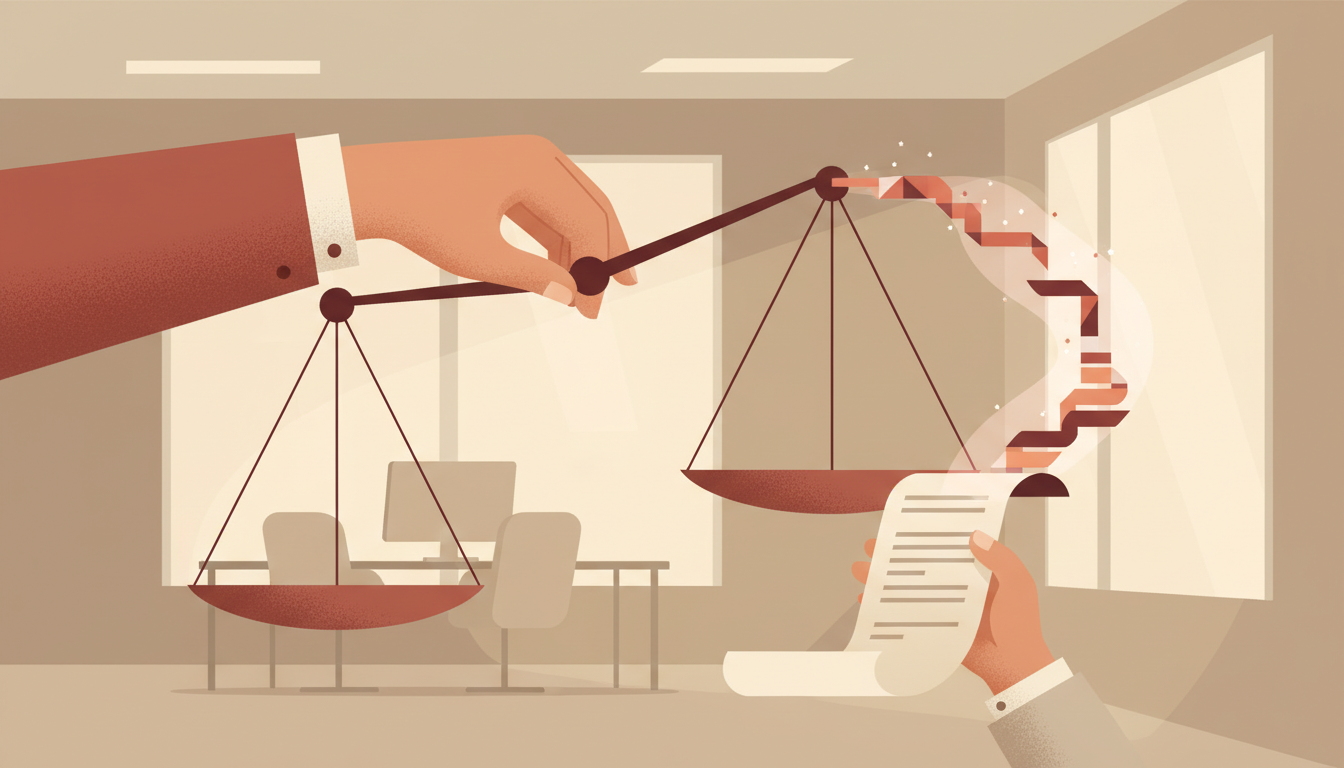
Featured Image Alt Text: Professional confidently negotiating across a table from a senior executive in a modern office setting, maintaining composed body language and direct eye contact.
Negotiate From a Position of Credibility
The Credibility Code shows you how to state your case without hedging, so your ask is heard as a professional position rather than a favor.
Discover The Credibility CodeRelated Articles

How to Negotiate When You Have No Power: 9 Proven Moves
When you feel powerless in a negotiation, shift your strategy from leverage-based bargaining to credibility-based influence. The most effective moves include reframing the conversation around shared interests, leveraging information asymmetry, building a strong BATNA (Best Alternative to a Negotiated Agreement), using anchoring language, and asking calibrated questions that redirect power dynamics. You don't need a title, budget authority, or market dominance to negotiate effectively—you need a

How to Negotiate When You Have No Leverage: 7 Moves
Quick Answer: You can negotiate effectively even without obvious leverage by reframing the conversation around value rather than power. The key moves include anchoring first, leveraging information asymmetry, creating options that cost the other side nothing, using silence strategically, building coalitions, demonstrating unique expertise, and deploying confident language patterns. Perceived leverage matters more than actual leverage — and you can shape that perception deliberately.

How to Negotiate a Counter Offer at Work Confidently
Negotiating a counter offer at work requires a strategic blend of preparation, timing, and confident communication. Whether your current employer is trying to retain you after you've received an external offer, or you're countering an initial job offer, the key is to anchor your request in market data, articulate your value clearly, and use a calm, assertive tone throughout the conversation. Lead with gratitude, present your counter with specific numbers and rationale, avoid ultimatums, and set