
Overcome Fear of Public Speaking at Work: A Pro Framework
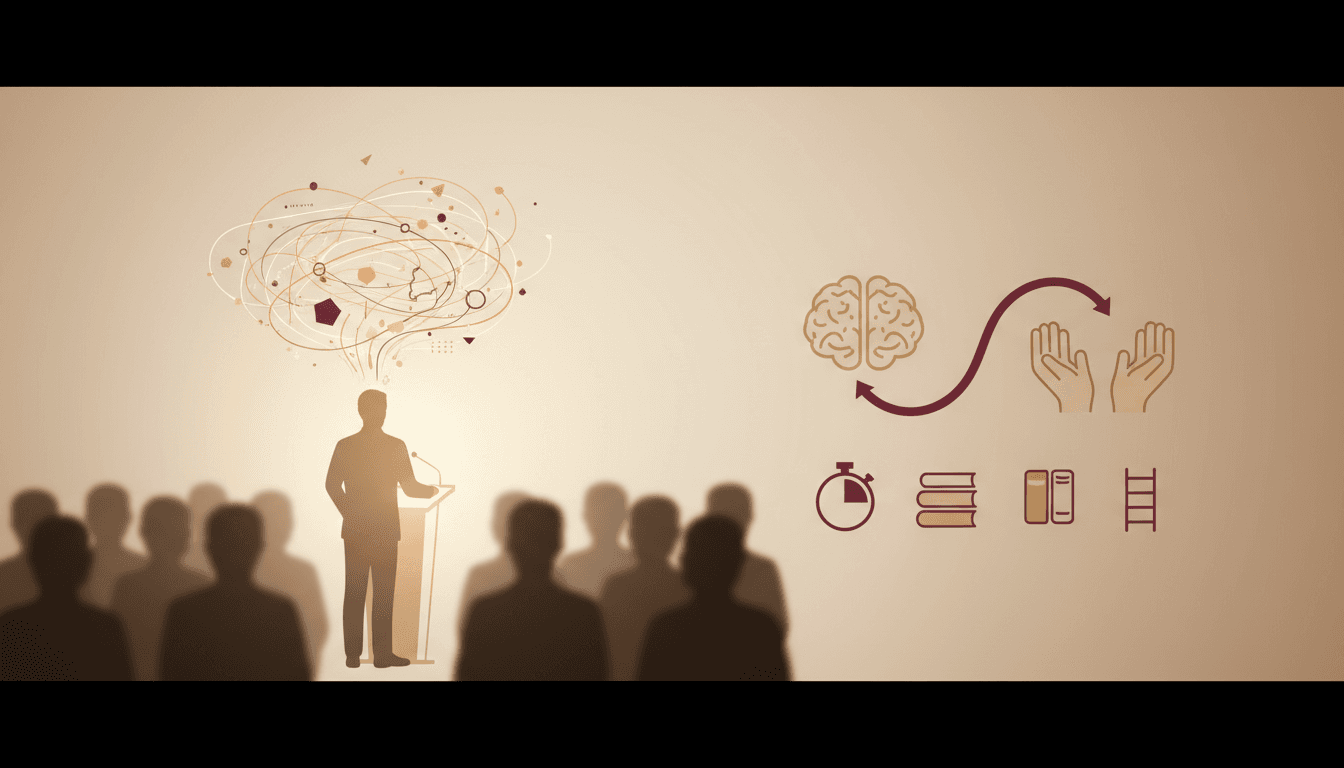
Public speaking fear at work isn't something you simply "get over" — you dismantle it with the right framework. To overcome fear of public speaking at work, use a four-phase approach: cognitive reframing (changing how you interpret anxiety), physical regulation (controlling your body's stress response), structured preparation rituals (removing uncertainty), and progressive exposure (building tolerance through graduated practice). This framework transforms speaking anxiety from a career obstacle into a manageable skill gap you can close systematically.
What Is Fear of Public Speaking at Work?
Fear of public speaking at work — sometimes called workplace glossophobia — is the anxiety, dread, or avoidance that professionals experience when asked to present, lead meetings, or speak in front of colleagues and leadership. It goes beyond general nervousness. It's a pattern of cognitive and physical stress responses triggered specifically by professional communication situations where you feel evaluated.
Unlike casual social anxiety, workplace public speaking fear carries unique stakes: your credibility, career trajectory, and professional reputation feel directly on the line. According to the National Institute of Mental Health, approximately 73% of the population experiences some degree of speech anxiety, making it one of the most common fears reported across demographics.
Why Public Speaking Anxiety Hits Harder at Work
The Professional Stakes Amplifier

General public speaking advice often misses a critical point: workplace speaking anxiety is different from giving a toast at a wedding. When you present a quarterly update to senior leadership, you're not just speaking — you're performing competence. Your audience includes people who influence your compensation, project assignments, and promotion timeline.
This is what psychologists call "evaluative threat." A 2019 study published in Frontiers in Psychology found that perceived social-evaluative threat significantly amplifies cortisol responses compared to non-evaluative speaking tasks. In other words, your body literally produces more stress hormones when you believe the audience is judging your professional worth.
The Visibility Paradox
Many mid-career professionals face a painful paradox: the very opportunities that advance their careers — presenting to executives, leading cross-functional meetings, pitching ideas — require the skill they fear most. Avoiding these moments feels safe in the short term but creates a visibility gap that stalls careers.
If you've ever turned down a chance to present or deferred to a colleague when you should have spoken up, you've experienced this paradox firsthand. Learning how to speak with confidence at work starts with understanding that avoidance is the real threat, not the presentation itself.
The Imposter Syndrome Connection
Public speaking fear at work is frequently tangled with imposter syndrome. You're not just afraid of stumbling over words — you're afraid the audience will discover you don't belong. A 2020 survey by the International Journal of Behavioral Science estimated that 70% of people experience imposter feelings at some point in their careers.
This means your anxiety before a presentation is often less about the mechanics of speaking and more about a deep fear of exposure. The framework below addresses both layers.
Phase 1: Cognitive Reframing — Change the Story Your Brain Tells
Reframe Anxiety as Activation
The first phase targets the mental narrative that fuels your fear. Most anxious speakers interpret their racing heart and sweaty palms as evidence that something is wrong. Cognitive reframing flips that interpretation.
Harvard Business School professor Alison Wood Brooks conducted a landmark study published in the Journal of Experimental Psychology (2014) showing that participants who reappraised anxiety as excitement performed significantly better in public speaking tasks than those who tried to calm down. The physiological state is nearly identical — it's the label you apply that changes the outcome.
Try this before your next presentation: Instead of saying "I'm so nervous," say "I'm activated. My body is preparing to perform." This isn't empty positive thinking. It's a research-backed cognitive intervention that redirects your brain's threat response.Identify and Dismantle Catastrophic Predictions
Anxious speakers are expert catastrophizers. Before a presentation, your brain generates worst-case scenarios: "I'll forget everything," "They'll think I'm incompetent," "I'll freeze and everyone will stare."
Use this three-column technique to dismantle these predictions:
- Prediction: Write the catastrophic thought exactly as it appears ("I'll lose my train of thought and look stupid")
- Evidence: List factual evidence for and against this prediction ("I've presented 12 times this year and lost my place twice — both times I recovered within seconds")
- Realistic outcome: Write what will most likely happen ("I might pause briefly, but I'll use my notes to get back on track, and no one will remember it")
This exercise, rooted in cognitive behavioral therapy, breaks the automatic loop between anxious thought and physical panic. Over time, your brain stops generating catastrophic predictions as default.
Shift from Performance Mindset to Service Mindset
One of the most powerful reframes is moving from "How will I be judged?" to "What does my audience need from me?" When you focus on delivering value rather than performing perfectly, the psychological pressure drops dramatically.
Before your next meeting or presentation, write down three things your audience needs to walk away understanding. This shifts your attention outward and gives you a concrete mission that replaces the vague, overwhelming goal of "doing well." For a deeper dive into this approach, explore how to present to senior leadership with a value-first mindset.
Phase 2: Physical Regulation — Control Your Body's Stress Response
The Physiological Sigh Technique
Your body's stress response isn't just a symptom of fear — it actively feeds it. When adrenaline floods your system, your prefrontal cortex (the part responsible for clear thinking and articulate speech) goes partially offline. You need physical techniques that interrupt this cascade.
The most effective rapid-calm technique, validated by Stanford neuroscientist Dr. Andrew Huberman, is the physiological sigh: two quick inhales through the nose followed by one long exhale through the mouth. Research published in Cell Reports Medicine (2023) found that cyclic physiological sighing for five minutes was more effective at reducing stress than meditation.
The 60-second pre-presentation protocol:- Three physiological sighs (approximately 30 seconds)
- Unclench your jaw and drop your shoulders
- Press your feet firmly into the floor
- Take one normal breath and begin
Power Posture and Grounding
Your body language doesn't just communicate to others — it communicates to your own nervous system. Standing tall with an open chest sends safety signals to your brain. Conversely, hunching, crossing arms, or gripping a podium reinforces the threat response.
Before you walk into the room, spend two minutes in an expansive posture: feet shoulder-width apart, hands on hips or arms open. A study by Cuddy, Wilmuth, Yap, and Carney (2015) published in Psychological Science found that adopting expansive postures before high-stakes social evaluations reduced cortisol and increased feelings of power. For a complete breakdown of body language strategies, read our guide on confident body language for public speaking.
Vocal Warm-Up to Prevent Voice Shaking
A shaking voice is one of the most distressing symptoms of speaking anxiety because it's audible to everyone. The cause is tension in the laryngeal muscles, which tighten under stress.
Three-minute vocal warm-up:- Humming: Hum at a comfortable pitch for 30 seconds, feeling the vibration in your chest and face
- Lip trills: Blow air through loosely closed lips while humming, sliding up and down your range
- Articulation drill: Repeat "red leather, yellow leather" five times slowly, then five times at normal speed
This routine relaxes the vocal muscles and gives you a richer, steadier tone. You can learn more about controlling vocal quality in our post on how to control your voice when nervous presenting.
Phase 3: Structured Preparation Rituals — Remove the Uncertainty
The 3-2-1 Content Structure
Most presentation anxiety spikes because speakers try to remember too much. The 3-2-1 structure eliminates this problem by giving you a simple architecture:
- 3 key points your audience must remember
- 2 supporting examples or data points per key point
- 1 clear call to action or takeaway
This framework works for a five-minute team update or a thirty-minute board presentation. When you know your structure cold, you free mental bandwidth to focus on delivery rather than recall.
Rehearsal That Actually Works
Most professionals either don't rehearse at all or rehearse incorrectly (silently reading slides). Effective rehearsal follows a specific progression:
- Talk-through rehearsal (Day 1): Walk through your content out loud, in your own words, without slides. Focus on flow, not perfection.
- Simulated rehearsal (Day 2): Stand up, use your slides or notes, and present as if the audience is there. Record yourself on your phone.
- Stress inoculation rehearsal (Day 3): Present to one trusted colleague or friend. Ask them to interrupt you with a question mid-way through. This trains your brain to handle disruptions without panic.
According to communication researcher Dr. Nick Morgan, professionals who rehearse out loud at least three times are 50% less likely to experience debilitating anxiety during the actual presentation.
The Pre-Presentation Checklist
Anxiety thrives on ambiguity. A physical checklist eliminates the "What if I forgot something?" spiral. Create a standard checklist that includes:
- [ ] Slides loaded and tested on the presentation computer
- [ ] Backup copy on USB and email
- [ ] Water bottle at the podium
- [ ] Notes printed (even if you don't plan to use them)
- [ ] Phone on silent
- [ ] Opening line memorized (the first 15 seconds matter most)
- [ ] Arrival 10 minutes early to claim the space
This isn't obsessive — it's strategic. Every item you check off is one fewer uncertainty your brain can latch onto. For a complete preparation system, see our guide on how to start a presentation with confidence.
Phase 4: Progressive Exposure — Build Tolerance Through Graduated Practice
The Exposure Ladder
Avoiding public speaking feels protective, but it actually strengthens the fear. Progressive exposure — a technique from clinical psychology — works by gradually increasing your speaking challenges so your nervous system learns that the feared outcome doesn't happen.
Build your personal exposure ladder with 8-10 rungs, from least to most anxiety-provoking:
- Rung 1: Ask one question in a small team meeting
- Rung 2: Give a 60-second status update in a team standup
- Rung 3: Lead a five-minute segment of a team meeting
- Rung 4: Present a brief update to a cross-functional group
- Rung 5: Deliver a 10-minute presentation to your department
- Rung 6: Present to a group that includes one senior leader
- Rung 7: Lead a 20-minute presentation to senior leadership
- Rung 8: Deliver a keynote or all-hands presentation
Spend at least one to two weeks at each rung before moving up. The goal isn't to feel zero anxiety — it's to prove to your nervous system that you can function effectively with anxiety. If you struggle with the early rungs, our article on how to speak up in meetings when you're shy offers practical starting strategies.
The Post-Presentation Debrief
What you do after speaking matters as much as what you do before. Most anxious speakers immediately ruminate on mistakes, which reinforces the fear cycle. Instead, use a structured debrief within one hour of finishing:
- What went well? (List at least three specifics — "I maintained eye contact with the VP during my key point")
- What would I adjust? (One specific, actionable change — not a vague self-criticism)
- What surprised me? (Often, the answer is "It wasn't as bad as I expected" — and that realization is therapeutic)
Write these down. Over time, this debrief log becomes concrete evidence that you can handle public speaking, which directly counteracts imposter syndrome.
Leveraging Low-Stakes Practice Environments
Not every exposure needs to happen in a high-stakes work setting. Seek out practice environments where the consequences are low but the skills transfer directly:
- Toastmasters International: Structured, supportive practice with feedback
- Internal lunch-and-learns: Volunteer to teach a skill you know well
- Cross-departmental introductions: Offer to present your team's work to another department
- Recording yourself: Present to your phone camera and review — this builds self-awareness without social risk
Turn Speaking Confidence Into Career Authority The Credibility Code provides the complete framework for building a commanding professional presence — from presentations to everyday conversations. Discover The Credibility Code
Building Long-Term Speaking Confidence at Work
From Fear Management to Genuine Confidence
The four-phase framework above is designed to get you functional fast. But long-term confidence comes from something deeper: identity shift. You stop being "a nervous person who has to present" and become "a professional who communicates with authority."
This shift happens through accumulated evidence. Every presentation you survive, every meeting you lead, every question you answer in front of senior leaders — these are data points that rewrite your self-concept. The framework accelerates this process by ensuring each experience is positive enough to reinforce the new identity.
Building credibility through consistent, confident communication is a compounding investment. Our guide on how to build credibility at work covers the broader strategy for establishing yourself as an authority.
When to Seek Professional Support
This framework is effective for the majority of professionals with moderate speaking anxiety. However, if your fear causes panic attacks, leads you to turn down promotions, or significantly impairs your daily work functioning, consider working with a therapist who specializes in cognitive behavioral therapy (CBT) for performance anxiety. The National Social Anxiety Center reports that CBT has a 75-85% effectiveness rate for social and performance anxiety disorders.
There's no weakness in getting professional support — it's the same strategic thinking you'd apply to any skill gap that's limiting your career.
Frequently Asked Questions
How long does it take to overcome fear of public speaking at work?
Most professionals using a structured framework like the four-phase approach see measurable improvement within four to six weeks of consistent practice. Full confidence — where anxiety is minimal and manageable — typically develops over three to six months. The key variable is frequency of exposure. Professionals who speak at least once per week progress significantly faster than those who present monthly.
What's the difference between public speaking anxiety and social anxiety?
Public speaking anxiety is a specific fear triggered by formal or semi-formal speaking situations — presentations, meetings, pitches. Social anxiety is broader, affecting everyday interactions like small talk, phone calls, and casual conversations. You can have public speaking anxiety without social anxiety. Treatment approaches overlap, but public speaking anxiety typically responds faster to exposure-based techniques because the triggers are more predictable and contained.
Can you be a good public speaker and still feel nervous?
Absolutely. Research consistently shows that most accomplished speakers experience pre-performance anxiety. The difference is that skilled speakers have learned to manage and channel that energy rather than eliminate it. A 2016 study in Communication Education found that experienced speakers reported similar physiological arousal to novice speakers — they simply interpreted it differently and had stronger coping strategies.
What are the best quick fixes for public speaking anxiety right before a presentation?
The three most effective immediate techniques are: the physiological sigh (two quick inhales through the nose, one long exhale through the mouth), grounding (pressing feet firmly into the floor and unclenching your jaw), and opening line memorization (knowing your first two sentences cold eliminates the terrifying "blank mind" moment). These can be done in under 90 seconds. For a more comprehensive list, see our guide on how to calm nerves before a presentation.
Should I tell my audience I'm nervous?
Generally, no. Research shows that audiences rarely detect nervousness as accurately as speakers believe — a phenomenon called the "illusion of transparency." Announcing your anxiety primes the audience to look for signs of it and can undermine your credibility. Instead, channel that energy into enthusiasm and focus on delivering value. The exception is a very small, trusted group where vulnerability might build connection.
How do I overcome fear of public speaking at work if I'm an introvert?
Introversion and speaking anxiety are related but distinct. Introverts can become excellent public speakers — they often excel because they prepare thoroughly and speak with substance rather than filler. The key adjustments are: build in recovery time after speaking events, leverage your natural strength of deep preparation, and choose progressive exposure steps that respect your energy levels. Our article on how to build leadership presence as an introvert covers this in detail.
Speak So the Room Takes You Seriously
The Credibility Code covers the verbal patterns that make presenters sound authoritative, and the ones that make audiences tune out.
Discover The Credibility CodeRelated Articles

Control Nervous Energy Before Public Speaking: 9 Methods
To control nervous energy before public speaking, use evidence-based techniques that work with your body's stress response rather than against it. The most effective methods include physiological sighing (a double-inhale followed by a long exhale), cognitive reappraisal (relabeling anxiety as excitement), somatic grounding exercises, and structured pre-speech rituals. These approaches don't eliminate nervous energy—they channel it into focused, commanding stage presence that makes you a more dyn

Overcome Fear of Public Speaking at Work: 7 Methods
Public speaking fear at work is best overcome through a combination of cognitive reframing, graduated exposure, and physiological regulation. The most effective methods include reframing anxiety as excitement (which Harvard research shows improves performance by up to 17%), building an exposure ladder from low-stakes to high-stakes speaking situations, mastering diaphragmatic breathing to control your nervous system, and rehearsing with structured frameworks that reduce cognitive load. These sev

How to Calm Nerves Before Speaking: 11 Expert Methods
To calm nerves before speaking, use a combination of physiological and cognitive techniques: practice box breathing (inhale 4 seconds, hold 4, exhale 4, hold 4), reframe anxiety as excitement, arrive early to own the space, and do a 60-second physical warm-up. Research from Harvard Business School shows that reframing anxiety as excitement can measurably improve speaking performance. The most effective approach combines body-based calming with mental preparation at least 30 minutes before you sp