
How Executives Structure Presentations Differently
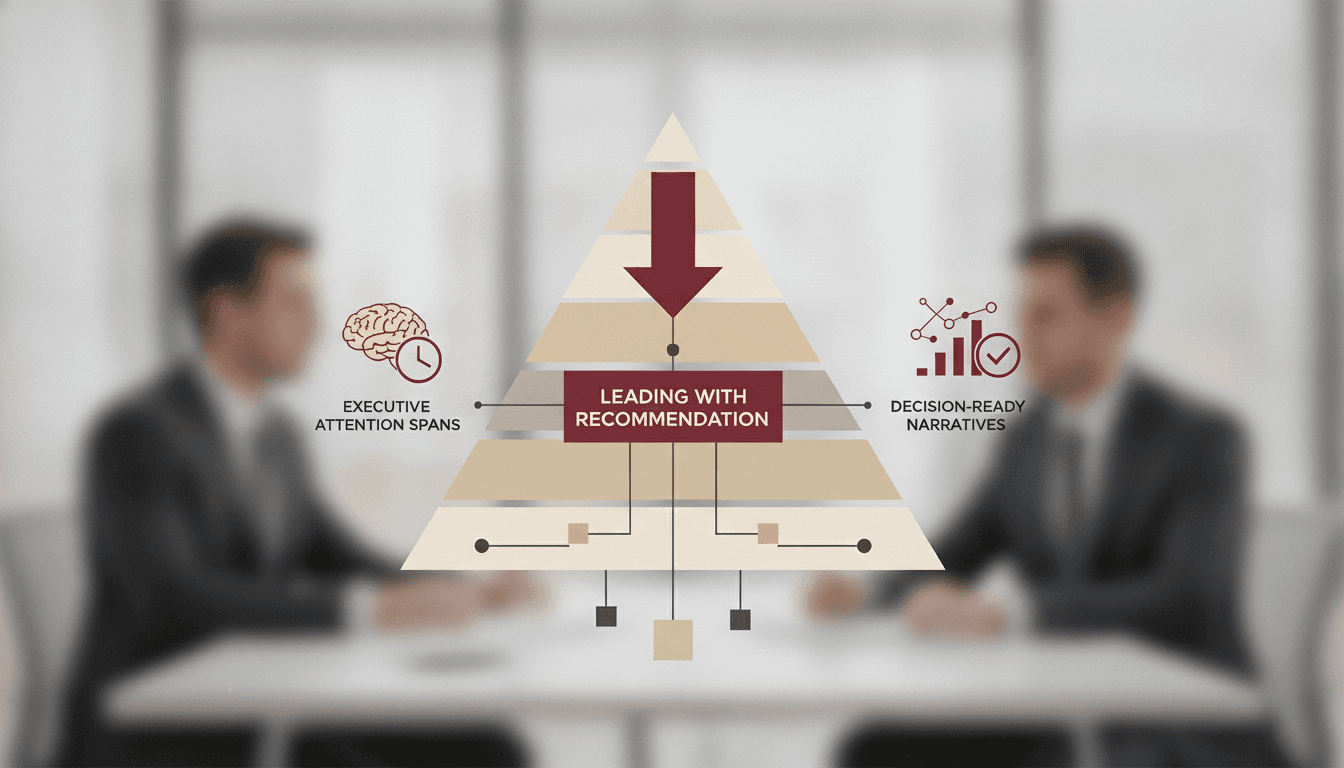
Executives structure presentations differently by leading with the recommendation first, using the pyramid principle to organize supporting evidence, and ruthlessly cutting detail in favor of decision-ready narratives. While mid-level professionals typically build up to a conclusion with data-heavy slides, senior executives flip the structure entirely — stating the answer upfront, then providing only the evidence needed to drive a decision. This approach respects executive attention spans, signals strategic thinking, and positions the presenter as a peer rather than a reporter.
What Does It Mean to Structure a Presentation Like an Executive?
Structuring a presentation like an executive means organizing your content around decisions, not data. It's the practice of leading with your recommendation, supporting it with a concise logical framework, and designing every slide to move the audience toward action rather than simply inform them.
This is fundamentally different from the "build-up" approach most professionals learn early in their careers — where context comes first, data fills the middle, and the conclusion arrives at the end. Executive-level presentation structure treats the conclusion as the starting point.
The Core Difference: Bottom-Up vs. Top-Down Structure
How Most Professionals Present (Bottom-Up)

Most mid-career professionals follow what feels natural: they present the way they did the work. They start with background, walk through data and analysis, and arrive at a recommendation on the final slide. It mirrors the research process.
This approach feels logical to the presenter. But to a senior audience, it creates frustration. According to a 2023 Prezi study, 79% of executives say they lose focus during presentations that don't get to the point quickly. The bottom-up structure forces decision-makers to sit through information they may already know — or don't need — before hearing what actually matters.
Here's what a typical bottom-up presentation looks like:
- Slide 1-3: Background and context
- Slide 4-8: Data, analysis, methodology
- Slide 9-10: Findings
- Slide 11: Recommendation
The problem? Many executives have already checked out by slide four.
How Executives Present (Top-Down)
Executive presenters flip this structure entirely. They open with the recommendation — the single most important thing the audience needs to know — and then provide just enough supporting evidence to build confidence in that recommendation.
The top-down structure looks like this:
- Slide 1: Recommendation and ask
- Slide 2: Three supporting reasons (the logic)
- Slide 3-5: Evidence for each reason
- Slide 6: Implications, risks, and next steps
This isn't just a stylistic preference. It's a strategic communication choice. When you lead with your answer, you immediately frame the conversation. The audience knows what you're arguing for, so every piece of data that follows has context and purpose.
If you're looking to understand more about how executives communicate differently than managers, this structural shift is one of the most visible differences.
Why Top-Down Works: The Cognitive Science
Research from the NN/g (Nielsen Norman Group) confirms that people process information more effectively when they receive the main point first. This is called the "inverted pyramid" in journalism, and it works for the same reason in business: it reduces cognitive load.
When an executive audience hears "I recommend we expand into the Southeast market in Q3," every subsequent slide is evaluated through that lens. The audience isn't guessing where you're going. They're assessing whether your logic holds. That's a fundamentally different — and more productive — kind of attention.
The Pyramid Principle: The Framework Behind Executive Presentations
What Is the Pyramid Principle?
The Pyramid Principle, developed by Barbara Minto at McKinsey & Company, is the gold standard for executive communication structure. The core idea is simple: start with the answer, then group supporting arguments into logical clusters, and support each cluster with evidence.
Visually, it looks like an inverted pyramid:
- Top: The governing thought (your recommendation)
- Middle: 2-4 key supporting arguments
- Base: Data and evidence supporting each argument
Every element at each level must answer the question raised by the level above it. If your recommendation is "We should acquire Company X," your supporting arguments must answer why. And your evidence must prove each why is valid.
How to Apply the Pyramid Principle in Practice
Let's say you're presenting a proposal to restructure your team's workflow. Here's how a mid-level professional might approach it versus how an executive would:
Mid-level approach: "Let me walk you through our current process, the bottlenecks we identified, the benchmarking data we collected, and then I'll share what we think we should do." Executive approach: "I'm recommending we consolidate our three review stages into one, which will cut cycle time by 40% and save $200K annually. Here are the three reasons this works."The second version takes seven seconds to deliver the core message. Everything that follows is supporting evidence, not preamble.
For a deeper dive into frameworks that help you communicate strategically as a leader, the Pyramid Principle is foundational.
The SCQA Framework for Setting Up Your Pyramid
Before you present your recommendation, you sometimes need a brief setup — especially for complex or controversial topics. The SCQA framework gives you a disciplined way to do this in 60 seconds or less:
- Situation: What's the current state? (Agreed-upon facts)
- Complication: What changed or what's the problem?
- Question: What do we need to decide?
- Answer: Your recommendation
Example: "Our customer acquisition cost has been stable at $45 for two years (Situation). Last quarter it jumped to $72 due to increased competition in paid channels (Complication). The question is whether we should double down on paid or shift budget to organic (Question). I recommend shifting 30% of paid budget to content marketing, and here's why (Answer)."
This entire setup takes about 20 seconds. Then you move into your pyramid of supporting evidence.
Write it the way a senior leader would. The Executive Email Kit gives you 20 templates, 30 subject lines, and 15 junior-to-senior rewrites for updates, asks, escalations, and bad news, so the executive acts on the first line. Get The Executive Email Kit — $27
Managing Executive Attention: The 10-Minute Rule
Why Executive Attention Works Differently

A Microsoft study found that the average human attention span has decreased to approximately 8 seconds for initial engagement — but this is misleading for presentation contexts. The real issue with executive audiences isn't attention span; it's attention allocation.
Senior leaders are making dozens of decisions daily. When they sit in your presentation, they're evaluating one core question: "Does this require my decision, and do I have enough information to make it?" The moment they feel they have the answer — or the moment they feel lost — their attention shifts.
According to a 2022 Harvard Business Review analysis, the most effective executive presentations last 10-15 minutes, with additional time reserved for discussion. The presentation itself is not the main event. The conversation it triggers is.
The 3x3 Slide Discipline
One practical technique executives use is the 3x3 rule: no more than three key messages, supported by no more than three pieces of evidence each. This creates a maximum of nine substantive content points — which is about what a senior audience can absorb and retain in a single sitting.
Here's how it works in practice:
Recommendation: Launch Product X in the European market by Q2.- Key message 1: Market demand is validated.
- Evidence: Customer survey data
- Evidence: Competitor analysis
- Evidence: Pre-order pipeline
- Key message 2: We have operational readiness.
- Evidence: Supply chain capacity
- Evidence: Regulatory approval timeline
- Evidence: Localization status
- Key message 3: Financial returns justify the investment.
- Evidence: ROI projections
- Evidence: Break-even analysis
- Evidence: Risk-adjusted scenarios
That's the entire presentation. Nine slides of substance, bookended by an opening recommendation and a closing action slide. If you want to present to C-suite executives effectively, this discipline is non-negotiable.
Building in "Discussion Space"
Executives don't want to sit quietly through 30 slides. They want to engage, challenge, and pressure-test your thinking. The best executive presenters deliberately build in space for this.
A practical technique: after each key message, pause and invite reaction. Say, "Before I move to the financial case, does the market validation logic hold for you?" This accomplishes two things. It shows confidence — you're not afraid of scrutiny. And it turns a monologue into a strategic conversation, which is what executives actually want.
If you want to handle being challenged in a meeting with poise, building in these deliberate pause points gives you a structural advantage.
Turning Data-Heavy Content Into Decision-Ready Narratives
The "So What?" Test
The single most powerful question you can ask about every slide in your presentation is: "So what?"
Most mid-level presenters show data. Executives show what the data means. There's a critical difference between a slide that says "Customer satisfaction scores dropped 12% in Q3" and one that says "Q3 satisfaction scores signal a retention risk that could cost us $1.4M in annual revenue."
The first is a data point. The second is a business insight that demands a decision.
Apply the "So What?" test to every piece of information in your deck. If you can't articulate why it matters to the decision at hand, cut it. According to presentation expert Nancy Duarte, the most impactful executive presentations contain 50-70% less data than what the presenter originally prepared. The discipline is in what you remove, not what you add.
The Headline-Driven Slide Approach
Executive-level presentations use slide titles as headlines — complete sentences that state the point of the slide, not just the topic.
Weak slide title: "Q3 Revenue Data" Strong slide title: "Q3 Revenue Exceeded Target by 8%, Driven by Enterprise Growth"When you use headline-driven titles, an executive can flip through your deck and understand the entire argument just by reading the titles. This is how senior leaders actually consume presentations — they often skim before or after the meeting, and your slide titles are the only thing they read.
This technique also forces you to clarify your own thinking. If you can't write a clear headline for a slide, you haven't figured out what the slide is actually saying.
The Appendix Strategy
Here's what separates confident executive presenters from anxious ones: they move supporting detail to the appendix instead of cutting it entirely.
Your main deck should contain only what's needed to support the recommendation. But you should have 15-30 appendix slides ready for deep-dive questions. This shows preparation without cluttering the narrative.
When an executive asks, "What's the methodology behind those projections?" you calmly say, "Great question — I have that detail on slide 22 in the appendix," and navigate there. This signals mastery. You've anticipated the question. You have the data. You just didn't lead with it because you understand what matters most.
For more on how to present ideas without rambling, the appendix strategy is one of the most effective structural tools available.
The Executive Opening: How the First 60 Seconds Set the Tone
The "Answer-First" Opening
The first 60 seconds of an executive presentation determine everything. In a 2021 Gartner survey of 500+ senior leaders, 68% said they form a judgment about a presenter's credibility within the first two minutes.
Executives open with the answer. Not with "Thank you for having me." Not with "Let me give you some background." They open with the point.
Compare these two openings:
Mid-level opening: "Thanks everyone. So today I want to walk you through the customer research we've been doing over the past quarter. We surveyed 2,000 customers and conducted 45 interviews, and I think you'll find the results really interesting..." Executive opening: "We need to redesign our onboarding flow. Our data shows it's causing a 34% drop-off in the first week, and I have a three-phase plan to fix it by Q2. Let me walk you through the logic."The second version takes 12 seconds. The audience immediately knows what you're proposing, why it matters, and what the rest of the presentation will cover. That's executive-level framing.
Establishing Stakes Early
After stating your recommendation, the strongest executive presenters immediately establish stakes — what's at risk if the audience doesn't act. This creates urgency without being dramatic.
"If we don't address this by Q2, we project a $2.3M revenue impact based on current churn trajectory."
Stakes answer the executive's unspoken question: "Why should I care about this right now?" Without stakes, your recommendation is interesting. With stakes, it's urgent.
The "Permission to Lead" Technique
Senior executives often use a subtle structural technique at the opening: they tell the audience exactly how the presentation will work.
"I'm going to share my recommendation, walk through three supporting reasons, and then I'd like 15 minutes for your questions and pushback."
This does something powerful. It positions you as the leader of the room for the next 20 minutes. You've set expectations, demonstrated structure, and implicitly asked for — and received — permission to guide the conversation. It's a leadership presence signal that most mid-level presenters miss entirely.
The Executive Close: Driving Decision, Not Applause
End With the Ask, Not a Summary
Most presentations end with a "Summary" slide that restates what was already said. Executive presentations end with an ask — a clear statement of what the presenter needs from the audience.
"I need approval to proceed with Phase 1 by Friday, which requires a $150K budget allocation from the innovation fund."
This is specific, time-bound, and actionable. It tells the audience exactly what decision they need to make and by when.
The Decision Slide Framework
The most effective executive closing slides contain four elements:
- Recommendation restated (one sentence)
- The ask (what you need from this audience)
- Timeline (key milestones and deadlines)
- Risk if delayed (what happens if no decision is made)
This single slide does more work than three pages of summary. It respects the audience's time and makes the decision easy to execute.
Preparing for the "No" Path
Sophisticated executive presenters also prepare for rejection. They have a fallback position ready — a scaled-down version of the recommendation that addresses likely objections.
"If the full investment feels premature, I'd recommend approving Phase 1 as a pilot with a $50K budget and a 90-day evaluation window."
This shows strategic flexibility and signals that you've thought beyond your own proposal. It's the kind of strategic thinking that distinguishes executive communicators from everyone else.
Frequently Asked Questions
What is the pyramid principle in executive presentations?
The Pyramid Principle, created by Barbara Minto at McKinsey, is a communication framework where you state your main recommendation first, then support it with grouped arguments, each backed by evidence. It structures information top-down rather than bottom-up, making it easier for senior audiences to follow your logic and make decisions quickly.
How long should an executive presentation be?
Most effective executive presentations run 10-15 minutes, with additional time for discussion. Harvard Business Review research suggests that shorter, decision-focused presentations generate better outcomes than longer data-heavy ones. The key is keeping your main deck to 8-12 slides and moving supporting detail to an appendix.
Executive presentation structure vs. regular presentation structure — what's the difference?
Regular presentations build up to a conclusion: background → data → analysis → recommendation. Executive presentations invert this: recommendation → supporting logic → evidence → action. The fundamental difference is that executive structure prioritizes decision-making speed, while regular structure prioritizes completeness. Executives lead with the answer; most professionals lead with the journey.
How do I present data to executives without overwhelming them?
Apply the "So What?" test to every data point. Only include data that directly supports your recommendation. Use headline-driven slide titles that state the insight, not just the topic. Move detailed methodology, raw data, and supplementary analysis to an appendix you can reference if questioned. Executives want conclusions and implications, not raw numbers.
Should I use slides when presenting to executives?
Slides are useful but should serve as visual evidence, not a script. Many executives prefer minimal slides — or even presenting without slides entirely for shorter updates. When you do use slides, follow the headline-driven approach: each slide title should state a complete thought so the deck tells a story even when skimmed independently.
How do I handle tough questions during an executive presentation?
Build in deliberate pause points after each key message to invite questions proactively. When challenged, acknowledge the question, reference your appendix data if relevant, and respond with a direct answer rather than a defensive explanation. Preparing a "pre-mortem" of likely objections before the meeting helps you respond with composure and credibility.
Communicate Like Someone Who Belongs at the Senior Table
20 email templates, 30 subject-line formulas, 15 junior-to-senior rewrites, and the one-page memo and executive summary, for writing to senior leaders who have ninety seconds and a decision to make. PDF.
Get The Executive Email Kit — $27Related Articles

Write Emails That Get Executive Attention: 5 Rules
To write emails that get executive attention, lead with your ask or key insight in the first two sentences, use an action-oriented subject line, keep the body under 125 words, structure information in the inverted pyramid format (conclusion first, details second), and close with one clear next step. Executives scan—they don't read. Every email you send either builds or erodes your professional credibility, so treat each one as a strategic communication, not a casual message.

How to Communicate With Executive Presence: A Guide
Communicating with executive presence means delivering your message with clarity, composure, and conviction so that people trust your judgment and follow your lead. It requires structuring your thoughts before speaking, managing your emotional tone under pressure, eliminating filler and hedging language, and adapting your style to senior audiences. Executive presence isn't about being the loudest voice — it's about being the most intentional one. This guide breaks down the specific communication

How Executives Think vs Managers: The Mindset Gap
The core difference between how executives think vs managers comes down to altitude. Managers think in tasks, timelines, and team output. Executives think in systems, trade-offs, and long-term organizational leverage. This isn't about intelligence—it's about mental framing. Managers ask, "How do we execute this well?" Executives ask, "Should we be doing this at all?" Understanding this gap is the single fastest way to change how senior leaders perceive your credibility and readiness for the next