Executive Communication

How to write and speak to executives: leading with the decision, compressing detail, and structuring updates and memos so senior leaders read them and act.

63 articles

Start here

Write Emails That Get Executive Attention: 5 Rules

Write Emails That Get Executive Attention: 5 Rules

To write emails that get executive attention, lead with your ask or key insight in the first two sentences, use an action-oriented subject line, keep the body under 125 words, structure information in the inverted pyramid format (conclusion first, details second), and close with one clear next step. Executives scan—they don't read. Every email you send either builds or erodes your professional credibility, so treat each one as a strategic communication, not a casual message.


Executive Communication Frameworks: 5 Models Leaders Use

Executive Communication Frameworks: 5 Models Leaders Use

Executive communication frameworks are structured models that help leaders organize their thinking and deliver messages with clarity, authority, and impact. The five most widely used frameworks are the Pyramid Principle (lead with the answer), SCQA (Situation-Complication-Question-Answer), SCR (Situation-Complication-Resolution), PREP (Point-Reason-Example-Point), and the CEO Briefing Model (headline-context-ask). Each framework serves a different communication scenario—from boardroom presentati

How to Write Like a Senior Leader: Email & Memo Mastery

How to Write Like a Senior Leader: Email & Memo Mastery

To write like a senior leader, strip your emails and memos down to their core message. Senior leaders write with brevity, decisiveness, and strategic framing. They lead with the conclusion, eliminate hedging language, and make every sentence earn its place. Instead of writing "I was wondering if we might consider possibly moving the deadline," a senior leader writes "I recommend we move the deadline to March 15. Here's why." The shift is about signaling clarity of thought, not just polishing pro

How to Brief Executives Quickly: The 60-Second Framework

How to Brief Executives Quickly: The 60-Second Framework

To brief executives quickly, use the Context-Headline-Ask (CHA) framework: open with one sentence of context, deliver your headline (the key insight or update), and close with a clear ask or recommendation. This structure respects executive time, demonstrates strategic thinking, and positions you as someone who communicates with authority. The best executive briefings take 60 seconds or less and always lead with the conclusion, not the backstory.

Executive Email Communication: Best Practices That Get Read

Executive Email Communication: Best Practices That Get Read

Executive email communication best practices center on three principles: lead with the decision or ask, write with strategic brevity, and calibrate tone to your audience's seniority. The best executive emails use the inverted pyramid structure—most important information first—keep subject lines under eight words, and eliminate hedging language. Unlike typical professional emails, executive-level messages treat every sentence as a leadership signal, prioritizing clarity and action over thoroughne

How to Communicate With Senior Leadership: The Unwritten Playbook

How to Communicate With Senior Leadership: The Unwritten Playbook

Communicating with senior leadership requires a fundamentally different approach than peer-to-peer conversations. To communicate effectively with VPs, SVPs, and C-suite executives, lead with the conclusion first, keep updates to three key points or fewer, frame everything through business impact, and know when to speak up versus when to listen. Senior leaders value brevity, strategic thinking, and confidence—not exhaustive detail. Master these unwritten rules, and you'll become the professional

More on Executive Communication

Executive Presence for Women in Leadership: A Real Framework

Executive Presence for Women in Leadership: A Real Framework

Executive presence for women in leadership is the ability to project authority, credibility, and composure in professional settings—while navigating the gender-specific biases that penalize women for the very behaviors rewarded in men. It requires a bias-aware approach that builds genuine authority through vocal presence, strategic language, and commanding body language, without forcing conformity to outdated masculine leadership norms. This framework gives you concrete, research-backed methods

How Executives Structure Presentations Differently

How Executives Structure Presentations Differently

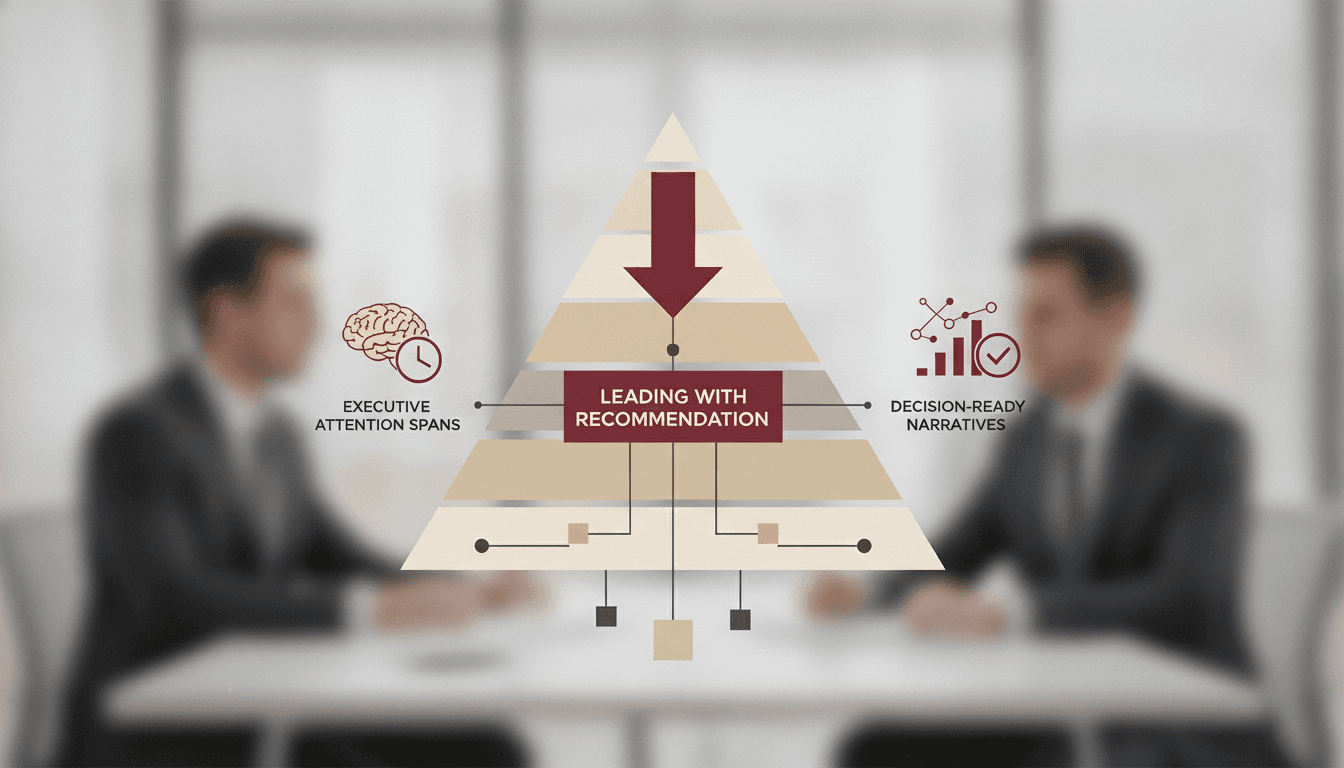
Executives structure presentations differently by leading with the recommendation first, using the pyramid principle to organize supporting evidence, and ruthlessly cutting detail in favor of decision-ready narratives. While mid-level professionals typically build up to a conclusion with data-heavy slides, senior executives flip the structure entirely — stating the answer upfront, then providing only the evidence needed to drive a decision. This approach respects executive attention spans, signa

How to Communicate With Senior Leadership: 10 Unwritten Rules

How to Communicate With Senior Leadership: 10 Unwritten Rules

Communicating with senior leadership requires a fundamentally different approach than communicating with peers or direct reports. The most effective way to communicate with senior leadership is to lead with the conclusion first, keep messages brief and solution-oriented, use data over opinions, respect their time ruthlessly, and demonstrate strategic thinking in every interaction. Senior leaders evaluate you not just on *what* you say, but on *how efficiently and credibly* you say it. Master the

How to Sound Authoritative in Emails: 9 Proven Tactics

How to Sound Authoritative in Emails: 9 Proven Tactics

To sound authoritative in emails, lead with your conclusion first, eliminate hedging language (like "just," "I think," and "sorry to bother you"), use shorter sentences, and structure your message so the reader knows exactly what you need and by when. Authoritative emails aren't aggressive — they're clear, direct, and decisive. The difference between being overlooked and being respected often comes down to how you write, not what you know.

Communicate With Senior Leadership: The Unwritten Playbook

Communicate With Senior Leadership: The Unwritten Playbook

To communicate effectively with senior leadership, lead with the outcome first, not the backstory. Senior leaders operate under extreme time pressure and make dozens of decisions daily. Structure every message around business impact, keep updates under two minutes unless asked to expand, and frame requests as decisions rather than open-ended questions. The professionals who earn leadership's attention consistently speak the language of strategy, risk, and results—not tasks and processes.

Executive vs Regular Communication: 10 Key Patterns

Executive vs Regular Communication: 10 Key Patterns

The difference between executive communication and regular communication comes down to ten distinct patterns: executives lead with outcomes instead of details, use decisive language instead of hedging, structure messages top-down instead of chronologically, speak in strategic terms instead of tactical ones, and manage attention rather than just sharing information. They also listen more selectively, frame problems as decisions, use silence deliberately, communicate with consistent brevity, and p

Executive Communication in Crisis: 6 Authority Principles

Executive Communication in Crisis: 6 Authority Principles

When a crisis hits your organization, the way you communicate in the first hours and days determines whether you retain or destroy stakeholder trust. The six authority principles executives use during crises are: lead with calm certainty, structure before you speak, practice radical transparency within guardrails, own what you don't know, control the narrative cadence, and communicate through your people. These principles help leaders project authority, reduce panic, and maintain credibility—eve

How Executives Build Instant Credibility: 9 Patterns

How Executives Build Instant Credibility: 9 Patterns

Executives build instant credibility by combining language precision, strategic brevity, confident body language, and vocal authority within the first 60–90 seconds of any interaction. The nine patterns include leading with outcomes instead of context, using declarative sentence structures, controlling vocal pace and tone, demonstrating strategic listening, signaling status through calm composure, structuring ideas in frameworks, eliminating hedging language, leveraging silence deliberately, and

How to Speak With Confidence in Front of Executives

How to Speak With Confidence in Front of Executives

To speak with confidence in front of executives, structure your message around outcomes and decisions rather than details, manage your status anxiety through deliberate preparation rituals, adopt executive-level language patterns that signal strategic thinking, and develop recovery techniques for when conversations go off-script. The key shift: executives don't want perfection — they want clarity, conviction, and someone who respects their time.

How to Communicate Like a Senior Leader: 8 Daily Shifts

How to Communicate Like a Senior Leader: 8 Daily Shifts

To communicate like a senior leader, shift from reporting details to framing decisions, from hedging your language to stating clear positions, and from reacting in the moment to responding with strategic intent. Senior leaders don't just share information—they shape how people think about it. The eight daily shifts below cover emails, meetings, one-on-ones, and presentations, transforming tentative mid-level communication into the authoritative style that earns trust, drives action, and accelera

Executive Presence vs Confidence: Key Differences Explained

Executive Presence vs Confidence: Key Differences Explained

While confidence is the internal belief in your own abilities, executive presence is the broader, outward-facing ability to project authority, composure, and influence in professional settings. Confidence is one ingredient of executive presence—but it's not the whole recipe. Executive presence combines gravitas, strategic communication, and commanding body language to shape how others perceive your leadership capability. You can be confident without having executive presence, but you cannot have

Executive vs Regular Communication: Key Differences

Executive vs Regular Communication: Key Differences

Executive communication differs from regular professional communication in six critical ways: structure, brevity, strategic framing, audience orientation, decision-focus, and authority signaling. While regular communication tends to be detail-heavy, process-oriented, and chronological, executive communication leads with the bottom line, frames everything around business impact, and drives toward decisions. Understanding these differences is the single most important shift mid-career professional

How Executives Build Credibility Quickly: 7 Patterns

How Executives Build Credibility Quickly: 7 Patterns

Executives build credibility quickly by deploying seven specific communication patterns: leading with decisive point-of-view statements, demonstrating strategic context before sharing details, using calibrated vulnerability, borrowing credibility through association, controlling conversational pacing, asking high-signal questions, and delivering consistent micro-commitments. These patterns work because they signal competence, confidence, and trustworthiness simultaneously—often within the first

How to Sound Authoritative in Emails: 9 Proven Shifts

How to Sound Authoritative in Emails: 9 Proven Shifts

To sound authoritative in emails, eliminate hedging language ("I just wanted to," "I think maybe"), lead with your conclusion instead of burying it, use direct requests instead of passive suggestions, and keep sentences short and decisive. Authoritative email writers state what they need, why it matters, and by when — without over-explaining or apologizing for taking up space. These nine shifts transform tentative emails into messages that command respect and get results.

How to Communicate With Executive Presence: A Guide

How to Communicate With Executive Presence: A Guide

Communicating with executive presence means delivering your message with clarity, composure, and conviction so that people trust your judgment and follow your lead. It requires structuring your thoughts before speaking, managing your emotional tone under pressure, eliminating filler and hedging language, and adapting your style to senior audiences. Executive presence isn't about being the loudest voice — it's about being the most intentional one. This guide breaks down the specific communication

How to Communicate Like a Senior Leader: 10 Principles

How to Communicate Like a Senior Leader: 10 Principles

To communicate like a senior leader, shift from sharing information to shaping decisions. Senior leaders speak with brevity, frame every message around business impact, use decisive language, and structure their thinking before they speak. They lead with the conclusion, eliminate hedging, and take ownership of their words. These ten principles will help you make that shift—whether you're preparing for a promotion or already in the role.

How to Present to C-Suite Executives: 8 Key Rules

How to Present to C-Suite Executives: 8 Key Rules

Presenting to C-suite executives requires a fundamentally different approach than presenting to any other audience. Lead with your recommendation—not your research. Structure your content around decisions, not data. Keep it concise: executives typically decide within the first five minutes whether your presentation is worth their time. Anticipate strategic questions, speak in business outcomes, and always tie your message to revenue, risk, or competitive advantage. The eight rules below will hel

How to Write Like a Senior Leader: 6 Key Principles

How to Write Like a Senior Leader: 6 Key Principles

Writing like a senior leader means stripping your communication down to its essentials: leading with the point, making clear recommendations, framing everything around business impact, and using decisive language that moves people to action. Senior leaders don't write to explain their thinking process—they write to drive decisions. The six principles below will show you exactly how to shift your writing from contributor-level to executive-level, with before-and-after examples you can apply to em

How to Stop Sounding Unsure in Emails: Before & After

How to Stop Sounding Unsure in Emails: Before & After

To stop sounding unsure in emails, eliminate hedging phrases ("I just wanted to," "I think maybe," "Sorry to bother you"), replace weak verbs with direct ones, lead with your point instead of burying it, and remove unnecessary qualifiers. Confident emails are shorter, structured with the ask or update first, and use declarative sentences. Small word-level changes — swapping "I was wondering if" for "I recommend" — can transform how colleagues perceive your competence and authority.

How Executives Structure Their Thinking Before Speaking

How Executives Structure Their Thinking Before Speaking

Executives structure their thinking before speaking by using mental frameworks—most commonly pyramid thinking (lead with the conclusion), issue-tree structuring (break complex problems into parts), and the SCQA framework (Situation, Complication, Question, Answer). These frameworks let leaders organize ideas in seconds, deliver clear recommendations, and project authority in any conversation. The difference between sounding uncertain and sounding commanding often comes down to *how* you organize

How Executives Build Instant Rapport: 6 Hidden Moves

How Executives Build Instant Rapport: 6 Hidden Moves

Executives build instant rapport by deploying six specific techniques in the first 60 seconds of any interaction: strategic mirroring of body language and vocal tone, deliberate name usage, status-matching language, calibrated vulnerability, genuine curiosity signals, and environment-aware positioning. These aren't charisma tricks—they're learnable communication patterns that create immediate trust and open the door to influence, negotiation, and lasting professional relationships.

How Executives Think vs Managers: The Mindset Gap

How Executives Think vs Managers: The Mindset Gap

The core difference between how executives think vs managers comes down to altitude. Managers think in tasks, timelines, and team output. Executives think in systems, trade-offs, and long-term organizational leverage. This isn't about intelligence—it's about mental framing. Managers ask, "How do we execute this well?" Executives ask, "Should we be doing this at all?" Understanding this gap is the single fastest way to change how senior leaders perceive your credibility and readiness for the next

Executive Speaking Cadence: Techniques That Command

Executive Speaking Cadence: Techniques That Command

Executive speaking cadence is the deliberate control of pace, rhythm, pauses, and tempo variation that separates commanding communicators from forgettable ones. The most effective executives don't just choose better words — they master *how* those words land. The core techniques include strategic deceleration (slowing to 120-130 words per minute for key points), the power pause (2-4 seconds of intentional silence before and after critical statements), tempo contrast (alternating between faster c

Executive vs Regular Communication: 6 Key Differences

Executive vs Regular Communication: 6 Key Differences

The core difference between executive communication and regular communication comes down to structure, intent, and impact. Executives lead with the conclusion, speak in outcomes rather than activities, and use language that drives decisions. Regular communicators tend to build up to their point, focus on process details, and use hedging language that dilutes authority. Understanding these six structural and tonal differences — and modeling them — is the fastest way to elevate your professional c

Other topics