
How to Build Authority in Your Career: A 5-Step Plan

What Is Career Authority?
Career authority is the professional standing that causes colleagues, leaders, and industry peers to recognize you as a trusted, go-to expert in a specific domain. It's the difference between being in the room and being the person others turn to when a decision needs to be made.
Career authority combines three elements: deep expertise in a defined area, visible proof that others can observe, and communication skills that project confidence and credibility. Unlike a job title—which can be assigned—authority must be built, demonstrated, and maintained over time.
According to a 2023 LinkedIn Workplace Learning Report, professionals who are perceived as subject-matter authorities are 2.3 times more likely to be tapped for leadership opportunities than equally qualified peers who lack visibility. Authority, in short, accelerates everything else in your career.
Step 1: Identify Your Credibility Niche
The first step to building authority is choosing where to build it. Trying to be the expert on everything dilutes your impact. The most credible professionals are known for something specific.

Find the Intersection of Expertise, Demand, and Passion
Your credibility niche sits at the overlap of three circles: what you know deeply, what your organization (or industry) needs, and what genuinely energizes you. If you pick a niche based only on demand, you'll burn out. If you pick one based only on passion, you may lack an audience.
Here's a practical exercise: List your top five skills or knowledge areas. Then ask yourself two filtering questions for each: "Do decision-makers in my company or industry actively seek guidance on this?" and "Could I talk about this for 30 minutes without notes?" The topic that gets a "yes" to both is your starting point.
For example, imagine you're a mid-career project manager. You could try to be known as a "great PM"—but that's vague. Instead, you might niche down to "the person who rescues stalled cross-functional projects." That specificity makes you memorable and referable.
Audit Your Current Reputation
Before you build forward, understand where you stand today. A simple reputation audit involves asking three to five trusted colleagues a single question: "When my name comes up in a meeting, what do people say I'm good at?"
If the answers are scattered—or worse, blank—you have a positioning problem, not a skills problem. A 2022 study by Edelman found that 63% of professionals believe their expertise is underrecognized at work. The gap is almost never about competence. It's about clarity and visibility.
For a deeper dive into establishing credibility quickly, read our guide on how to build credibility at work fast.
Define Your Authority Statement
Condense your niche into a single sentence: "I help [audience] achieve [outcome] through [method/expertise]." This isn't a tagline for your email signature—it's a strategic filter. Every piece of content you create, every meeting you lead, and every project you volunteer for should reinforce this statement.
A strong authority statement for our project manager example: "I help cross-functional teams get stalled initiatives back on track by redesigning workflows and accountability structures." Clear, specific, and immediately valuable.
Step 2: Create Visible Proof Points
Expertise that nobody sees doesn't build authority. Step two is about making your knowledge tangible and observable to the people who matter.
Build a Portfolio of Results
Authority is earned through outcomes, not opinions. Start documenting your wins with specificity. Instead of "improved team performance," record "reduced project delivery time by 22% across three product launches in Q2." Numbers make credibility concrete.
A Harvard Business Review analysis found that professionals who quantify their contributions during performance conversations are 40% more likely to receive above-average ratings (HBR, 2021). The same principle applies to authority-building: measurable results are your strongest proof points.
Keep a running "credibility file"—a simple document where you log accomplishments, positive feedback, and project outcomes every week. This becomes the raw material for everything from promotion conversations to thought leadership content.
Volunteer for High-Visibility Projects
Not all work is equally visible. Authority grows fastest when you attach your expertise to initiatives that senior leaders care about. Volunteer for cross-departmental task forces, lead the post-mortem on a major initiative, or offer to present findings to the leadership team.
This doesn't mean chasing glory. It means strategically placing yourself where your niche expertise solves real, visible problems. If you're the person who consistently delivers in high-stakes moments, authority follows naturally. For strategies on positioning yourself for advancement, check out how to position yourself for promotion.
Earn Endorsements and Social Proof
Third-party validation accelerates authority faster than self-promotion ever could. Seek endorsements in three forms: written (LinkedIn recommendations, internal testimonials), spoken (colleagues who refer others to you), and structural (being invited to lead, present, or advise).
Ask a senior colleague to introduce you as the expert on your niche topic before your next presentation. Request that a satisfied internal client send a brief note to your manager. These small acts of social proof compound over time into an unshakeable reputation.
Step 3: Master Authoritative Communication
You can have deep expertise and impressive results—but if you can't communicate them with confidence and clarity, your authority will plateau. How you speak, write, and present determines how seriously people take you.

Speak With Confidence in High-Stakes Moments
Authority is built or broken in meetings, presentations, and one-on-one conversations with senior leaders. The professionals who command attention share specific habits: they speak in declarative sentences, eliminate hedging language ("I just think maybe we could..."), and use strategic pauses to let key points land.
Research from the University of Wolverhampton found that listeners rate speakers who use fewer filler words and more deliberate pauses as 30% more competent and trustworthy. Your delivery matters as much as your content.
Start by eliminating three credibility-killing phrases from your vocabulary: "Does that make sense?" (replace with "Here's why this matters"), "I'm no expert, but..." (replace with stating your point directly), and "Sorry, but..." when you have nothing to apologize for. For a comprehensive framework, explore our guide on how to speak with authority and confidence.
Write With Authority in Emails and Documents
Your written communication signals your professional caliber every day. Authority in writing comes from three principles: brevity (say it in fewer words), structure (lead with the conclusion, then support it), and directness (state what you need, not what you're wondering about).
Compare these two email openings:
- Weak: "Hi team, I was just wondering if maybe we should think about possibly revisiting the Q3 timeline? I know everyone's busy, but I thought it might be worth discussing."
- Strong: "Team, I recommend we adjust the Q3 timeline. Here's why, and here's my proposed revision."
The second version signals confidence, clarity, and leadership. For more on this, read how to write emails that get executive attention.
Use Body Language That Projects Credibility
Nonverbal communication accounts for a significant portion of how your authority is perceived. A 2009 study published in Psychological Science by Carney, Cuddy, and Yap found that expansive, open postures are associated with increased feelings of power and higher tolerance for risk—both qualities linked to leadership perception.
Three immediate body language shifts that project authority: plant your feet (stop shifting your weight), use deliberate hand gestures (rather than fidgeting or crossing your arms), and maintain steady eye contact for three to five seconds at a time during conversations. These aren't performance tricks—they're signals that tell others you believe in what you're saying. Our detailed guide on confident body language covers this in depth.
Step 4: Leverage Internal and External Platforms
Authority doesn't build itself in isolation. You need platforms—both inside and outside your organization—where your expertise is visible to the right audiences.
Claim Internal Stages
Inside your organization, "stages" are any forum where you can demonstrate expertise to an audience that matters. These include: leading team meetings, presenting at all-hands events, facilitating training sessions, writing internal newsletters or knowledge-base articles, and mentoring junior colleagues.
A practical strategy: identify the one recurring meeting in your organization where decisions get made and senior leaders are present. Then find a way to contribute meaningfully—whether by presenting data, proposing a solution, or leading a discussion segment. If speaking up in large meetings feels daunting, our guide on how to speak up in large group meetings with impact provides actionable techniques.
According to Gartner's 2023 research on employee visibility, professionals who present to cross-functional audiences at least once per quarter are 47% more likely to be identified as high-potential talent by senior leadership. Visibility isn't vanity—it's strategy.
Build an External Thought Leadership Presence
External authority—being known in your industry, not just your company—creates career insurance and opens doors that internal reputation alone cannot. Start with one platform and one format:
- LinkedIn articles or posts sharing insights from your niche (aim for one per week)
- Industry conference presentations or panel participation
- Guest contributions to trade publications or podcasts
- Professional community engagement (answering questions, contributing to forums)
You don't need a massive following. You need the right people to associate your name with your niche expertise. Even 500 engaged LinkedIn connections in your industry can generate speaking invitations, job offers, and partnership opportunities. For a step-by-step approach, see our framework on thought leadership on LinkedIn.
Create a Signature Framework or Methodology
Nothing cements authority like a named framework. When you organize your expertise into a repeatable, teachable method, you shift from "person with opinions" to "person with a system."
Think about it: McKinsey has the 7-S Framework. Stephen Covey had the 7 Habits. You don't need to be a global brand—you need a clear, memorable structure that colleagues and clients can reference.
Our project manager example might develop the "3R Recovery Method" for stalled projects: Realign (clarify the true objective), Restructure (redesign workflows and ownership), Relaunch (set new milestones with accountability). Now she's not just fixing projects—she's teaching a methodology. That's authority.
Step 5: Sustain and Compound Your Authority Over Time
Building authority is not a one-time project. It's an ongoing practice that compounds—or erodes—based on consistency.
Stay Current and Evolve Your Expertise
Authority has a shelf life if you stop learning. Dedicate at least five hours per week to deepening your niche expertise through reading, courses, peer conversations, and experimentation. The professionals who maintain authority for decades are relentless learners who evolve their point of view as their field changes.
A 2024 World Economic Forum report found that 44% of workers' core skills will be disrupted within five years. The authority you build today must be maintained through continuous learning tomorrow.
Mentor Others and Multiply Your Influence
One of the most powerful authority-building strategies is also one of the most generous: teach what you know. When you mentor junior colleagues, lead workshops, or create resources that help others succeed, you become embedded in your organization's culture as a leader—regardless of your title.
Mentoring also forces you to articulate your expertise clearly, which sharpens your own thinking. It creates advocates who speak about your value when you're not in the room. And it signals to senior leaders that you think beyond your own role—a key trait they look for in promotion candidates. For more on leading without a formal title, explore leadership presence without formal authority.
Protect Your Credibility With Consistency
Authority is built slowly and can be damaged quickly. Three practices protect your credibility over the long term:
- Deliver on commitments. Every missed deadline or broken promise chips away at your reputation. Under-promise and over-deliver.
- Admit what you don't know. Paradoxically, saying "I don't have the answer to that, but I'll find out" builds more trust than bluffing. A 2022 study in the Journal of Experimental Social Psychology found that leaders who acknowledge uncertainty are rated as more trustworthy than those who project false confidence.
- Stay consistent across contexts. Your authority should look the same in a one-on-one meeting, a boardroom presentation, and a Slack message. Inconsistency breeds doubt.
Turn This Plan Into Action If you're ready to go beyond strategy and start building real authority in your career, The Credibility Code provides the communication scripts, frameworks, and daily practices that make it happen. Discover The Credibility Code
Frequently Asked Questions
How long does it take to build authority in your career?
Most professionals begin to see a noticeable shift in how they're perceived within three to six months of consistent, strategic effort. However, deep, industry-level authority typically takes two to three years of sustained visibility and expertise-building. The key accelerator is specificity—the narrower your niche, the faster you become the recognized expert. Consistency matters more than speed.
What is the difference between career authority and executive presence?
Career authority is about being recognized as a subject-matter expert—the go-to person for specific knowledge or outcomes. Executive presence is about how you carry yourself: your communication style, composure, and ability to command a room. They're complementary but distinct. You can have authority without presence (the brilliant but awkward expert) or presence without authority (the polished but shallow communicator). The most influential professionals develop both. Learn more about the distinction in our guide on executive presence vs. leadership presence.
Can you build authority without a leadership title?
Absolutely. Authority is perception-driven, not title-driven. Some of the most influential people in any organization hold individual contributor or mid-level roles. They build authority through expertise, visibility, and communication—not positional power. Focus on solving high-value problems, sharing your knowledge publicly, and communicating with confidence. Titles often follow authority, not the other way around.
How do I build authority in a new job or company?
Start by listening and learning for the first 30 days—understand the culture, key players, and pressing challenges. Then identify one quick win where your expertise can create visible value. Volunteer for a cross-functional project, share a relevant insight in a team meeting, or write a brief analysis that helps your manager. Early credibility comes from demonstrating competence quickly and consistently. Our guide on building professional credibility fast at a new job has a detailed playbook.
What are the biggest mistakes people make when trying to build career authority?
The three most common mistakes are: (1) being too broad—trying to be known for everything instead of one clear niche, (2) waiting for permission—expecting a title or invitation instead of proactively creating visibility, and (3) focusing only on expertise while neglecting communication skills. You can be the smartest person in the room and still get overlooked if you can't articulate your value with clarity and confidence.
How do I build authority as an introvert?
Introverts often build deeper, more sustainable authority because they tend to listen more, prepare thoroughly, and contribute thoughtfully rather than frequently. Focus on written platforms (email, LinkedIn, internal documents), one-on-one relationship building, and prepared speaking opportunities rather than impromptu group discussions. Quality of contribution matters far more than quantity. See our dedicated guide on personal brand for introverts at work.
Be the Person Leadership Thinks Of First
The Credibility Code is a practical guide to the communication habits that get professionals noticed, trusted, and promoted.
Discover The Credibility CodeRelated Articles

How to Build Authority in Your Career: A 5-Phase System
Building authority in your career requires a deliberate, phased approach that compounds over time. The system works across five stages: (1) establish baseline competence and reliability, (2) develop a distinctive professional point of view, (3) increase strategic visibility within your organization, (4) expand influence beyond your immediate team, and (5) become the recognized go-to voice in your domain. Each phase builds on the last, and skipping stages is why most authority-building efforts st

Build Career Authority Without Social Media: 7 Moves
You can build career authority without social media by focusing on seven high-impact offline strategies: becoming the go-to problem solver in your organization, securing internal speaking opportunities, publishing in industry channels, building strategic sponsor relationships, leading visible cross-functional projects, creating proprietary frameworks, and earning credibility through how you communicate daily. These moves build lasting authority rooted in demonstrated expertise—not follower count
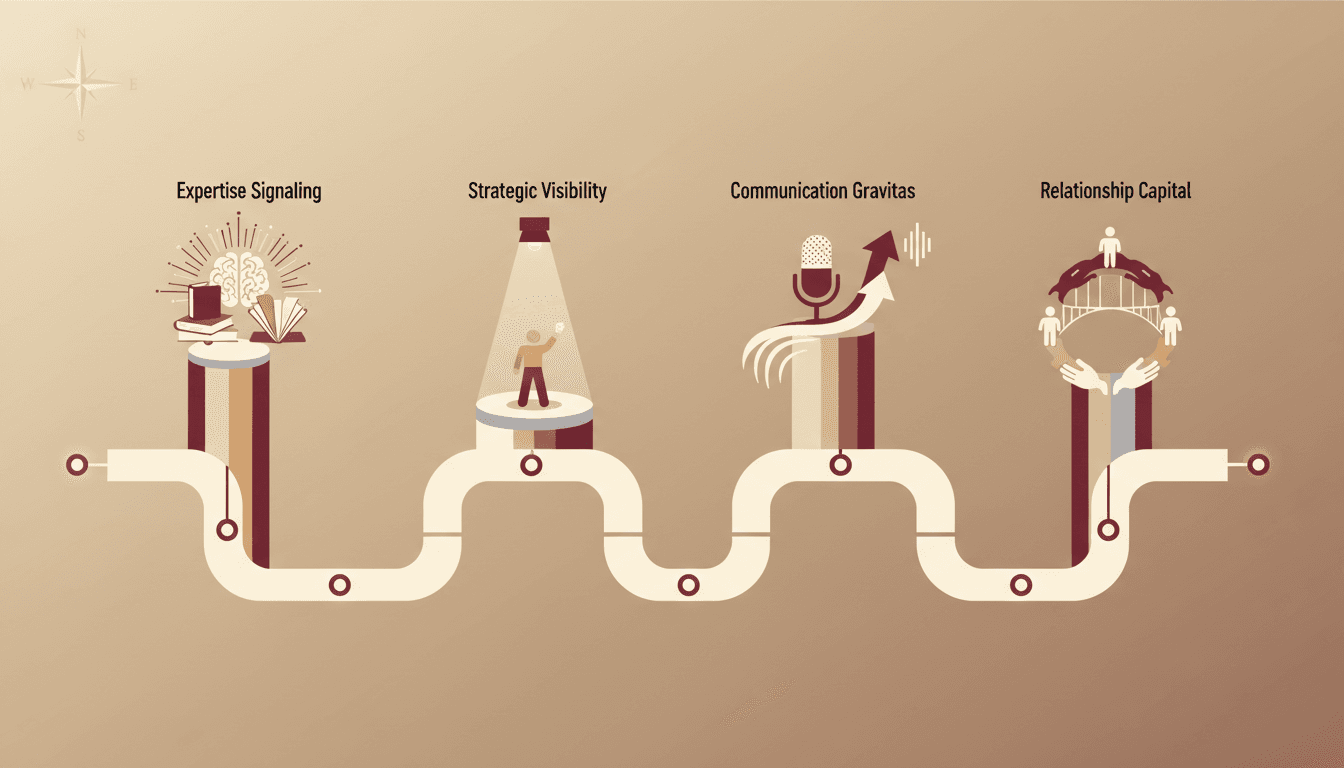
Build Authority in Your Career: The Credibility Roadmap
To build authority in your career, you need to master four interconnected pillars: expertise signaling, strategic visibility, communication gravitas, and relationship capital. Authority isn't granted by a title—it's earned through consistent, deliberate actions that position you as the go-to person in your domain. This roadmap breaks each pillar into concrete milestones so you can move from competent contributor to recognized authority within 12 to 18 months.