
How to Establish Credibility in a Speech: 9 Proven Methods
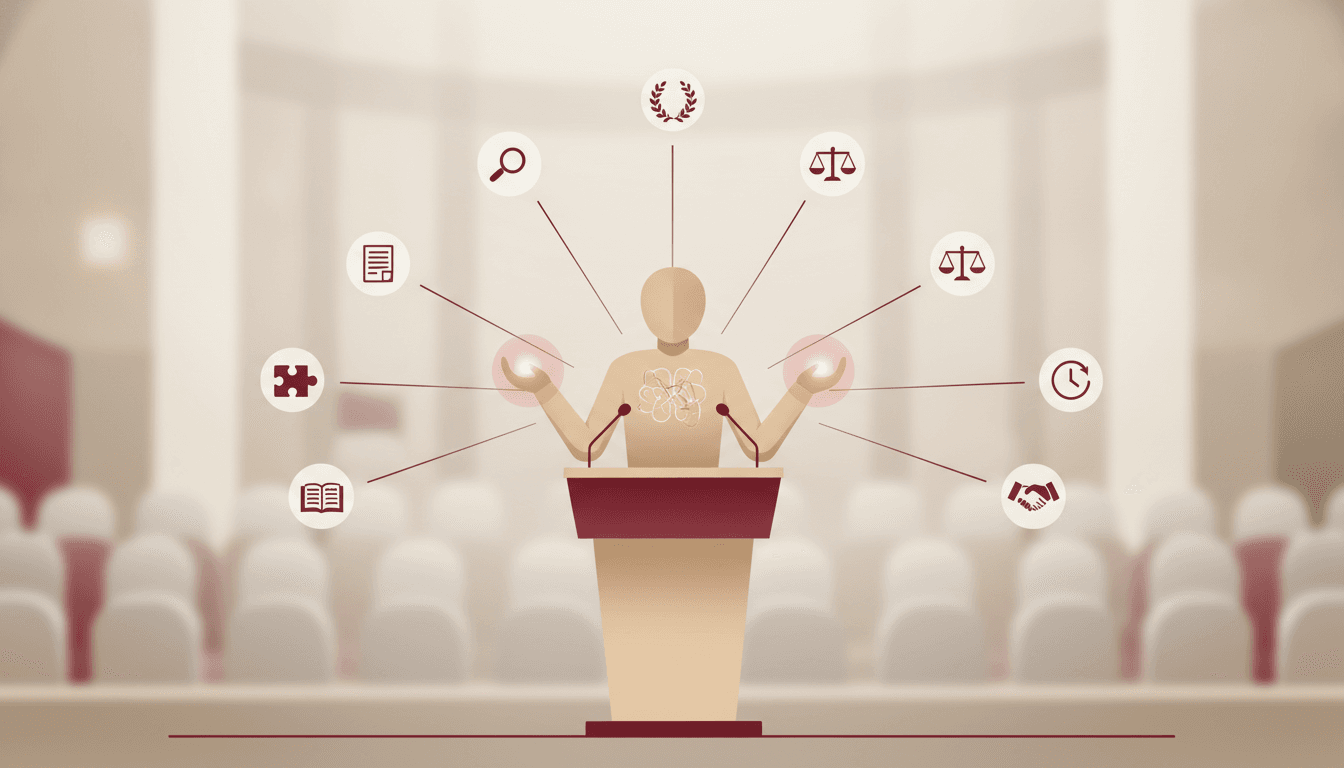
To establish credibility in a speech, you need to demonstrate expertise, build trust, and signal authority from the moment you begin. The most effective speakers do this by combining strategic self-introduction, evidence-based arguments, audience-centered framing, confident delivery, and structural clarity. Credibility isn't just about what you know — it's about how quickly your audience decides to believe you. These nine methods will help you earn that trust before, during, and after you speak.
What Is Speaker Credibility?
Speaker credibility — known in classical rhetoric as ethos — is the audience's perception that you are trustworthy, knowledgeable, and worth listening to. It's not a fixed trait. It's a judgment your audience makes within the first 30 to 60 seconds and continues to reassess throughout your speech.
Aristotle identified ethos as one of the three pillars of persuasion, alongside logos (logic) and pathos (emotion). Modern communication research confirms his instinct: a 2018 study published in the Journal of Communication found that perceived speaker credibility accounted for up to 60% of an audience's willingness to accept a message, regardless of the evidence quality presented.
In practical terms, credibility has two dimensions. Initial credibility is what your audience believes about you before you open your mouth — your title, reputation, and introduction. Derived credibility is what you earn through your words, structure, and delivery during the speech itself. The nine methods below address both.
Method 1: Establish Authority in Your Opening (The First 60 Seconds)
The opening of your speech is your highest-leverage moment for credibility. Research from Princeton psychologists Janine Willis and Alexander Todorov shows that people form judgments about trustworthiness in as little as 100 milliseconds. Your first words either confirm or undermine those snap judgments.

Lead with a Credibility Anchor
A credibility anchor is a single, specific statement that signals your right to speak on the topic. This isn't about reciting your full résumé. It's about offering one concrete proof point that connects your experience to the audience's problem.
Weak opening: "I've been working in cybersecurity for a while, and I'd like to talk about data breaches." Strong opening: "In the last three years, my team has responded to 47 data breaches across Fortune 500 companies. Today, I'll share the three patterns we see in every single one."The strong version works because it's specific (47 breaches), relevant (Fortune 500), and forward-looking (three patterns). It gives the audience a reason to keep listening.
Avoid the Credibility Killers
Certain phrases actively destroy credibility in an opening. Saying "I'm no expert, but..." or "I'll try to keep this short" signals low confidence. According to a study from the University of Wolverhampton, speakers who used hedging language in their introductions were rated 32% less persuasive than those who opened with direct, declarative statements.
If you struggle with undermining language, our guide on how to stop sounding uncertain at work covers the most common phrases to eliminate.
Method 2: Use Evidence Framing to Build Logical Trust
Facts alone don't build credibility. How you frame evidence does. Audiences trust speakers who show their reasoning, not just their conclusions.
The Source-Stat-Significance Framework
Every time you introduce a piece of evidence, use this three-part structure:
- Source — Name the institution, researcher, or study.
- Stat — State the specific number or finding.
- Significance — Explain why it matters to this audience.
This framework works because it satisfies the audience's need for proof (source), precision (stat), and relevance (significance). It also mirrors how executives structure their thoughts before speaking — with clarity and intentional framing.
Cite Contrarian or Surprising Data
Audiences pay closer attention when evidence challenges their assumptions. A 2020 study in Psychological Science found that speakers who presented unexpected findings were perceived as more knowledgeable than those who confirmed existing beliefs — because it signaled deeper expertise.
Instead of saying "Studies confirm what we all know," try: "The data here might surprise you." Then deliver a finding that reframes the topic.
Method 3: Demonstrate Audience Awareness
Nothing builds trust faster than showing your audience you understand their world. Generic speeches feel like lectures. Tailored speeches feel like conversations.
Reference Their Specific Context
Before your speech, research your audience's industry, challenges, and recent events. Then weave those references into your content. If you're presenting to a sales team that just missed quarterly targets, acknowledge it: "I know Q3 didn't land where you wanted. What I'm about to share directly addresses the pipeline gap most of you are facing."
Use "You" More Than "I"
A simple linguistic shift creates a powerful credibility signal. Speakers who overuse "I" are perceived as self-focused. Speakers who use "you" and "we" are perceived as collaborative and trustworthy. Aim for a 3:1 ratio of "you/we" to "I" statements in any speech.
Method 4: Master Your Vocal Delivery
Your voice is a credibility instrument. Research from Quantified Communications analyzed over 100,000 speech presentations and found that vocal delivery accounts for 23% of a speaker's perceived effectiveness — more than visual aids or slide design.
Control Pace, Pitch, and Pauses
Credible speakers tend to speak at a moderate pace (around 140-160 words per minute for persuasive content), use a lower pitch register, and pause deliberately after key points. Rushing signals nervousness. Monotone delivery signals disengagement.
The most powerful tool is the strategic pause. When you make a bold claim and then pause for two to three seconds, you signal confidence. You're giving the audience time to absorb — which says, "I trust this point enough to let it breathe."
For a deeper dive into vocal authority, explore our guide on how to speak with gravitas: 9 shifts that command respect.
Eliminate Vocal Fillers
"Um," "uh," "like," and "you know" are credibility leaks. A study from the University of Michigan found that speakers who used frequent fillers were rated as less credible, less prepared, and less intelligent — even when their content was identical to filler-free speakers. Replace fillers with silence. A pause always sounds more authoritative than a filler.
If presentation nerves trigger your filler words, our article on how to calm nerves before a presentation offers practical pre-speech techniques.
Method 5: Structure Your Speech for Maximum Authority
Credible speakers don't ramble. They use clear structures that signal preparation, expertise, and respect for the audience's time.
Use the Problem-Mechanism-Solution Framework
This structure works especially well for persuasive or informational speeches:
- Problem — Define the challenge your audience faces.
- Mechanism — Explain why the problem exists (this is where expertise shines).
- Solution — Offer your recommendation with evidence.
The "mechanism" step is where most speakers fail — and where credibility is truly built. Anyone can name a problem and suggest a fix. Explaining the underlying cause demonstrates genuine understanding.
Signal Your Structure Early
Tell your audience the roadmap in the first 90 seconds: "I'm going to cover three things today: why retention is falling, the hidden driver most teams miss, and a framework you can implement this quarter." This structural preview signals preparation and gives your audience a reason to stay engaged. It's the same principle behind how to present ideas clearly at work using the clarity method.
Method 6: Leverage Social Proof and Third-Party Validation
Your credibility multiplies when others vouch for you — even indirectly.
Use Strategic Name-Dropping (Without Being Obnoxious)
Referencing respected figures, institutions, or clients you've worked with transfers their credibility to you. The key is relevance and brevity.
Effective: "When I consulted with the product team at Salesforce on this exact issue, we found..." Ineffective: "I've worked with Google, Amazon, Microsoft, Meta, and pretty much every major tech company..."One specific, contextual reference beats a laundry list every time.
Let Your Introduction Do the Heavy Lifting
If someone is introducing you, give them a written introduction that highlights your most relevant credential for this specific audience. Don't leave it to chance. A strong third-party introduction builds initial credibility before you say a word. According to a 2019 analysis by Duarte, Inc., speakers who received tailored introductions scored 22% higher on post-speech credibility ratings than those who introduced themselves.
Method 7: Handle Questions and Challenges with Composure
How you respond when challenged reveals more about your credibility than any prepared remark. Audiences are watching for defensiveness, evasion, or composure.
Use the Acknowledge-Bridge-Deliver Method
When faced with a tough question:
- Acknowledge — "That's an important concern."
- Bridge — "What the data actually shows us is..."
- Deliver — Provide your answer with a specific fact or example.
This method shows respect for the questioner while maintaining your authority. It avoids the two credibility traps: dismissing the question (arrogant) or over-apologizing (weak).
For a complete system on handling unexpected questions, see our guide on how to handle Q&A after a presentation like a pro.
Admit What You Don't Know — Strategically
Paradoxically, saying "I don't have that specific number, but I can get it to you by tomorrow" builds more credibility than bluffing. Audiences can detect fabrication. Honest acknowledgment paired with a commitment to follow up signals integrity — a core component of ethos.
Build the Kind of Authority People Remember Whether you're presenting to five people or five hundred, credibility is the foundation of influence. Discover The Credibility Code to master the full system for commanding presence in any professional setting. Discover The Credibility Code
Method 8: Align Your Body Language with Your Message
Your nonverbal signals either reinforce or contradict your words. When there's a mismatch, audiences trust the body language over the content every time.
Adopt the Credibility Stance
Stand with your feet shoulder-width apart, weight evenly distributed, hands visible and relaxed at your sides or gesture zone (between your waist and shoulders). Avoid crossed arms, hands in pockets, or swaying. Research by Amy Cuddy at Harvard Business School found that expansive, open postures increase both the speaker's felt confidence and the audience's perception of their competence.
Make Deliberate Eye Contact
In smaller settings, hold eye contact with one person for a full thought (3-5 seconds) before moving to the next. In larger audiences, focus on sections of the room. Sustained eye contact communicates conviction. Darting eyes communicate anxiety.
For a comprehensive breakdown of physical presence, our guide on confident body language for public speaking covers eight specific shifts you can practice today.
Method 9: Close with Authority, Not Apology
Your closing is the last impression your audience takes away. A weak close ("So, yeah, that's basically it") can undo 20 minutes of strong content.
End with a Clear, Confident Call to Action
Tell your audience exactly what you want them to do, think, or feel. Use a direct, declarative sentence: "Starting Monday, I want each team lead to audit their onboarding process using the three criteria we discussed." Specificity in your close reinforces that you are someone who leads, not someone who merely presents.
Use the Bookend Technique
Return to your opening story, statistic, or question and close the loop. If you opened with "47 data breaches," close with: "The 48th breach is preventable — if you act on what we've covered today." This creates narrative coherence, which audiences associate with preparation and intelligence.
For more techniques on powerful endings, explore our guide on how to close a presentation with impact.
Frequently Asked Questions
How do you establish credibility at the beginning of a speech?
Establish credibility in your opening by leading with a specific, relevant credential (not your full bio), making a bold declarative statement, and previewing your speech structure. Avoid hedging phrases like "I'll try to..." or "I'm not sure if..." The first 60 seconds should answer one question for your audience: "Why should I listen to this person on this topic?" One strong proof point beats a list of accomplishments.
What is the difference between initial credibility and derived credibility?
Initial credibility is the trust and authority your audience assigns you before you speak — based on your title, reputation, introduction, or credentials. Derived credibility is what you earn during the speech through your evidence, structure, delivery, and how you handle questions. The strongest speakers invest in both. Even a well-known expert can lose derived credibility through poor delivery or weak evidence.
How can I build credibility in a speech if I'm not an expert?
You don't need to be the world's foremost authority. You need to demonstrate that you've done the work. Cite specific research, share firsthand observations, and be transparent about the boundaries of your knowledge. Audiences respect honesty and preparation more than titles. Framing your perspective as "Here's what I found when I investigated this" can be just as credible as "Here's what I've known for 20 years."
How does body language affect credibility in a speech?
Body language accounts for a significant portion of how audiences evaluate speakers. Open posture, steady eye contact, purposeful gestures, and stillness (avoiding pacing or swaying) all signal confidence and competence. When your body language contradicts your words — such as avoiding eye contact while claiming certainty — audiences trust the nonverbal cue. Practicing your physical delivery is as important as rehearsing your content.
What words or phrases destroy credibility in a speech?
Phrases like "I think," "sort of," "just," "I'm no expert," "hopefully," and "does that make sense?" signal uncertainty. Excessive filler words ("um," "uh," "like") also erode trust. Replace hedging language with direct statements. Instead of "I think this could maybe work," say "This approach works — and here's why." For a full list, see our guide on 12 words that undermine your credibility at work.
How do you maintain credibility throughout an entire speech?
Maintaining credibility requires consistent delivery of evidence, confident vocal tone, and structural clarity from start to finish. Vary your evidence types (data, stories, expert quotes) to sustain interest. Use transitions that reinforce your authority: "The second pattern we consistently see is..." Handle challenges with composure rather than defensiveness. And close with the same conviction you opened with — never let your energy trail off at the end.
Speak So the Room Takes You Seriously
The Credibility Code covers the verbal patterns that make presenters sound authoritative, and the ones that make audiences tune out.
Discover The Credibility CodeRelated Articles

How to Sound Confident in a Presentation: 9 Proven Tactics
To sound confident in a presentation, focus on three pillars: vocal delivery, verbal precision, and structural clarity. Slow your speaking pace to 130–150 words per minute, use strategic pauses instead of filler words, replace hedging language ("I think maybe…") with power phrases ("The data shows…"), and open with your strongest point. Confidence isn't about feeling fearless — it's about controlling the signals your audience receives.

How to Sound Confident in a Presentation: 9 Pro Secrets
To sound confident in a presentation, focus on three pillars: vocal delivery, language structure, and psychological preparation. Slow your speaking pace by 10–15%, eliminate hedging phrases like "I think" or "sort of," and anchor your opening with a declarative statement rather than an apology. Use strategic pauses instead of filler words, drop your pitch at the end of sentences, and structure your content around no more than three core points. Confidence is less about feeling fearless and more

How to Sound Confident in a Presentation: 9 Proven Methods
To sound confident in a presentation, focus on these core techniques: lower your vocal pitch slightly, slow your speaking pace to 130–150 words per minute, pause deliberately instead of using filler words, control your breathing from your diaphragm, and open with a strong declarative statement. These methods work even when you feel nervous because confidence is a skill of *delivery*, not a reflection of your internal state. The audience hears your voice — not your heartbeat.