
How to Sound Confident in a Presentation: 9 Pro Secrets

To sound confident in a presentation, focus on three pillars: vocal delivery, language structure, and psychological preparation. Slow your speaking pace by 10–15%, eliminate hedging phrases like "I think" or "sort of," and anchor your opening with a declarative statement rather than an apology. Use strategic pauses instead of filler words, drop your pitch at the end of sentences, and structure your content around no more than three core points. Confidence is less about feeling fearless and more about sounding intentional.
What Does It Mean to "Sound Confident" in a Presentation?
Sounding confident in a presentation means your voice, word choices, and delivery style signal authority, composure, and conviction—regardless of how nervous you feel internally. It's the perception of certainty your audience receives through your tone, pacing, structure, and body language.
This is an important distinction: confidence in presentations isn't about eliminating nerves. According to the National Institute of Mental Health, approximately 73% of the population experiences some degree of glossophobia (fear of public speaking). The professionals who appear most confident aren't fearless—they've simply learned specific techniques that override nervous signals and project credibility instead.
Sounding confident is a trainable skill, not a personality trait. And the nine secrets below are the exact techniques that separate commanding presenters from forgettable ones.
Secret #1: Control Your Vocal Pace and Pitch
Your voice is the single most powerful tool you have in a presentation. Before your audience processes your words, they process how you sound. A rushed, high-pitched delivery tells the room you're anxious. A measured, lower-register delivery tells them you're in command.

Slow Down by 10–15%
Most nervous presenters speak 20–30% faster than their natural conversational pace. This creates a cascade of problems: you stumble over words, skip important transitions, and signal to the audience that you want to get off stage as quickly as possible.
The fix is simple but counterintuitive. When you rehearse, time yourself. Then in the actual presentation, consciously slow down by about 10–15%. It will feel uncomfortably slow to you—but to your audience, it will sound authoritative and deliberate.
A study published in the Journal of Experimental Psychology found that speakers who used a moderate pace (around 3.5 words per second) were rated as significantly more credible and competent than those who spoke quickly. Speed signals anxiety. Deliberateness signals control.
Drop Your Pitch at Sentence Endings
One of the most common vocal habits that undermines confidence is "upspeak"—ending declarative statements with a rising intonation, as if you're asking a question. Compare these two deliveries:
- Weak: "Our Q3 results exceeded projections?" (rising pitch)
- Strong: "Our Q3 results exceeded projections." (falling pitch)
The content is identical. The impact is worlds apart. Practice recording yourself and listening specifically for rising intonation on statements. Every sentence that delivers a fact, conclusion, or recommendation should end with a downward pitch. For a deeper dive into vocal authority, see our guide on how to develop a commanding voice at work.
Use Your Chest Voice, Not Your Head Voice
When adrenaline hits, your breathing becomes shallow, which pushes your voice into a higher, thinner register. Before your presentation, take five deep diaphragmatic breaths—inhaling through your nose for four counts, holding for two, and exhaling through your mouth for six. This physically lowers your larynx and activates your chest voice, which sounds richer, fuller, and more authoritative.
Secret #2: Eliminate Credibility-Killing Language
The words you choose in a presentation either build authority or quietly dismantle it. Most presenters unknowingly use language patterns that signal uncertainty—and audiences pick up on these signals instantly, even if they can't articulate why.
Replace Hedging with Declarative Statements
Hedging language is the verbal equivalent of tiptoeing. It softens your message to the point where it loses impact. Here are before-and-after examples:
| Before (Hedging) | After (Declarative) |
|---|---|
| "I kind of think we should consider…" | "I recommend we…" |
| "This might be worth looking at…" | "This deserves our attention because…" |
| "I'm not sure, but maybe…" | "Based on the data, here's what I see…" |
| "Sorry, I just wanted to say…" | "Here's what's important…" |
Research from the University of Texas at Austin found that speakers who used fewer hedge words were perceived as 30% more competent by listeners, even when the actual content quality was held constant. Your words are either building your credibility or borrowing against it. For a comprehensive list of phrases to eliminate, check out 12 words that undermine your credibility at work.
Lead with "What," Not "I"
Nervous presenters over-index on "I" statements: "I think," "I believe," "I feel." This centers the audience's attention on your subjective opinion rather than on objective value. Shift the frame:
- Instead of: "I believe this strategy will work."
- Say: "This strategy works because of three factors."
The second version sounds more authoritative because it positions the insight as a fact to be examined, not an opinion to be judged.
Secret #3: Master the Strategic Pause
If there's one technique that separates amateur presenters from professionals, it's the strategic pause. Most people fill every moment of silence with filler words—"um," "uh," "so," "like," "you know." These fillers don't just sound unpolished; according to a University of Michigan study, they reduce perceived speaker competence by up to 27%.
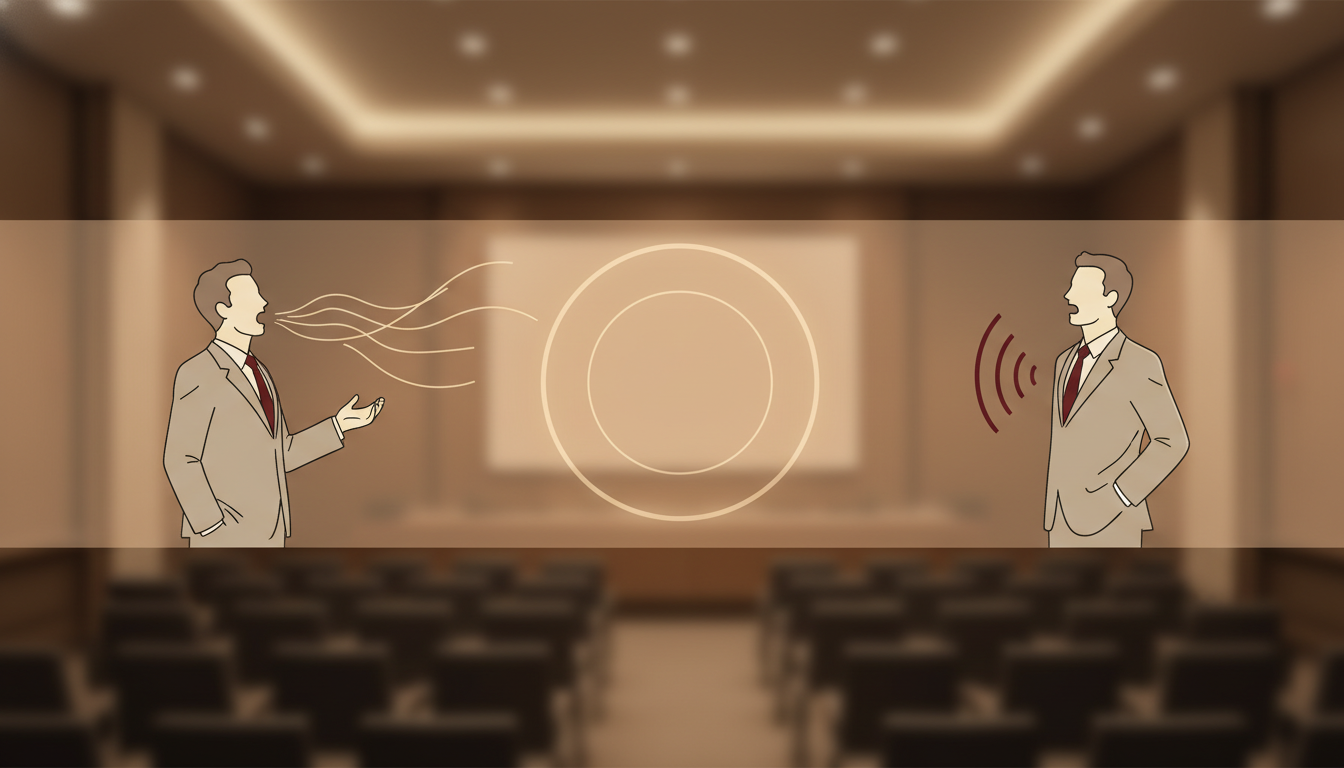
Replace Fillers with Silence
The next time you feel an "um" rising, simply close your mouth and pause for one to two seconds. That silence—which feels eternal to you—reads as confidence, thoughtfulness, and control to your audience.
Practice this framework: Speak. Stop. Breathe. Speak.
Deliver a complete thought. Stop. Take a breath. Begin the next thought. This rhythm prevents filler words from creeping in and gives your audience time to absorb each point.
Use Pauses to Signal Importance
Strategic pauses aren't just defensive—they're offensive tools. When you pause before a key point, you create anticipation. When you pause after a key point, you create weight. The most powerful communicators use silence the way a musician uses rests: not as absence, but as emphasis.
Example: "We grew revenue by 40% this quarter. (2-second pause) And here's what made the difference."That pause forces the audience to lean in. It signals, "What I'm about to say matters." For more techniques on using pauses effectively, read our guide on how to pause effectively in public speaking.
Secret #4: Structure Your Content for Maximum Authority
Confident-sounding presenters don't just deliver information—they structure it in a way that signals clarity of thought. A rambling, disorganized presentation undermines your credibility no matter how strong your voice sounds.
Use the Rule of Three
The human brain processes information most efficiently in groups of three. Structure your presentation around three core points, three supporting arguments, or three action items. This isn't arbitrary—cognitive research from Georgetown University confirms that audiences retain information structured in triads significantly better than information presented in longer lists.
Example framework:- "Today I'll cover three things: where we are, where we need to go, and how we get there."
This single sentence tells the audience you've thought carefully about your content, you respect their time, and you know exactly where you're heading.
Open with a Declaration, Not an Apology
The first 30 seconds of your presentation set the audience's perception of your confidence for the entire talk. Never open with:
- "Sorry, I'm a little nervous."
- "I didn't have much time to prepare."
- "I'm not really an expert on this, but…"
Instead, open with a declarative statement, a surprising statistic, or a direct question. Compare:
- Weak: "So, um, thanks for having me. I'll try to keep this short."
- Strong: "Last quarter, we left $2.3 million on the table. Today I'll show you how we capture it."
The second opening commands attention because it leads with value and specificity. For more high-impact opening strategies, explore how to start a presentation with confidence.
Signpost Your Transitions
Confident presenters tell the audience where they are in the presentation's structure. Use explicit transition phrases:
- "That's the problem. Now let's look at the solution."
- "That covers the first point. Here's the second."
- "Before I move on, here's why this matters."
Signposting demonstrates intellectual control over your material. It tells the audience you know exactly where you are and where you're going—which is the definition of sounding confident.
Secret #5: Command the Room with Body Language
Research by Albert Mehrabian—often cited but frequently misunderstood—established that nonverbal cues significantly influence how messages are received, particularly when verbal and nonverbal signals conflict. In a presentation, your body language either reinforces or contradicts your words.
Plant Your Feet and Own Your Space
Nervous presenters sway, shift their weight, or pace aimlessly. These movements telegraph anxiety. Instead, plant your feet shoulder-width apart and stand still when delivering key points. When you do move, move with purpose—step toward the audience to emphasize a point, then return to your anchor position.
Use Open, Deliberate Gestures
Keep your hands visible and use gestures that match your message. Avoid crossing your arms, gripping the podium, or putting your hands in your pockets. Effective gestures are:
- Palms up when presenting options or inviting input
- Palms down when making definitive statements
- Counting on fingers when listing points (reinforces your Rule of Three structure)
A study from the University of Chicago found that speakers who used purposeful hand gestures were rated 12% more persuasive than those who kept their hands still. For a complete guide to projecting authority through body language, see leadership presence body language: 11 cues that signal power.
Make Sustained Eye Contact
Don't scan the room like a lighthouse. Instead, deliver a complete thought to one person, then move to another person for the next thought. Hold eye contact for 3–5 seconds per person. This creates a sense of personal connection and signals that you're speaking to people, not at them.
Secret #6: Prepare a Confidence Anchor Routine
The most confident-sounding presenters don't wing their preparation. They follow a systematic pre-presentation routine that primes their voice, body, and mindset for peak performance.
The 15-Minute Pre-Presentation Checklist
Use this checklist in the 15 minutes before any presentation:
Minutes 15–10: Physical Reset- [ ] Five diaphragmatic breaths (4-count inhale, 2-count hold, 6-count exhale)
- [ ] Shoulder rolls and jaw relaxation (release tension that tightens your voice)
- [ ] Power pose for 2 minutes (hands on hips or arms wide—this reduces cortisol, per Harvard research by Amy Cuddy)
- [ ] Hum at your lowest comfortable pitch for 30 seconds
- [ ] Read your opening paragraph aloud at your target pace
- [ ] Practice three key pauses in your first two minutes
- [ ] Review your three core points (not your entire script)
- [ ] Visualize your strong opening—the first sentence, delivered with a downward pitch
- [ ] Remind yourself: "I know this material. I earned this room."
This routine works because it addresses all three channels of confident delivery: body, voice, and mindset. For additional strategies on managing pre-presentation nerves, read how to calm nerves before a presentation: 11 proven methods.
Build Unshakable Presentation Confidence The Credibility Code includes the complete pre-presentation confidence system, vocal authority drills, and language frameworks used by executives who command every room they enter. Discover The Credibility Code
Secret #7: Handle Q&A Without Losing Composure
Many presenters sound confident during their prepared remarks but fall apart during the Q&A. This is where credibility is often won or lost—because the audience sees you thinking in real time.
Use the "Acknowledge, Bridge, Deliver" Framework
When you get a tough question, don't rush to answer. Use this three-step framework:
- Acknowledge the question: "That's an important consideration."
- Bridge to your expertise: "What the data actually shows us is…"
- Deliver a concise answer in 2–3 sentences.
This framework buys you thinking time while sounding composed and respectful. It prevents the two biggest Q&A mistakes: rambling and getting defensive.
What to Say When You Don't Know the Answer
Nothing destroys confidence faster than bluffing. If you don't know the answer, say so directly—but frame it with authority:
- Weak: "Um, I'm not sure… I'd have to look into that, sorry."
- Strong: "I don't have that specific figure in front of me. I'll follow up with you by end of day with the exact data."
The second response sounds more confident because it's specific, action-oriented, and unapologetic. For a deeper exploration of handling difficult questions, see our guide on how to handle Q&A after a presentation like a pro.
Secret #8: Rehearse for Delivery, Not Just Content
Most professionals rehearse what they'll say. Confident presenters rehearse how they'll say it. There's a critical difference.
Record and Review Yourself
Record a video of yourself delivering your presentation. Watch it with the sound off first—assess your body language, gestures, and facial expressions. Then listen with your eyes closed—assess your pace, pitch, filler words, and pauses.
You'll almost certainly discover habits you didn't know you had. Maybe you touch your face when making a key point. Maybe your voice rises at the end of every sentence. These are invisible to you in the moment but obvious to your audience.
Rehearse in Conditions That Match the Real Thing
If you'll be standing, rehearse standing. If you'll use a clicker, rehearse with a clicker. If you'll present to 20 people, rehearse in front of at least 2–3 people rather than an empty room. A study by the University of Wolverhampton found that performers who rehearsed under conditions similar to their actual performance showed 22% less anxiety and performed significantly better than those who practiced in isolation.
The goal isn't memorization—it's muscle memory for your delivery patterns. You want your voice, gestures, and pacing to feel automatic so your cognitive resources are free for connecting with the audience.
Secret #9: Close with Authority, Not Apology
Your closing is the last impression you leave. It determines whether the audience remembers you as confident and commanding or uncertain and forgettable.
End on a Declarative Note
Never end with:
- "So, yeah… that's basically it."
- "I guess that's all I have. Any questions?"
- "Sorry if I went over time."
Instead, close with a clear call to action, a powerful summary, or a forward-looking statement:
- "Here are the three actions I'm asking this team to take by Friday."
- "The opportunity is $4.2 million. The risk of inaction is losing it to our competitors. Let's move."
- "That's the vision. I'm ready to answer your questions."
Use the "Bookend" Technique
Reference your opening in your closing. If you opened with a statistic, return to it. If you opened with a question, answer it. This creates a sense of structural completeness that signals intellectual command.
Example:- Opening: "Last quarter, we left $2.3 million on the table."
- Closing: "That $2.3 million? Here's exactly how we capture it—starting Monday."
This technique makes your presentation feel intentional from start to finish. For more techniques on powerful closings, explore how to close a presentation with impact.
Frequently Asked Questions
How can I sound confident in a presentation when I feel nervous?
Feeling nervous and sounding confident are not mutually exclusive. Focus on the physical mechanics: slow your pace, drop your pitch at sentence endings, and use strategic pauses instead of filler words. Preparation is your greatest anxiety reducer—rehearse your delivery (not just your content) at least three times. Use the 15-minute pre-presentation checklist above to reset your body and voice before you begin. Nerves don't disappear, but they become invisible when your delivery mechanics are solid.
What's the difference between sounding confident and sounding arrogant?
Confidence is rooted in evidence and composure; arrogance is rooted in dismissiveness and self-promotion. A confident presenter says, "The data supports this approach, and here's why." An arrogant presenter says, "Obviously I'm right about this." Confident speakers acknowledge complexity, invite questions, and credit their teams. Arrogant speakers shut down dissent and center themselves. The key differentiator is intellectual humility paired with vocal certainty.
How do I stop saying "um" and "uh" during presentations?
Replace filler words with intentional silence. When you feel an "um" coming, close your mouth and pause for one to two seconds. Practice the "Speak. Stop. Breathe. Speak." rhythm during rehearsal. Recording yourself is the fastest way to build awareness—most people don't realize how frequently they use fillers until they hear themselves. Within two to three practice sessions, you'll notice a dramatic reduction. See our full guide on how to stop using filler words in professional speaking.
How long should I practice before a presentation to sound confident?
For a 15-minute presentation, plan three to five full run-throughs focused on delivery, not just content review. Space these across two to three days rather than cramming the night before. Each rehearsal should target a specific element: one for pacing, one for pauses and emphasis, one for body language. Total preparation time is typically three to five hours for a high-stakes presentation, including content development and delivery rehearsal.
Can introverts sound confident in presentations?
Absolutely. Introverts often excel at presentation confidence because they tend to prepare more thoroughly and speak more deliberately. The techniques in this article—strategic pauses, structured content, declarative language—align naturally with introverted communication strengths. Many of the most authoritative presenters are introverts who've learned to channel their reflective nature into composed, high-impact delivery. Introversion is not a barrier; it's an advantage when paired with the right techniques.
Does body language really affect how confident I sound?
Yes. Research consistently shows that audiences process nonverbal cues before and alongside verbal content. If your words say "I'm confident" but your body says "I'm anxious" (through swaying, fidgeting, or avoiding eye contact), your body wins. Planting your feet, using open gestures, and making sustained eye contact create a visual foundation that reinforces your vocal confidence. The two channels—voice and body—must align for maximum impact.
Speak So the Room Takes You Seriously
The Credibility Code covers the verbal patterns that make presenters sound authoritative, and the ones that make audiences tune out.
Discover The Credibility CodeRelated Articles

How to Sound Confident in a Presentation: 9 Proven Methods
To sound confident in a presentation, focus on these core techniques: lower your vocal pitch slightly, slow your speaking pace to 130–150 words per minute, pause deliberately instead of using filler words, control your breathing from your diaphragm, and open with a strong declarative statement. These methods work even when you feel nervous because confidence is a skill of *delivery*, not a reflection of your internal state. The audience hears your voice — not your heartbeat.

How to Sound Confident in a Presentation: 9 Proven Tactics
To sound confident in a presentation, focus on three pillars: vocal delivery, verbal precision, and structural clarity. Slow your speaking pace to 130–150 words per minute, use strategic pauses instead of filler words, replace hedging language ("I think maybe…") with power phrases ("The data shows…"), and open with your strongest point. Confidence isn't about feeling fearless — it's about controlling the signals your audience receives.

How to Establish Credibility in a Speech: 9 Proven Methods
To establish credibility in a speech, you need to demonstrate expertise, build trust, and signal authority from the moment you begin. The most effective speakers do this by combining strategic self-introduction, evidence-based arguments, audience-centered framing, confident delivery, and structural clarity. Credibility isn't just about what you know — it's about how quickly your audience decides to believe you. These nine methods will help you earn that trust before, during, and after you speak.