
How to Present Ideas Without Getting Dismissed at Work

To present ideas without getting dismissed at work, lead with the problem your idea solves (not the idea itself), anchor your proposal in data or evidence, align your framing with stakeholder priorities, and use confident vocal delivery—slower pace, downward inflections, and strategic pauses. Follow up in writing to create a paper trail that ensures your contribution is remembered and credited. Timing and format matter as much as the idea itself.
What Does It Mean to Get Your Ideas Dismissed at Work?
Getting your ideas dismissed at work means you share a suggestion, proposal, or solution—and it's ignored, glossed over, or attributed to someone else who repeats it moments later. It's not that your ideas lack merit. It's that the way they're packaged, delivered, or timed fails to signal credibility to the room.
Idea dismissal is a communication problem, not an intelligence problem. According to a 2023 study by VitalSmarts (now Crucial Learning), 69% of managers say they're often uncomfortable communicating with employees—meaning even good ideas get lost when delivery doesn't match the audience's expectations. The gap between having a great idea and getting credit for it is almost entirely a framing and presence gap.
If you've ever felt overlooked at work, you already know this pain. The good news: it's fixable with specific, learnable techniques.
Frame Your Idea Around the Problem, Not the Solution
The single biggest reason ideas get dismissed is that the presenter leads with the solution. Decision-makers don't care about your idea until they care about the problem it solves.

Use the Problem-First Framework
Before you pitch anything, answer this question in your opening sentence: What organizational pain does this idea address?
Here's the difference:
Weak framing: "I think we should switch to a new project management tool." Strong framing: "We're losing an estimated 6 hours per team member per week on manual status updates. I've identified a solution that could recover most of that time."The second version creates urgency before introducing the solution. It signals that you've done your homework and that you're thinking about business outcomes—not just personal preferences.
Research from Harvard Business Review (2019) found that proposals framed around business problems were 30% more likely to receive executive approval than those framed around features or preferences.
Align With Stakeholder Priorities
Every room has a hierarchy of concerns. Your CEO cares about revenue and risk. Your VP cares about team performance and hitting quarterly targets. Your direct manager cares about not looking bad to their boss.
Before you present an idea, map it to the specific priorities of the person who can say yes. Ask yourself:
- What metric does this person own?
- What keeps them up at night?
- How does my idea make their job easier or their results better?
When you frame ideas in the language of your audience's goals, you stop sounding like someone with an opinion and start sounding like a strategic partner. This is a core skill in communicating with senior executives effectively.
Anchor With Data, Not Opinions
Ideas backed by numbers are harder to dismiss. You don't need a full research report—you need one or two concrete data points that validate the problem or support your proposed solution.
Compare these two statements:
- "I feel like our onboarding process is too slow."
- "Our current onboarding takes 14 days on average. The industry benchmark is 7. That gap is costing us roughly $23,000 per new hire in delayed productivity."
The second version is nearly impossible to wave away. Even a single relevant statistic transforms your idea from subjective to substantive.
Master the Vocal Delivery That Commands Attention
What you say matters. How you say it determines whether anyone listens. Research from UCLA professor Albert Mehrabian's foundational communication studies shows that tone of voice accounts for approximately 38% of how messages are received in situations where words and tone are incongruent. In high-stakes meetings, your voice is your credibility signal.
Eliminate Uptalk and Vocal Fry
Uptalk—ending statements with a rising pitch, as if asking a question—immediately signals uncertainty. It tells the room you're not sure of your own idea.
Practice this: Record yourself delivering your key point. Listen for any rise in pitch at the end of declarative sentences. Then re-record, deliberately dropping your pitch at the end of each statement.
Vocal fry—a creaky, low-register trailing off at the end of sentences—signals disengagement or low energy. Both patterns undermine credibility before your audience even processes your words.
For a deeper dive into vocal authority, explore our guide on how to develop a commanding voice at work.
Use Strategic Pauses Instead of Fillers
Filler words ("um," "like," "so," "basically") are credibility killers. A 2019 study published in the Journal of Nonverbal Behavior found that speakers who used fewer filler words were rated as 20% more competent and 18% more trustworthy by listeners.
Replace fillers with silence. A two-second pause before your key point creates anticipation. A pause after your key point gives the room time to absorb it. Silence signals confidence—it tells the room you're comfortable holding space.
Try this exercise: Practice your next idea pitch and intentionally insert a full two-second pause before your most important sentence. It will feel uncomfortably long to you. To your audience, it will feel commanding.
Slow Down at the Critical Moment
When we're nervous, we speed up. Rapid delivery signals anxiety and makes your idea harder to follow. The fix is counterintuitive: slow down most at the moment that matters most.
When you reach your core recommendation, drop your speaking pace by roughly 20%. Enunciate each word. This creates a natural emphasis that draws the room's attention to exactly where you want it.
Say it once, and be taken seriously. The Authority Toolkit gives you 8 frameworks, the 7 shifts that make speech sound sure, and 100+ phrases for meetings and email, so the point lands the first time you make it. Get The Authority Toolkit — $27
Choose the Right Moment and Format
Even a perfectly framed, confidently delivered idea will fail if the timing or format is wrong. Strategic timing is an underrated skill that separates professionals who get heard from those who get ignored.

Read the Room Before You Speak
Don't pitch a new initiative in the last five minutes of a meeting when everyone is mentally checked out. Don't introduce a complex idea during a crisis update. Don't propose a budget increase right after your team missed a target.
The best time to present an idea is when:
- The relevant problem has just been discussed or acknowledged
- The decision-maker is in a receptive mode (brainstorming, planning, or problem-solving—not firefighting)
- You have at least 3-5 uninterrupted minutes to make your case
A study from the University of Michigan's Ross School of Business (2021) found that proposals introduced during dedicated agenda time were 47% more likely to receive a follow-up action than ideas raised during open discussion or "any other business" segments.
Pre-Sell Before the Meeting
The most effective presenters rarely surprise the room. They've already socialized their idea with one or two key stakeholders before the formal meeting.
This doesn't mean lobbying. It means having a brief, informal conversation: "I've been thinking about the onboarding bottleneck. I have a data-backed proposal. Would you be open to hearing a quick overview before Thursday's meeting?"
Pre-selling accomplishes three things:
- You get early feedback that lets you refine your pitch
- You create an ally who may champion your idea in the meeting
- You reduce the chance of being blindsided by objections
This is a form of influencing without formal authority—one of the most valuable skills in any organization.
Match the Format to the Audience
Some leaders are visual thinkers. Others are data-driven. Some prefer written memos; others want a verbal pitch. Presenting your idea in the wrong format is like speaking the wrong language.
Before your next pitch, ask yourself: How does this decision-maker prefer to receive information? If you don't know, observe how they communicate. Do they send long emails or short bullet points? Do they reference charts in meetings or tell stories?
Adapt your delivery format accordingly. For executives who value brevity, consider the approach outlined in how to brief executives quickly using the 60-second framework.
Protect Your Idea With a Paper Trail
Getting your idea heard in the room is only half the battle. The other half is ensuring it's remembered and attributed to you. Without a follow-up strategy, your idea is vulnerable to being forgotten—or worse, repeated by someone else who gets the credit.
Send a Follow-Up Email Within 24 Hours
After presenting your idea in a meeting, send a brief follow-up email to the key decision-maker(s) within 24 hours. This email should:
- Reference the specific idea you proposed
- Summarize the key data point or business case
- Suggest a clear next step
Example:
"Hi [Name], following up on today's discussion—I wanted to recap the onboarding optimization proposal I shared. Based on our current 14-day average vs. the 7-day industry benchmark, I believe we can recover approximately $23K per new hire. Happy to put together a one-page implementation plan if you'd like to explore this further."This creates a timestamp, a written record, and a clear ownership trail. It also signals professionalism and initiative. For more on writing emails that command attention, see our guide on how to write emails that get taken seriously at work.
Name Your Idea
This is a subtle but powerful technique. When you give your proposal a name—"the onboarding acceleration plan," "the client retention framework," "the Q3 efficiency initiative"—it becomes a thing. Named ideas are harder to steal, easier to reference, and more likely to stick in people's memories.
In your follow-up email and in future conversations, refer to your idea by its name. Over time, others will too—and it will be permanently associated with you.
Build on Your Idea Publicly
Don't pitch once and disappear. In subsequent meetings, reference your proposal naturally: "Building on the onboarding acceleration plan I proposed last week..." or "I've gathered additional data on the efficiency initiative I shared."
This repetition reinforces ownership and keeps your idea on the agenda. It also demonstrates persistence and commitment—qualities that build credibility at work.
Handle Dismissal in Real Time
Even with perfect preparation, you'll occasionally face dismissal in the moment—an interruption, a subject change, or the dreaded "let's table that." How you respond in that moment determines whether your idea dies or lives to fight another day.
Use the Redirect Technique
If someone talks over you or redirects the conversation, wait for the next natural pause and say:
"I want to circle back to the point I was making about [specific topic], because I think it directly addresses the challenge we're discussing."This is assertive without being aggressive. It signals that your idea has relevance and that you're not willing to let it disappear. For more strategies on handling these situations, explore how to handle being talked over in meetings.
Reclaim Stolen Ideas Diplomatically
If someone repeats your idea and receives credit, respond immediately and graciously:
"I'm glad you're building on that, [Name]. When I originally raised that point a few minutes ago, I was also thinking we could add [additional detail]."This accomplishes two things: it re-establishes your ownership without creating conflict, and it adds new value that reinforces your expertise.
Know When to Escalate the Format
If your ideas are consistently dismissed in group meetings, change the venue. Request a one-on-one with the decision-maker. Put your proposal in a written memo. Ask for dedicated agenda time.
Sometimes the problem isn't your idea or your delivery—it's the format. Group dynamics, meeting culture, and room politics can all work against you. Changing the format removes those variables and gives your idea a fair hearing. Our guide on leadership presence in one-on-one meetings covers how to maximize these conversations.
Build a Reputation That Precedes Your Ideas
The ultimate solution to idea dismissal isn't a better pitch—it's a stronger professional reputation. When people see you as credible and competent, your ideas get a warmer reception before you even open your mouth.
Become Known for One Area of Expertise
Don't try to be the person with opinions on everything. Instead, become the recognized authority on one specific domain. When you consistently contribute high-quality insights in a focused area, people start seeking your input—rather than you having to fight for airtime.
According to a 2022 LinkedIn Workplace Learning Report, professionals who were recognized as subject matter experts were 3.5 times more likely to be included in strategic conversations and cross-functional projects.
Deliver Small Wins Consistently
Before pitching your transformative idea, build a track record of smaller, executed wins. Every time you follow through on a commitment, share useful data, or solve a minor problem efficiently, you deposit credibility into your professional reputation account.
When you finally pitch the big idea, you're not an unknown quantity. You're the person who always delivers—and that reputation makes your ideas nearly impossible to dismiss.
This is the foundation of building authority at work without a title.
Frequently Asked Questions
Why do my ideas keep getting ignored at work?
Your ideas likely get ignored due to framing, timing, or delivery issues—not because they lack merit. Common culprits include leading with the solution instead of the problem, using tentative language ("I just think maybe we could..."), presenting at the wrong moment, or lacking a data anchor. Shifting to problem-first framing, confident vocal delivery, and strategic timing can dramatically change how your ideas are received.
How do I present an idea to my boss without sounding pushy?
Frame your idea as a solution to a problem your boss already cares about. Use language like "I noticed [problem] and I've been thinking about a way to address it" rather than "I think we should do X." This positions you as a problem-solver, not a critic. Follow up with data and a suggested next step, and let your boss feel ownership of the decision to move forward.
What's the difference between being assertive and being aggressive when presenting ideas?
Assertiveness means stating your position clearly, backing it with evidence, and holding your ground calmly. Aggressiveness involves dismissing others' perspectives, using confrontational tone, or forcing your idea at inappropriate moments. Assertive presenters say "Here's what the data suggests and why I recommend this approach." Aggressive presenters say "This is obviously the right answer and anyone who disagrees isn't paying attention." The key difference is respect—for both your own ideas and others' input.
How do I get credit when someone else repeats my idea?
Immediately and graciously reclaim ownership by saying something like: "I'm glad you're expanding on that—when I raised that point earlier, I was also considering [additional detail]." This re-establishes your contribution without creating conflict. To prevent it from happening, always follow up in writing after meetings and name your proposals so they become associated with you.
How do I present ideas to senior leadership without being nervous?
Preparation reduces nervousness more than any breathing technique. Know your one key message, your supporting data point, and your specific ask. Practice delivering it in under 90 seconds. Arrive early to the room so you feel settled. Use a slow, deliberate speaking pace—it calms your nervous system and projects confidence. For a complete framework, read our guide on how to present ideas to senior management.
How can introverts present ideas effectively in meetings?
Introverts often excel at written and one-on-one communication. Leverage those strengths by pre-selling ideas in individual conversations, sending well-crafted proposal emails before meetings, and requesting dedicated agenda time rather than competing in open discussion. When you do speak in the meeting, use the problem-first framework and keep your contribution concise—quality over quantity signals authority. Our guide on speaking up in meetings as an introvert offers a complete strategy.
Stop Sounding Uncertain in Everyday Conversations
8 communication frameworks, the 7 speech shifts with 30 before-and-after rewrites, 6 email templates, and 100+ phrases for speaking and writing with calm authority at work. PDF.
Get The Authority Toolkit — $27Related Articles

How to Communicate With Authority at Work: A Framework
To communicate with authority at work, you need to master four pillars: language precision (eliminating weak words and using decisive phrasing), vocal delivery (controlling pace, pitch, and pauses), structural clarity (organizing ideas so they land instantly), and conviction signaling (aligning body language, tone, and message). This framework gives you specific, repeatable techniques for each pillar—with before-and-after examples for presenting ideas, giving feedback, and handling pushback.
How to Communicate With Confidence at Work: A Complete System
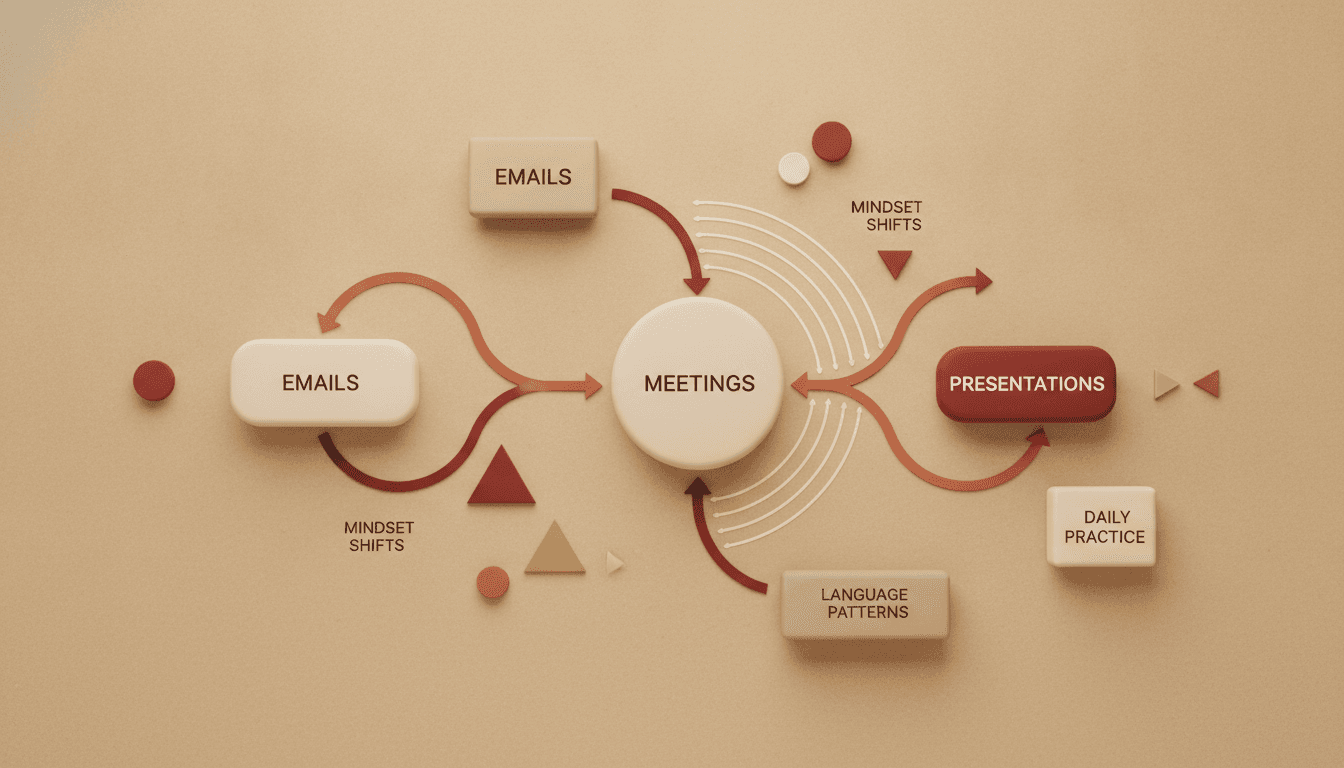
Communicating with confidence at work requires a systematic approach across four dimensions: mindset, language, delivery, and daily practice. Start by eliminating hedging words ("I just think," "sorry, but") from your vocabulary. Then adopt structured speaking frameworks like the Point-Reason-Example-Point method for meetings and presentations. Build a daily practice routine that includes vocal warm-ups, pre-meeting preparation, and post-interaction reflection. Confidence isn't a personality tra

Stop Hedging Language at Work: Speak With Certainty
To stop hedging language at work, identify your most-used qualifier phrases — like "I just think maybe," "I could be wrong, but," and "sort of" — and replace them with direct, declarative alternatives. Start by auditing your speech and emails for one week, tracking every hedge word you use. Then practice specific replacement phrases daily until direct language becomes your default. Most professionals can dramatically reduce hedging within 30 days using a structured awareness-and-replacement meth