
How to Handle Being Talked Over in Meetings (Scripts)

What Does "Being Talked Over in Meetings" Actually Mean?
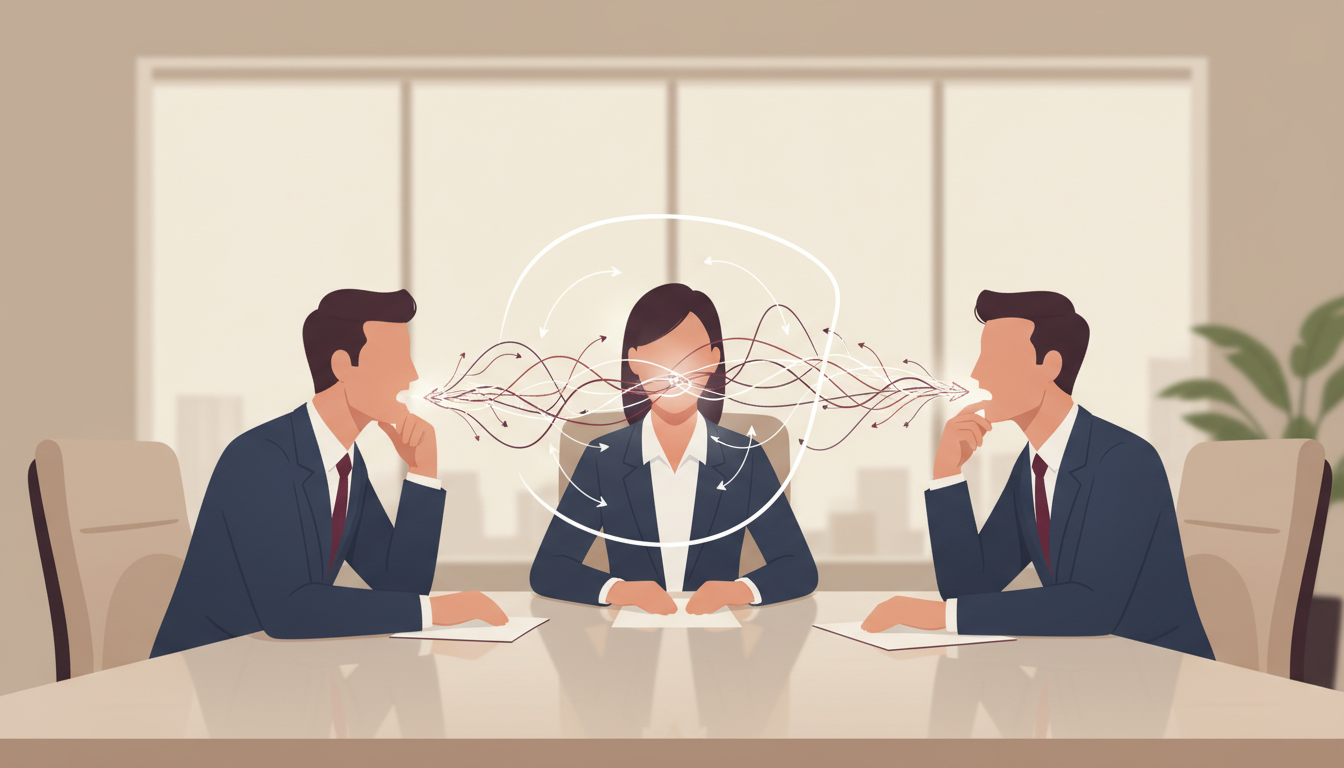
Being talked over in meetings is the experience of having your speaking turn interrupted, overridden, or ignored by another participant—often repeatedly. It goes beyond a one-time accidental interruption. It's a pattern where your contributions are cut short, spoken over, or attributed to someone else after you've introduced them.
This behavior can be intentional or unconscious, but the impact is the same: your ideas don't land, your credibility erodes, and your influence in the room shrinks. According to a study published in the Journal of Language and Social Psychology, men interrupted women 33% more often than they interrupted other men, highlighting that this issue is often systemic, not just situational (Hancock & Rubin, 2015).
Understanding the difference between a conversational overlap and a pattern of being talked over is critical. The occasional interruption is normal human communication. But if you consistently leave meetings feeling unheard, you're dealing with a credibility and presence gap that requires a strategic response—not just frustration.
Why People Get Talked Over (And Why It Matters)
The Root Causes Are Rarely About Your Ideas

Most professionals assume they get interrupted because their ideas aren't strong enough. That's almost never true. The real causes are rooted in communication signals—how you open, how you hold the floor, and how you use your voice and body.
Common root causes include:
- Tentative openers: Starting with "I just think maybe…" or "Sorry, but…" signals uncertainty and invites override.
- Low vocal energy: Speaking softly or trailing off at the end of sentences gives listeners a perceived "opening" to jump in.
- Passive body language: Leaning back, avoiding eye contact, or fidgeting communicates that you're not fully claiming the space.
- Lack of structural framing: Diving into details without signaling the shape of your point ("I have two observations on this") makes it easy for others to cut in.
If you notice these patterns in yourself, our guide on how to stop sounding unsure when you speak at work breaks down the specific language shifts that make an immediate difference.
The Professional Cost Is Real
Being talked over isn't just annoying—it's career-limiting. Research from Brigham Young University found that in group settings, women spoke 75% less than men when they were in the minority, partly because of interruption patterns that discouraged participation (Karpowitz & Mendelberg, 2014). Over time, this dynamic leads to fewer visible contributions, weaker perceived leadership capability, and slower career advancement.
When your voice is consistently overridden, decision-makers stop associating you with original thinking. Your ideas may still influence outcomes—but often through someone else who restates them louder. That's not just a meeting problem. It's a credibility and authority problem.
Prevention: How to Set Yourself Up to Be Heard
The best way to handle being talked over is to reduce the chances it happens in the first place. These are pre-meeting and early-meeting strategies that shift the dynamic before anyone opens their mouth.
Claim Agenda Space Before the Meeting
If you know you have something important to contribute, don't leave it to chance. Email the meeting organizer or your manager beforehand:
Script: "I've been working on [topic] and have some findings I'd like to share during the meeting. Could we add five minutes for me to walk through my recommendation?"This does two things: it guarantees you a speaking slot, and it signals to the room that your contribution is expected and sanctioned.
Open with a Structural Frame
When it's your turn to speak, the first five seconds determine whether people listen or look for an opening to jump in. Use a framing technique to signal structure and length:
Script: "I want to make two quick points on this—first about timing, then about budget."This tells the room you have a clear, bounded contribution. It psychologically discourages interruption because people know you're not going to ramble—they can see the finish line.
For more on how to structure your speaking for maximum impact, see our breakdown of how to speak with authority and confidence.
Position Yourself Strategically in the Room
Physical positioning matters more than most people realize. A study by Albert Mehrabian, widely cited in communication research, found that 55% of interpersonal communication is driven by body language. Sitting at the center of the table (rather than the edges), maintaining an open posture, and making direct eye contact with the speaker before you contribute all signal that you're a primary participant—not a peripheral one.
In virtual meetings, this translates to camera placement (eye level, well-lit), unmuting confidently, and using the first-name address: "Building on what Sarah said…" This anchors you as an active contributor from the start.
Know exactly what to say next time. The Pushback Playbook has 50 word-for-word scripts for moments like this one: what they say, what you say, why it works, and what to do if they push back. Get The Pushback Playbook — $27
In-the-Moment Scripts: What to Say When You're Interrupted
This is the section you'll want to bookmark. These scripts are designed for real workplace dynamics—assertive enough to reclaim the floor, professional enough to maintain relationships.
The Calm Reclaim
Use this when someone talks over you mid-sentence. Keep your voice steady. Don't raise your volume—raise your clarity.
Script: "I'd like to finish my thought—then I'd love to hear yours." Why it works: It's direct without being aggressive. It acknowledges the other person's desire to speak while firmly holding your ground. The word "then" creates a sequence that's hard to argue with.The Redirect After Being Overridden
Sometimes the moment passes. Someone talks over you, the conversation moves on, and you're left sitting with an unfinished point. Don't let it go. Wait for a natural pause and use this:
Script: "I want to circle back to what I was saying before—because it's directly relevant to the decision we're making." Why it works: Tying your point to the decision at hand gives it urgency and importance. It reframes your contribution as essential, not optional.The Ally Assist
If you have a trusted colleague in the meeting, agree beforehand to back each other up. When one of you gets interrupted, the other says:
Script: "I'd actually like to hear the rest of what [Name] was saying—I think it's important."According to a 2019 study from the Harvard Kennedy School, "amplification"—where allies repeat and credit a colleague's point—was one of the most effective strategies for ensuring women's voices were heard in meetings during the Obama White House era. This tactic works for anyone who regularly gets talked over.
The Pattern Interrupt for Repeat Offenders
If one person consistently talks over you, a private conversation is warranted. But in the meeting, you can use a slightly firmer script:
Script: "[Name], I notice we keep overlapping. Let me finish this point, and then I'll hand it to you."This names the pattern without making it personal. It's factual and forward-looking. For more on navigating these dynamics assertively, explore our guide on being more assertive in meetings without being aggressive.
After the Meeting: Reinforcing Your Voice in Writing
Send a Follow-Up That Documents Your Contribution
If your point was lost in the meeting, reclaim it in writing. A well-crafted follow-up email ensures your idea is on the record—attributed to you.
Script: "Following up on today's discussion—I wanted to capture the recommendation I raised regarding [topic]: [one-sentence summary]. Happy to discuss further or develop this into a proposal."This isn't petty. It's strategic. Written follow-ups are how decisions get documented, and being the person who captures the insight in writing positions you as a driver, not a bystander. For more on how your writing signals authority, see our piece on leadership presence in email.
Address Persistent Patterns with Your Manager
If being talked over is a recurring experience—especially by the same individuals—raise it with your manager using specific, factual language.
Script: "I've noticed a pattern in our team meetings where my contributions are getting cut short. I want to make sure my input is landing effectively. Can we discuss how to address this?"This frames the issue as a business problem (your input isn't landing), not a personal complaint. Most managers will respond constructively when the framing is professional and solution-oriented.
Building Long-Term Presence That Discourages Interruption
Develop Your Vocal Authority
People who rarely get interrupted tend to share specific vocal traits: a steady pace, a downward inflection at the end of statements, and strategic pauses. These aren't personality traits—they're learnable skills.
A study by Quantified Communications found that speakers who used deliberate pauses were perceived as 30% more confident and credible than those who filled silence with filler words. Practicing vocal delivery—even for five minutes a day—can dramatically shift how others respond to you in meetings.
Our guide on how to develop a commanding voice at work walks through specific vocal exercises you can practice before your next meeting.
Build a Reputation as a Concise, High-Value Contributor
The professionals who hold the floor most effectively aren't the loudest—they're the most concise. When people know that your contributions are brief, relevant, and actionable, they're far less likely to interrupt. They've learned that when you speak, it matters.
This means ruthlessly editing your contributions. Before speaking, ask yourself: What's the one thing I need this room to walk away with? Lead with that. Cut the preamble. End with a clear next step or recommendation.
If conciseness is something you're working on, how to speak concisely at work offers a practical framework for tightening your message without losing substance.
Own Your Space with Confident Body Language
Your physical presence is a silent signal that either invites or discourages interruption. Key shifts include:
- Plant your hands on the table (not in your lap) when you're about to speak
- Lean slightly forward when making a point—this signals engagement and ownership
- Hold eye contact with the person most likely to interrupt, which creates a subtle accountability
- Don't physically shrink when someone starts to talk over you—maintain your posture and continue at the same volume for 2-3 seconds before pausing
These micro-behaviors compound over time. They don't just prevent interruption in one meeting—they reshape how colleagues perceive your authority across every interaction.
Frequently Asked Questions
How do I stop being talked over in meetings without seeming rude?
Use calm, direct language that holds your ground without escalating. Phrases like "I'd like to finish my point" or "Let me complete this thought" are assertive but professional. The key is tone—keep your voice steady and your facial expression neutral. Assertiveness isn't rudeness; it's clarity. Most people respect directness when it's delivered without hostility.
Is being talked over in meetings a form of workplace disrespect?
It can be, especially when it's a pattern directed at specific individuals. Occasional interruptions are normal in fast-paced discussions. But consistent interruption—particularly when it targets the same people—signals a power dynamic issue. If it's happening regularly, it's worth addressing both in the moment and with your manager to ensure it doesn't erode your professional standing.
Being talked over vs. being interrupted: What's the difference?
Being interrupted is a single instance where someone cuts into your speaking turn—it may be accidental or enthusiastic. Being talked over is more sustained: someone speaks louder or longer until your voice is effectively drowned out. The distinction matters because being talked over is harder to recover from in the moment and often reflects a deeper credibility or presence gap that requires a strategic response.
How do I handle being talked over in virtual meetings?
Virtual meetings add unique challenges because visual and vocal cues are muted. Use the chat function strategically: type "I'd like to add to this" to queue yourself. When speaking, state your name first: "This is [Name]—I want to build on that point." Unmute confidently and speak within the first second to claim the floor. Camera-on presence also matters—people are less likely to talk over someone they can see.
What if my boss is the one talking over me?
This requires a more nuanced approach. In the meeting, use a deferential but firm script: "I want to make sure I capture this fully—can I finish this thought?" After the meeting, have a private conversation framed around effectiveness: "I want to make sure my contributions are landing in our meetings. I've noticed I sometimes get cut short—any suggestions?" This invites collaboration rather than confrontation. For more on this dynamic, see our guide on how to speak up to your boss without damaging trust.
Can building executive presence reduce how often I get talked over?
Absolutely. Executive presence—the combination of vocal authority, confident body language, and concise communication—is one of the strongest long-term defenses against being talked over. When you consistently show up with presence, people learn to listen. Research from the Center for Talent Innovation found that executive presence accounts for 26% of what it takes to get promoted, and a significant component is the ability to command a room. Start with our leadership presence in meetings guide for actionable habits.
Never Be Caught Without the Right Words Again
50 word-for-word scripts for being talked down to, interrupted, dismissed, and put on the spot at work, plus five worksheets. PDF, 50 pages.
Get The Pushback Playbook — $27Related Articles

How to Handle Being Talked Down to at Work Professionally
To handle being talked down to at work, stay calm and address the behavior directly using neutral, assertive language. Name the specific behavior without attacking the person by saying something like, "I'd appreciate it if we could discuss this as equals—I have relevant expertise here." Set clear boundaries, document patterns of condescension, and escalate to HR if the behavior continues. The goal is to protect your credibility and professional standing without matching their tone or becoming re

How to Speak With Confidence in Meetings: 8 Techniques
To speak with confidence in meetings, prepare two to three key points before every session, use a structured speaking framework like Point–Evidence–Recommendation, sit in a high-visibility seat, lower your vocal pitch at the end of sentences, and eliminate filler words with strategic pauses. These eight techniques—covering preparation, body language, vocal delivery, and real-time recovery—will help you contribute with authority and be taken seriously in any meeting, starting today.

How to Handle Being Interrupted in Meetings Professionally
When you're interrupted in a meeting, pause briefly, maintain open body language, and use a calm redirect phrase such as "I'd like to finish my point" or "Let me complete this thought." The key is responding without escalating—combining assertive language with composed delivery signals confidence and commands respect. Chronic interrupters can be managed through proactive strategies like pre-framing your contributions, building alliances, and addressing the pattern directly in private.