
Why People Don't Take You Seriously at Work (Fix It)

What Does "Not Being Taken Seriously at Work" Actually Mean?
Not being taken seriously at work means your ideas, contributions, and professional presence are consistently undervalued, overlooked, or dismissed by colleagues, managers, or leadership—despite your actual competence and qualifications. It's the gap between what you know you're capable of and how others perceive you.
This isn't about being disliked. It's about being discounted. You might get interrupted in meetings, passed over for high-visibility projects, or watch someone else repackage your idea and receive the credit. The root cause is almost never a skills deficit. It's a credibility signal deficit—the way you communicate, position yourself, and show up is sending unintended messages that say "I'm not sure I belong here."
According to a 2023 study by Zenger/Folkman published in Harvard Business Review, professionals who scored in the bottom quartile for "communication effectiveness" were rated 80% less likely to be seen as leadership material—regardless of their technical ability. Your skills get you in the room. Your communication habits determine whether anyone listens once you're there.
If you've been searching "why people don't take me seriously at work," you're already ahead—because awareness is the first step toward fixing it. For a deeper dive into the full credibility picture, start with our guide on how to be taken seriously at work: 11 proven strategies.
The 6 Invisible Habits That Destroy Your Workplace Credibility
Most credibility killers don't feel like mistakes when you're making them. They feel like politeness, humility, or caution. Here are the six most damaging patterns—and why they're so hard to spot on your own.
1. Hedging Language: The "Just" and "Maybe" Epidemic
Hedging language is when you soften your statements so much that they lose all authority. Phrases like "I just wanted to suggest…," "I could be wrong, but…," or "Maybe we should possibly consider…" signal uncertainty to your audience—even when you're confident in what you're saying.
A study from Language in Society (Cambridge University Press, 2019) found that speakers who used hedging phrases were rated as 34% less competent and 22% less hirable than those who stated the same ideas directly. You might think you're being collaborative. Your audience hears someone who doesn't trust their own thinking.
Scenario: In a strategy meeting, you say, "I just think maybe we should look at the Q3 numbers again?" Compare that to: "We need to revisit the Q3 numbers—there's a gap between our projections and actuals." Same insight. Completely different credibility impact.2. Chronic Over-Apologizing
Saying "sorry" when you bump into someone is polite. Saying "Sorry, but I have a question" or "Sorry to bother you, but here's my update" in professional settings is a credibility tax you pay every time you open your mouth.
Over-apologizing frames your contributions as interruptions and your presence as an imposition. Research from Psychological Science (2010, Schumann & Ross) found that excessive apologizing reduces perceived social status and authority, particularly in workplace hierarchies.
The fix is simple: Replace "sorry" with purpose. Instead of "Sorry, can I add something?" try "I want to build on that point." Instead of "Sorry for the late reply," try "Thanks for your patience." You're not removing courtesy—you're removing self-diminishment.3. Uptalk and Vocal Fry
Uptalk—raising your pitch at the end of declarative sentences so they sound like questions—is one of the fastest ways to undermine your authority. When you say "We should launch in Q2?" instead of "We should launch in Q2," you're unconsciously asking for permission instead of making a recommendation.
This is a vocal pattern issue, and it's deeply fixable. Our guide on vocal authority: how to sound like a leader when you speak walks through specific exercises to retrain your pitch patterns.
4. Rambling and Over-Explaining
When you don't feel taken seriously, the instinct is to explain more—to pile on context, caveats, and backstory until someone finally acknowledges your point. But the opposite happens. The more you talk, the less weight each word carries.
According to a study by Quantified Communications (2020), executives who communicated in the top 10% for clarity used 40% fewer words than average to make the same points. Brevity signals confidence. Over-explaining signals insecurity. Learn how to tighten your communication with our clarity framework for speaking concisely at work.
5. Passive Body Language
Credibility isn't just auditory—it's visual. Crossed arms, avoiding eye contact, taking up minimal physical space, fidgeting, or looking at your notes instead of your audience all telegraph "I'm not comfortable being here."
Research by Amy Cuddy at Harvard Business School (published in Psychological Science, 2010) demonstrated that expansive, open body language not only changes how others perceive you but also alters your own hormonal response to stress—increasing testosterone and decreasing cortisol. For a comprehensive breakdown, read our complete guide to body language for leadership presence.
6. Failing to Claim Your Expertise
This is the most strategic habit on the list. Many professionals do excellent work but never position that work in a way that builds their authority. They assume results speak for themselves. They don't.
If you're not framing your contributions, sharing insights proactively, or making your expertise visible, you're leaving your reputation to chance. And chance is not your ally in competitive workplaces.
Know exactly what to say next time. The Pushback Playbook has 50 word-for-word scripts for moments like this one: what they say, what you say, why it works, and what to do if they push back. Get The Pushback Playbook — $27
How to Fix Each Credibility Killer: A Concrete Action Plan
Diagnosing the problem is only half the battle. Here's how to systematically correct each habit.

Replace Hedging With Direct Assertion
Start a "hedge log." For one week, write down every hedging phrase you catch yourself using—in emails, meetings, and conversations. Then rewrite each one using direct language.
Before: "I just wanted to flag that maybe we should think about adjusting the timeline?" After: "I recommend we adjust the timeline. Here's why."The framework is simple: State → Support → Stop. Make your statement, give one supporting reason, and stop talking. Resist the urge to add qualifiers after the fact.
Build an Apology Replacement Bank
Create a mental list of replacement phrases for your most common "sorry" triggers:
- "Sorry I'm late" → "Thank you for waiting."
- "Sorry, quick question" → "I have a question about X."
- "Sorry to push back" → "I see it differently. Here's my perspective."
- "Sorry for the long email" → "Here's the summary; details below."
Practice these daily until they become automatic. This isn't about becoming cold—it's about communicating that your contributions have value. Our assertive communication scripts and frameworks guide has dozens more replacements you can use immediately.
Retrain Your Voice With the "Period Practice"
Every evening for two weeks, read a paragraph from any business article out loud. Focus on ending every sentence with a downward inflection—a vocal period. Record yourself and listen back. You'll be surprised how often uptalk sneaks in.
For meetings, practice your three most important points before you walk in. Say them out loud, with deliberate downward inflection. Preparation eliminates the vocal uncertainty that triggers uptalk.
Use the "Bottom Line Up Front" (BLUF) Method
Borrowed from military communication, BLUF means you lead with your conclusion and follow with supporting evidence—never the other way around.
Rambling version: "So I was looking at the data from last quarter, and there were some interesting trends, and I talked to the analytics team, and they mentioned that the conversion rates were actually declining, so I think we might want to consider changing our approach to the landing page." BLUF version: "We need to redesign the landing page. Conversion rates dropped 18% last quarter, and the analytics team confirmed the current layout is underperforming. Here's my recommended fix."The BLUF method forces clarity and signals that you respect your audience's time—a hallmark of executive-level communication.
The Positioning Problem: Why Good Work Alone Won't Earn You Respect
Your Reputation Is a Communication Strategy
A 2022 LinkedIn Workplace Confidence Survey found that 70% of professionals believe their work should "speak for itself"—yet only 15% of those same professionals reported feeling adequately recognized for their contributions. The disconnect is clear: visibility doesn't happen by accident.
Being taken seriously requires intentional positioning. That means sharing your wins (without bragging), contributing insights in visible forums, and making sure decision-makers know what you bring to the table. This is not self-promotion—it's professional communication.
For a step-by-step approach, see our guide on how to position yourself as an expert at work.
Stop Waiting to Be Called On
If your default in meetings is to wait until someone asks your opinion, you're training your colleagues to overlook you. Credible professionals contribute proactively. They don't wait for an invitation to add value.
Practical rule: In every meeting, commit to making one substantive contribution in the first 10 minutes. It could be a question, an observation, or a recommendation. The point is to establish your presence early, before the conversation's direction is set by others.If meetings feel particularly challenging, our guide on how to build confidence in meetings, even as an introvert offers specific strategies tailored to quieter communication styles.
Frame Your Contributions With Impact Language
There's a difference between describing what you did and framing why it mattered. Impact language connects your work to outcomes that your audience cares about.
Descriptive: "I updated the client report." Impact-framed: "I revised the client report to highlight our 22% efficiency gain—it's ready for the executive review."This small shift changes how people categorize you. You go from task-doer to strategic thinker. Over time, this reframing compounds into a reputation that commands respect.
The Confidence-Credibility Loop: Why Mindset Matters Too
Imposter Syndrome Is a Credibility Saboteur

Let's name the elephant in the room. Many professionals who aren't taken seriously have internalized the belief that they shouldn't be. Imposter syndrome—the persistent feeling that you're a fraud despite evidence of competence—affects an estimated 70% of people at some point in their careers (International Journal of Behavioral Science, 2011).
When you feel like an imposter, it leaks into your communication. You hedge more. You apologize more. You shrink your physical presence. The external habits and the internal narrative reinforce each other in a vicious cycle.
Breaking this cycle requires working on both sides simultaneously: fix the habits (which changes how others respond to you) and address the mindset (which changes how you respond to yourself). Our guide to overcoming imposter syndrome at work tackles the internal side in depth.
Small Wins Create Credibility Momentum
You don't need to overhaul your entire communication style overnight. Start with one fix—say, eliminating hedging language in emails for one week. When you notice people responding differently, that evidence fuels your confidence, which makes the next fix easier.
This is the confidence-credibility loop: better communication → better responses from others → stronger self-belief → even better communication. The key is starting small and staying consistent.
Frequently Asked Questions
Why do my coworkers not take me seriously even though I'm qualified?
Qualifications establish your potential credibility, but communication habits determine your perceived credibility. If you hedge, over-apologize, ramble, or fail to position your expertise visibly, your colleagues will unconsciously discount your contributions regardless of your resume. The fix isn't more credentials—it's stronger communication signals.
How can I be more assertive at work without being aggressive?
Assertiveness is about clarity and directness, not volume or dominance. Use "I" statements ("I recommend…" instead of "You should…"), maintain steady eye contact, and state your position before inviting discussion. The key distinction: assertive people express their views confidently; aggressive people dismiss others' views. Our full guide on being assertive at work without being aggressive covers this in detail.
Confidence vs. credibility: what's the difference?
Confidence is your internal belief in your abilities. Credibility is other people's belief in your abilities. You can be confident but lack credibility if your communication habits undermine you. Conversely, you can build credibility through strong communication even while your confidence is still growing. The most effective professionals develop both simultaneously. See our breakdown of the 5 pillars of credibility in communication.
How long does it take to change how people perceive you at work?
Research on impression formation suggests that consistent behavioral change can shift colleague perceptions within 4–8 weeks. The key word is consistent. Sporadic changes get overlooked. Daily, deliberate practice of even one or two new communication habits creates noticeable shifts in how others respond to you within a month.
What should I do if I get interrupted constantly in meetings?
Interruption is a credibility signal—people interrupt those they perceive as lower-status. To counter it: (1) Don't stop talking when interrupted; finish your sentence calmly. (2) Use a "bridge back" phrase: "I want to finish my point—" and continue. (3) Speak with a lower pitch and slower pace, which research shows reduces interruption frequency. (4) Contribute earlier in meetings to establish presence before patterns set in.
Can I build credibility quickly at a new job?
Yes. The first 90 days at a new job are a credibility window where people form lasting impressions. Prioritize learning names, asking strategic questions (not just logistical ones), delivering one early visible win, and communicating with clarity from day one. Our guide on building professional credibility fast at a new job provides a week-by-week framework.
Featured image alt text: Professional confidently presenting ideas in a meeting while colleagues listen attentively, representing workplace credibility and authority.
Never Be Caught Without the Right Words Again
50 word-for-word scripts for being talked down to, interrupted, dismissed, and put on the spot at work, plus five worksheets. PDF, 50 pages.
Get The Pushback Playbook — $27Related Articles

How to Handle Being Talked Down to at Work Professionally
To handle being talked down to at work, stay calm and address the behavior directly using neutral, assertive language. Name the specific behavior without attacking the person by saying something like, "I'd appreciate it if we could discuss this as equals—I have relevant expertise here." Set clear boundaries, document patterns of condescension, and escalate to HR if the behavior continues. The goal is to protect your credibility and professional standing without matching their tone or becoming re

How to Stop Being Passive at Work: 10 Daily Shifts
To stop being passive at work, replace habits like deferring decisions, over-qualifying your statements, and avoiding conflict with assertive alternatives. The key is making small, daily shifts: state your opinion before asking for others', eliminate hedging language from emails, volunteer to lead rather than follow, and address disagreements directly instead of staying silent. These micro-changes compound into a confident, credible professional presence that earns respect and accelerates your c
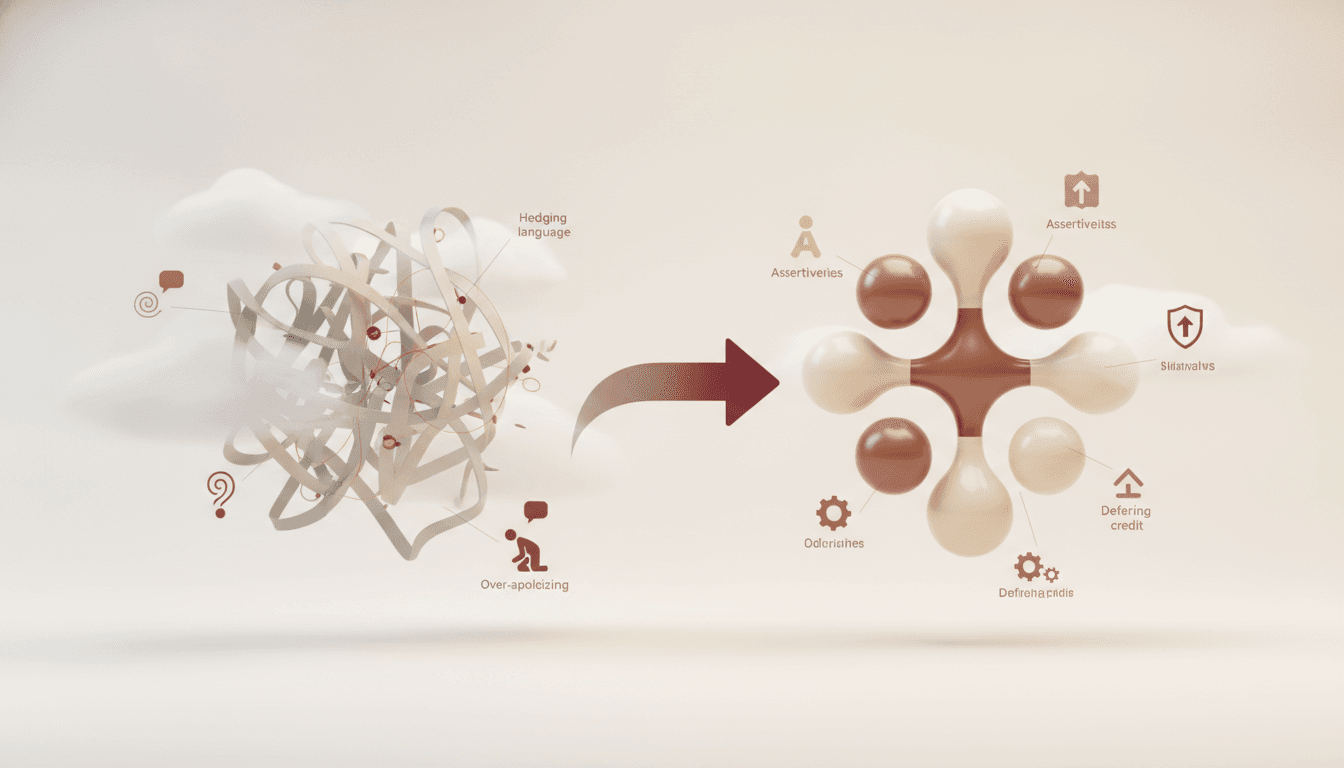
How to Stop Undermining Yourself at Work: 11 Hidden Habits
You stop undermining yourself at work by identifying and replacing the subtle communication habits that silently erode your credibility. The most common self-undermining behaviors include hedging your language ("I just think maybe..."), over-apologizing, using upspeak, deferring credit, and shrinking your physical presence. Each habit sends an unintentional signal that you lack conviction—even when your ideas are strong. Below, you'll find all 11 hidden habits with specific before-and-after repl