
How to Communicate With Confidence at Work: A Full Guide

Communicating with confidence at work requires deliberate shifts in your language, vocal delivery, body language, and mindset. Start by eliminating hedging phrases ("I just think," "I'm not sure, but..."), replacing them with direct statements. Ground your voice by breathing from your diaphragm, slowing your pace, and pausing before key points. Prepare talking points before meetings so you speak with structure, not stream-of-consciousness. Practice daily in low-stakes conversations, and build upward. Confidence isn't a personality trait — it's a communication skill you train.
What Is Confident Communication at Work?
Confident communication at work is the ability to express your ideas, opinions, and needs clearly, directly, and without unnecessary apology or hesitation — in any professional setting. It combines language precision, vocal authority, composed body language, and a mindset rooted in self-trust rather than seeking approval.
Confident communication doesn't mean being the loudest voice in the room. It means being the clearest. It's the difference between saying "I just wanted to maybe suggest we could possibly consider..." and saying "I recommend we move forward with Option B. Here's why." The first invites dismissal. The second commands attention.
Why Confidence in Communication Matters More Than You Think
The Career Cost of Uncertain Communication

Most professionals underestimate how much their communication style shapes their career trajectory. According to a 2023 study by the National Association of Colleges and Employers (NACE), communication skills ranked as the number one attribute employers seek in candidates — above technical skills, leadership, and problem-solving.
Yet it's not just about getting hired. How you communicate daily determines whether you're seen as leadership material or someone who stays in the background. When you hedge, over-apologize, or ramble in meetings, decision-makers unconsciously categorize you as less competent — even when your ideas are strong. If you've ever felt overlooked in meetings, your communication patterns may be the root cause.
Confidence vs. Competence: The Perception Gap
Research from the Journal of Personality and Social Psychology found that people who express ideas with confidence are perceived as more competent — regardless of whether their ideas are actually better. This creates a "perception gap" where talented professionals get passed over simply because their delivery doesn't match their ability.
This isn't about faking it. It's about closing the gap between what you know and how you sound. When your communication matches your competence, people take you seriously. When it doesn't, someone less qualified — but more assertive — gets the promotion, the project, or the credit.
The Compound Effect of Daily Communication Habits
Confidence at work isn't built in a single high-stakes presentation. It compounds through hundreds of small interactions: the way you respond to a Slack message, how you open a meeting, whether you speak up when you disagree, and how you structure an email.
Every interaction is a data point. Your colleagues and leaders are constantly, unconsciously forming an impression of your credibility. Small shifts — eliminating filler words, making direct requests, holding eye contact a beat longer — accumulate into a fundamentally different professional presence over weeks and months.
The 5 Mindset Shifts That Unlock Confident Communication
Shift 1: From "I Need to Be Liked" to "I Need to Be Clear"
The most common barrier to confident communication isn't a lack of vocabulary or technique. It's the fear of being perceived negatively. When your primary goal is to be liked, you soften your language, avoid disagreement, and bury your point under qualifiers.
Confident communicators flip this priority. Their goal is clarity, not approval. This doesn't mean being rude — it means saying "I disagree with that approach because of X" instead of "I mean, it's probably fine, but maybe we could also think about..." Clarity is actually more respectful than vagueness because it respects everyone's time.
Shift 2: From "I'm Not Ready" to "I Know Enough to Contribute"
Perfectionism masquerades as preparation. You tell yourself you'll speak up once you've done more research, once you have more experience, once you're absolutely certain. But that moment never arrives.
The reframe: you don't need to be the definitive expert to contribute. You need to have a perspective worth hearing. In most meetings, the person who speaks with structure and conviction — even with 70% of the information — has more influence than the person who stays silent waiting for 100%. If this pattern feels familiar, explore how to stop shrinking in high-stakes conversations.
Shift 3: From Reactive to Intentional
Uncertain communicators react. They get caught off guard, respond emotionally, and then replay the conversation for hours wishing they'd said something different. Confident communicators are intentional. They prepare. They anticipate.
Before any meeting, ask yourself three questions: What is my main point? What might I be asked? What outcome do I want? This 60-second practice transforms you from someone who "wings it" into someone who shows up with purpose. Executives do this instinctively — it's one of the key differences in how executives communicate.
Shift 4: From "What If I'm Wrong?" to "What If I'm Right?"
Fear-based communicators catastrophize. They imagine the worst outcome of speaking up — being challenged, being wrong, being embarrassed. This keeps them silent.
Flip the question. What if your idea saves the project? What if your pushback prevents a costly mistake? What if speaking up is exactly what earns you the visibility you need? The risk of staying silent is almost always greater than the risk of speaking up imperfectly.
Shift 5: From Seeking Permission to Taking Space
Notice how uncertain communicators enter conversations: "Can I just add something?" "Sorry, but I had a thought." "This might be a dumb question, but..."
These phrases are permission-seeking rituals. They signal to the room that you don't believe your contribution is worth hearing. Instead, take space directly: "I want to add a point here." "There's a factor we haven't considered." "Here's what I recommend." For a deeper dive into language patterns that erode authority, read about the 12 words that undermine your credibility at work.
Say it once, and be taken seriously. The Authority Toolkit gives you 8 frameworks, the 7 shifts that make speech sound sure, and 100+ phrases for meetings and email, so the point lands the first time you make it. Get The Authority Toolkit — $27
Language Patterns: What Confident Communicators Say Differently
Eliminate Hedging and Softening Language
A 2022 study published in the Harvard Business Review found that professionals who used hedging language ("I think," "sort of," "maybe") were rated 25% less competent by evaluators — even when the substance of their ideas was identical to those who spoke directly.
Here are specific before-and-after swaps:
- Before: "I just wanted to check in about the timeline." → After: "I'm following up on the timeline. Where do we stand?"
- Before: "I kind of feel like we should go a different direction." → After: "I recommend we change direction. Here's my reasoning."
- Before: "Sorry to bother you, but could I get your feedback?" → After: "I'd value your feedback on this. Can we schedule 15 minutes?"
- Before: "This might not be the best idea, but..." → After: "Here's a proposal I'd like us to consider."
These aren't cosmetic changes. Each swap removes a signal of self-doubt and replaces it with a signal of authority. For a comprehensive list, see our guide on how to stop hedging language at work.
Structure Your Ideas Before You Speak
Rambling is the enemy of confidence. When you speak without structure, you lose your audience — and your own thread. Confident communicators use simple frameworks to organize their thoughts in real time.
The Point-Reason-Example (PRE) Framework:- Point: State your main idea in one sentence.
- Reason: Give one or two reasons why it matters.
- Example: Offer a specific example or data point.
This takes 15 seconds to deliver and positions you as someone who thinks clearly under pressure.
Use Decisive Language in Emails
Your written communication is a permanent record of your professional presence. According to a 2021 Grammarly Business report, professionals spend an average of 19.5 hours per week on written communication. That's nearly half your work week building — or undermining — your credibility through text.
Confident email language is concise, direct, and action-oriented. Replace "I was wondering if you might be able to..." with "Please send me the updated report by Thursday." Replace "I think we should probably..." with "I recommend we..." For a complete system, explore how to project authority in emails.
Body Language and Vocal Delivery: The Nonverbal Confidence Code
How Your Body Signals Confidence (or Doesn't)
Research by Albert Mehrabian — often cited but frequently misunderstood — suggests that in emotionally ambiguous communication, body language and tone account for a significant portion of how messages are received. While the exact percentages are debated, the principle holds: how you deliver a message matters as much as what you say.
Five body language shifts that signal confidence:- Plant your feet. Whether standing or sitting, ground yourself. Shifting weight or crossing ankles signals discomfort.
- Open your chest and shoulders. Avoid crossing arms or hunching forward. Take up appropriate space.
- Use purposeful hand gestures. Gestures that match your words amplify your message. Fidgeting undermines it.
- Hold eye contact for 3-5 seconds. Long enough to signal engagement, short enough to avoid intensity.
- Pause instead of fidgeting. When you finish a point, resist the urge to fill the silence. Let it land.
For a comprehensive breakdown, explore our guide on leadership presence body language cues that signal power.
Vocal Delivery: Sound Like You Mean It
Your voice is the most underused confidence tool you have. Three vocal elements separate confident speakers from uncertain ones:
Pace: Nervous communicators speed up. Confident ones slow down — especially at key moments. Practice delivering your main point at 70% of your natural speed. Pitch: When you're anxious, your pitch rises. A study from Quantified Communications found that speakers with lower vocal variety in pitch were perceived as more authoritative. This doesn't mean monotone — it means grounding your voice in your natural lower register, especially at the end of sentences. Pausing: The strategic pause is the single most powerful vocal technique. Pause before your main point to create anticipation. Pause after it to let it land. Most people rush past their best ideas. Don't. If your voice tends to shake under pressure, try these methods for developing a confident speaking voice.Virtual Communication: Confidence on Camera
With remote and hybrid work now standard, your confidence must translate through a screen. The fundamentals still apply, but with adjustments:
- Camera at eye level. Looking down at a laptop makes you appear smaller and less engaged.
- Look at the camera, not the screen, when making key points. This simulates direct eye contact.
- Use a strong, well-lit background. Visual clutter dilutes your presence.
- Mute strategically, but unmute to contribute. Staying on mute the entire meeting signals passivity.
- Nod and react visibly. On camera, subtle reactions disappear. Amplify your engagement slightly.
Confident Communication in High-Stakes Scenarios
In Meetings: Command Attention Without Dominating
The meeting room is where professional reputations are built or eroded. Here's a scenario-based approach:
Scenario: You have an idea but the conversation is moving fast.Don't wait for a perfect opening. Use a bridge phrase: "I want to build on what Sarah said—" or "Before we move on, there's a factor worth considering." These phrases claim space without interrupting.
Scenario: Someone challenges your idea publicly.Don't get defensive. Acknowledge the challenge, then redirect: "That's a fair point. Here's the data that led me to this conclusion..." This shows composure and substance. For more specific scripts, check out how to handle tough questions in meetings.
Scenario: You're the most junior person in the room.Prepare one strong, well-researched point before the meeting. Deliver it early — within the first 10 minutes. This sets the tone for how you're perceived for the rest of the discussion.
In Negotiations: Assert Your Value Without Aggression
Negotiation is where communication confidence pays the most tangible dividends. According to a 2023 PayScale survey, 73% of employers reported that they didn't penalize employees who negotiated — yet only 37% of workers had ever tried.
The confidence gap in negotiation is expensive. Here's a framework:
- Anchor with data. "Based on market research from [source], the range for this role is X-Y."
- State your ask directly. "I'm targeting the upper end of that range based on my experience in Z."
- Pause. Let them respond. Don't fill the silence with justifications.
- If pushed back, reframe — don't retreat. "I understand budget constraints. What flexibility exists in other areas — title, bonus structure, or review timeline?"
If negotiation makes you anxious, our guide on how to negotiate when you feel intimidated offers a step-by-step framework for staying grounded.
In Presentations: Deliver With Authority
Presentations amplify everything. Your preparation, your nerves, your clarity — all of it gets magnified. Three principles for confident presentations:
Open with a statement, not an apology. Never start with "Sorry, I'm a little nervous" or "I know this is a lot of information." Start with a bold claim, a question, or a relevant data point. Your first 30 seconds set the audience's expectations. Use the "one idea per slide" rule. Cluttered slides signal cluttered thinking. Each slide should reinforce one point. You are the presentation — the slides are supporting evidence. End with a clear call to action. Don't trail off with "So, yeah, that's pretty much it." Close with: "Here's what I'm recommending, and here's the next step I need from this group." For a deeper dive, explore how to speak with authority in presentations.Daily Micro-Practices That Build Lasting Confidence
The 5-Minute Morning Rehearsal
Before your workday begins, spend five minutes rehearsing your communication for the day. Review your calendar. For each meeting or interaction, identify:
- Your main point or objective
- One sentence you want to deliver with conviction
- A potential challenge and your response
This isn't scripting — it's priming. Athletes visualize before they compete. Confident communicators prepare before they speak.
The "One Bold Move" Daily Challenge
Each day, commit to one communication act that stretches your comfort zone. Examples:
- Speak first in a meeting instead of waiting
- Send an email without softening language
- Share a dissenting opinion respectfully
- Introduce yourself to someone senior
- Ask a direct question instead of hinting
Track these daily. Within 30 days, you'll notice a measurable shift in how you carry yourself — and how others respond to you.
The Post-Interaction Debrief
After any significant conversation, meeting, or presentation, spend two minutes reflecting:
- What did I do well? (Anchor the positive — most people skip this.)
- What's one thing I'd adjust next time? (Not five things. One.)
- Did I hedge, apologize, or shrink? (If yes, note the specific moment.)
This builds metacognition — awareness of your own communication patterns. Awareness is the prerequisite for change. For a structured daily system, see our guide on daily workplace confidence exercises that actually work.
Build a Confidence Evidence File
Imposter syndrome thrives on selective memory. You forget your wins and replay your failures. Counter this by maintaining a running document of:
- Positive feedback you've received
- Successful presentations or meetings
- Moments you spoke up and it mattered
- Problems you solved or decisions you influenced
Review this file before high-stakes situations. It's not vanity — it's evidence-based self-trust.
Frequently Asked Questions
How long does it take to become a more confident communicator at work?
Most professionals notice meaningful shifts within 2-4 weeks of deliberate practice. The key is consistency, not intensity. Small daily actions — eliminating one hedging phrase, preparing talking points for one meeting, making one direct request — compound faster than occasional dramatic efforts. Research on habit formation from University College London suggests an average of 66 days to solidify a new behavioral pattern.
What's the difference between confidence and arrogance in communication?
Confidence is rooted in clarity and competence. You state your position directly, back it with evidence, and remain open to other perspectives. Arrogance dismisses other viewpoints, refuses to acknowledge uncertainty, and prioritizes being right over being effective. The practical test: confident communicators say "Here's what I recommend and why." Arrogant communicators say "I'm right and anyone who disagrees is wrong."
How can introverts communicate with confidence at work?
Confidence doesn't require extroversion. Introverts often excel at preparation, deep thinking, and written communication — all of which are powerful confidence tools. Focus on preparing one strong point before meetings, leveraging written channels like email where you can be precise, and using strategic pauses (which introverts do naturally) to signal authority. For a complete strategy, explore how to build confidence in meetings as an introvert.
Can you sound confident even when you're nervous?
Absolutely. Confidence is a skill, not a feeling. You can feel nervous internally while appearing composed externally. The techniques that create this effect include slowing your speech pace, grounding your feet, breathing from your diaphragm, and using structured frameworks (like Point-Reason-Example) so your ideas come out organized even when your mind is racing. Nervousness and confidence can coexist.
How do I communicate with confidence in emails specifically?
Confident emails are concise, direct, and action-oriented. Lead with your main point or request in the first two sentences. Eliminate softening phrases like "just," "sorry to bother you," and "I was wondering if maybe..." Use clear subject lines that state the purpose. End with a specific next step or deadline. For a detailed system, see our guide on how to sound confident in emails.
How do I recover if I lose confidence mid-conversation?
Pause. A two-second pause feels like an eternity to you but reads as composure to your audience. Take a breath, then re-anchor yourself with a structured statement: "Let me restate my main point." or "Here's the key takeaway." You can also buy time with a bridge phrase: "That's an important question — let me address it directly." Recovery is a skill, and practicing it makes you more resilient over time.
Stop Sounding Uncertain in Everyday Conversations
8 communication frameworks, the 7 speech shifts with 30 before-and-after rewrites, 6 email templates, and 100+ phrases for speaking and writing with calm authority at work. PDF.
Get The Authority Toolkit — $27Related Articles
How to Communicate With Confidence at Work: A Complete System
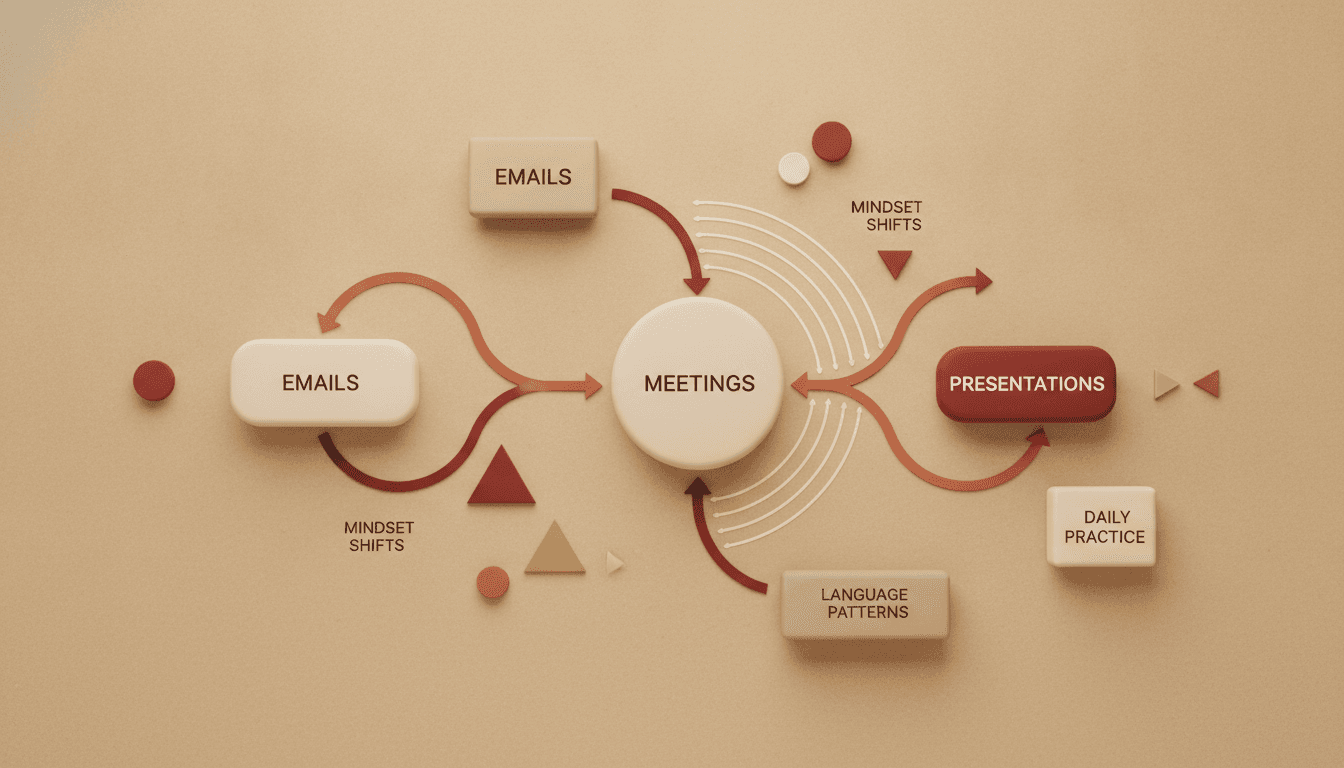
Communicating with confidence at work requires a systematic approach across four dimensions: mindset, language, delivery, and daily practice. Start by eliminating hedging words ("I just think," "sorry, but") from your vocabulary. Then adopt structured speaking frameworks like the Point-Reason-Example-Point method for meetings and presentations. Build a daily practice routine that includes vocal warm-ups, pre-meeting preparation, and post-interaction reflection. Confidence isn't a personality tra

How to Sound Authoritative: 9 Shifts That Work Instantly
To sound authoritative, focus on nine specific shifts across your voice, language, and behavior: lower your vocal pitch at the end of sentences, eliminate hedging words like "just" and "I think," slow your speaking pace by 10-15%, use declarative sentence structures, pause before key points instead of filling silence, ground your body language, lead with conclusions rather than context, choose precise vocabulary, and maintain steady eye contact. These changes work immediately because they signal

How to Sound Credible in Meetings: 9 Subtle Shifts
To sound credible in meetings, focus on three dimensions: what you say (structure and word choice), how you say it (vocal delivery and pacing), and what you don't say (eliminating credibility-killing filler). The most impactful shifts include leading with your conclusion first, replacing hedge words like "I think" with definitive language, pausing instead of using filler words, grounding opinions in evidence, and using a downward vocal inflection at the end of statements. These changes are subtl