
How to Project Authority in Emails: 11 Writing Shifts

To project authority in emails, replace tentative language with decisive phrasing, lead with your conclusion instead of burying it, use shorter sentences, and eliminate unnecessary qualifiers. Authority in email comes from structure, word choice, and formatting—not length or aggression. The 11 writing shifts below cover specific changes to openings, closings, requests, sentence structure, and tone that make your emails read as confident and credible rather than uncertain or apologetic.
What Is Email Authority?
Email authority is the perception of confidence, competence, and credibility that your written messages create in the reader's mind. It's the quality that makes recipients take your message seriously, respond promptly, and trust your judgment—before they've ever met you in person.
Unlike verbal communication, email strips away vocal tone, body language, and presence. That means every word, every structural choice, and every formatting decision either builds or undermines your authority. According to a 2023 Grammarly and Harris Poll study, 72% of business leaders say written communication skills directly impact their perception of a colleague's professionalism and competence.
Email authority isn't about being aggressive or cold. It's about writing with clarity, confidence, and intentionality—so your message commands the same respect you would in person. For a deeper dive into how writing signals leadership, see our guide on leadership presence in email.
The Cost of Tentative Emails
How Weak Emails Undermine Your Career

Every email you send is a micro-audition for your credibility. When your messages read as uncertain, you train colleagues to treat your ideas as optional. A McKinsey Global Institute report found that professionals spend an average of 28% of their workweek reading and responding to email—meaning your written communication is shaping perceptions of you more than nearly any other activity.
Consider this scenario: A project manager sends a status update that reads, "I was kind of thinking we might want to maybe push the deadline back a bit, if that's okay with everyone?" Compare that to: "I'm recommending we extend the deadline to March 15. Here's why." The first version invites people to dismiss you. The second invites people to engage with your thinking.
The Patterns That Signal Uncertainty
Tentative emails share common DNA. They over-apologize, hedge every claim, bury the point, and ask permission when none is needed. Research from Catalyst (2020) shows that professionals who communicate assertively—including in writing—are 27% more likely to be perceived as leadership material by their peers.
If you've noticed that your emails get slow responses, get ignored, or get overruled without discussion, the issue may not be your ideas. It may be your email writing patterns. We explore this dynamic further in our post on words that make you sound less confident at work.
The 11 Authority Writing Shifts
Shift 1: Lead With Your Point, Not Your Process
Tentative writers build up to their conclusion. Authoritative writers start with it.
Before: "Hi team, I've been reviewing the Q3 data and looking at some trends, and after comparing a few different approaches, I think we should probably consider reallocating the budget toward digital channels." After: "I'm recommending we reallocate the Q3 budget toward digital channels. Here's the supporting data."Executives scan. According to a Nielsen Norman Group study on email reading behavior, 79% of users scan rather than read word-by-word. If your point is in paragraph three, most readers never reach it.
Shift 2: Replace "I Think" With "I Recommend"
"I think" signals an opinion you're not sure about. "I recommend" signals a professional judgment you stand behind.
Before: "I think we should bring in a third-party vendor for this." After: "I recommend we bring in a third-party vendor. The cost savings and timeline benefits justify it."This doesn't mean you can never say "I think." But when you're making a professional recommendation, use language that matches the weight of your expertise. For more on this kind of language precision, check out how to sound more senior at work: 9 language shifts.
Shift 3: Cut the Pre-Apology
Phrases like "Sorry to bother you," "I know you're busy, but," and "This might be a dumb question" are authority killers. They tell the reader to deprioritize your message before they've even read it.
Before: "Sorry to bother you—I know you're swamped. I just had a quick question about the vendor contract if you have a sec." After: "Quick question on the vendor contract: Are we locked into the current pricing through Q4?"You don't need to apologize for doing your job. Directness is not rudeness—it's respect for everyone's time.
Shift 4: Use Shorter Sentences for Key Statements
Long, winding sentences dilute authority. When you need to land a point, make the sentence short.
Before: "Given the complexity of the situation and the various factors we've been discussing over the past few weeks, I believe that the best course of action at this point would be to pause the rollout until we've had a chance to address the outstanding issues." After: "We should pause the rollout. Three issues need resolution before we proceed." Then list the three issues.Short sentences signal confidence. They show you've done the thinking and arrived at clarity.
Write it the way a senior leader would. The Executive Email Kit gives you 20 templates, 30 subject lines, and 15 junior-to-senior rewrites for updates, asks, escalations, and bad news, so the executive acts on the first line. Get The Executive Email Kit — $27
Shift 5: Replace Passive Voice With Active Voice
Passive voice hides who's responsible. Active voice shows ownership and decisiveness.
Before: "The report was reviewed and some concerns were identified." After: "I reviewed the report and identified three concerns."A study published in the Journal of Business Communication (2019) found that active voice in professional emails increased reader perceptions of the sender's competence by 22% compared to passive constructions. Active voice tells the reader: I did this. I own this. I'm accountable.
Shift 6: Make Requests Specific, Not Open-Ended
Vague requests get vague responses—or no response at all. Authority emails tell the reader exactly what you need and by when.
Before: "Let me know your thoughts when you get a chance." After: "Please confirm the revised budget by Thursday at noon so I can finalize the proposal."Specificity signals that you've thought through the next step and you're leading the process, not waiting for someone else to lead it. Our article on writing emails that get executive responses breaks this down in detail.
Shift 7: Eliminate Unnecessary Qualifiers
Words like "just," "actually," "kind of," "a little bit," and "sort of" weaken every sentence they appear in.
Before: "I just wanted to quickly touch base about the project timeline—I'm actually a little concerned we might sort of be falling behind." After: "I want to discuss the project timeline. We're behind by two weeks, and I have a plan to get us back on track."Count the qualifiers in your last five sent emails. Most professionals are shocked by how many they use. Each one chips away at your authority.
Shift 8: Structure Emails With Visual Hierarchy
Authority emails are easy to scan. They use bullet points, numbered lists, bold text for key terms, and clear paragraph breaks. A wall of text signals disorganized thinking.
Before: A 200-word paragraph covering three different topics with no formatting. After:Three items for your review:
- Budget revision — Updated figures attached. Please approve by Friday.
- Vendor selection — I recommend Option B. Rationale in the attached comparison.
- Timeline adjustment — Proposing a two-week extension. Details below.
This structure tells the reader: I've organized my thinking. I respect your time. I know what I need from you.
Shift 9: Close With Direction, Not Deference
Your closing line is the last impression your email makes. Don't waste it on "Let me know if this makes sense" or "Hope this helps!"
Before: "Let me know what you think! Happy to chat more if needed. 😊" After: "I'll move forward with this plan unless I hear otherwise by Wednesday."The first closing puts the reader in charge. The second puts you in charge—while still leaving room for input. That's authority.
Shift 10: Use "We" Strategically—Not as a Shield
"We" can signal leadership ("We're moving forward with Phase 2") or it can be a way to avoid ownership ("We probably should have caught that sooner"). Use "I" when you're taking a position. Use "we" when you're rallying a team.
Before: "We were thinking it might be good to revisit the strategy." After: "I'm proposing we revisit the strategy. Here's what I'd change."This shift is particularly important for emerging leaders. If you're building authority without a title, owning your language in emails is one of the fastest ways to change how people perceive you.
Shift 11: Match Your Tone to Your Audience
Authority doesn't mean one tone fits all. Writing to your team requires a different register than writing to a C-suite executive. The constant is clarity and confidence—but the level of detail, formality, and context shifts.
To a peer: "Quick update: I've locked in the vendor. Kickoff is next Tuesday. I'll send the brief by EOD Friday." To a VP: "Vendor finalized. Kickoff scheduled for March 12. Brief to follow by Friday. Happy to walk through the selection rationale if helpful."The VP version is tighter, more outcome-focused, and offers context without drowning in it. For more on calibrating your communication for senior audiences, see how to communicate with senior executives effectively.
Before-and-After Rewrites for Common Scenarios
The Status Update
Before: "Hey everyone, just wanted to give a quick update on where things stand with the project. So basically we've been making some progress but there have been a few bumps in the road. The design team is a little behind but they're working on it and I think we'll probably be okay. Let me know if you have any questions!" After:"Project status as of March 7:
- Design: Two days behind schedule. Recovery plan in place—revised mockups due Thursday.
- Development: On track. Sprint 3 complete.
- Launch date: Holding at April 1. I'll flag if that changes.
No action needed from you at this time."
The second version is shorter, clearer, and positions you as someone who has the situation under control.
The Disagreement Email
Before: "I don't want to step on anyone's toes, but I was kind of wondering if maybe we should think about going in a different direction? I could be wrong, but it seems like the current approach might have some issues. Just my two cents!" After:"I'd like to propose an alternative approach. The current plan has two risks:
- Timeline risk — The integration phase requires 6 weeks we don't have.
- Cost risk — Vendor B's pricing increases 15% after Q2.
My recommendation: Shift to a phased rollout. I've outlined the comparison in the attached document. Can we discuss at Thursday's meeting?"
Building an Authority Email Habit
The 60-Second Email Audit

Before you hit send on any important email, run this quick check:
- Does the first sentence state my point? If not, move it up.
- Can I cut any qualifiers? Search for "just," "kind of," "maybe," "sort of."
- Is my request specific? Does the reader know exactly what to do and by when?
- Would I say this to someone I respect? If the tone is too deferential, tighten it.
This audit takes 60 seconds and transforms the impression your emails create. Over time, authoritative writing becomes your default—not something you have to consciously construct.
Practice With Low-Stakes Emails First
You don't have to overhaul every email overnight. Start with internal team updates and routine requests. Practice leading with your point, cutting qualifiers, and closing with direction. As the new patterns become natural, bring them into higher-stakes communication—executive updates, client emails, and cross-functional requests.
Building authority in writing follows the same trajectory as building confidence at work through daily habits. Small, consistent shifts compound into a fundamentally different professional presence.
Frequently Asked Questions
How do I project authority in emails without sounding rude?
Authority and rudeness are different things entirely. Authority comes from clarity, structure, and decisive language. Rudeness comes from dismissiveness, condescension, or disrespect. You can be direct and warm simultaneously. Say "I recommend we go with Option A" instead of "I think maybe we should consider Option A, if that works for everyone." The first is authoritative. Neither is rude.
What's the difference between confident emails and aggressive emails?
Confident emails state positions clearly, provide reasoning, and invite dialogue. Aggressive emails use ultimatums, dismiss others' input, or use confrontational language. "I'm recommending we change vendors—here's the data" is confident. "We're changing vendors and I don't want to hear objections" is aggressive. The key difference is whether you're leading the conversation or shutting it down.
How long should a professional authority email be?
Most authoritative emails are shorter than you'd expect—between 50 and 200 words for routine communication. A Boomerang study analyzing over 40 million emails found that messages between 50 and 125 words had the highest response rates, at above 50%. Brevity signals confidence. If you need more space, use attachments or schedule a meeting.
Can introverts project authority in emails?
Absolutely—and email is often where introverts have the biggest advantage. Writing gives you time to think, edit, and structure your message deliberately. You don't need charisma or a commanding voice. You need clear thinking and precise language. Many introverts find that building authority without being loud is easier in writing than in any other medium.
Should I use exclamation points in professional emails?
Use them sparingly. One exclamation point in a congratulatory message is fine. Multiple exclamation points in a business email ("Thanks so much!! Looking forward to it!!") undermine authority. They signal eagerness to please rather than professional confidence. When in doubt, use a period.
How do I write authoritative emails to people more senior than me?
Be concise, lead with the information they need, and frame your input as professional judgment rather than opinion. Senior leaders value brevity and clarity above all. Don't over-explain or over-qualify. State your recommendation, provide brief supporting evidence, and make your ask specific. Our guide on how to write like a senior leader covers this in depth.
Communicate Like Someone Who Belongs at the Senior Table
20 email templates, 30 subject-line formulas, 15 junior-to-senior rewrites, and the one-page memo and executive summary, for writing to senior leaders who have ninety seconds and a decision to make. PDF.
Get The Executive Email Kit — $27Related Articles

Write Emails That Get Executive Attention: 5 Rules
To write emails that get executive attention, lead with your ask or key insight in the first two sentences, use an action-oriented subject line, keep the body under 125 words, structure information in the inverted pyramid format (conclusion first, details second), and close with one clear next step. Executives scan—they don't read. Every email you send either builds or erodes your professional credibility, so treat each one as a strategic communication, not a casual message.
How Executives Structure Emails for Maximum Impact
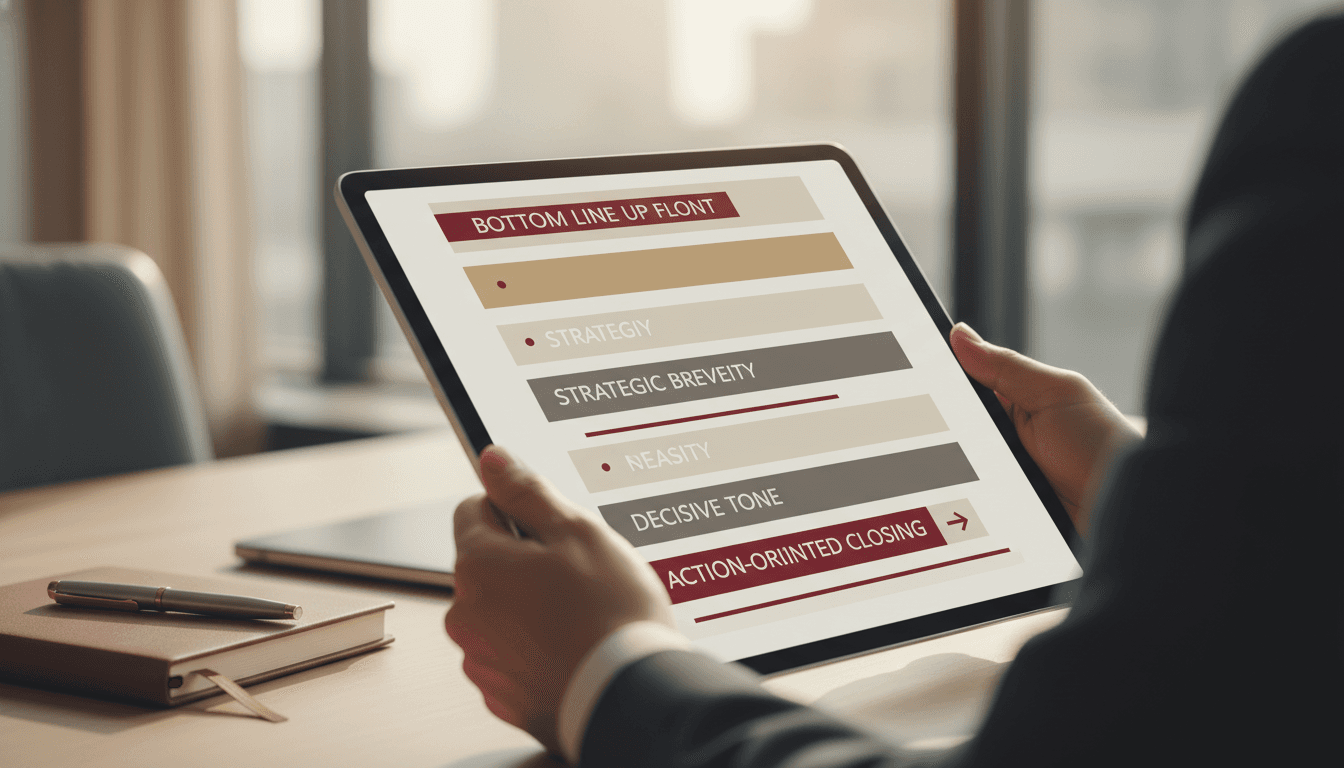
Executives structure emails for impact by leading with the bottom line first, keeping messages under five sentences when possible, using decisive language free of hedging words, and closing with a single clear action item and deadline. They treat every email as a leadership signal—prioritizing clarity over courtesy padding, structuring information hierarchically so the busiest reader gets the point in seconds, and using formatting strategically to guide the eye. This approach ensures their messa

How to Brief Executives Quickly: The 60-Second Framework
To brief executives quickly, use the Context-Headline-Ask (CHA) framework: open with one sentence of context, deliver your headline (the key insight or update), and close with a clear ask or recommendation. This structure respects executive time, demonstrates strategic thinking, and positions you as someone who communicates with authority. The best executive briefings take 60 seconds or less and always lead with the conclusion, not the backstory.