
How to Communicate With Confidence at Work: Daily Habits

To communicate with confidence at work, build daily habits that reshape how you speak, write, and show up. Start by eliminating undermining language ("just," "sorry," "I think"), replacing hedge phrases with direct statements, and using structured responses in meetings. Pair these language shifts with intentional body language—steady eye contact, deliberate pauses, and open posture. Confidence at work isn't a personality trait; it's a set of repeatable communication behaviors you practice every day until they become automatic.
What Is Confident Communication at Work?
Confident communication at work is the ability to express ideas, opinions, and decisions clearly and directly—without over-qualifying, apologizing unnecessarily, or deferring to others by default. It's not about being loud or dominant. It's about sounding certain, credible, and composed across every channel: meetings, emails, Slack messages, presentations, and one-on-ones.
Confident communicators share three traits: they speak with clarity (no rambling), they own their message (no excessive hedging), and they stay composed under pressure (no emotional spiraling). According to a 2023 study by the National Association of Colleges and Employers (NACE), communication skills rank as the #1 competency employers seek—above leadership, teamwork, and technical ability. How you communicate doesn't just support your career. It is your career.
Why Most Professionals Sound Less Confident Than They Are
The Undermining Language Trap

Most people don't lack confidence—they lack awareness of how their language signals uncertainty. Phrases like "I just wanted to check in," "Sorry, but I think maybe we should…," and "Does that make sense?" are so embedded in professional culture that they feel polite. But to decision-makers, they sound hesitant.
A study published in the Journal of Language and Social Psychology (2019) found that speakers who used hedge words were perceived as 24% less competent than those who made direct statements—even when the content was identical. The problem isn't what you know. It's the verbal packaging around what you know.
The Visibility Gap
You may deliver excellent work, but if your communication doesn't match that quality, people won't notice. This is what career researchers call the "visibility gap"—the distance between your actual competence and how competent others perceive you to be.
If you've ever felt overlooked at work despite strong performance, your communication habits are likely the missing link. Confident communication closes the visibility gap by making your expertise impossible to ignore.
Confusing Confidence With Personality
Here's the most important reframe: confidence at work is not a personality trait. It's a skill set. Introverts, quiet leaders, and people who naturally defer can all develop a confident communication style through deliberate practice. You don't need to become someone else. You need to build better habits.
The 5 Daily Language Swaps That Build Instant Credibility
The fastest way to sound more confident is to change specific words and phrases you use every day. These aren't cosmetic tweaks—they fundamentally shift how others perceive your authority.
Swap #1: Replace Hedges With Positions
Before: "I think maybe we should consider looking at the Q3 data." After: "I recommend we review the Q3 data before deciding."The word "recommend" signals ownership. "I think maybe" signals you're not even sure of your own suggestion. Practice this swap in every email and meeting for one week and you'll notice a difference in how people respond.
Swap #2: Drop Unnecessary Apologies
Before: "Sorry, just a quick question—could you send me the report?" After: "Could you send me the report by end of day?"Apologizing when no apology is warranted trains others to see you as someone who takes up space reluctantly. For a deeper dive into this pattern, see our guide on how to stop over-apologizing at work and what to say instead.
Swap #3: Replace "Does That Make Sense?" With a Forward Statement
Before: "So that's my proposal. Does that make sense?" After: "That's my proposal. I'd welcome your input on the timeline.""Does that make sense?" puts the burden of clarity on your audience and subtly implies your own explanation might be confusing. Redirect the conversation forward instead.
Swap #4: Use "I Will" Instead of "I'll Try"
Before: "I'll try to have that ready by Friday." After: "I'll have that ready by Friday.""Try" is an escape hatch. It tells your manager you're already preparing an excuse. Commit or renegotiate the deadline—both are more credible than hedging.
Swap #5: Lead With the Point, Not the Disclaimer
Before: "This might be a dumb question, but…" After: State the question directly.According to research from Harvard Business Review (2022), professionals who preface their contributions with disclaimers are 35% less likely to have their ideas adopted in group settings. Your ideas deserve to stand on their own.
Say it once, and be taken seriously. The Authority Toolkit gives you 8 frameworks, the 7 shifts that make speech sound sure, and 100+ phrases for meetings and email, so the point lands the first time you make it. Get The Authority Toolkit — $27
Confident Communication Habits for Meetings
Meetings are where reputations are built or eroded. Every meeting is a micro-audition for your credibility. Here's how to show up with confidence consistently.

The First-Five-Minutes Rule
Speak within the first five minutes of any meeting. Research from organizational psychologist Adam Grant, cited in his book Originals (2016), shows that early contributors are perceived as more engaged and more influential than those who wait to speak. You don't need to say something groundbreaking—anchor your presence with a brief, relevant comment or question.
Example: "Before we dive in, I want to flag that client feedback on the beta has been trending positive. That might shape how we discuss the rollout timeline."This signals preparation, strategic thinking, and initiative—all in two sentences. For more on this skill, explore our guide on how to communicate strategic thinking at work clearly.
The Structured Response Framework (P.R.E.P.)
When you're asked a question or need to contribute an opinion, use the P.R.E.P. method to sound organized and decisive:
- Point: State your position clearly.
- Reason: Give one supporting reason.
- Example: Offer a brief, concrete example.
- Point: Restate your position.
This takes 20 seconds to deliver and sounds exponentially more credible than rambling. If you're someone who struggles when put on the spot in meetings, P.R.E.P. is your safety net.
Handling Interruptions and Being Talked Over
A 2014 study from George Washington University found that men interrupted women 33% more often in professional settings. But interruptions happen to everyone, and how you handle them defines your presence.
Script for reclaiming the floor:- "I'd like to finish my point—" (then continue without pausing for permission)
- "Let me complete this thought, and then I want to hear yours."
Calm, direct, non-aggressive. Practice this exact phrasing so it's automatic when you need it.
Confident Communication in Emails and Slack
Written communication is where many professionals unknowingly sabotage their credibility. Every email and Slack message is a tiny brand statement.
The Authority Email Formula
Confident emails follow a predictable structure:
- Lead with the ask or key information (first sentence).
- Provide necessary context (2-3 sentences max).
- Close with a clear next step or deadline.
"Hi! Hope you're doing well. I just wanted to follow up on the thing we discussed last week. I was wondering if maybe you had a chance to look at the proposal? No rush at all, just whenever you get a chance. Thanks so much!"
After:"Hi Sarah—following up on the Henderson proposal. Could you share your feedback by Thursday so we can finalize before the client meeting on Monday? Happy to jump on a quick call if that's easier."
The second version is 40% shorter, 100% clearer, and signals someone who respects both their own time and the reader's. For a complete system on this, see our guide on how to sound authoritative in emails.
Slack-Specific Confidence Habits
Slack's casual tone makes it easy to slip into uncertainty signaling. Three rules:
- Don't start messages with "Sorry to bother you." Start with the request.
- Use periods, not ellipses. "Let's revisit the timeline." vs. "Let's revisit the timeline…" Ellipses signal hesitation.
- Batch your message into one block. Sending five fragmented messages in a row signals scattered thinking. Compose your full thought, then send.
Tone vs. Content: Why Both Matter
A 2021 Grammarly Business report found that 69% of business professionals said poor written communication led to misunderstandings and reduced confidence in the sender. Your tone—word choice, sentence structure, formatting—carries as much weight as your actual message. Write like a person who expects to be taken seriously, and people will take you seriously.
Body Language and Vocal Habits That Signal Confidence
What you say matters. How you say it—and how you look while saying it—matters just as much.
The Three Vocal Shifts
- Eliminate upspeak. Ending statements with a rising intonation turns every sentence into a question. Record yourself in your next meeting (most video platforms allow this) and listen for the pattern.
- Pause instead of filling. Replace "um," "uh," and "like" with a one-second pause. According to a University of Michigan study (2015), speakers who paused deliberately were rated as 26% more credible than those who used filler words. Silence signals control.
- Lower your pitch at the end of sentences. A downward pitch signals certainty and finality. An upward pitch signals you're seeking approval. This single shift changes how authoritative you sound in every conversation.
For a comprehensive vocal training approach, read our guide on how to speak with gravitas through vocal and language mastery.
Posture and Presence in the Room
You don't need to power-pose your way through the workday. But three physical habits make a measurable difference:
- Take up space. Place your materials on the table. Rest your arms on the armrests. Avoid crossing your arms or hunching over your laptop.
- Make eye contact for 3-5 seconds at a time. This is the range that signals engagement without intensity. In virtual meetings, look at the camera lens—not the screen—when speaking.
- Stillness signals authority. Fidgeting, swaying, and excessive hand gestures signal nervous energy. Plant your feet. Anchor your hands. Move with intention.
Virtual Meeting Presence
Remote work has created new confidence challenges. On video calls, your face is your entire presence. Frame yourself so your head and shoulders fill the screen, position your camera at eye level, and ensure your lighting comes from in front of you—not behind. These technical details aren't vanity. They're credibility infrastructure.
Building a 30-Day Confident Communication Routine
Knowing what to do is different from doing it consistently. Here's a four-week habit stack to make confident communication automatic.
Week 1: Audit and Awareness
- Review your last 20 sent emails. Highlight every hedge word, unnecessary apology, and vague sign-off.
- Record yourself in one meeting (with permission or use a personal voice memo). Listen for upspeak, filler words, and disclaimers.
- Choose your top three weak communication habits to eliminate.
Week 2: Language Replacement
- Implement the five language swaps from Section 3 in every written communication.
- Before each meeting, write down one point you'll make in the first five minutes.
- Practice P.R.E.P. responses to three common questions in your role.
Week 3: Vocal and Physical Calibration
- Record yourself delivering a two-minute update. Listen for filler words and upspeak. Re-record until clean.
- In meetings, practice the "pause instead of fill" technique. Aim for three deliberate pauses per meeting.
- Adjust your video setup for optimal virtual presence.
Week 4: Integration and Feedback
- Ask a trusted colleague: "Have you noticed any change in how I communicate in meetings?" Specific feedback accelerates growth.
- Review your emails from Week 1 against Week 4. Document the shifts.
- Identify one high-stakes communication moment in the coming month (presentation, negotiation, executive briefing) and prepare using your new habits.
Consistency matters more than perfection. A McKinsey report on leadership development (2023) found that professionals who practiced communication skills daily for 30 days showed a 40% improvement in peer-rated leadership presence compared to those who attended a single training session.
Frequently Asked Questions
How long does it take to build confident communication habits?
Most professionals notice a shift within two to three weeks of deliberate practice. Language swaps produce immediate results—people respond differently when you drop hedge words and lead with direct statements. Vocal and body language changes take longer, typically four to six weeks, because they involve retraining physical patterns. Consistency matters more than intensity.
What's the difference between confident communication and aggressive communication?
Confident communication is direct, clear, and respectful. You state your position without hedging, but you also invite dialogue and acknowledge other perspectives. Aggressive communication dismisses others, dominates conversations, and uses intimidation. The key distinction: confident communicators own their message while respecting the room. For practical scripts on this balance, see our guide on being assertive without being aggressive.
How can introverts communicate with confidence at work?
Introverts often excel at confident communication once they build the right habits. Preparation is the introvert's advantage—write down your key points before meetings, use structured frameworks like P.R.E.P. for responses, and leverage written channels where you can compose thoughtful, authoritative messages. Confidence doesn't require being the loudest voice. It requires being the clearest one.
Can you sound confident in emails without sounding rude?
Absolutely. Confident emails are concise and direct, but they're not cold. Use the recipient's name, include a clear next step, and close warmly—just cut the excessive qualifiers. "Could you send the report by Thursday?" is both confident and polite. "Sorry to bother you, but I was wondering if maybe you could possibly send the report whenever you get a chance?" is neither.
How do I communicate with confidence when I'm new to a role?
Start by asking strategic questions rather than trying to prove expertise you haven't yet built. Phrases like "What's worked well in the past?" and "Here's what I'm seeing from the data—does that align with your experience?" show intellectual rigor without overstepping. New doesn't mean uncertain. For a full approach, read our guide on building professional credibility fast at a new job.
Does confident communication actually impact career advancement?
Yes, significantly. A 2022 study by Zenger Folkman analyzing 360-degree feedback from over 100,000 leaders found that communication effectiveness was the single strongest predictor of being rated as a "high-potential" leader. Professionals who communicate with confidence are promoted faster, given more visibility, and trusted with higher-stakes projects.
Stop Sounding Uncertain in Everyday Conversations
8 communication frameworks, the 7 speech shifts with 30 before-and-after rewrites, 6 email templates, and 100+ phrases for speaking and writing with calm authority at work. PDF.
Get The Authority Toolkit — $27Related Articles
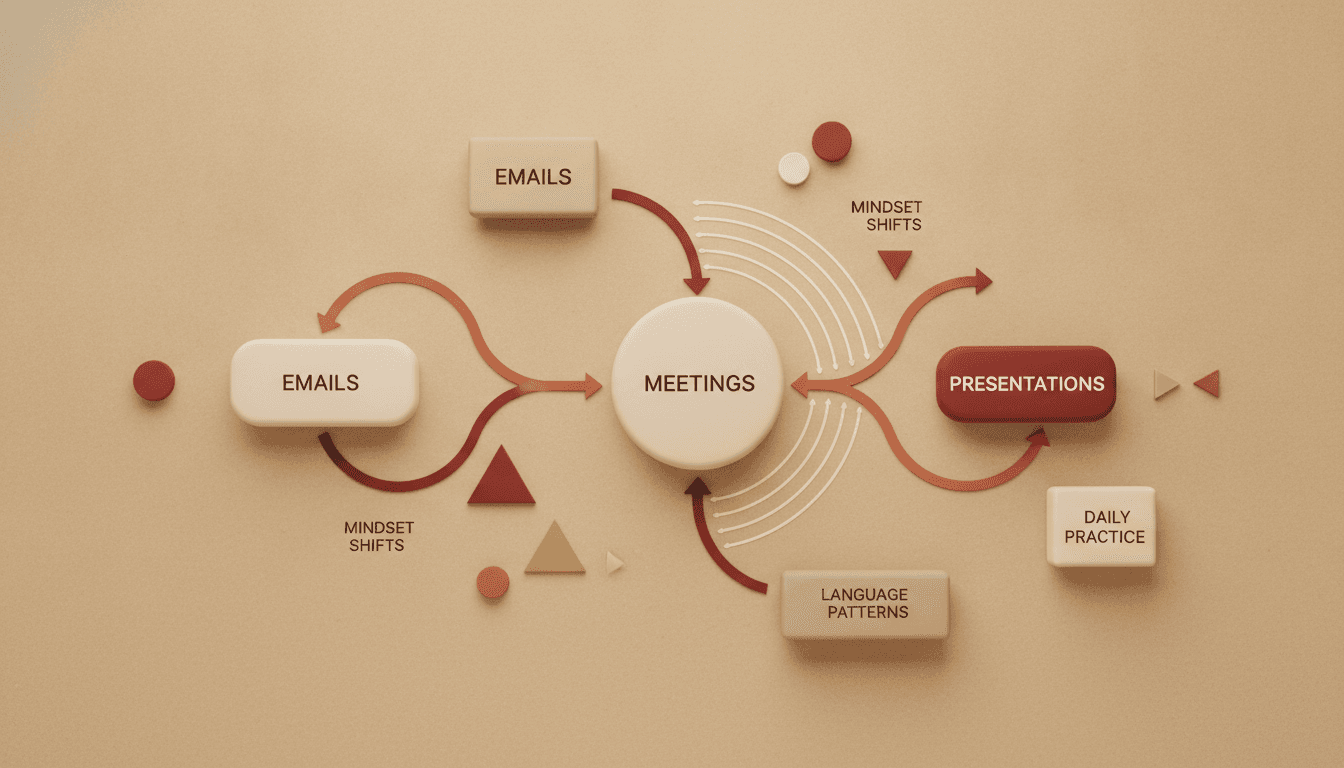
How to Communicate With Confidence at Work: A Complete System
Communicating with confidence at work requires a systematic approach across four dimensions: mindset, language, delivery, and daily practice. Start by eliminating hedging words ("I just think," "sorry, but") from your vocabulary. Then adopt structured speaking frameworks like the Point-Reason-Example-Point method for meetings and presentations. Build a daily practice routine that includes vocal warm-ups, pre-meeting preparation, and post-interaction reflection. Confidence isn't a personality tra

How to Sound Authoritative: 9 Shifts That Work Instantly
To sound authoritative, focus on nine specific shifts across your voice, language, and behavior: lower your vocal pitch at the end of sentences, eliminate hedging words like "just" and "I think," slow your speaking pace by 10-15%, use declarative sentence structures, pause before key points instead of filling silence, ground your body language, lead with conclusions rather than context, choose precise vocabulary, and maintain steady eye contact. These changes work immediately because they signal

How to Be More Assertive in Professional Emails (With Examples)
To be more assertive in professional emails, replace hedging language with direct statements, lead with your main point, use confident sentence structures, and state clear expectations with deadlines. Assertive emails aren't aggressive — they're clear, respectful, and impossible to misinterpret. The key shift is moving from "I was just wondering if maybe we could…" to "I'd like to move forward with X by Friday." Below, you'll find 15+ before-and-after rewrites covering the most common profession