
Leadership Presence in Difficult Meetings: A Playbook

What Is Leadership Presence in Difficult Meetings?
Leadership presence in difficult meetings is the capacity to project calm authority, steer productive outcomes, and maintain your credibility when a meeting involves conflict, high emotion, political tension, or adversarial dynamics. It's the intersection of composure, communication skill, and strategic awareness.
Unlike general meeting confidence, leadership presence in difficult meetings specifically addresses moments where others are raising their voices, undermining your position, derailing the agenda, or creating pressure that makes most professionals shrink. It's not about dominating the room—it's about anchoring it.
According to a 2023 study by the Center for Creative Leadership, 91% of senior leaders identified the ability to remain composed under pressure as the single most important leadership competency for advancement. Yet fewer than 30% of mid-career professionals said they felt confident doing so in high-conflict meetings.
Why Difficult Meetings Are Career-Defining Moments
The Visibility Factor

Difficult meetings are disproportionately watched. When tension rises, every person in the room—and on the video call—pays closer attention. A 2022 Harvard Business Review analysis found that colleagues form lasting impressions of a professional's leadership capability within the first 90 seconds of a conflict moment. How you respond when challenged in front of stakeholders shapes your reputation far more than any polished presentation.
Consider this: You're in a quarterly review and a peer publicly questions the validity of your team's data. Every eye shifts to you. In that moment, you're not just defending a report—you're defining how the room perceives your competence, temperament, and readiness for greater responsibility.
The Cost of Losing Composure
When professionals lose composure in high-stakes meetings, the damage extends far beyond that single conversation. Research from VitalSmarts (now Crucial Learning) shows that 80% of professionals have seen a colleague's reputation permanently damaged by a single emotional outburst in a meeting. The effects include being passed over for promotions, losing influence with senior leaders, and being excluded from future strategic conversations.
The opposite is equally true. Professionals who project calm authority under pressure are consistently rated as more promotable, more trustworthy, and more capable of leading larger teams.
Political Awareness vs. Political Games
Difficult meetings often involve organizational politics—competing agendas, turf wars, resource battles, or power plays. Leadership presence doesn't mean ignoring politics. It means navigating them without compromising your integrity. This requires reading the room: understanding who has influence, what motivations are driving the conflict, and where the real decision is being made.
The ANCHOR Framework: Your Foundation for Difficult Meetings
Maintaining leadership presence in difficult meetings requires a system, not just willpower. The ANCHOR Framework gives you six repeatable steps to stay grounded and credible in any high-tension scenario.
A — Assess the Room Before You Speak
Before the meeting even begins, do a 60-second situational scan. Ask yourself:
- Who has the most at stake? That person will likely drive the tension.
- What's the unspoken agenda? The real conflict is often beneath the surface topic.
- Where are the alliances? Knowing who supports whom helps you anticipate dynamics.
During the meeting, continue assessing. Watch body language shifts—crossed arms, side conversations, eye-rolls. These signals tell you when the temperature is rising before words do. For a deeper dive into reading and using body language, see our guide on body language for leadership presence.
N — Neutralize Your Emotional Response
The moment you feel a surge of defensiveness, anger, or anxiety, your body is preparing to fight or flee. Neither serves you in a meeting. Use the 3-Second Reset:
- Inhale for a silent count of two.
- Drop your shoulders one inch (tension accumulates there first).
- Place both feet flat on the floor to physically ground yourself.
This micro-reset takes three seconds and is invisible to others. It interrupts the cortisol spike that leads to reactive, regrettable responses. You can layer this with the techniques in our resource on speaking with poise under pressure.
C — Choose Your Entry Point Carefully
Not every moment of conflict requires your immediate response. Premature responses often sound defensive. Strategic silence—pausing for 2-4 seconds before responding—signals confidence and gives you time to formulate a precise reply.
Script example:When a colleague says, "Honestly, I don't think this approach was thought through at all," resist the urge to immediately counter. Instead, pause. Then say:
"I appreciate the directness. Let me walk through the rationale behind the approach, and then I'd welcome specific feedback on where you see gaps."This response accomplishes three things: it acknowledges the challenge without conceding, it redirects to substance, and it positions you as the person controlling the conversation's direction.
H — Hold Your Ground with Evidence, Not Emotion
When your position is challenged, your credibility depends on how you defend it. Emotional defenses ("That's not fair" or "You don't understand") erode authority. Evidence-based defenses build it.
Use the Claim-Evidence-Impact structure:
- Claim: State your position in one sentence.
- Evidence: Cite specific data, precedent, or documented outcomes.
- Impact: Connect it to what the room cares about (revenue, risk, timeline).
O — Open Doors for Others (Strategically)
One of the most powerful moves in a difficult meeting is inviting others into the conversation—on your terms. This demonstrates confidence (you're not threatened by other perspectives) and builds alliances in real time.
Script example: "Sarah, you've been close to the implementation side. What are you seeing that might inform this decision?"This works especially well when you know Sarah's perspective supports your position. It's not manipulation—it's strategic facilitation.
R — Redirect When Conversations Derail
Derailment is one of the most common challenges in difficult meetings. Someone introduces an unrelated grievance, the conversation spirals into blame, or a tangent consumes all the oxygen. Your ability to redirect without appearing dismissive is a hallmark of leadership presence.
Redirection scripts:- "That's an important point, and it deserves its own conversation. For now, let's stay focused on the decision we need to make by Friday."
- "I want to make sure we give that topic the time it needs. Can we add it to the follow-up agenda and keep moving on the current item?"
- "I hear the concern. Let's separate the process issue from the decision in front of us so we can make progress on both."
De-Escalation Scripts for the 5 Most Common Difficult Meeting Scenarios
Knowing what to say in specific conflict scenarios is the difference between freezing and leading. Here are five situations you're likely to face, with word-for-word scripts.
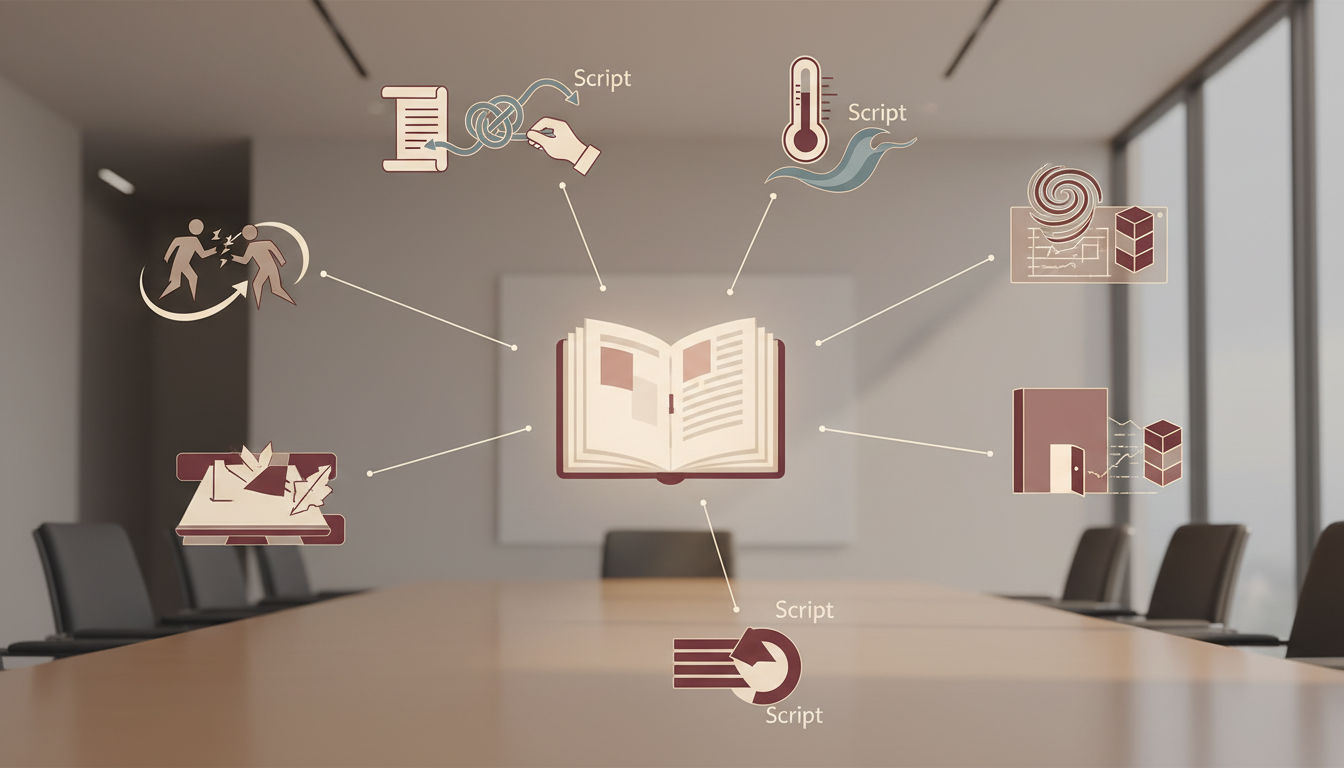
Scenario 1: Someone Publicly Challenges Your Competence
The situation: A senior stakeholder says, "I'm not sure you have the experience to lead this initiative." Your response: "I understand the concern about getting this right. Here's what I bring to this: [specific credential or result]. I'm also building on the work of [team/data/precedent]. I'd rather focus our time on the substance of the plan—where specifically do you see risk?" Why it works: You acknowledge without apologizing, establish credibility with evidence, and redirect to substance. For more strategies on handling this kind of challenge, explore our article on how to establish credibility quickly in any room.Scenario 2: Two Colleagues Are in Open Conflict
The situation: Two peers are arguing about resource allocation and the meeting has stalled. Your response: "We clearly have two strong perspectives here, and both have merit. Let me suggest we separate this into two questions: first, what outcome do we all agree we need? And second, what's the most efficient path to get there? [Name], can you start with the outcome you're solving for?" Why it works: You validate both sides, reframe the conflict as a shared problem, and take control of the process.Scenario 3: You're Being Talked Over Repeatedly
The situation: A colleague keeps interrupting you mid-sentence. Your response (after the second interruption): "I'd like to finish my point—it directly addresses what you're raising." Then continue without pausing for permission.If it persists:
"I notice we're stepping on each other. I'll hear your full perspective once I've completed mine."This is one of the most common credibility-eroding dynamics in meetings. Our guide on how to handle being talked over in meetings provides additional scripts and strategies.
Scenario 4: A Decision-Maker Is Visibly Disengaged
The situation: The VP whose approval you need is checking their phone and hasn't made eye contact in five minutes. Your response: "[Name], before we go further, I want to make sure we're addressing what matters most to you. What's the one question you need answered to move forward on this?" Why it works: You re-engage them without calling out their behavior, and you signal that you're focused on their priorities—not just your agenda.Scenario 5: Someone Introduces Misleading Information
The situation: A colleague cites a statistic or claim that you know is inaccurate, and it's influencing the room. Your response: "I want to make sure we're working from the same data. The figures I have from [source] show [correct information]. Can we align on the source before we draw conclusions?" Why it works: You correct without accusing. You question the data, not the person. This preserves the relationship while protecting the integrity of the discussion.The Physiology of Presence: What Your Body Communicates in Tense Moments
Vocal Control Under Pressure
Your voice is the first thing to betray nervousness. According to research published in the Journal of Nonverbal Behavior (2020), listeners form judgments about a speaker's confidence within 500 milliseconds of hearing their voice. In difficult meetings, three vocal elements matter most:
- Pace: Slow down by 15-20%. Anxious speakers accelerate. Authoritative speakers decelerate.
- Pitch: Stress raises vocal pitch. Consciously speak from your chest rather than your throat to maintain a lower, steadier tone.
- Pausing: A 2-3 second pause before responding to a challenge signals thoughtfulness, not hesitation. It's the most underused tool in professional communication.
For a comprehensive approach to vocal authority, see our guide on how to develop a commanding voice at work.
Posture and Positioning
In high-tension meetings, your physical presence either reinforces or undermines your words. Three non-negotiable posture principles:
- Occupy your space. Keep your elbows at or beyond the width of your torso. Shrinking inward signals submission.
- Maintain a neutral facial expression. A micro-expression of contempt, frustration, or fear can undo an otherwise composed verbal response.
- Use deliberate hand gestures. Steepling (fingertips touching) and open-palm gestures project confidence. Fidgeting, touching your face, or gripping your pen signals anxiety.
The Power of Stillness
A 2021 study from Stanford's Graduate School of Business found that leaders who displayed physical stillness during conflict were rated 34% more trustworthy and 28% more competent than those who shifted, fidgeted, or used excessive movement. Stillness is not passivity—it's controlled presence. When the room is chaotic, be the still point.
Lead Every Room with Authority. The Credibility Code gives you the frameworks, scripts, and daily practices to build the kind of presence that commands respect—even in the most difficult meetings. Discover The Credibility Code
Preparation: How to Walk Into Any Difficult Meeting Ready
The Pre-Meeting Intelligence Briefing
Fifteen minutes of preparation can transform your performance in a difficult meeting. Before walking in, answer these five questions:
- What decision needs to be made? If you can't answer this, you'll be reactive instead of strategic.
- Who will resist, and why? Anticipate objections so you can address them with composure rather than surprise.
- What's my one non-negotiable? Know your bottom line before emotions cloud your judgment.
- What can I concede? Having a pre-planned concession makes you appear collaborative without giving up what matters.
- What's my opening line? Scripting your first sentence eliminates the anxiety of the blank-page moment.
This preparation mirrors the strategic communication approach outlined in our professional communication framework for influence.
Mental Rehearsal
Elite athletes visualize performance. You should too. Spend 3-5 minutes before a high-stakes meeting mentally walking through the scenario: the room, the faces, the likely challenges, and your responses. Research from the University of Chicago shows that mental rehearsal activates the same neural pathways as physical practice, improving actual performance by up to 23%.
The Post-Meeting Debrief
After every difficult meeting, spend five minutes answering:
- What worked? Identify specific moments where you maintained presence.
- What triggered me? Name the moment you felt your composure slip, even slightly.
- What will I do differently? Choose one specific adjustment for next time.
This debrief habit compounds over time. Within 90 days, you'll notice a measurable shift in how you handle tension. For professionals rebuilding confidence after setbacks in these situations, our article on rebuilding workplace confidence after being overlooked offers a complementary perspective.
Frequently Asked Questions
How do you maintain leadership presence when someone is yelling in a meeting?
Lower your volume instead of matching theirs. Speak slowly and deliberately. Use a phrase like, "I can see this matters to you. I want to address it properly—can we take the volume down so we can work through this?" Physical stillness and steady eye contact reinforce your composure. The person yelling loses credibility; the person who stays calm gains it.
What is the difference between leadership presence and executive presence in meetings?
Leadership presence is the ability to influence, inspire, and guide others through your communication and demeanor—regardless of your title. Executive presence is a subset that specifically refers to the gravitas, communication polish, and appearance expected at the senior executive level. In difficult meetings, leadership presence is more about composure and strategic communication, while executive presence also encompasses organizational authority. Learn more about this distinction in our article on executive presence vs. leadership presence.
How do you assert your position in a meeting without being aggressive?
Use the Claim-Evidence-Impact structure: state your position clearly, back it with data, and connect it to shared goals. Avoid accusatory language ("You're wrong") and use ownership language ("Here's what I've found" or "The data shows"). Assertiveness is about clarity and conviction, not volume or force.
How do you recover if you lose composure in a meeting?
Pause. Take a breath. Then say, "Let me reset—I want to make sure I'm addressing this clearly." This acknowledges the moment without over-apologizing. After the meeting, follow up with key stakeholders individually to reinforce your actual position. One moment of lost composure doesn't define you—your recovery does.
How do you handle a meeting where you're the most junior person and face pushback?
Anchor your contributions in data and preparation, not opinion. Use phrases like, "Based on what the data shows..." or "From the customer conversations we've had..." This shifts authority from your title to your evidence. Preparation is your equalizer. Our guide on speaking up in meetings with senior leaders covers this in depth.
Can you build leadership presence in virtual difficult meetings?
Yes, but it requires deliberate adjustments. Position your camera at eye level, look directly into the lens when speaking (not at faces on screen), and use a slightly slower speaking pace to compensate for audio lag. Eliminate background distractions. In virtual settings, your voice carries even more weight than your body language, so vocal control becomes your primary tool.
Build Presence People Notice Before You Say a Word
The Credibility Code gives you the specific verbal and nonverbal habits that make people treat you as the senior person in the room.
Discover The Credibility CodeRelated Articles

Project Calm Authority Under Pressure: A Leader's Guide
To project calm authority under pressure, anchor yourself with a controlled exhale before responding, slow your speech rate by 10–15%, plant your feet or hands in a stable position, and choose deliberate language that acknowledges the situation without matching its chaos. Calm authority isn't the absence of stress—it's the visible management of it. Leaders who master this skill earn deeper trust, defuse escalations faster, and maintain decision-making clarity when it matters most.

Leadership Presence in Difficult Conversations: A Method
Leadership presence in difficult conversations is the ability to maintain composure, credibility, and authority when workplace tension is high—whether you're delivering tough feedback, navigating conflict, or pushing back on a senior stakeholder. The method involves four pillars: emotional regulation before and during the conversation, strategic framing of your message, deliberate body language under pressure, and specific language patterns that de-escalate without surrendering your position. Th

How to Build Presence as a Quiet Leader: 8 Moves
Building presence as a quiet leader means leveraging strategic silence, deliberate body language, and high-impact contributions to command authority without raising your volume. Instead of mimicking extroverted leadership styles, quiet leaders build credibility through preparation, precision, and composure. The eight moves below give you a repeatable system for developing commanding presence that aligns with your natural temperament — no personality overhaul required.